

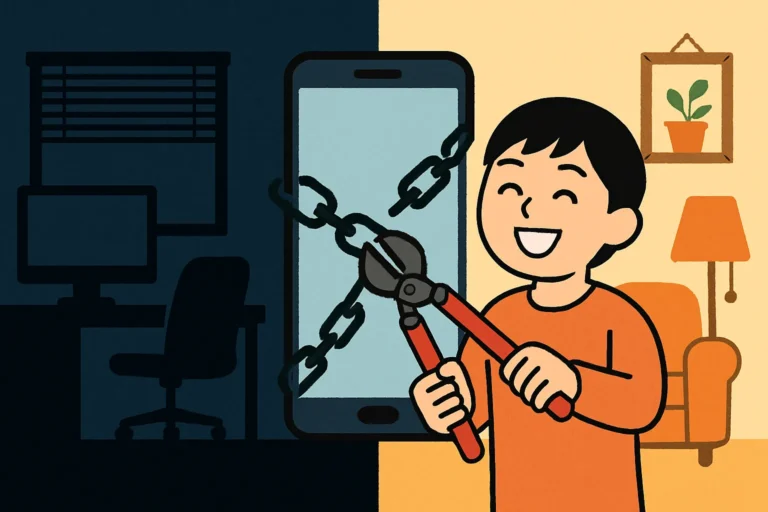
Your Phone is Not Your Boss! Korean for a Better Work-Life Balance
Hello! This is Daily Korean, here to upgrade your Korean skills!
Do you ever feel like your smartphone is permanently attached to your hand? Do work emails and messages follow you home, long after you’ve left the office? You’re not alone!
Nowadays in Korea, there’s a huge conversation happening around “워라밸” (Worabel), which is the Korean way of saying “Work-Life Balance.” Many people are looking for ways to disconnect and protect their personal time. Today, we’ll learn some essential Korean expressions to talk about this exact topic: how to reduce smartphone use and truly separate your work from your life. Let’s get started!
Core Expressions You Need to Know
Here are three key phrases to help you reclaim your free time, the Korean way!
1. 스마트폰에 중독되다 (Seumateupon-e jungdokdoeda)
- Pronunciation [Romanization]: [seumateupon-e jungdokttweda]
- English Meaning: To be addicted to a smartphone.
- Detailed Explanation: This is the perfect phrase to describe that feeling of constantly needing to check your phone.
중독되다(jungdokdoeda) means “to become addicted,” and you can attach it to any noun using the particle-에. It’s a common way to talk about habits, from coffee addiction (커피에 중독되다) to being addicted to a new K-drama (드라마에 중독되다). - 💡 Pronunciation Tip:
The되in중독되다is often pronounced as [뒈/dwe]. Also, when되follows a consonant likeㄱin중독, it becomes tensed, sounding more like [뙤/ttwe]. So, while written asjungdok-doe-da, the natural pronunciation is closer to [jungdok-ttwe-da]. This tensing of consonants is very common in Korean and makes your speech sound much more natural!
2. 일과 삶을 분리하다 (Ilgwa salmeul bullihada)
- Pronunciation [Romanization]: [ilgwa salmeul bullihada]
- English Meaning: To separate work and life.
- Detailed Explanation: This is the heart of “Worabel”!
일(il) means “work,”삶(salm) means “life,” and분리하다(bullihada) is the verb “to separate.” You use the particle-과/와(gwa/wa) to mean “and” when connecting nouns. This phrase directly expresses the goal of achieving a healthy work-life balance. - 💡 Pronunciation Tip:
Listen closely to분리(bulli). It’s not pronounced “bun-ri”! In Korean, when aㄴ(n) sound is followed by aㄹ(r/l) sound, theㄴchanges toㄹ. This is an assimilation rule called ‘유음화’ (liquidization). So,분리 (bun-ri)is pronounced as [불리 (bulli)]. You’ll see this in words like신라 (Sinra)-> [실라 (Silla)] too!
3. 퇴근 후에는 (Toegeun hu-eneun)
- Pronunciation [Romanization]: [toegeun-hueneun]
- English Meaning: After getting off work… / After work…
- Detailed Explanation: This is your magic phrase for setting boundaries.
퇴근(toegeun) means “getting off work,” and-ㄴ 후에(n hu-e) is a grammar pattern meaning “after doing…” The topic marker-는(neun) adds emphasis, creating a sense of “As for the time after work (it’s different).” You can use this to state your rules, like “After work, I don’t check my email.” - 💡 Pronunciation Tip:
This phrase is a perfect example of liaison, or ‘연음’ (yeoneum). The final consonant of a syllable block moves to the next syllable if it starts with a vowel (ㅇ). So,퇴근 후에is not read as “toegeun / hu / e.” Theㄴ(n) from근links to후, and theㅎis often silent here, making it sound like [퇴그누에 (toegeunue)]. It flows smoothly!
Example Dialogue
Let’s see how these expressions are used in a real conversation between two friends, Minjun and Sora.
A: 민준 (Minjun): 아, 또 업무 메시지 왔어… 퇴근 후에는 좀 쉬고 싶은데.
A, tto eommu mesiji wasseo… Toegeun hu-eneun jom swigo sipeunde.
(Ugh, I got another work message… I just want to rest after work.)
B: 소라 (Sora): 너 완전 스마트폰에 중독된 것 같아. 일과 삶을 분리해야 스트레스 안 받아.
Neo wanjeon seumateupon-e jungdokdoen geot gata. Ilgwa salmeul bullihaeya seuteureseu an bada.
(You seem totally addicted to your smartphone. You have to separate work and life to not get stressed.)
A: 민준 (Minjun): 맞아. 알림이라도 꺼야겠어. 계속 신경 쓰여.
Maja. Allimirado kkeoyagesseo. Gyesok sin-gyeong sseuyeo.
(You’re right. I should at least turn off my notifications. It keeps bothering me.)
B: 소라 (Sora): 좋은 생각이야! 퇴근 후에는 너의 시간이잖아.
Joeun saenggagiya! Toegeun hu-eneun neoui siganijana.
(Good idea! The time after work is your time, you know.)
Culture Tip: The Real Story Behind ‘워라밸’ (Worabel)
In Korea, the term 워라밸 (Worabel) became a massive buzzword, especially for Millennials and Gen Z. It represents a shift away from the traditional culture of long working hours and company dinners (회식).
Why is this so important now? Because of apps like KakaoTalk (카카오톡). While it’s a great messenger app for friends, it’s also the primary communication tool for most companies. This means your boss and colleagues can message you at 10 PM on a Sunday!
This constant connection has led to a strong desire to 일과 삶을 분리하다. Younger generations are now actively seeking companies that respect personal time and champion a good “Worabel.” So, when you use these phrases, you’re not just speaking Korean; you’re tapping into a major social movement in modern Korea!
Let’s Practice!
Time to check your understanding. Let’s see what you’ve learned!
1. Fill in the blank:
저는 퇴근 후에 회사 이메일을 확인하지 않아요. ___________ 중요하다고 생각해요.
(I don’t check work emails after I get off work. I think _______ is important.)
- (A) 스마트폰 중독 (seumateupon jungdok)
(B) 일과 삶의 분리 (ilgwa salmui bulli)
2. Your Turn!
Using
퇴근 후에는..., write a short sentence in Korean about what you like to do after work to relax.
Great job today! Learning these expressions will not only improve your Korean but also help you understand a very important aspect of modern Korean culture.
Leave your answers to the practice questions in the comments below! We’d love to see them. Until next time
Frequently Asked Questions (FAQ)
Q: What does "A: 민준" mean in Korean and how do you pronounce it?
A: In Korean, "A: 민준" is pronounced [Minjun] and means: 아, 또 업무 메시지 왔어...
Q: What does "B: 소라" mean in Korean and how do you pronounce it?
A: In Korean, "B: 소라" is pronounced [Sora] and means: 너 완전
Q: What does "A: 민준" mean in Korean and how do you pronounce it?
A: In Korean, "A: 민준" is pronounced [Minjun] and means: 맞아. 알림이라도 꺼야겠어. 계속
Q: What does "B: 소라" mean in Korean and how do you pronounce it?
A: In Korean, "B: 소라" is pronounced [Sora] and means: 좋은 생각이야! 퇴근 후에는 너의 시간이잖아.







