

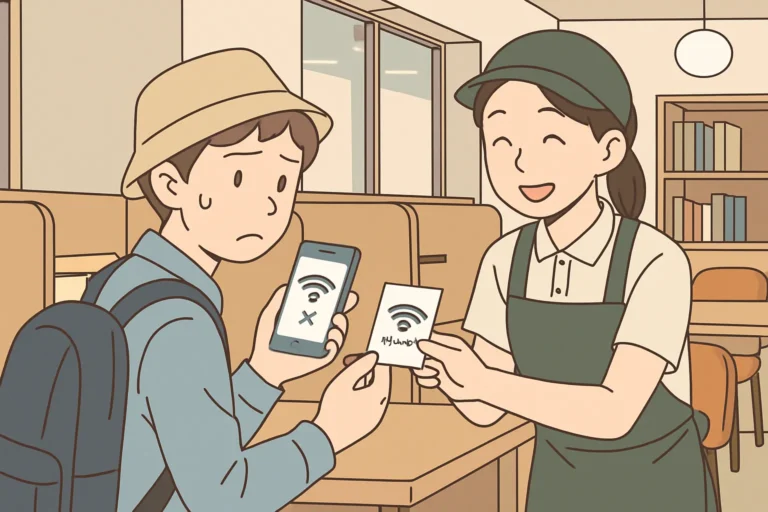
Free Wi-Fi in Korea? Ask Like a Pro!
Hello! Welcome to [Daily Hangul], here to upgrade your Korean skills!
Are you planning a trip to Korea? One of the first things you’ll probably want to do is connect to the internet. Whether you’re in a cute cafe, a restaurant, or your guesthouse, knowing how to ask for the Wi-Fi password is an essential survival skill!
These days in Korea, “study cafes” (스터디 카페) are incredibly popular places for students and remote workers to get things done. Of course, fast and free Wi-Fi is a must! Today, we’ll learn some super useful phrases so you can get online smoothly and confidently, just like a local. Let’s get started!
Core Expressions You Need to Know
Here are three simple but powerful phrases to help you connect anywhere.
1. 여기 와이파이 있어요? (Is there Wi-Fi here?)
- Pronunciation [Romanization]: Yeogi waipai isseoyo?
- English Meaning: Is there Wi-Fi here?
- Detailed Explanation: This is the most basic and common way to ask if a place offers Wi-Fi.
- 여기 (yeogi) means “here.”
- 와이파이 (waipai) is the Korean way of saying “Wi-Fi.” Easy, right?
- 있어요? (isseoyo?) is a polite way to ask “Is there…?” or “Do you have…?” You can use it for anything! (e.g., “물 있어요?” – Do you have water?)
- 💡 Pronunciation Tip:
The key is the double consonant ‘ㅆ’ in 있어요 (isseoyo). It’s a tense, strong ‘ss’ sound, almost like a short hiss. It’s not ‘i-seo-yo’, but [is-seo-yo]. Make the ‘ss’ sound sharp and connect it to the next vowel ‘어 (eo)’. This will make you sound much more natural!
2. 비밀번호가 뭐예요? (What is the password?)
- Pronunciation [Romanization]: Bimilbeonhoga mwoyeyo?
- English Meaning: What is the password?
-
Detailed Explanation: Once you’ve confirmed they have Wi-Fi, this is how you ask for the password.
- 비밀번호 (bimilbeonho) means “password.” (Literally: “secret number”)
- ~가 (ga) is a subject particle attached to nouns ending in a vowel.
- 뭐예요? (mwoyeyo?) is the polite way to ask “What is it?”
- 💡 Pronunciation Tip:
Let’s look at 번호가 [beonoga]. The final consonant ‘ㄴ (n)’ in ‘번 (beon)’ links to the next syllable ‘호 (ho)’. When ‘ㄴ’ is followed by ‘ㅎ (h)’, the ‘h’ sound often becomes very weak or disappears entirely. So, instead of a choppy “beon-ho-ga,” it flows smoothly into [beonoga]. This linking rule is a secret to sounding fluent!
3. 아이디랑 비밀번호 좀 알려주세요. (Please tell me the ID and password.)
- Pronunciation [Romanization]: Aidirang bimilbeonho jom allyeojuseyo.
- English Meaning: Please tell me the Wi-Fi ID and password.
-
Detailed Explanation: This is a very polite and complete sentence that will impress any Korean!
- 아이디 (aidi) means “ID” or “username.”
- ~(이)랑 (irang) is a casual way to say “and.”
- 좀 (jom) is a magic word! It means “a little” but is often added to requests to make them sound softer and more polite.
- 알려주세요 (allyeojuseyo) means “Please tell me” or “Please let me know.” It comes from the verb 알리다 (allida – to inform) combined with the polite request form ~주세요 (juseyo – please give).
- 💡 Pronunciation Tip:
In 알려주세요 (allyeojuseyo), you see two ‘ㄹ (l)’ characters together. When this happens in the middle of a word, it’s pronounced like a soft English ‘l’ sound, not an ‘r’ sound. Let it roll off your tongue smoothly: [al-lyeo-ju-se-yo].
Example Dialogue (At a Study Cafe)
Let’s see these phrases in action!
- A (You): 저기요, 여기 와이파이 있어요?
- (Jeogiyo, yeogi waipai isseoyo?)
- Excuse me, is there Wi-Fi here?
- B (Staff): 네, 있습니다. 영수증에 적혀 있어요.
- (Ne, itseumnida. Yeongsujeunge jeokyeo isseoyo.)
- Yes, we have it. It’s written on the receipt.
- A (You): 아, 영수증을 버렸어요. 비밀번호가 뭐예요?
- (A, yeongsujeungeul beoryeosseoyo. Bimilbeonhoga mwoyeyo?)
- Oh, I threw the receipt away. What is the password?
- B (Staff): 아이디는 ‘Daily_Hangul’이고, 비밀번호는 ‘lovekorea1004’입니다.
- (Aidineun ‘Daily_Hangul’igo, bimilbeonhoneun ‘lovekorea1004’imnida.)
- The ID is ‘Daily_Hangul’ and the password is ‘lovekorea1004’.
- A (You): 감사합니다!
- (Gamsahamnida!)
- Thank you!
Culture Tip & Trend Deep Dive
As we mentioned, Study Cafes (스터디 카페) are a huge trend in Korea! Unlike bustling coffee shops, these places are designed for quiet focus. For a few thousand won per hour, you get a desk, a drink, and most importantly, super-fast Wi-Fi. It’s a glimpse into the modern, “hustle culture” of Korean youth.
Here’s a pro tip: Often, the Wi-Fi ID and password are printed on your purchase receipt (영수증 – yeongsujeung). So, before you ask, check your receipt first! But if you can’t find it or don’t have one, using “비밀번호 좀 알려주세요” is perfectly natural and polite. Knowing this little phrase will make your cafe experience in Korea so much easier!
Let’s Review & Practice!
Great job today! You’ve learned how to ask for Wi-Fi in Korea like a pro. Remember these key phrases:
* 여기 와이파이 있어요? (Is there Wi-Fi here?)
* 비밀번호가 뭐예요? (What is the password?)
* … 좀 알려주세요. (Please tell me…)
Now, it’s your turn to practice!
- Fill in the blank: You want to politely ask what the password is.
비밀번호가 ________?
- Make a sentence: How would you ask a cafe worker, “Please tell me the Wi-Fi password”?
Leave your answers in the comments below using the expressions you learned today! We’d love to see you practice. See you next time at [Daily Hangul]
Frequently Asked Questions (FAQ)
Q: What does "여기" mean in Korean and how do you pronounce it?
A: In Korean, "여기" is pronounced [yeogi] and means: means "here."
Q: What does "와이파이" mean in Korean and how do you pronounce it?
A: In Korean, "와이파이" is pronounced [waipai] and means: is the Korean way of saying "Wi-Fi." Easy, right?
Q: What does "있어요?" mean in Korean and how do you pronounce it?
A: In Korean, "있어요?" is pronounced [isseoyo?] and means: is a polite way to ask "Is there...?" or "Do you have...?" You can use it for anything! (e.g., "물 있어요?" - Do you have water?)
Q: What does "있어요" mean in Korean and how do you pronounce it?
A: In Korean, "있어요" is pronounced [isseoyo] and means: . It's a tense, strong 'ss' sound, almost like a short hiss. It's not 'i-seo-yo', but







