

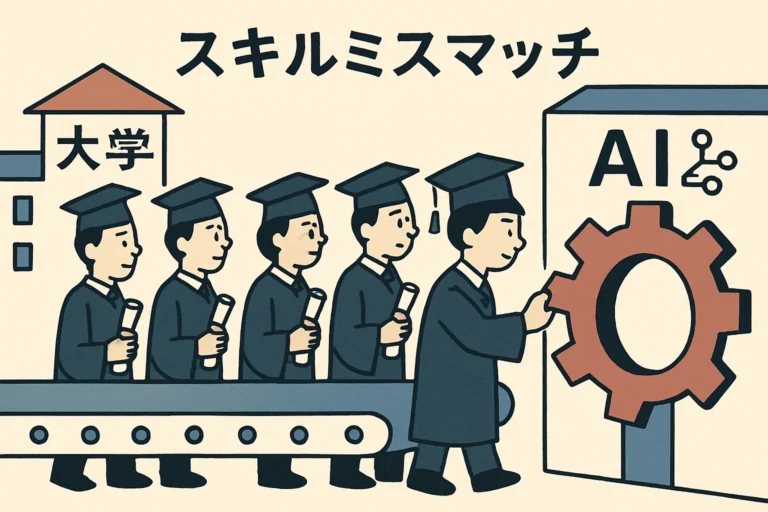
Future-Proof Your Korean: Debating Korea’s ‘Skill Mismatch’!
Hello everyone! Welcome back to [Maeil Hangeul], the place to upgrade your Korean skills!
Today, we’re diving into a very sophisticated and timely topic: how to critique and discuss the future of work and education in Korean. This is perfect for when you want to engage in deeper conversations with Korean friends or colleagues, or even understand the news and opinion pieces like a native.
Lately in Korea, there’s been a huge debate about the “skill mismatch” (스킬 미스매치). A recent government report highlighted a growing gap between what students learn in university and the skills that cutting-edge industries, like AI and robotics, actually need. It’s a hot topic! So, let’s learn the advanced vocabulary you need to jump right into this important conversation.
Core Expressions for a High-Level Debate
Here are three key phrases that will make you sound incredibly fluent when discussing social issues.
1. 현실과 동떨어지다 (hyeonsilgwa dongddeoreojida)
- Pronunciation [hyeon-sil-gwa dong-ddereo-ji-da]
- English Meaning: To be out of touch with reality; to be detached from the real world.
- Detailed Explanation: This is a powerful phrase used to criticize a plan, idea, or system that seems impractical or doesn’t reflect the current situation.
현실(hyeonsil) means ‘reality,’ and동떨어지다(dongddeoreojida) means ‘to be far apart’ or ‘isolated.’ You can use it to argue that the current education curriculum, for example, is not preparing students for the actual job market. - 💡 Pronunciation Tip:
The final consonantㄹin현실(hyeonsil) smoothly connects to the과(gwa) that follows, creating a natural [hyeonsilgwa] sound. For동떨어지다, notice the double consonantㄸ(dd). This is a tensed sound, made with a burst of air held back at the start. Practice saying it with more force than a regular ‘d’ sound.
2. -이/가 시급하다 (-i/ga sigeupada)
- Pronunciation [si-geu-pa-da]
- English Meaning: (Something) is urgent; is urgently needed.
- Detailed Explanation: This grammatical pattern attaches to a noun to express a pressing need for something.
시급하다(sigeupada) is an adjective meaning ‘to be urgent.’ It’s more formal and impactful than simply saying “we need…” (필요해요). Use it when you want to propose a solution with a sense of urgency. For example, “교육 개혁이 시급하다” (Gyoyuk gaehyeog-i sigeupada) means “Education reform is urgently needed.” - 💡 Pronunciation Tip:
This is a fantastic example of consonant aspiration (자음 축약). Theㅂ(b/p) sound in급(geup) meets theㅎ(h) in하다(hada). They combine to create a strong, aspiratedㅍ(p) sound. So, instead of saying [si-geup-ha-da] separately, it naturally becomes [시그파다, sigeupada]. This is a key feature of fluent Korean pronunciation!
3. 양산하다 (yangsanhada)
- Pronunciation [yang-san-ha-da]
- English Meaning: To mass-produce.
- Detailed Explanation: While
양산하다literally means ‘to mass-produce,’ like in a factory, it’s often used metaphorically with a negative connotation. In debates about education or employment, it implies churning out a large number of people (like graduates or certificate holders) who are all the same and lack unique, valuable skills. It suggests quantity over quality. - 💡 Pronunciation Tip:
The pronunciation here is quite straightforward. Just be sure to clearly articulate each syllable. Pay attention to the final nasal soundㄴ(n) in산(san). Make sure it’s a clean ‘n’ sound and doesn’t accidentally becomeㅇ(ng), which would change the word to상(sang – prize/statue).
Example Dialogue
Let’s see how these expressions are used in a real conversation about the recent news.
A: 최신 뉴스 봤어? 기업이 원하는 인재랑 지금 대학 교육이 너무 현실과 동떨어져 있대.
(Choesin nyuseu bwasseo? Gieob-i wonhaneun injae-rang jigeum daehak gyoyug-i neomu hyeonsilgwa dongddeoreojeo itdae.)
A: Did you see the latest news? It says that the talent companies want and what universities teach now are completely out of touch with reality.
B: 완전 공감해. 다들 똑같은 스펙만 쌓게 하고… 대학이 그냥 졸업생을 양산하는 공장 같아.
(Wanjeon gonggamhae. Dadeul ttokgateun seupengman ssake hago… Daehag-i geunyang joreopsaeng-eul yangsanhaneun gongjang gata.)
B: I totally agree. They just make everyone build the same exact ‘specs’ (qualifications)… It’s like universities are factories just mass-producing graduates.
A: 맞아. 인공지능 시대에 맞는 실무 교육 커리큘럼의 도입이 시급해.
(Maja. In-gongjineung sidae-e manneun silmu gyoyuk keorikyulleom-ui doib-i sigeupae.)
A: Exactly. The introduction of a practical curriculum fit for the AI era is urgently needed.
Culture Tip & Trend Deep Dive
In Korea, the concept of ‘스펙’ (spec) is incredibly important. It’s short for ‘specification’ and refers to a person’s resume-building qualifications: university name, GPA, English test scores (like TOEIC), certificates, internships, etc.
The criticism of ‘양산하다’ (mass-producing) is directly tied to this ‘spec culture.’ The argument is that the intense competition forces everyone to pursue the same set of specs, regardless of their actual interests or the future needs of the economy. When you use a phrase like “대학이 스펙 좋은 졸업생만 양산하고 있다” (Universities are just mass-producing graduates with good specs), you are tapping into a major social frustration felt by the Korean Z generation. You’re not just using a word; you’re showing you understand a deep-seated social issue. This is how you demonstrate true C2-level cultural fluency!
Wrap-up & Practice
Today, we learned three powerful expressions to elevate your Korean and engage in meaningful debates about society:
* 현실과 동떨어지다 (to be out of touch with reality)
* -이/가 시급하다 (is urgently needed)
* 양산하다 (to mass-produce, often with a negative nuance)
Now, let’s put your knowledge to the test!
Practice Questions:
- Fill in the blank:
많은 전문가들은 현재의 입시 위주 교육 시스템을 바꾸는 것이 ___________고 말한다.
(Many experts say that changing the current entrance-exam-focused education system is ___________.) -
Using one of today’s expressions, write one sentence in Korean giving your opinion on the education system in your country.
We’d love to see your answers! Leave a comment below with your practice sentences. Keep up the fantastic work
Frequently Asked Questions (FAQ)
Q: What does "'스펙'" mean in Korean and how do you pronounce it?
A: In Korean, "'스펙'" is pronounced [spec] and means: is incredibly important. It's short for 'specification' and refers to a person's resume-building qualifications: university name, GPA, English test scores (like TOEIC), certificates, internships, etc.
Q: What does "'양산하다'" mean in Korean and how do you pronounce it?
A: In Korean, "'양산하다'" is pronounced [mass-producing] and means: is directly tied to this 'spec culture.' The argument is that the intense competition forces everyone to pursue the







