

Blame Game Over: Master Korean Phrases for Project Post-Mortems
Hello! This is [매일한글] (Maeil Hangeul), here to upgrade your Korean skills!
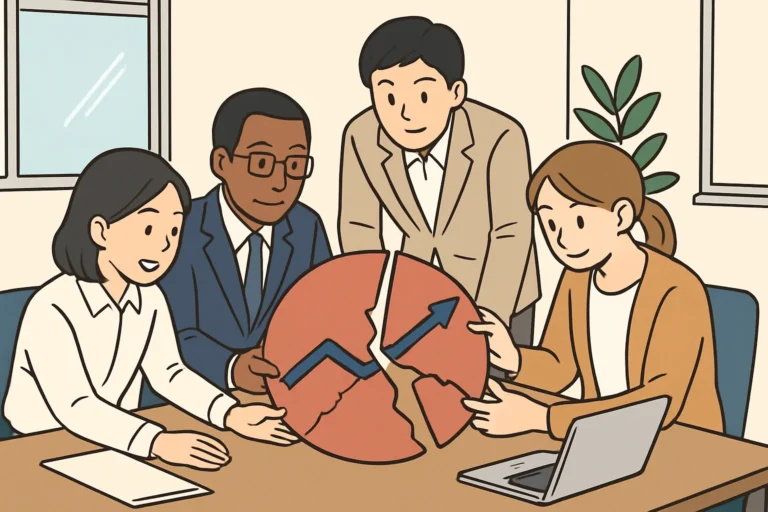
Today, we’re diving into a situation that can be nerve-wracking in any language: discussing a project that didn’t go as planned. It’s a scenario that requires tact, professionalism, and the right vocabulary. Recently in Korean companies, especially in the fast-paced tech and startup scenes, there’s a growing culture of ‘회고’ (hoego), or “retrospectives.” Instead of pointing fingers, the focus is on learning and improving.
This lesson will equip you with the essential C1-level phrases to navigate these conversations constructively, turning potential conflict into a valuable team-building opportunity. Let’s learn how to discuss failure like a pro in a Korean workplace!
Core Expressions for a Constructive ‘Hoego’ (회고)
Here are four key phrases that will help you handle a project retrospective with confidence and grace.
1. 우리 한번 되짚어 봐요. (Uri hanbeon doejjipeo bwayo.)
- English Meaning: Let’s take a look back / Let’s review what happened.
- Detailed Explanation: This is the perfect opening line. It’s a soft, collaborative invitation to review the process, not to start a blame game. ‘되짚다’ (doejjipda) literally means to re-trace one’s steps. Using this phrase sets a calm, analytical tone for the meeting, showing you’re focused on understanding the “what” and “how,” not the “who.”
- 💡 Pronunciation Tip: The key here is liaison (연음). The final consonant of a syllable (받침) often moves to the next syllable if it starts with a vowel. So, 짚어 (jip-eo) is not pronounced ‘jip-eo’ but smoothly as [지퍼 (jipeo)], just like the word for ‘zipper’!
2. 그건 제 불찰이었습니다. (Geugeon je bulcharieotseumnida.)
- English Meaning: That was my oversight / my fault.
- Detailed Explanation: This is a highly professional and mature way to take responsibility. ‘불찰’ (bulchal) specifically means a mistake made due to carelessness or lack of careful examination. It’s more formal and nuanced than simply saying ‘제 실수예요’ (It’s my mistake) or ‘죄송합니다’ (I’m sorry). Using this phrase shows you have reflected on your role in the issue and are accountable, which builds trust with your team.
- 💡 Pronunciation Tip: Again, liaison is your friend! In 불찰이었습니다 (bulchal-ieot-seumnida), the final ㄹ (l) of ‘불찰’ links with the following ‘이’. It sounds like [불차리얻씀니다 (bulchari-eot-seumnida)]. Practice linking the words for a more natural flow.
3. 이번 일을 교훈 삼아… (Ibeon ireul gyo-hun sama…)
- English Meaning: Taking this incident as a lesson… / Learning from this experience…
- Detailed Explanation: This is a brilliant pivot phrase that shifts the conversation from the past mistake to future improvement. ‘교훈’ (gyo-hun) means ‘a lesson,’ and ‘-을/를 교훈 삼아’ is an idiomatic expression that means to learn from something. Using this after acknowledging a mistake demonstrates a proactive, growth-oriented mindset, which is highly valued in any professional setting.
- 💡 Pronunciation Tip: Notice the pronunciation of 일을 [이를 (ireul)]. The ㄹ (l) sound from ‘일’ carries over to the particle ‘을’, making it sound like one smooth word instead of two choppy ones. This is another perfect example of liaison.
4. 다음부터는 …하는 게 어떨까요? (Daeumbuteoneun …haneun ge eotteolkkayo?)
- English Meaning: From next time, how about we…? / What do you think about… from now on?
- Detailed Explanation: This is the ultimate collaborative suggestion pattern. Instead of giving a direct command (‘Do this!’), you’re politely proposing a solution and asking for your team’s opinion. It’s the perfect follow-up to ‘이번 일을 교훈 삼아…’. It shows you’re not just a problem-finder but also a solution-builder.
- 💡 Pronunciation Tip: The double consonant in 어떨까요 [어떨까?] is important. The ㄹ sound in ‘어떨’ is a clear ‘l’ sound. Make sure your tongue touches the roof of your mouth just behind your teeth. The intonation at the end should rise slightly, as it’s a genuine question.
Example Dialogue: The ‘Hoego’ Meeting
Let’s see these phrases in a realistic conversation about a failed app launch.
- A (팀장님/Team Leader): 이번 앱 론칭 프로젝트 결과가 좋지 않았네요. 비난하려는 게 아니니, 우리 한번 되짚어 봐요. 어떤 점이 가장 큰 문제였을까요?
- (The result of this app launch project wasn’t good. I’m not here to blame anyone, so let’s take a look back. What do you think was the biggest issue?)
- B (담당자/Person in Charge): 마지막 테스트 단계에서 서버 용량 체크를 꼼꼼히 못 했습니다. 트래픽이 몰렸을 때 서버가 다운된 건 그건 제 불찰이었습니다. 정말 죄송합니다.
- (I failed to double-check the server capacity during the final testing phase. The server crashing during the traffic spike… that was my oversight. I am truly sorry.)
- A (팀장님/Team Leader): 괜찮아요. 인정하고 말해줘서 고마워요. 이번 일을 교훈 삼아, 다음부터는 론칭 전 체크리스트를 만들어서 다 같이 확인하는 게 어떨까요?
- (It’s okay. Thank you for admitting it. Taking this as a lesson, from next time on, how about we create a pre-launch checklist and review it together?)
- B (담당자/Person in Charge): 네, 좋은 생각입니다. 그렇게 하면 다시는 이런 실수를 반복하지 않을 겁니다.
- (Yes, that’s a great idea. If we do that, we won’t repeat this kind of mistake again.)
Culture Tip & Trend Deep Dive
In the past, hierarchical Korean work culture often made admitting mistakes (especially to a superior) a very difficult thing to do. However, with the global influence of agile methodologies and a younger generation (the MZ 세대) entering the workforce, the culture of ‘회고’ (hoego) is becoming a standard practice.
The key is to show that you are focused on the ‘일’ (il – the work), not the ‘사람’ (saram – the person). When you use a phrase like “제 불찰이었습니다” (It was my oversight) and immediately follow it with “이번 일을 교훈 삼아…” (Taking this as a lesson…), you masterfully achieve two things:
1. You show personal accountability, which builds trust.
2. You immediately pivot the focus away from your personal mistake and toward a constructive, team-wide solution.
This approach helps everyone save face (체면) and proves you are a reliable and forward-thinking team member.
Let’s Wrap It Up & Practice!
Today, we learned four powerful phrases to handle project failures in a Korean workplace:
* 우리 한번 되짚어 봐요. (Let’s review.)
* 그건 제 불찰이었습니다. (It was my oversight.)
* 이번 일을 교훈 삼아… (Taking this as a lesson…)
* …하는 게 어떨까요? (How about we…?)
Now, it’s your turn to practice!
- Fill in the blank: Your team missed an important deadline. You were responsible for collecting the final data. What do you say?
제가 데이터를 늦게 전달한 것, 그건 제 _________.
- Make a sentence: Using the pattern “이번 일을 교훈 삼아 …하는 게 어떨까요?”, suggest a solution for poor communication within a team.
Leave your answers in the comments below! We’d love to see how you use these expressions. Keep up the great work
Frequently Asked Questions (FAQ)
Q: What does "[매일한글]" mean in Korean and how do you pronounce it?
A: In Korean, "[매일한글]" is pronounced [Maeil Hangeul] and means: , here to upgrade your Korean skills!
Q: What does "'회고'" mean in Korean and how do you pronounce it?
A: In Korean, "'회고'" is pronounced [hoego] and means: , or "retrospectives." Instead of pointing fingers, the focus is on learning and improving.
Q: What does "짚어" mean in Korean and how do you pronounce it?
A: In Korean, "짚어" is pronounced [jip-eo] and means: is not pronounced 'jip-eo' but smoothly as
Q: What does "'불찰'" mean in Korean and how do you pronounce it?
A: In Korean, "'불찰'" is pronounced [bulchal] and means: specifically means a mistake made due to carelessness or lack of careful examination. It’s more formal and nuanced than simply saying '제 실수예요' (It's my mistake) or '죄송합니다' (I'm sorry). Using this phrase shows you have reflected on your role in the issue and are accountable, which builds trust with your team.







