

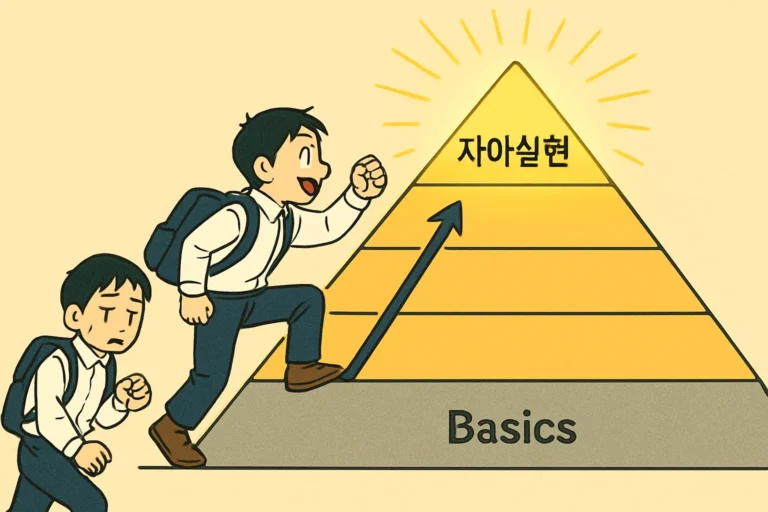
Maslow’s Secret: Unlock Your Ultimate Korean Learning Motivation
Hello! It’s [Maeil Hangeul], here to upgrade your Korean skills to a whole new level!
As advanced learners, we’ve all been there: you hit a plateau, and the initial excitement of learning fades. How do you reignite that fire? Today, we’re going beyond grammar charts and vocabulary lists. We’ll explore a profound psychological concept that holds the key to unlocking your motivation. Lately in Korea, there’s a growing conversation among educators and high-achieving learners about the deep psychology of learning. It’s not just about what you study, but why. At the heart of this discussion is Maslow’s Hierarchy of Needs, and understanding it can transform your approach to mastering Korean.
Let’s dive in!
Core Expressions for the In-Depth Learner
Here are the essential terms you need to discuss this topic like a native intellectual.
- 한국어 표현: 욕구 위계 이론 (Yok-gu Wi-gye I-ron)
- Pronunciation [Romanized]: Yok-gu Wi-gye I-ron
- English Meaning: Hierarchy of Needs Theory
- Detailed Explanation: This is the formal term for Maslow’s theory. Let’s break it down: 욕구 (yok-gu) means ‘need’ or ‘desire,’ 위계 (wi-gye) means ‘hierarchy’ or ‘ranking system,’ and 이론 (i-ron) means ‘theory.’ While you won’t use this in casual conversation, it’s indispensable for academic articles, formal presentations, or discussions on psychology and education in Korean.
- 한국어 표현: 자아실현 (Ja-a-sil-hyeon)
- Pronunciation [Romanized]: Ja-a-sil-hyeon
- English Meaning: Self-actualization
- Detailed Explanation: This powerful term refers to the pinnacle of Maslow’s pyramid. 자아 (ja-a) means ‘self’ or ‘ego,’ and 실현 (sil-hyeon) means ‘realization’ or ‘fulfillment.’ It describes the process of realizing and achieving your full potential. For many, reaching true fluency in a foreign language is a form of 자아실현, as it unlocks new parts of one’s identity.
- 한국어 표현: 동기 부여 (Dong-gi Bu-yeo)
- Pronunciation [Romanized]: Dong-gi Bu-yeo
- English Meaning: Motivation (the act of motivating)
- Detailed Explanation: 동기 (dong-gi) is the ‘motive’ or ‘reason,’ and 부여 (bu-yeo) means ‘to grant’ or ‘to give.’ So, 동기 부여 is the act of providing or instilling motivation. It’s a key term in Korean corporate, educational, and self-development contexts. For example, a teacher’s goal is to provide 동기 부여 to their students.
- 한국어 표현: 내재적 동기 (Nae-jae-jeok Dong-gi) vs. 외재적 동기 (Oe-jae-jeok Dong-gi)
- Pronunciation [Romanized]: Nae-jae-jeok Dong-gi vs. Oe-jae-jeok Dong-gi
- English Meaning: Intrinsic Motivation vs. Extrinsic Motivation
- Detailed Explanation: This distinction is crucial for advanced analysis. 내재적 (nae-jae-jeok) means ‘intrinsic’ or ‘internal,’ while 외재적 (oe-jae-jeok) means ‘extrinsic’ or ‘external.’ Learning Korean for the sheer joy of it is driven by 내재적 동기. Learning it just to pass a test or get a promotion is driven by 외재적 동기. Maslow argues that true 자아실현 is fueled by intrinsic motivation.
Sample Dialogue: A University Study Session
Let’s see how these terms play out in a realistic conversation between two university students in Seoul.
A: 요즘 한국학 심화 과정을 공부하면서 슬럼프에 빠진 것 같아요. 학습에 대한 동기 부여가 예전 같지 않아요.
(Lately, I feel like I’m in a slump while studying for the advanced Korean Studies course. My learning motivation isn’t what it used to be.)
B: 아, 그 심정 이해해요. 혹시 매슬로우의 욕구 위계 이론에 대해 들어봤어요? 기본적인 생리적, 안정적 욕구가 충족되지 않으면 고차원적인 지적 활동에 집중하기 어렵다고 하잖아요.
(Ah, I know that feeling. Have you ever heard of Maslow’s Hierarchy of Needs Theory? It says that if basic physiological and safety needs aren’t met, it’s hard to focus on higher-level intellectual activities.)
A: 그렇군요. 생각해보니 최근 프로젝트 때문에 잠도 부족하고 스트레스가 심했어요. 언어 학습의 궁극적인 목표는 자아실현의 한 과정인데, 기본부터 다시 챙겨야겠네요.
(That makes sense. Come to think of it, I’ve been sleep-deprived and highly stressed because of a recent project. The ultimate goal of language learning is part of the process of self-actualization, but I guess I need to take care of the fundamentals first.)
B: 맞아요. TOPIK 점수 같은 외재적 동기도 무시할 순 없지만, 배움 자체의 즐거움이라는 내재적 동기를 되찾으려면 심리적 안정이 우선이죠.
(Exactly. You can’t ignore extrinsic motivation like TOPIK scores, but psychological stability is the priority if you want to rediscover the intrinsic motivation that comes from the joy of learning itself.)
Culture Tip & Trend Deep Dive
So, how does this theory specifically relate to modern Korea?
In Korea’s famously competitive education system (입시 경쟁), the focus has historically been on fulfilling the lower-to-middle tiers of Maslow’s pyramid. The intense pressure to enter a top university and secure a stable job is a powerful driver related to ‘Safety Needs’ (안전의 욕구). This environment naturally cultivates a strong reliance on 외재적 동기 (extrinsic motivation)—good grades, awards, and social recognition.
However, there is a significant cultural shift happening right now. Many young Koreans and progressive educators are questioning this model. They are asking, “What about personal fulfillment? What about creativity?” This has led to a growing emphasis on fostering 내재적 동기 (intrinsic motivation) and encouraging the pursuit of 자아실현 (self-actualization) beyond standardized test scores. When you use these terms, you’re not just using advanced vocabulary; you’re tapping into a core conversation about the future of Korean society. Knowing this context will make you sound not just fluent, but culturally insightful.
Let’s Review and Practice!
Today, we took a deep dive into the psychology of learning, connecting it to advanced Korean vocabulary. We learned that our motivation (동기 부여) is complex, and according to the 욕구 위계 이론, we need to meet our basic needs to achieve our highest potential, or 자아실현.
Now it’s your turn to apply what you’ve learned!
- Fill-in-the-blank:
Studying Korean not for a test, but for the pure joy of understanding K-dramas on a deeper level is an example of _______________.
(Hint: Intrinsic Motivation) -
Short Answer:
In your own Korean learning journey, what is your biggest source of 동기 부여? Write a short sentence or two in the comments below!
Thank you for studying with me today. Keep exploring, stay motivated, and I’ll see you in the next post
Frequently Asked Questions (FAQ)
Q: What does "욕구" mean in Korean and how do you pronounce it?
A: In Korean, "욕구" is pronounced [yok-gu] and means: means 'need' or 'desire,'
Q: What does "위계" mean in Korean and how do you pronounce it?
A: In Korean, "위계" is pronounced [wi-gye] and means: means 'hierarchy' or 'ranking system,' and
Q: What does "이론" mean in Korean and how do you pronounce it?
A: In Korean, "이론" is pronounced [i-ron] and means: means 'theory.' While you won't use this in casual conversation, it's indispensable for academic articles, formal presentations, or discussions on psychology and education in Korean.
Q: What does "자아" mean in Korean and how do you pronounce it?
A: In Korean, "자아" is pronounced [ja-a] and means: means 'self' or 'ego,' and







