

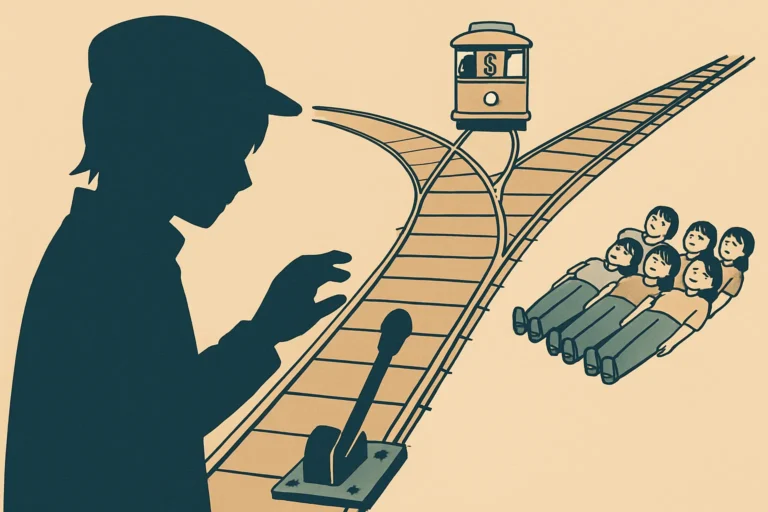
Would You Pull the Lever? The Trolley Problem in Korean
Hello! It’s your friendly guide at Daily Korean, here to upgrade your language skills from advanced to eloquent!
Ever found yourself in a heated debate about a tough ethical choice? Today, we’re diving deep into a topic that’s not just for philosophy class but is a recurring theme in intense Korean dramas and webtoons: the Trolley Problem. We’ll learn the Korean vocabulary to discuss complex ethical dilemmas, allowing you to participate in profound conversations and truly understand the moral conflicts portrayed in Korean media.
Lately, survival-themed K-dramas and webtoons like Squid Game or All of Us Are Dead have been incredibly popular in Korea. These stories constantly force characters into impossible situations, sparking huge online debates among viewers. Learning how to articulate these dilemmas in Korean will not only boost your vocabulary but also connect you to these passionate cultural conversations. Let’s get started!
Key Expressions for Your Moral Compass
Here are the essential terms you need to navigate any ethical debate like a native speaker.
1. 공리주의 (Gong-ri-ju-ui)
* Pronunciation: [Gong-ree-joo-eui]
* English Meaning: Utilitarianism
* Detailed Description: This is the philosophical principle of “the greatest good for the greatest number.” In Korean discussions, it’s the go-to term for justifying an action based on its overall positive consequences, even if it involves a sacrifice. It’s a formal, academic term, perfect for debates and serious discussions.
2. 의무론 (Ui-mu-ron)
* Pronunciation: [Ui-moo-ron]
* English Meaning: Deontology
* Detailed Description: This is the counter-argument to utilitarianism. Deontology argues that certain actions are inherently right or wrong, regardless of their consequences. It focuses on moral duties and rules (e.g., “one must not kill”). Use this term to argue for a choice based on principle, not outcome.
3. 딜레마에 빠지다 (Dillema-e ppajida)
* Pronunciation: [Dill-le-ma-eh ppa-ji-da]
* English Meaning: To fall into a dilemma; to be in a predicament.
* Detailed Description: This is a fantastic, natural-sounding phrase to describe being stuck between a rock and a hard place. It perfectly captures the feeling of facing a difficult choice with no good options. You can use it in both formal and informal contexts.
4. 대의를 위해 소를 희생하다 (Dae-ui-reul wihae so-reul hisaenghada)
* Pronunciation: [Dae-eui-reul wi-hae so-reul hee-saeng-ha-da]
* English Meaning: To sacrifice the few (small) for the sake of the many (great cause).
* Detailed Description: This is a sophisticated idiomatic expression that directly translates the core conflict of the Trolley Problem. ‘대의’ (dae-ui) means a great cause or justification, while ‘소’ (so) means small or minor. Using this phrase will make you sound incredibly fluent and insightful during a debate.
Example Dialogue: Post-Drama Discussion
Imagine two friends discussing the finale of a popular zombie thriller.
A: 그 드라마 마지막 장면 봤어? 주인공이 한 명을 희생시켜서 나머지 사람들을 구했잖아. 정말 딜레마에 빠졌을 것 같아.
(Geu deurama majimak jangmyeon bwasseo? Ju-in-gong-i han myeong-eul hisaengsikyeoseo nameoji saramdeur-eul guhaetjana. Jeongmal dillema-e ppajyeosseul geot gata.)
A: Did you see the final scene of that drama? The main character saved everyone else by sacrificing one person. They must have been in a real dilemma.
B: 맞아. 공리주의 관점에서는 최선의 선택이었지. 대의를 위해 소를 희생한 셈이니까.
(Maja. Gong-ri-ju-ui gwanjeom-eseoneun choeseon-ui seontaeg-ieotji. Dae-ui-reul wihae so-reul hisaenghan sem-inikka.)
B: I agree. From a utilitarian perspective, it was the best choice. It was a case of sacrificing the few for the sake of the many.
A: 그렇긴 한데, 의무론적으로 보면 살인은 어떤 상황에서도 정당화될 수 없잖아. 나라면 그런 결정을 못 했을 거야.
(Geureogin hande, ui-mu-ron-jeog-euro bomyeon sarin-eun eotteon sanghwang-eseodo jeongdanghwadoel su eopjana. Naramyeon geureon gyeoljeong-eul mot haesseul geoya.)
A: That’s true, but from a deontological point of view, killing can never be justified, no matter the situation. I don’t think I could have made that decision.
Culture Tip & Trend Deep Dive
In Korea, discussing ethical dilemmas isn’t just for academics; it’s a popular form of entertainment and social bonding!
- MBTI & Moral Choices: A huge trend in Korea is analyzing situations through the lens of the MBTI personality test. When a character in a drama faces a Trolley Problem-like choice, online forums explode with comments like, “That’s such a T (Thinking) decision! An F (Feeling) character would never do that!” or “As an INTJ, I would have pulled the lever immediately.” People love to debate how different personality types would react, making these philosophical discussions personal and relatable.
- Survival Shows & Webtoons: The Trolley Problem is the basic premise for many popular Korean webtoons and reality shows like The Devil’s Plan. These shows test contestants’ intelligence, social skills, and moral fiber, often forcing them to choose between personal gain and group welfare. The audience becomes part of the debate, passionately arguing on social media about who made the “right” choice. Understanding terms like 공리주의 and 대의를 위해 소를 희생하다 gives you a key to unlock these vibrant fan communities.
Let’s Recap & Practice!
Great job! Today we learned how to discuss complex moral choices in Korean. We covered 공리주의 (utilitarianism), 의무론 (deontology), the phrase 딜레마에 빠지다 (to be in a dilemma), and the powerful idiom 대의를 위해 소를 희생하다 (to sacrifice the few for the many).
Now, let’s put your knowledge to the test!
1. Fill in the Blank:
If you believe that the consequences determine the morality of an action, you are looking at it from a ______________ (Gong-ri-ju-ui / Ui-mu-ron) perspective.
2. Your Turn!
In the classic Trolley Problem, would you pull the lever to save five people at the cost of one? Try to write your answer in Korean in the comments below using at least one of today’s expressions!
We can’t wait to read your thoughtful opinions. Keep up the fantastic work, and see you next time at Daily Korean
Frequently Asked Questions (FAQ)
Q: What does "의무론" mean in Korean and how do you pronounce it?
A: In Korean, "의무론" is pronounced [deontology] and means: , the phrase
Q: What does "딜레마에 빠지다" mean in Korean and how do you pronounce it?
A: In Korean, "딜레마에 빠지다" is pronounced [to be in a dilemma] and means: , and the powerful idiom







