Ouch! Your Korean Pharmacy Survival Guide
Hello! This is Maeil Hangul, here to upgrade your Korean skills!
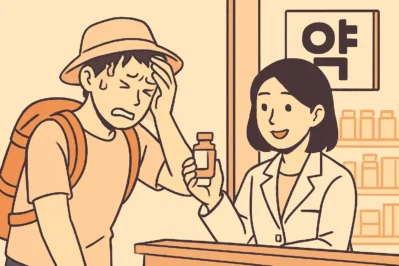
Ever traveled to a new country and suddenly felt a little unwell? It happens! Today, we’re going to learn some essential Korean phrases so you can confidently walk into a pharmacy (약국) and get the medicine you need.
You might be wondering, “Why now?” Well, the seasons are changing in Korea, and it’s a time when many people catch a cold (this is called ‘환절기 감기’). Knowing how to explain your symptoms is a real-life superpower! Let’s get you prepared so you can feel better and get back to enjoying your Korean adventure.
Core Expressions You Must Know
Here are three simple but powerful phrases to master.
1. 머리가 아파요. (Meori-ga apayo.)
- Romanization: Meori-ga apayo.
- English Meaning: I have a headache. / My head hurts.
- Detailed Explanation: This is your go-to phrase for explaining pain. ‘머리’ (meori) means ‘head’, and ‘아파요’ (apayo) means ‘it hurts’. You can easily swap out the body part!
- Stomach hurts? 배가 아파요. (Bae-ga apayo.)
- Throat hurts? 목이 아파요. (Mog-i apayo.)
‘~이/가 아파요’ is a super useful pattern!
- 💡 Pronunciation Tip:
The ‘ㅍ’ (p) sound in ‘아파요’ (apayo) is aspirated. This means you should release a little puff of air when you say it, like the ‘p’ in “park.” It’s stronger than the ‘ㅂ’ (b) sound in ‘배’ (bae), which has almost no air puff. Try holding your hand in front of your mouth. You should feel more air for ‘파’ (pa) than for ‘바’ (ba)!
2. 이 약 주세요. (I yak juseyo.)
- Romanization: I yak juseyo.
- English Meaning: Please give me this medicine.
- Detailed Explanation: This is the magic phrase for buying anything in Korea. ‘이’ (i) means ‘this’, ‘약’ (yak) means ‘medicine’, and ‘주세요’ (juseyo) is the polite way to say ‘please give me’. You can simply point at what you want and say “이거 주세요 (Igeo juseyo),” which means “Please give me this thing.”
- 💡 Pronunciation Tip:
Listen closely to the word ‘약’ [yak]. The final ‘ㄱ’ (k) sound isn’t fully released like the ‘k’ in the English word “book.” Instead, you stop the sound in your throat. It’s a “stopped” sound. This is very common for final consonants in Korean and will make you sound much more natural.
3. 소화제 있어요? (Sohwaje isseoyo?)
- Romanization: Sohwaje isseoyo?
- English Meaning: Do you have digestive medicine?
- Detailed Explanation: Koreans often eat delicious, rich foods, so digestive aids, called ‘소화제’ (sohwaje), are very common. The pattern ‘Noun + 있어요?’ (isseoyo?) means “Do you have (Noun)?” It’s perfect for asking if a store has something in stock.
- Want a painkiller? 진통제 있어요? (Jintongje isseoyo?)
- Need a band-aid? 밴드 있어요? (Baendeu isseoyo?)
- 💡 Pronunciation Tip:
The ‘ㅆ’ in ‘있어요’ [isseoyo] is a “tense” sound. To make this sound, make an ‘s’ sound but tighten the muscles in your tongue and don’t let much air escape. It should sound stronger and higher-pitched than a regular ‘ㅅ’ (s). Think of it as a very sharp, quick “ss” sound!
Example Dialogue at the Pharmacy
Let’s see these phrases in action! Imagine you ate too much delicious tteokbokki.
- A (You): 안녕하세요. 머리가 아프고 소화가 잘 안 돼요.
- Annyeonghaseyo. Meori-ga apgo sohwaga jal an dwaeyo.
- (Hello. I have a headache and indigestion.)
- B (Pharmacist): 아, 그러세요? 이 소화제랑 두통약 드셔보세요. 효과가 좋아요.
- A, geureoseyo? I sohwajerang dutongyak deushyeoboseyo. Hyogwaga joayo.
- (Oh, really? Please try this digestive aid and headache medicine. They work well.)
- A (You): 네, 이 약들 주세요. 감사합니다!
- Ne, i yakdeul juseyo. Gamsahamnida!
- (Yes, please give me these medicines. Thank you!)
Culture Tip & Trend Deep Dive
In Korea, pharmacies (약국) are marked with a big red cross and are incredibly easy to find. Unlike in some countries, you can often buy many types of effective medicine directly from the pharmacist after describing your symptoms.
Trend Alert: You’ll often see small glass bottles of “energy drinks” like 박카스 (Bacchus) or hangover cures near the counter. These are a huge part of Korean work and social culture. If you tell a Korean friend you’re feeling tired, they might just buy you a Bacchus! It’s a common way to show you care. Knowing about these popular items will make you seem like a local!
Wrap-up & Practice Time!
Great job today! You’ve learned how to:
* Explain that you’re in pain using “~이/가 아파요.”
* Ask for something politely with “~주세요.”
* Check if something is available using “~있어요?”
Now, let’s practice!
- Fill in the blank: Your throat hurts. How would you say it?
목이 _______.
- Make a sentence: You want to buy a band-aid. What would you say to the pharmacist?
________ 있어요?
Leave your answers in the comments below using the phrases we learned today! We’d love to see you try them out. Until next time, stay healthy