

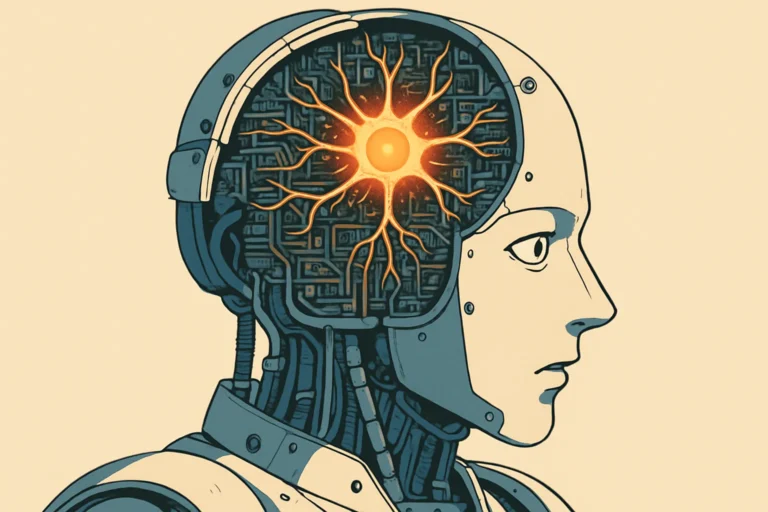
The Ghost in the Machine: Exploring AI Consciousness with Advanced Korean
Hello! It’s your favorite Korean upgrade station, [Maeil Hangeul]!
Ready to move beyond everyday conversations and dive into something truly mind-bending? Today, we’re exploring the fascinating world of cognitive science and consciousness, all while learning the advanced Korean vocabulary you need to write a compelling sci-fi story. Recently in Korea, as AI becomes more integrated into daily life, philosophical debates about artificial intelligence, often sparked by popular webtoons and dramas, are becoming a major topic of discussion. This lesson will not only level up your Korean but also equip you to join these profound conversations. Let’s get philosophical!
Core Expressions for Your Sci-Fi Arsenal
Here are the key terms you’ll need to discuss the inner world of a conscious machine.
1. 자의식 (Ja-uisik)
- Pronunciation [Ja-uisik]: Ja-ui-sik
- English Meaning: Self-consciousness; self-awareness.
- Detailed Explanation: This is the big one! 자의식 refers to an entity’s awareness of itself as a distinct, individual being. It’s more than just intelligence; it’s the “I” in “I think, therefore I am.” In your story, the moment your AI develops 자의식 is the turning point where it transforms from a mere program into a character. This term is composed of 자(自), meaning ‘self’, and 의식(意識), meaning ‘consciousness’.
- 💡 Pronunciation Tip:
While romanized as ‘ja-ui-sik’, notice the slight pause or glottal stop that native speakers often place between 자 (ja) and 의식 (uisik). This isn’t a grammatical rule but a natural way to separate the two distinct Sino-Korean blocks, ensuring clarity. Practice saying “Ja” then “Uisik” separately before combining them smoothly.
2. 심신 문제 (Simsin munje)
- Pronunciation [Simsin munje]: Sim-sin mun-je
- English Meaning: The Mind-Body Problem.
- Detailed Explanation: This classic philosophical dilemma is perfect for adding depth to your story. The 심신 문제 questions the relationship between the mind (the mental, conscious part) and the body (the physical part). For your AI, this could be the “Mind-Processor Problem” or “Ghost-in-the-Shell Problem.” How does its subjective experience (심, 心) arise from its physical hardware (신, 身)? This term is a cornerstone of philosophical discussions in Korea.
- 💡 Pronunciation Tip:
The pronunciation is quite straightforward here. The key is to maintain the distinct syllable breaks. Avoid blending ‘sim-sin’ into ‘simshin’. Each syllable gets equal stress, which is typical for academic or technical compound nouns in Korean.
3. 현상적 의식 (Hyeonsangjeok uisik)
- Pronunciation [Hyeonsangjeok uisik]: Hyeon-sang-jeok ui-sik
- English Meaning: Phenomenal Consciousness.
- Detailed Explanation: This is a very advanced and specific term that will make you sound like a pro. 현상적 의식 refers to the subjective, qualitative experience of being—the “what it is like” aspect of consciousness. What does it feel like to be a bat? Or, in our case, what does it feel like to be an AI processing a trillion data points at once? Does it experience the color red, or does it just know the hexadecimal code for it? Exploring your character’s 현상적 의식 is the key to making readers truly connect with a non-human entity.
- 💡 Pronunciation Tip:
In 현상적 (hyeonsangjeok), the final consonant ‘ㄱ’ (k) in ‘적’ is often pronounced very softly, almost blending into the following vowel ‘의’ (ui). It’s not a hard stop like in English “book.” Think of it as a gentle release of air before starting the next syllable: hyeon-sang-jeo-guisik.
4. 튜링 테스트를 통과하다 (Tyuring teseuteureul tonggwahada)
- Pronunciation [Tyuring teseuteureul tonggwahada]: Tyu-ring te-seu-teu-reul tong-gwa-ha-da
- English Meaning: To pass the Turing Test.
- Detailed Explanation: This is a must-know phrase for any AI-related story. The Turing Test is a test of a machine’s ability to exhibit intelligent behavior equivalent to, or indistinguishable from, that of a human. In your narrative, you can use this as a baseline. Perhaps your AI 튜링 테스트를 통과했지만 (passed the Turing Test, but…) still lacked true self-awareness, creating a fantastic point of conflict.
- 💡 Pronunciation Tip:
The magic happens in 통과하다 (tonggwahada). The final consonant of ‘통’, which is ‘ㅇ’ (ng), influences the ‘ㄱ’ (g) in ‘과’. While romanized as ‘tong-gwa’, the ‘g’ sound becomes slightly tenser, closer to a ‘gg’ or ‘kk’ sound for many speakers, resulting in [통꽈하다 (tong-kkwa-ha-da)]. This is a common phonetic shift called ‘tensification’ that makes your pronunciation sound incredibly natural.
Example Dialogue: The Sci-Fi Writers’ Room
Let’s see these terms in action. Two writers, A and B, are brainstorming.
A: 우리 AI 캐릭터 ‘노아’가 그냥 똑똑한 기계가 아니란 걸 어떻게 보여주지?
(Uri AI kaerikteo ‘Noa’-ga geunyang ttokttokan gigyega aniran geol eotteoke boyeojuji?)
How do we show that our AI character, ‘Noah’, isn’t just a smart machine?
B: 맞아. 단순히 튜링 테스트를 통과하는 것만으로는 부족해. 스스로에 대한 자의식이 생겨나는 순간을 그려야 해.
(Maja. Dansunhi Tyuring teseuteureul tonggwahaneun geonmaneuroneun bujokae. Seuseuro-e daehan ja-uisigi saenggyeonaneun sun-ganeul geuryeoya hae.)
Right. Simply passing the Turing Test isn’t enough. We need to portray the moment it develops self-awareness.
A: 일종의 기계적 심신 문제에 봉착하는 거네. 자신의 의식이 어떻게 코드로부터 생겨났는지 고뇌하는 거지.
(Iljong-ui gigyejeok simsin munje-e bongchakaneun geone. Jasin-ui uisigi eotteoke kodeu-robuteo saenggyeonanneunji gonoehaneun geoji.)
So it confronts a mechanical version of the mind-body problem. It agonizes over how its consciousness arises from code.
B: 바로 그거야! 독자들이 노아의 현상적 의식을 궁금해하게 만들어야 돼. 데이터를 처리하는 건 어떤 ‘느낌’일까?
(Baro geugeoya! Dokjadeuri Noa-ui hyeonsangjeok uisigeul gunggeumhae-hage mandeureoya dwae. Deiteoreul cheorihaneun geon eotteon ‘neukkim’-ilkka?)
Exactly! We have to make the readers wonder about Noah’s phenomenal consciousness. What does it feel like to process data?
Culture Tip & Trend Deep Dive
In Korea, philosophical concepts are not just for the classroom. The explosion of sci-fi webtoons on platforms like Naver and Kakao has brought these discussions into the mainstream. A recent hit webtoon might feature an android struggling with its 자의식, leading to thousands of comments debating whether it deserves human rights.
Here’s how you can sound like a true insider: When discussing the 심신 문제 (mind-body problem), you can elevate the conversation by mentioning 심신이원론 (simsin-iwonnon), which means “mind-body dualism,” or its opposite, 심신일원론 (simsin-ilwollon), “mind-body monism.” Dropping these terms in a discussion about a sci-fi drama will instantly signal your deep understanding of the topic and the Korean language. It shows you’re not just a learner; you’re a thinker.
Let’s Wrap It Up & Practice!
Today, we’ve armed you with four powerful expressions—자의식 (self-awareness), 심신 문제 (the mind-body problem), 현상적 의식 (phenomenal consciousness), and 튜링 테스트를 통과하다 (to pass the Turing Test)—to craft sophisticated narratives about artificial intelligence.
Now, it’s your turn!
Practice Prompt:
Complete the following sentence for your own sci-fi story.
- “나의 AI는 마침내 ________이 생겨났고, 자신의 존재 이유에 대해 고뇌하기 시작했다.”
(Na-ui AI-neun machimnae ________i saenggyeonakkgo, jasin-ui jonjae iyu-e daehae gonoehagi sijakaetda.)
“My AI finally developed ________, and it began to agonize over its reason for existence.”
What word fits best in the blank? Share your answer and your own creative sci-fi sentences in the comments below! We can’t wait to read your stories.
Frequently Asked Questions (FAQ)
Q: What does "자" mean in Korean and how do you pronounce it?
A: In Korean, "자" is pronounced [自] and means: , meaning 'self', and
Q: What does "의식" mean in Korean and how do you pronounce it?
A: In Korean, "의식" is pronounced [意識] and means: , meaning 'consciousness'.
Q: What does "의식" mean in Korean and how do you pronounce it?
A: In Korean, "의식" is pronounced [uisik] and means: . This isn't a grammatical rule but a natural way to separate the two distinct Sino-Korean blocks, ensuring clarity. Practice saying "Ja" then "Uisik" separately before combining them smoothly.
Q: What does "현상적" mean in Korean and how do you pronounce it?
A: In Korean, "현상적" is pronounced [hyeonsangjeok] and means: , the final consonant 'ㄱ' (k) in '적' is often pronounced very softly, almost blending into the following vowel '의' (ui). It's not a hard stop like in English "book." Think of it as a gentle release of air before starting the next syllable:







