Phase 1: Why “Putting Yourself in Their Shoes” Matters in Korean Dating
안녕하세요! 매일한글 에디터입니다. (Annyeonghaseyo! Hello, this is your Daily Hangul Editor!)
Picture this: You are watching a hit Korean dating show or sharing bingsu at a Hongdae cafe when your partner’s phone lights up at midnight. “Oh, just a friend,” they say. In Korea, debates over texting frequency and opposite-sex friends (남사친/여사친) are huge! Many of my intermediate students ask how to express discomfort without sounding overly jealous. Based on real learner coaching, today you will learn empathetic Korean phrases centered on one golden rule: putting yourself in your partner’s shoes. Master these expressions to set healthy boundaries with warmth and confidence!
Phase 2: Top 3 Essential Expressions Deep Dive
1. 역지사지로 생각해 보면 (Yeokjisajiro saenggakhae bomyeon)
- Pronunciation: Yeok-ji-sa-ji-ro saeng-gak-hae bo-myeon (Sounds like “Yuck-jee-sah-jee-roh seng-gak-heh boh-myun” — keep yeok short like “yuck” without the harsh ending)
- Meaning: Literally “if you think by changing positions/places.” Actually means “When you put yourself in the other person’s shoes…”
- K-Culture Moment: In Korean dating reality shows like EXchange (환승연애), cast members or panelists frequently use this four-character idiom when analyzing why a partner got upset over late-night texts with an ex or close friend.
- Editor’s Insight: Using a sajaseongeo (four-character idiom) like 역지사지 (yeokjisaji) immediately elevates your Level 3 Korean! It shifts the tone from an emotional complaint to a mature, logical appeal to fairness.
- Situation Spectrum: Casual ✅ | Semi-formal ✅ | Formal ✅
- 🤔 Think About It: In English, we talk about walking a mile in someone’s shoes. In Korean, 역지사지 (yeokjisaji) focuses on swapping ground or stance. Why do you think framing a boundary as “fairness” works better in Korean than saying “I don’t like it”?
2. 똑같이 행동했을 때 기분이 나쁠 것 같다면 (Ttokgachi haengdonghaesseul ttae gibuni nappeul geot gatdamyeon)
- Pronunciation: Ttok-ga-chi haeng-dong-haes-seul ttae gi-bu-ni nap-peul geot gat-da-myeon (The tt in ttok is a tense, crisp “t” like the t in “stop”, never breathy)
- Meaning: Literally “if it seems you would feel bad when someone acted the exact same way.” Actually means “If you’d feel uncomfortable seeing me do the exact same thing…”
- K-Culture Moment: Think of classic K-Drama cafe confrontations where the female lead calmly holds her iced americano and mirrors her boyfriend’s behavior back to him so he realizes his double standard.
- Editor’s Insight: Notice the intermediate grammar
-을 것 같다면(eul geot gatdamyeon, “if it seems like it would…”). Softening certainty with것 같다prevents your partner from feeling attacked and invites them to imagine the scenario.- Situation Spectrum: Casual ✅ | Semi-formal ✅ | Formal ⚠️ (Use
기분이 언짢으실 것 같다면in very formal settings)- 🤔 Think About It: Korean relies heavily on hypothetical softeners like
-다면and것 같다. How direct are you in your native language when calling out a partner’s double standard?3. 하지 않는 게 맞아요 (Haji anneun ge majayo)
- Pronunciation: Ha-ji an-neun ge ma-ja-yo (Say “Ha-jee ahn-neun geh mah-jah-yoh” — notice the
ㅎin않는disappears smoothly into an n sound!)- Meaning: Literally “not doing it is right.” Actually means “It’s the right thing not to do it” or “You shouldn’t do it.”
- K-Culture Moment: When K-Pop idols or hosts on talk shows discuss relationship etiquette—like the famous perilla leaf debate—they wrap up their opinion firmly with
~는 게 맞아요(~neun ge majayo) to express moral clarity.- Editor’s Insight: Compare
하지 마세요(“Don’t do it” — sounds like an order) with하지 않는 게 맞아요(“It’s right not to do it” — appeals to shared values). For intermediate learners,-는 게 맞다is a secret weapon for sounding persuasive without sounding bossy.- Situation Spectrum: Casual ✅ (Drop
-요->맞아) | Semi-formal ✅ | Formal ✅- 🤔 Think About It: Why does framing a request around what is “right” (
맞다) rather than personal preference feel so persuasive in Korean culture?
Phase 3: Textbook Korean vs. Real Korean
Situation 1: Referring to a Platonic Opposite-Sex Friend
- 📖 Textbook Korean: 이성 친구랑 단둘이 만나는 건 좀 불편해요. (Iseong chingurang danduri mannaneun geon jom bulpyeonhaeyo.) — “Meeting alone with an opposite-sex friend is a bit uncomfortable.”
- 🗣️ Real Korean: 남사친/여사친이랑 단둘이 만나는 건 좀 아닌 것 같아. (Namsachin/Yeosachinirang danduri mannaneun geon jom anin geot gata.) — “Hanging out one-on-one with a guy/girl friend just doesn’t feel right.”
- 💡 Why is it different? Nobody in casual Korean dating calls a friend
이성 친구(opposite-sex friend)—that sounds like a sociology textbook! Koreans use the snappy portmanteaus 남사친 (namsachin: male friend) and 여사친 (yeosachin: female friend), and soften “uncomfortable” into좀 아닌 것 같아(it feels a bit off).
Situation 2: Talking About Texting Frequency
- 📖 Textbook Korean: 연락 빈도가 너무 적어서 유감입니다. (Yeollak bindoga neomu jeogeoseo yugamimnida.) — “I regret that the frequency of contact is too low.”
- 🗣️ Real Korean: 연락 텀이 너무 길어서 좀 서운해. (Yeollak teomi neomu gireoseo jom seounhae.) — “The gap between your texts is so long that I feel a bit hurt/let down.”
- 💡 Why is it different? Using
유감입니다sounds like a corporate press release! In real relationships, Koreans borrow the Konglish word 텀 (teom, from “term”/interval) for texting gaps and use the deeply Korean emotion word 서운하다 (seounhada), which expresses tender disappointment rather than anger.
Phase 4: K-Culture Deep Dive & Non-Verbal Manners
4-1. Nunchi (눈치) & Body Language
In Korea, how you bring up relationship boundaries matters just as much as your words. Avoid bringing up texting or 남사친/여사친 issues over KakaoTalk while annoyed—text lacks warmth and often escalates misunderstandings. Instead, talk face-to-face at a quiet cafe. Maintain calm eye contact, keep your shoulders relaxed, and avoid crossing your arms or pointing fingers. Using a slightly softer, slower pace when saying 입장 바꿔서 생각해 봐 (Ipjang bakkwoseo saenggakhae bwa — “Think about it from my side”) shows nunchi (social awareness) and invites cooperation instead of defensiveness.
4-2. Cultural Code Analysis: K-Variety & The Famous Boundary Debates
If you follow Korean pop culture, you have probably heard of the 깻잎 논쟁 (Kkaennip Nonjaeng / Perilla Leaf Debate) popularized by Korean variety shows and K-Pop idols! Should your partner help peel a stuck perilla leaf off the plate for your opposite-sex friend? What about late-night texting or drinking one-on-one? In Korea, where group hangouts and late-night KakaoTalk culture are huge, couples actively negotiate these boundaries early on. The universal gold standard in Korean dating culture is 역지사지 (yeokjisaji): before replying to a midnight text from a friend, ask yourself how you would feel if your partner did the exact same thing.
Phase 5: Real-Life Roleplay Scenario
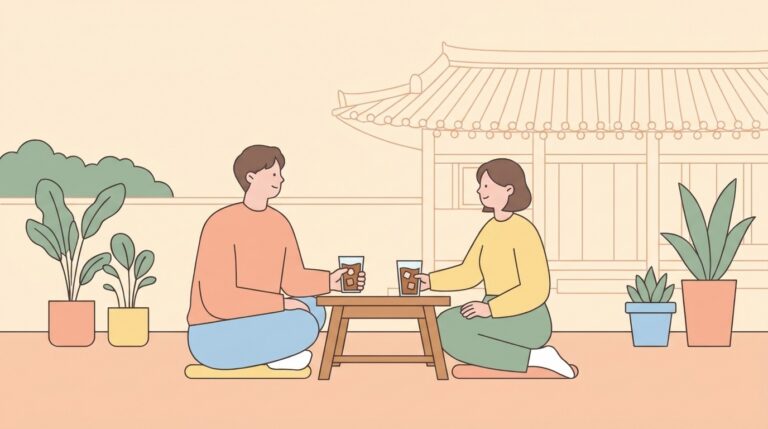
Setting: A cozy, dimly lit cafe in Yeonnam-dong, Seoul. Rain taps softly against the window as you and your Korean partner, Ji-hoon (지훈), sit across from each other over warm yuja tea. Earlier, Ji-hoon casually mentioned grabbing late-night drinks one-on-one with his yeosachin (female friend) while barely texting you all evening.
- Ji-hoon: 🎭 (Looking up from his phone, smiling casually) 어, 미안! 아까 수진이랑 얘기하느라 카톡을 못 봤네. (Eo, mian! Akka Sujinirang yaegihaneura katogeul mot bwanne.) — “Oh, sorry! I was talking with Sujin earlier so I missed your KakaoTalk message.”
- You: 🎭 (Taking a calm breath and gently setting your teacup down) 지훈아, 잠깐 진지하게 얘기 좀 할 수 있어? (Jihuna, jamkkan jinjihage yaegi jom hal su isseo?) — “Ji-hoon, can we talk seriously for a moment?”
- Ji-hoon: 🎭 (Surprised, putting his phone face-down on the table) 응, 왜 그래? 무슨 일 있어? (Eung, wae geurae? Museun il isseo?) — “Yeah, what’s wrong? Did something happen?”
- You: 🎭 (Looking at him steadily with a gentle expression) 사실 아까 연락이 안 돼서 좀 서운했어. 그리고 여사친이랑 단둘이 늦게 술 마시는 것도 신경 쓰이고. (Sasil akka yeollagi an dwaeseo jom seounhaesseo. Geurigo yeosachinirang danduri neutge sul masineun geotdo singyeong sseuigo.) — “Honestly, I felt a bit hurt earlier when I couldn’t reach you. And drinking late one-on-one with a female friend also bothers me.”
- Ji-hoon: 🎭 (Tilting his head slightly, a bit defensive) 에이, 수진이는 진짜 그냥 친구야. 오해하지 마. (Ei, Sujinineun jinjja geunyang chinguya. Ohaehaji ma.) — “Hey, Sujin is really just a friend. Don’t misunderstand.”
- You: 🎭 (Nodding calmly to show you hear him, then leaning in slightly) 믿지, 당연히 믿어. 그런데 내가 역지사지로 생각해 봐도… (Mitji, dangyeonhi mideo. Geureonde naega yeokjisajiro saenggakhae bwado…) — “I trust you, of course I do. Still, even when I put myself in your shoes…”
- Ji-hoon: 🎭 (Pausing, listening attentively) 음… 내가 반대로 생각해 보면 어떨 것 같냐고? (Eum… naega bandaero saenggakhae bomyeon eotteol geot gatnyago?) — “Hmm… you mean how would I feel if it were the other way around?”
- You: 🎭 (Speaking softly but firmly) 응. 내 연인이 똑같이 행동했을 때 기분이 나쁠 것 같다면, 서로 하지 않는 게 맞다고 생각해. (Eung. Nae yeonini ttokgachi haengdonghaesseul ttae gibuni nappeul geot gatdamyeon, seoro haji anneun ge matdago saenggakhae.) — “Yeah. If you’d feel uncomfortable seeing your partner do the exact same thing, I think it’s right for both of us not to do it.”
🔀 Interactive Branching Point: How would you respond if Ji-hoon stays quiet for a second?
- Option A: “내가 너무 예민한가? 미안, 그냥 잊어버려.” (Naega neomu yeminhanga? Mian, geunyang ijeobeoryeo.) — “Am I being too sensitive? Sorry, just forget it.”
- Feedback (Bad): Backing down right after stating a fair boundary signals that your feelings aren’t important, and the same issue will likely repeat.
- Option B: “만약 내가 남사친이랑 새벽까지 술 마시고 연락 안 되면, 지훈이 너도 서운할 것 같지 않아?” (Manyak naega namsachinirang saebyeokkkaji sul masigo yeollak an doemyeon, Jihuni neodo seounhal geot gatji ana?) — “If I drank until dawn with a guy friend and didn’t text you, wouldn’t you feel hurt too, Ji-hoon?”
- Feedback (Best): Brilliant Level 3 Korean! Using a gentle hypothetical (
만약 ~라면) and checking empathy (~것 같지 않아?) helps Ji-hoon truly feel your perspective without starting a fight.
- Feedback (Best): Brilliant Level 3 Korean! Using a gentle hypothetical (
- Option C: “앞으로 여자랑은 말도 섞지 마!” (Apeuro yeojarangeun maldo seokji ma!) — “Don’t even talk to any girls from now on!”
- Feedback (Risk): Way too extreme! Total bans sound controlling and destroy mutual trust.
Phase 6: 10-Second Emotion Shadowing Drill
Read these aloud, pausing briefly at every / and matching the emotional cue!
- [🥺 Hurt yet gentle]
연락이 / 너무 안 돼서 / 솔직히 좀 서운했어. (Yeollagi / neomu an dwaeseo / soljiki jom seounhaesseo.)
“Honestly, I felt a bit hurt because you were hard to reach.” -
[🤔 Calmly reasoning]
내가 역지사지로 / 생각해 봐도 / 이건 좀 아닌 것 같아. (Naega yeokjisajiro / saenggakhae bwado / igeon jom anin geot gata.)
“Even putting myself in your shoes, this doesn’t feel right.” -
[😌 Firm and sincere]
똑같이 행동했을 때 / 기분이 나쁠 것 같다면 / 하지 않는 게 맞아요. (Ttokgachi haengdonghaesseul ttae / gibuni nappeul geot gatdamyeon / haji anneun ge majayo.)
“If it seems you’d feel bad if the other person did the exact same thing, it’s right not to do it.”
Phase 7: K-Culture Mini Dictionary
- 역지사지 (Yeokjisaji) | Putting oneself in another’s shoes | Used daily in relationships, family talks, and even office meetings when asking someone to see the other side fairly.
- 남사친 / 여사친 (Namsachin / Yeosachin) | Platonic male friend / female friend | Short for namja saram chingu / yeoja saram chingu (literally “male/female human friend”), distinguishing platonic friends from
남자친구/여자친구(boyfriend/girlfriend). - 연락 빈도 (Yeollak bindo) | Frequency of contact/texting | Common in dating discussions and Korean matchmaking profiles; casually, people also say
연락 문제(contact issues). - 서운하다 (Seounhada) | To feel hurt, let down, or neglected | Expresses soft emotional disappointment toward someone you care about—much gentler and warmer than
화나다(to be angry).
Phase 8: Survival Kit for Travelers
Even if you are traveling in Korea and meeting friends or going on dates in Seoul, clear communication keeps things smooth!
- Top 3 Survival Phrases:
- 도착하면 톡 할게요! (Dochakhamyeon tok halgeyo!) — “I’ll KakaoTalk you when I arrive!” Pro Tip: Koreans use “톡” (tok) as shorthand for KakaoTalk. Letting someone know you arrived safely builds huge trust.
- 오늘 좀 일찍 들어가 봐야 될 것 같아요. (Oneul jom iljjik deureoga bwaya doel geot gatayo.) — “I think I should head home a bit early today.” Pro Tip: A super polite way to leave a late-night drinking gathering (
술자리) without awkwardness. - 입장 바꿔서 생각해 주세요. (Ipjang bakkwoseo saenggakhae juseyo.) — “Please put yourself in my shoes.” Pro Tip: Useful not only in dating, but also when resolving polite misunderstandings with roommates or travel buddies.
- Editor’s Travel Note: Before touching down at Incheon Airport, make sure to Install KakaoTalk Messenger App so you can stay in touch effortlessly—practically everyone in Korea texts there instead of SMS! Also, Download Naver Map for Korea Navigation since Google Maps walking directions don’t work well locally. Need a late-night ride back after a date? Grab a T-money card at any GS25 or CU convenience store for subways and buses, or use Kakao T to hail a safe cab right to your door.
Phase 9: One Step Deeper — Empathy in Korean Relationships
In Korean society, relationships are rarely viewed through the lens of pure individualism; instead, there is a deep emphasis on 우리 (uri, “us/we”) and mutual harmony. Because people value keeping the peace, expressing hurt directly as “You are wrong” often shuts down communication. That is why concepts like 역지사지 (yeokjisaji) and 서운함 (seounham) are so powerful—they invite your partner into a shared emotional space where fairness and care naturally guide your choices. When both people protect each other’s peace of mind, boundaries stop feeling like rules and start feeling like love.
💬 Your Turn: What is your personal boundary on texting frequency or 남사친/여사친 in a relationship? Share your thoughts in the comments using one new Korean word you learned today!
Phase 10: FAQ & Common Mistakes
Q: Is “역지사지” too formal to say to my Korean boyfriend or girlfriend?
A: Not at all! Even though 역지사지 is a four-character idiom, Koreans in their 20s and 30s use it constantly in everyday dating talks and variety shows. Saying 역지사지로 생각해 봐 sounds articulate and fair, not stiff.
Q: What is the difference between “입장 바꿔 생각하다” and “역지사지”?
A: They share the exact same meaning! 입장 바꿔 생각하다 (ipjang bakkwo saenggakhada) uses everyday Korean words (“change positions and think”), while 역지사지 is the concise Sino-Korean idiom. Knowing both makes your Level 3 Korean shine.
Q: How often do Korean couples expect each other to text?
A: Generally, Korean couples text fairly frequently throughout the day—often sending quick updates like 밥 먹었어? (Did you eat?) or 집에 왔어 (I’m home). However, every couple is different, which is why talking openly about 연락 빈도 early on helps avoid misunderstandings.
🚨 Common Mistakes Alert!
- Mistake: Mixing up
남자친구(boyfriend) and남사친(male friend).- Correct Action: Always include the
사(for saram, person) in남사친/여사친when you mean a strictly platonic friend!
- Correct Action: Always include the
- Mistake: Saying
하지 마(“Don’t do it”) abruptly in polite conversation.- Correct Action: Soften it with
하지 않는 게 맞아요(“It’s right not to do it”) to focus on mutual respect rather than issuing a command.
- Correct Action: Soften it with
- Mistake: Saying
화났어(“I’m angry”) when you actually feel hurt or lonely.- Correct Action: Use
서운해(“I feel hurt/let down”) so your partner feels motivated to comfort you rather than defend themselves.
- Correct Action: Use
Phase 11: Action Mission & K-Culture Quest
- 🥉 Bronze Mission (Solo Practice): Record yourself saying the Phase 6 shadowing sentences on your phone three times, paying attention to the smooth pronunciation of
하지 않는 게 맞아요(haji anneun ge majayo). - 🥈 Silver Mission (Share Online): Post a story or comment tagging
#DailyHangulsharing whether you lean strict or relaxed on the Korean남사친/여사친debate! - 🥇 Gold Mission (Real-Life Use): Next time a friend or partner forgets to consider how their action affects you, gently try saying
입장 바꿔서 생각해 봐(Ipjang bakkwoseo saenggakhae bwa) in a real conversation. - 🎮 K-Culture Mission: Watch an episode of a Korean dating show (like EXchange or Single’s Inferno) or a slice-of-life K-Drama this week and see if you can spot the words
남사친,여사친,서운해, or역지사지!
Phase 12: Interactive Quiz Challenge
1. Situation Judgment: Your Korean partner gets upset because you went to a late-night café alone with an opposite-sex friend without texting. Which response shows the most empathetic Level 3 Korean?
* A) 이성 친구일 뿐인데 왜 그래요?
* B) 입장 바꿔서 생각해 보니까 내가 연락을 못 해서 서운했을 것 같아. 미안해.
* C) 유감입니다. 연락 빈도를 높이겠습니다.
👉 Click to reveal Answer & Explanation for Q1
Answer: B!
Option A sounds dismissive, and Option C sounds like a stiff business email. Option B uses 입장 바꿔서 생각해 보니까 (putting myself in your shoes) and acknowledges their 서운함 (hurt feelings) warmly and naturally!
2. Fill in the Blank: Complete the golden rule in natural Korean:
“똑같이 행동했을 때 기분이 나쁠 것 같다면 ______ 게 맞아요.” (If you’d feel bad when someone acted the exact same way, it’s right not to do it.)
👉 Click to reveal Answer & Explanation for Q2
Answer: 하지 않는 (haji anneun)
Full sentence: 똑같이 행동했을 때 기분이 나쁠 것 같다면 하지 않는 게 맞아요. Remember that -지 않는 게 맞다 means “it is right not to do (something).”
3. True or False (Culture Quiz): In Korean, calling a platonic male friend “남자친구” (namjachingu) is completely fine and won’t cause any misunderstandings.
👉 Click to reveal Answer & Explanation for Q3
Answer: False!
남자친구 strictly means “boyfriend”! For a platonic male friend, Koreans say 남사친 (namsachin), short for 남자 사람 친구.
🎬 Watch Our Daily Videos! (Daily Hangul Official Instagram)
Review the expressions you learned in this article with our fun daily short videos! Check out native pronunciation and real-life nuances in action.
- Instagram @dailyhangul_en