

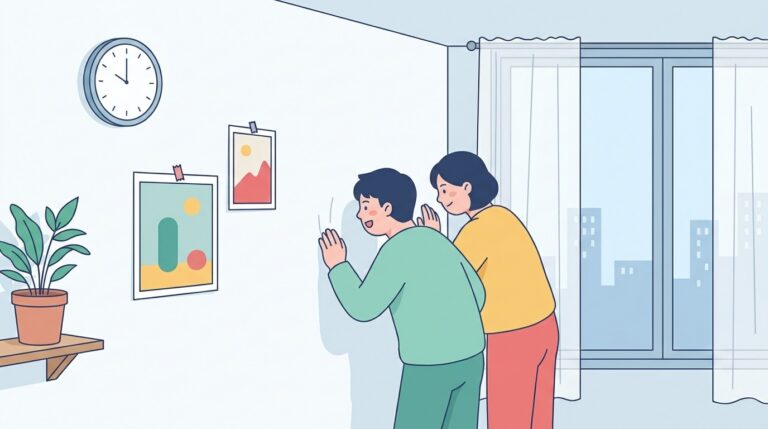
Phase 1: Empathy — Move-Out Panic in Your Dream Korean Room
Hello! I’m your Daily Hangul editor. Have you ever watched I Live Alone (나 혼자 산다) and dreamed of decorating your own cozy Korean officetel with cute frames and minimalist wall clocks? That dream gets scary fast on move-out day! In Korea, landlords take wonsangbokgu (원상복구 – property restoration) seriously, and one tiny nail hole can cost a chunk of your huge bojeunggeum (보증금 – security deposit). Many of my B1 students panic when their landlord eyes the wallpaper, even though they used damage-free kkokkopin (꼭꼬핀 – wallpaper pins) or removable hooks! Based on real expat move-out consultations, today’s guide gives you the exact natural Korean phrases to protect your deposit stress-free.
Phase 2: Deep Dive Into 3 Core Expressions
1. 액자나 시계를 걸 때는 흔적이 남지 않는 꼭꼬핀이나 접착 후크를 사용했어요
- Pronunciation: Aekjana sigyereul geol ttaeneun heunjeogi namji anneun kkokkopinina jeopchak hukeureul sayonghaesseoyo (Think of “anneun” like “an-nun”—the j sound smoothly melts into an n sound, just like “gonna” in casual English! Also, “kkokko” has a crisp, bouncy k like “cocoa” said with extra energy.)
- Meaning: Literally “When hanging frames or clocks, I used traceless kkokkopins or adhesive hooks.” Practically, it means: “Don’t worry, I didn’t damage your walls—I’m a responsible tenant!”
- K-Culture Moment: Picture a scene in a slice-of-life K-Drama like Because This Is My First Life where the main character carefully peels off a wall hook on moving day, holding their breath so the wallpaper stays spotless before the landlord arrives.
- Editor’s Insight: Naming the exact Korean product—kkokkopin (꼭꼬핀)—immediately signals to a Korean landlord that you know local rental etiquette. It lowers their guard way faster than just saying “I didn’t break anything.”
- Situation Spectrum: Casual 🚫 / Semi-formal ✅ / Formal ✅ (Using -아/어요 keeps it polite, clear, and respectful for landlord-tenant talks.)
- 🤔 Think About It: In many Western apartments, tiny picture nails are normal wear and tear, and tenants just spackle and paint over them. In Korea, walls are covered in paper or silk wallpaper (byeokji), so patching a single hole often requires re-papering the entire wall! How does housing construction shape what “damage” means in your language?
2. 벽지에 못을 박지 않고 조심해서 썼어요
- Pronunciation: Byeokjie moseul bakji anko josimhaeseo sseosseoyo (Pronounce “anko” with a sharp k sound like “an-ko”—the hidden h merges with g to make it punchy! “Sseosseoyo” starts with a tight, hissed s, like holding back air before saying “saw.”)
- Meaning: Literally “I didn’t hammer nails into the wallpaper and used it carefully.” Nuance: “I treated your property like my own.”
- K-Culture Moment: On Korean home-makeover variety shows like Where Is My Home (구해줘! 홈즈), realtors constantly inspect wall corners for nail holes. Saying 못을 박지 않았어요 (moseul bakji anasseoyo – I didn’t hammer nails) is the ultimate reassurance.
- Editor’s Insight: Korean landlords worry most about mot (못 – nails). Explicitly ruling out nails right away clears up the biggest misunderstanding before they even look closely.
- Situation Spectrum: Casual ⚠️ / Semi-formal ✅ / Formal ✅
- 🤔 Think About It: Notice the word 조심해서 (josimhaeseo – carefully). Korean communication loves highlighting your attitude and effort toward the shared space, not just the final physical result. Do people emphasize care and effort when negotiating leases in your home country?
3. 원상복구 비용에서 빼지 않으셔도 될 것 같아요
- Pronunciation: Wonsangbokgu biyongeseo ppaeji aneusyeodo doel geot gatayo (Pronounce “ppaeji” with a strong, popped p without a puff of air—like the p in “spin”! And “gatayo” sounds smooth, like “ga-ta-yo.”)
- Meaning: Literally “I think you probably don’t need to subtract from the restoration fee.” Nuance: A soft, diplomatic way to say “Please don’t deduct anything from my deposit for this.”
- K-Culture Moment: Just like an experienced office worker in Misaeng (미생) negotiating politely over coffee without sounding confrontational, ending with ~것 같아요 (geot gatayo – I think/it seems) keeps the atmosphere cooperative while standing your ground.
- Editor’s Insight: Instead of bluntly saying “Don’t take my money!” (돈 빼지 마세요!), adding -(으)셔도 될 것 같아요 respects the landlord’s authority while gently guiding them to agree with you.
- Situation Spectrum: Casual 🚫 / Semi-formal ✅ / Formal ✅
- 🤔 Think About It: English speakers often value directness in financial talks (“There is no damage, so return the full deposit”). Why do you think Korean favors indirect softeners like “it seems” even when the numbers are clear?
Phase 3: Textbook Korean vs. Real Korean
Situation 1: Proving you left zero marks on the wall
- 📖 Textbook Korean: 벽면에 훼손이 전혀 발생하지 않았습니다. (Byeongmyeone hwesoni jeonhyeo balsaenghaji anasseumnida. – No damage has occurred on the wall surface whatsoever.)
- 🗣️ Real Korean: 벽에 자국 하나도 안 남게 깔끔하게 썼어요. (Byeoge jaguk hanado an namge kkalkkeumhage sseosseoyo. – I kept it super clean so not even one mark stayed on the wall.)
- 💡 Why the difference? Textbook Korean uses heavy Sino-Korean legal words like 훼손 (hweson – damage) and 발생 (balsaeng – occurrence), which can make a landlord feel like you’re reading a lawsuit to them! Native speakers use friendly native words like 자국 (jaguk – mark) and 깔끔하게 (kkalkkeumhage – neatly) to build instant trust.
Situation 2: Confirming your full deposit return
- 📖 Textbook Korean: 임대차 보증금 전액을 반환해 주시기 바랍니다. (Imdaecha bojeunggeum jeonaegeul banhwanhae jusigi baramnida. – Please return the full lease security deposit.)
- 🗣️ Real Korean: 혹시 까이는 거 없이 보증금 다 받을 수 있는 거죠? (Hoksi kkaineun geo eopsi bojeunggeum da badeul su inneun geojyo? – I can get the whole deposit back without any deductions, right?)
- 💡 Why the difference? In everyday speech, Koreans rarely say 공제 (gongje – deduction); they say 까이다 (kkaida – to get chipped/deducted). Adding 혹시 (hoksi – by any chance) and ~거죠? turns a stiff demand into a warm confirmation.
Phase 4: K-Culture Deep Dive & Non-Verbal Manners
4-1. Nunchi (눈치) & Gestures
When walking through your empty room with the landlord, how you move matters just as much as your Korean vocabulary:
* Open-Palm Guidance: When showing where your clock or frame hung, gesture toward the spotless wall with an open, upward-facing palm—never stab at the wall with one index finger, which feels defensive or accusatory.
* Soft Eye Contact & Nod: Maintain gentle eye contact, give a slight 15-degree nod while speaking, and keep your voice calm and warm. Raising your pitch in panic signals guilt even when the wall is pristine!
* The “Receipt” Pose: Hold your smartphone naturally in front of you with your move-in day photos ready. Saying 입주할 때 찍은 사진이에요 (Ipjuhal ttae jjigeun sajinieyo – These are photos I took when moving in) calmly ends any debate in seconds.
4-2. Cultural Code Analysis: K-Variety & Bang-kkumigi (방꾸미기)
If you follow Korean YouTube vlogs or shows like I Live Alone (나 혼자 산다), you’ve probably heard the buzzword 방꾸미기 (bang-kkumigi – room decorating). Young Koreans living in 20-square-meter one-rooms or officetels spend huge effort turning tiny rental spaces into aesthetic cafés. Because almost every Korean rental uses paper-thin wallpaper (silkeu byeokji or hapji byeokji) pasted directly over concrete, drilling or nailing is strictly taboo. That cultural clash gave birth to an entire K-Living industry of damage-free hacks—led by the legendary kkokkopin (a tiny angled pin that slides gently behind wallpaper without tearing it) and removable 3M adhesive hooks!
Phase 5: Practical Roleplay Scenario
Setting: Saturday morning in a bright Gangnam officetel. Moving boxes are taped up by the door. NPC: Landlord Park (박 사장님), a practical middle-aged landlord holding a checklist and squinting closely at the living room wall.
- Landlord Park: 🎭 (Squinting near the window wall) 여기 벽지에 뭐 붙였던 자리 같은데, 못 박았어요?
Yeogi byeokjie mwo buchyeotdeon jari gateunde, mot bagasseoyo? (It looks like something was attached to the wallpaper here—did you hammer a nail?) - You: 🎭 (Smiling calmly, gesturing with an open palm toward the clean wall) 아, 아니에요 사장님! 벽지에 못을 박지 않고 조심해서 썼어요.
A, anieyo sajangnim! Byeokjie moseul bakji anko josimhaeseo sseosseoyo. (Oh, no sir! I didn’t hammer nails into the wallpaper and used it carefully.) - Landlord Park: 🎭 (Tilting his head, stepping closer) 그럼 여기에 시계랑 액자는 어떻게 걸었어요?
Geureom yeogie sigyerang aekjaneun eotteoke georeosseoyo? (Then how did you hang your clock and frames here?) - You: 🎭 (Pulling out a tiny leftover pin from your bag to show him) 액자나 시계를 걸 때는 흔적이 남지 않는 꼭꼬핀이나 접착 후크를 사용했어요.
Aekjana sigyereul geol ttaeneun heunjeogi namji anneun kkokkopinina jeopchak hukeureul sayonghaesseoyo. (When hanging frames or clocks, I used damage-free pins or removable adhesive hooks.) - Landlord Park: 🎭 (Nodding slowly as he touches the smooth paper) 아, 꼭꼬핀 썼구나. 찢어진 데는 없네.
A, kkokkopin sseotguna. Jjijeojin deneun eomne. (Ah, you used kkokkopin. There are no tears.) - You: 🎭 (Showing a photo on your phone politely) 네, 떼어낼 때도 자국 안 남게 천천히 뗐어요. 벽지 상태 그대로예요!
Ne, tteeonael ttaedo jaguk an namge cheoncheonhi ttaesseoyo. Byeokji sangtae geudaeroeyo! (Yes, when removing them too, I peeled them slowly so no marks stayed. The wallpaper is in the exact same condition!) - Landlord Park: 🎭 (Checking a box on his clipboard) 그래요, 집을 아주 깔끔하게 잘 쓰셨네요.
Geuraeyo, jibeul aju kkalkkeumhage jal sseosyeonneyo. (Alright, you kept the place very neat and clean.) - You: 🎭 (Giving a polite slight bow) 감사합니다! 그럼 원상복구 비용에서 빼지 않으셔도 될 것 같아요. 보증금 확인 부탁드려요!
Gamsahamnida! Geureom wonsangbokgu biyongeseo ppaeji aneusyeodo doel geot gatayo. Bojeunggeum hwagin butakdeuryeoyo! (Thank you! Then I don’t think you need to deduct anything for restoration. Please check my deposit return!)
🔀 Interactive Branching Point: What if Landlord Park still notices a tiny shadow from a removable hook?
Choose your response:
* Option A: “It’s just a tiny shadow from an adhesive hook, not a tear! Look, I can wipe it off gently right now with a wet tissue, so please don’t charge me.”
* Option B: “That’s nothing! Why are you being so picky about a tiny mark? Just give me all my money back right now!”
* Option C: “Oh, I’m so sorry! Take whatever you want from my deposit to replace the whole wall!”
Feedback:
* Option A (Best ✅): Calm, solution-focused, and shows great nunchi. Offering to wipe off minor residue on the spot saves landlords from calling cleaners and usually saves your deposit 100%.
* Option B (Bad ❌): Confrontational tone makes landlords defensive, turning a 5-second wipe into a costly inspection dispute.
* Option C (Risk ⚠️): Being overly apologetic about minor wear invites unnecessary deductions—re-papering a whole wall can cost 300,000+ KRW!
Phase 6: 10-Second Emotional Shadowing Drill
Read these aloud like a movie actor! Pause briefly at each / and follow the emotion tags:
- [😊 Warm & Reassuring]
벽지에 / 못을 박지 않고 / 조심해서 썼어요.
(Byeokjie / moseul bakji anko / josimhaeseo sseosseoyo.) - [😌 Calm & Confident]
액자나 시계를 걸 때는 / 흔적이 남지 않는 꼭꼬핀이나 / 접착 후크를 사용했어요.
(Aekjana sigyereul geol ttaeneun / heunjeogi namji anneun kkokkopinina / jeopchak hukeureul sayonghaesseoyo.) - [🥺 Polite & Diplomatic]
그럼 / 원상복구 비용에서 / 빼지 않으셔도 될 것 같아요.
(Geureom / wonsangbokgu biyongeseo / ppaeji aneusyeodo doel geot gatayo.)
Phase 7: K-Culture Mini Dictionary
- 꼭꼬핀 (kkokkopin) | Damage-free wallpaper pin | A must-have Korean household clip sold at Daiso and Today’s House that hooks onto wallpaper without poking the concrete behind it.
- 원상복구 (wonsangbokgu) | Property restoration | A standard clause in every Korean lease (gyeyakseo) requiring tenants to return the home in its original move-in condition.
- 보증금 (bojeunggeum) | Security deposit | Often 5 million to 50+ million KRW in Korea; returned on move-out day after utility bills and restoration checks are cleared.
- 실크벽지 (silkeubyeokji) | PVC/vinyl-coated wallpaper | The smooth, slightly thicker Korean wallpaper type; easier to wipe clean than basic paper (hapji), though still vulnerable to strong glue.
Phase 8: Survival Kit for Expats & Long-Term Visitors
Top 3 Survival Phrases
- 사진 찍어 뒀어요 (Sajin jjigeo dwosseoyo – I took photos beforehand) — Pro Tip: Say this on move-in day AND move-out day so everyone knows you documented pre-existing scratches.
- 이건 원래 있던 거예요 (Igeon wollae itdeon geoyeyo – This was already here) — Pro Tip: Lifesaver when a landlord points at an old mark near the doorframe.
- 계좌로 보내주시면 돼요 (Gyejwaro bonaejusimyeon dwaeyo – You can just send it to my bank account) — Pro Tip: Keep your Korean bank account number copied in KakaoTalk to paste immediately.
Editor’s Travel & Living Note
- Before buying wall hooks in Korea, check local guides like the Today’s House Damage-Free Interior Store or visit your neighborhood Daiso (다이소) to grab kkokkopin for 1,000–2,000 KRW.
- If you run into a stubborn deposit dispute in Seoul, search the Seoul Housing Lease Dispute Mediation Committee Guide for free legal mediation info.
- Local Pro Tip: Always settle your final gas, electricity, and building management fees (gwallibi) via Korean bank transfer or Kakao Pay on move-out morning, and photograph the meter readings! Landlords love tenants who wrap up utilities cleanly.
Phase 9: “One Step Deeper” — Harmony & Boundaries in Korean
In Korean society, a rental contract isn’t viewed purely as cold paperwork; it’s also a temporary inyeon (인연 – human connection) between you and the homeowner. That is why B1 learners quickly notice that demanding rights aggressively often backfires, while pairing clear proof with soft endings like ~것 같아요 preserves the landlord’s face (chemyeon). When you respect the space and explain your care calmly, Korean landlords often respond with unexpected jeong (정 – warmth), sometimes even letting tiny scuffs slide without a word. Learning Korean at the intermediate level means mastering both precision and warmth.
💬 Your Turn: Have you ever decorated a rental room abroad or worried about getting a deposit back? Share your funniest or most stressful decorating story in the comments below!
Phase 10: FAQ & Myth-Busting
Q: Can I use strong 3M mounting tape on Korean wallpaper?
A: Be very careful! Extra-strong foam tape can rip a chunk of silkeubyeokji right off the wall when removed. Always look for packages labeled 흔적 없는 (heunjeok eomneun – traceless) or use kkokkopin for lightweight frames.
Q: What is the difference between 꼭꼬핀 (kkokkopin) and a regular pushpin?
A: A regular pushpin goes straight into the wall and leaves a visible hole. A kkokkopin slides downward at a shallow angle between the wallpaper and wall, holding up to 2kg while leaving virtually no visible trace.
Q: When do landlords return the 보증금 (deposit) in Korea?
A: Usually on the exact day you hand over the keys/door lock passcode, right after checking the room and subtracting final utility bills (gonggwageum).
🚨 Common Mistakes TOP 3
- Calling every wall “wall” (byeok) instead of “wallpaper” (byeokji): Saying 벽에 구멍 안 냈어요 sounds like you didn’t drill into concrete, whereas landlords care specifically about 벽지 (byeokji). Correct Action: Always specify 벽지 (byeokji)!
- Using command form 하지 마세요 for money: Saying 돈 빼지 마세요! (Don’t take my money!) sounds hostile. Correct Action: Soften it with 빼지 않으셔도 될 것 같아요.
- Ripping adhesive hooks off cold walls quickly: Pulling hooks fast in winter tears wallpaper! Correct Action: Warm the adhesive gently with a hairdryer for 10 seconds before peeling slowly.
Phase 11: Action Mission & Engagement
- 🥉 Bronze Mission (Solo Practice): Stand near a framed picture or clock in your room and say Phase 2’s Expression #1 aloud three times while gesturing calmly with an open palm!
- 🥈 Silver Mission (SNS Share): Snap a photo of your favorite room decoration and post a Story with the caption: 흔적이 남지 않는 꼭꼬핀! (Damage-free kkokkopin!) and tag
@DailyHangul. - 🥇 Gold Mission (Real-Life Use): Next time you visit a Daiso or Korean hardware shop—or talk to a Korean roommate—ask: 벽지에 흔적 안 남는 후크 있어요? (Do you have hooks that don’t leave marks on wallpaper?)
- 🎮 K-Culture Mission: Watch an episode of I Live Alone (나 혼자 산다) or a Korean one-room moving vlog on YouTube, and spot how the host hangs posters, clocks, or string lights without nails!
Phase 12: Interactive Quiz Challenge
1. Situational Judgment: Your landlord sees a faint circle where your clock used to hang and asks if you hammered a nail. What is the BEST response?
A) 벽지에 못을 박지 않고 흔적 안 남는 꼭꼬핀을 사용했어요.
B) 임대차 보증금 전액을 당장 반환해 주시기 바랍니다.
C) 내 집도 아닌데 그냥 대충 썼어요.
Click to reveal Answer & Explanation
Answer: A! Option A politely clarifies you didn’t use nails and specifies the damage-free kkokkopin. Option B sounds overly stiff and confrontational like a legal notice, and Option C (
🎬 Watch Our Daily Videos! (Daily Hangul Official Instagram)
Review the expressions you learned in this article with our fun daily short videos! Check out native pronunciation and real-life nuances in action.
- Instagram @dailyhangul_en







