

Phase 1: Why Textbook Economics Won’t Save Your Wallet in Seoul
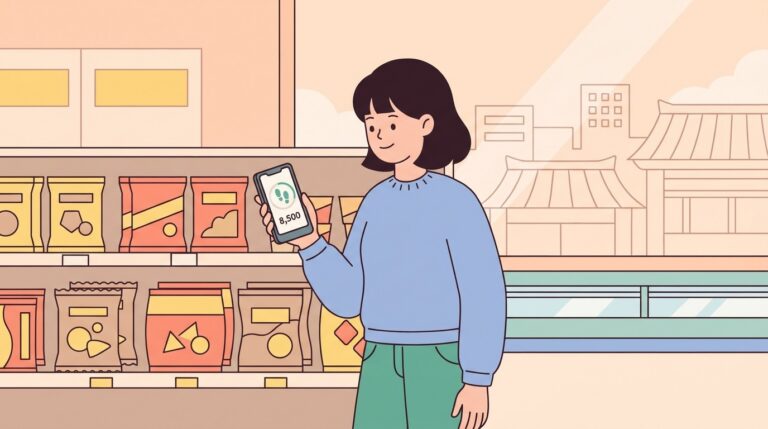
안녕하세요! 매일한글 에디터입니다. (Annyeonghaseyo! Maeil Hangeul Editeo-imnida. — Hello! This is the Daily Hangul Editor.) Picture this: you are sitting in a trendy Seoul cafe with your Korean friend, watching them furiously shake their smartphone for 10 won on a step-counter app while unwrapping a store-brand PB protein bar. Meanwhile, your favorite snack bag feels suspiciously lighter—classic shrinkflation! If you only know stiff textbook economics terms, you will feel completely lost in real Korean conversations about inflation. Based on feedback from hundreds of B2 learners, mastering these everyday thrift expressions lets you bond effortlessly with locals over smart money habits.
Phase 2: Deep Dive into 3 Essential B2 Expressions
1. 앱테크가 꽤 쏠쏠해요 (Aep-tekeu-ga kkwae ssolssolhaeyo — App-tech is surprisingly rewarding)
- Pronunciation: Aep-tekeu-ga kkwae ssolssolhaeyo. Think of kkwae like saying “kway” quickly, and ssol-ssol like a crisp, bouncy “ssol-ssol” (as if pennies are clinking neatly into a jar).
- Meaning: Literally “App-technology is quite decent/solid.” In real life, 쏠쏠하다 (ssolssolhada) describes small earnings, perks, or benefits that aren’t huge on their own, yet feel delightfully worthwhile when they add up.
- K-Culture Moment: On Korean reality shows like I Live Alone (나 혼자 산다 / Na Honja Sanda), frugal celebrities proudly show off turning 10-won pedometer points or attendance check-ins into a free convenience store Americano, nodding happily and saying, “이거 생각보다 쏠쏠해요! (Igeo saenggakboda ssolssolhaeyo! — This is more rewarding than you’d think!)”
- Editor’s Insight: B2 learners often overuse “돈이 돼요 (doni dwaeyo — it makes money)” or “이익이에요 (iigieyo — it’s a profit)”, which sound too transactional. 쏠쏠하다 carries an emotional sparkle of cozy satisfaction—it is the exact word Koreans use for side perks, cashback, or selling clutter online.
- Situation Spectrum:
- Casual (
앱테크 꽤 쏠쏠해/ Aep-tekeu kkwae ssolssolhae): ✅ - Semi-formal (
앱테크가 꽤 쏠쏠해요/ Aep-tekeu-ga kkwae ssolssolhaeyo): ✅ - Formal (
앱테크 수익이 쏠쏠합니다/ Aep-tekeu suigi ssolssolhamnida): ⚠️ (Fine in casual office banter, avoid in formal financial reports)
- Casual (
- 🤔 Think About It: In English, collecting 10 cents from an app might feel embarrassing to brag about, whereas in Korea, 앱테크 (aep-tekeu) is treated like a clever game. How does your culture view “micro-saving” habits in public?
2. 요즘 다들 가성비를 따지잖아요 (Yojeum dadeul gaseongbi-reul ttajijanayo — Everyone prioritizes value for money these days, you know)
- Pronunciation: Yo-jeum da-deul ga-seong-bi-reul tta-ji-ja-na-yo. Notice 따지다 (ttajida) starts with a tense double “tt”—hold your breath slightly before releasing it like the “t” in “stop,” not an airy “t” in “top.”
- Meaning: Literally “These days everyone scrutinizes price-to-performance, as you know.” 가성비 (gaseongbi) combines 가격 (gagyeok — price) and 성능 (seongneung — performance), while 따지다 (ttajida) means to weigh carefully or be picky about something. Ending with -잖아요 (-janayo) creates instant solidarity with the listener.
- K-Culture Moment: You will hear this constantly in Korean grocery vlogs and convenience store taste-test shorts when YouTubers compare pricey name-brand snacks shrunk by shrinkflation against generous PB (Private Brand) store-brand items.
- Editor’s Insight: A common B2 trap is translating “cheap” directly as “싸다 (ssada)”. Calling a friend’s gift or lifestyle ssada can sound rude or low-quality! Instead, praising something’s 가성비 (gaseongbi) or calling it 혜자스럽다 (hyejaseureopda — super generous for the price) makes both you and the buyer look smart.
- Situation Spectrum:
- Casual (
요즘 다 가성비 따지잖아/ Yojeum da gaseongbi ttajijana): ✅ - Semi-formal (
요즘 다들 가성비를 따지잖아요/ Yojeum dadeul gaseongbi-reul ttajijanayo): ✅ - Formal (
가성비를 중시하는 추세입니다/ Gaseongbi-reul jungsihaneun chuseimnida): 🚫 (Drop-잖아요in formal presentations and use중시하다instead)
- Casual (
- 🤔 Think About It: Why do you think Koreans coined a single sleek buzzword (가성비) that applies equally to laptops, $2 convenience store lunches, and dating spots?
3. 중고로 쿨거래했어요 (Junggo-ro kulgeoraehaesseoyo — I had a smooth, no-haggle secondhand deal)
- Pronunciation: Jung-go-ro kul-geo-rae-hae-sseo-yo. Pronounce 쿨 (kul) like “cool” without curling the “l” too heavily, and 거래 (georae) smoothly like “guh-reh.”
- Meaning: Literally “I did a cool transaction as secondhand.” 쿨거래 (kulgeorae) is Konglish + Korean meaning a brisk, stress-free secondhand trade with zero awkward haggling, ghosting, or nitpicking.
- K-Culture Moment: In modern slice-of-life K-Dramas and webtoons, characters meeting at subway exits via 당근 (Danggeun — Karrot Market) sigh with relief when the buyer pays right away, cheering “오늘 완전 쿨거래했네! (Oneul wanjeon kulgeoraehaenne! — What a clean deal today!)”
- Editor’s Insight: In Korean secondhand culture, 네고 (nego — negotiation/haggling) is normal, so when someone skips the drama and shows up on time, calling them a 쿨거래자 (kulgeoraeja) or thanking them for a 쿨거래 is the ultimate compliment—and guarantees you get high “manner temperature” (매너온도 / maeneo-ondo) ratings!
- Situation Spectrum:
- Casual (
방금 쿨거래했어/ Banggeum kulgeoraehaesseo): ✅ - Semi-formal (
중고로 쿨거래했어요/ Junggo-ro kulgeoraehaesseoyo): ✅ - Formal (
중고 거래를 원활하게 마쳤습니다/ Junggo georae-reul wonhwalhage machyeotseumnida): 🚫 (Keep쿨거래out of formal business emails)
- Casual (
- 🤔 Think About It: On Korean trading apps, your reputation is literally measured as a body temperature starting at 36.5°C! Does a numerical “kindness score” encourage trust, or would it feel stressful in your country?
Phase 3: Textbook Korean vs. Real Korean
Situation 1: Reacting to Shrinkflation at a Cafe or Mart
- 📖 Textbook Korean: 물가가 너무 올라서 상품의 양이 줄어들었어요. (Mulga-ga neomu ollaseo sangpum-ui yang-i jureodeureosseoyo. — Because prices rose so much, the quantity of the product decreased.)
- 🗣️ Real Korean: 월급 빼고 다 올라서 이제 과자도 질소만 가득해요! (Wolgeup ppaego da ollaseo ije gwaja-do jilso-man gadeukhaeyo! — Everything went up except my paycheck, so even chip bags are just full of nitrogen now!)
- 💡 Why the difference? Native speakers rarely speak in dry news-anchor sentences with friends. Using the iconic Korean idiom “월급 빼고 다 올랐다 (everything rose except my salary)” plus teasing “nitrogen bags” (질소 과자 / jilso gwaja) immediately bonds you through shared humor.
Situation 2: Suggesting a PB Product or Secondhand App
- 📖 Textbook Korean: 유명 브랜드 제품 대신에 마트 자체 브랜드 상품을 사는 것이 경제적입니다. (Yumyeong beuraendeu jepum daesin-e mateu jache beuraendeu sangpum-eul saneun geosi gyeongjejeogimnida. — Buying a mart’s own brand product instead of a famous brand is economical.)
- 🗣️ Real Korean: 굳이 비싼 거 살 필요 있어요? 그냥 PB 상품이나 당근에서 찾으면 되죠! (Guji bissan geo sal piryo isseoyo? Geunyang PB sangpum-ina Danggeun-eseo chajeumyeon doezyo! — Why bother buying an expensive one? Just grab a PB product or look on Danggeun!)
- 💡 Why the difference? Notice 굳이 (guji — why go out of your way to…) and using 당근 (Danggeun) as shorthand for all secondhand shopping. In B2 spoken Korean, brevity plus rhetorical “-죠 (-jyo)” shows street-smart confidence.
Phase 4: K-Culture Deep Dive & Non-Verbal Manners
4-1. Nunchi (눈치) & Gestures in Thrift Culture
When doing a face-to-face 직거래 (jikgeorae — direct secondhand trade) outside a Seoul subway exit, nunchi matters! Never yank the item out of the seller’s hand or inspect it with a suspicious squint. Instead, offer a small, friendly nod (목례 / mongnye), say “안녕하세요, 당근에서 오셨죠? (Annyeonghaseyo, Danggeun-eseo osyeotjyo? — Hi, you’re from Danggeun, right?)”, briefly check the item politely in open light, and transfer the money immediately while showing your phone screen clearly if using bank transfer. At convenience stores, if you are stacking 출석 체크 (chulseok chekeu — daily app check-in) barcodes or membership points at the register, have your app open before stepping up to the counter—Koreans move fast during rush hour!
4-2. Cultural Code: From “Jjan-tech” to Convenience Store PB Wars
During Korea’s high-inflation era, frugality transformed from a quiet necessity into a proud lifestyle called 짠테크 (jjan-tekeu)—combining 짜다 (jjada — salty/stingy) and 재테크 (jaetekeu — financial tech). Young office workers even join hilarious anonymous KakaoTalk open chats called 거지방 (geojibang — “broke chatrooms”), where strangers playfully scold each other out of buying $5 iced lattes! Meanwhile, major convenience stores (CU, GS25, 7-Eleven) and hypermarkets (E-Mart’s No Brand) have turned PB 상품 (PB sangpum — Private Brand goods) into viral K-Food sensations, offering oversized cream breads and hearty lunchboxes that beat shrinkflation without sacrificing flavor.
Phase 5: Real-Life Roleplay Scenario
Setting: It is 6:45 PM outside Exit 3 of Hapjeong Station in Seoul. Crisp autumn air mixes with the warm smell of roasted chestnuts and the bright neon glow of a GS25 convenience store across the street.
Characters: Min-ji (민지), a savvy 28-year-old Korean marketer who tracks every step on her reward app, and You, her B2-level foreign friend learning to navigate high prices in Seoul.
- Min-ji: 🎭 (Waving excitedly while glancing down at her smartwatch)
야, 나 오늘 만 보 채워서 앱테크로 천 원이나 모았어!
(Ya, na oneul man bo chaewo-seo aep-tekeu-ro cheon won-ina moasseo!)
Hey, I hit 10,000 steps today and saved a whole 1,000 won through app-tech! -
You: 🎭 (Laughing with an impressed nod)
와, 매일 걷기만 해도 꽤 쏠쏠하네요! 저도 그 앱 깔아야겠어요.
(Wa, maeil geotgi-man haedo kkwae ssolssolhaeneyo! Jeo-do geu aep kkarayagesseoyo.)
Whoa, it’s pretty rewarding just for walking every day! I should install that app too. -
Min-ji: 🎭 (Pointing across the street toward the convenience store)
당연하지! 근데 배고프지 않아? 우리 저기 가서 PB 상품 도시락 하나 먹을래?
(Dangyeonhaji! Geunde baegopeuji ana? Uri jeogi gaseo PB sangpum dosirak hana meogeullae?)
Of course! Hey, aren’t you hungry? Wanna go over there and grab a store-brand PB lunchbox? -
You: 🎭 (Sighing dramatically about recent grocery prices)
좋아요! 요즘 슈링크플레이션 때문에 일반 과자도 양이 너무 줄었잖아요.
(Joayo! Yojeum syuringkeupeulleisyeon ttaemune ilban gwaja-do yang-i neomu jureotjanayo.)
Sounds good! Because of shrinkflation lately, even regular snacks have shrunk so much. -
Min-ji: 🎭 (Opening her phone to check a notification)
맞아, 월급 빼고 다 올랐어. 잠깐만, 나 방금 당근 알림 떴는데 커피머신 직거래 좀 하고 갈래!
(Maja, wolgeup ppaego da ollasseo. Jamkkanman, na banggeum Danggeun allim tteonneunde keopimeosin jikgeorae jom hago gallae!)
Right, everything went up except paychecks. Wait, my Danggeun alert just popped up—let’s do a quick direct trade for a coffee machine first! -
You: 🎭 (Checking the time and smiling encouragingly)
오, 카페 값 아끼려고 사시는 거예요? 완전 현명하시네요!
(O, kape gap akkiryeogo sasineun geoyeyo? Wanjeon hyeonmyeonghasineyo!)
Oh, are you buying it to save on cafe bills? That’s super smart of you! -
Min-ji: 🎭 (Spotting the seller under the subway sign and beaming)
응! 저기 판매자분 오셨다. 얼른 쿨거래하고 PB 간식 사러 가자!
(Eung! Jeogi panmaeja-bun osyeotda. Eolleun kulgeoraehago PB gansik sareo gaja!)
Yeah! Look, the seller is here. Let’s wrap up a smooth no-haggle deal and go buy PB snacks! -
You: 🎭 (Giving a thumbs-up while holding open the convenience store door)
알겠어요! 저는 먼저 들어가서 1+1 행사랑 가성비 좋은 거 보고 있을게요!
(Algesseoyo! Jeoneun meonjeo deureogaseo won-peulleoseu-won haengsa-rang gaseongbi joeun geo bogo isseulgeyo!)
Got it! I’ll head in first and check out the 1+1 deals and high-value items!
🔀 Interactive Branching Point: The seller hands Min-ji the coffee machine, and she asks you what you think before paying. How do you respond?
- Option A:
상태가 거의 새것 같네요! 이 가격이면 진짜 혜자스러워요.(Sangtae-ga geoui saegeot gatneyo! I gagyeog-imyeon jinjja hyejaseureowoyo. — The condition looks practically brand new! At this price, it’s a total steal.)- Feedback (Best!): Native-level perfection! Using 거의 새것 (almost brand new) plus 혜자스럽다 (generous/great value) sounds polite to the seller while reassuring Min-ji she nailed a smart deal.
- Option B:
너무 싸구려 같아요. 당장 값을 절반으로 깎으세요.(Neomu ssaguryeo gatayo. Dangjang gap-seul jeolban-euro kkakkeuseyo. — It looks too cheap/junky. Cut the price in half right now.)- Feedback (Bad!): Ouch! 싸구려 (ssaguryeo) is an insult meaning “cheap junk,” and demanding a 50% last-minute discount (후려치기 / huryeochigi) breaks Korean secondhand etiquette and tanks your manner temperature.
- Option C:
기능이 괜찮은 것 같은데, 현장에서 정상 작동하는지만 살짝 확인해 볼까요?(Gineung-i gwaenchaneun geot gateunde, hyeonjang-eseo jeongsang jakdonghaneunji-man saljjak hwaginhae bolkkayo? — The features look good, should we just quickly check if it works properly right here?)- Feedback (Risk / Smart Caution): Very practical! Adding 살짝 (saljjak — gently/just briefly) softens the request so you avoid offending the seller while still protecting yourself from a broken item.
Phase 6: 10-Second Emotion Shadowing Drill
Read each line aloud with the rhythm slashes (/) and match the emotional cue!
- [😤 Shocked by shrinkflation]
아니, / 이 과자 / 예전보다 / 양이 반으로 줄었잖아요!
(Ani, / i gwaja / yejeon-boda / yang-i ban-euro jureotjanayo! — Wait, the portion of this snack shrunk in half compared to before!) -
[😏 Proudly flexing an app-tech reward]
티끌 모아 태산이라고, / 출석 체크만 해도 / 은근히 쏠쏠해요.
(Tikkeul moa taesan-irago, / chulseok chekeu-man haedo / eungeunhi ssolssolhaeyo. — Many a little makes a mickle; even just doing daily check-ins is subtly rewarding.) -
[🤩 Hyped about a PB bargain]
우와, / 이 PB 상품 / 가성비가 완전 갑인데요?
(Uwa, / i PB sangpum / gaseongbi-ga wanjeon gab-indeyo? — Whoa, this PB product’s value for money is totally top-tier!)
Phase 7: K-Culture Mini Dictionary
- 짠테크 (Jjan-tekeu) | “Salty” Tech / Micro-Frugality | Combines jjada (stingy/salty) + jaetekeu (financial tech). Used daily in news, vlogs, and office conversations to describe turning tiny savings—like 10-won app clicks or bringing a tumbler—into a proud habit.
- 슈링크플레이션 (Syuringkeupeulleisyeon) | Shrinkflation | Widely used in Korean economic news and social media complaints when food companies keep the sticker price identical while shrinking weight or volume.
- PB 상품 (PB sangpum) | Private Brand / Store-Brand Product | Korean shoppers distinguish between NB 상품 (National Brand) and PB 상품 (like E-Mart’s Peacock or CU’s HEYROO), often praising PB lines for superior taste and lower prices.
- 매너온도 (Maeneo-ondo) | Manner Temperature | The iconic trust rating on Korea’s Danggeun (Karrot) app, starting at 36.5°C (human body temperature). Punctual, polite 쿨거래 makes your temperature rise; ghosting makes it drop.
Phase 8: Survival Kit for Travelers in Korea
Top 3 Survival Phrases
- 이거 1+1 행사 적용되나요? (Igeo won-peulleoseu-won haengsa jeokyongdoenayo? — Does the 1+1 promo apply to this?)
Pro Tip: Convenience store promos often require paying with a specific card or scanning a membership app, so ask before tapping your card! - 포인트 적립할 수 있어요? (Pointeu jeongniphal su isseoyo? — Can I earn reward points?)
Pro Tip: Even if you don’t have a Korean phone number, some cafes give paper stamps or let you donate/save via global apps. - 몇 번 출구 앞에서 뵐까요? (Myeot beon chulgu ap-eseo boelkkayo? — Which subway exit should we meet in front of?)
Pro Tip: Always specify the exact exit number (출구 / chulgu) for secondhand meetups—major Seoul stations have over 10 exits!
Editor’s Travel Note
Before touching down at Incheon, prepare your digital toolkit! Check out the Download the Naver Map App for Accurate Subway Exits guide so you never get lost looking for Exit 3 during a meetup, and read up on Explore the Karrot Market (Danggeun) App for Local Deals if you are staying long-term and want cheap furniture or K-pop merch. If you have a Korean alien registration card (ARC) and bank account, Check the Toss App for Pedometer App-Tech Rewards to earn points just by walking through Gyeongbokgung Palace! For quick meals, remember that GS25, CU, and E-Mart24 all let you load a T-money transit card with cash while grabbing a budget-friendly PB lunchbox.
Phase 9: One Step Deeper — From Quiet Frugality to Community Pride
Just twenty years ago in Korea’s status-conscious society, admitting you clipped coupons or bought discounted leftovers could spark subtle embarrassment about “losing face” (체면 / chemyeon). Today, high inflation and soaring interest rates have completely flipped that cultural script: smart frugality is now a public badge of intelligence and resilience. By transforming brand names like Danggeun into everyday verbs (당근하다) and laughing together over 10-won app clicks, Koreans turned solitary financial stress into a playful, collective survival sport. Language always mirrors how a society heals together under pressure.
💬 Your Turn: Have you noticed shrinkflation where you live, or do you have a favorite “app-tech” or secondhand thrifting trick? Share your story in the comments below—bonus points if you try writing one Korean phrase from today’s guide!
Phase 10: FAQ & Mistake Prevention
Q: Is “PB 상품” pronounced using English letters, and will every Korean clerk understand it?
A: Yes! Koreans say “피비 상품 (Pi-bi sangpum)” clearly, or refer to it as “자체 브랜드 (jache beuraendeu — in-house brand).” Every mart and convenience store worker knows this term immediately.
Q: Can tourists without a Korean phone number use app-tech or Danggeun Market?
A: Unfortunately, most Korean reward apps (like Toss or Cashwalk) and Danggeun Market require Korean telecom identity verification (본인인증 / bonin injeung) tied to a Korean residence card. However, short-term visitors can still score massive savings using convenience store PB items and 1+1/2+1 deals!
Q: What is the difference between “가성비 (gaseongbi)” and “가심비 (gasimbi)”?
A: Great B2 distinction! 가성비 focuses on objective value for money (price vs. utility), while 가심비 (가격 대비 마음의 만족 / price vs. emotional satisfaction) means paying a bit extra because something sparks pure joy—like treating yourself to a luxury dessert after saving money all week with PB meals.
🚨 Common Mistakes Warning Board
- Mistake: Saying
이거 너무 싸요(Igeo neomu ssayo) to praise a friend’s newly bought secondhand jacket.
Correct Action: Calling something “too cheap” can sound backhanded. Say가성비가 최고예요 (Gaseongbi-ga choegoyeyo — The value is the best)or득템하셨네요! (Deuktemhasyeotneyo! — What a great score!). - Mistake: Asking for a discount using
깎아 주세요 (Kkakka juseyo)aggressively in convenience stores or department stores.
Correct Action: Traditional markets and Danggeun chats allow polite haggling (조금만 에누리될까요? / Jogeumman enuri doelkkayo?), but convenience stores and PB marts have fixed barcode prices. - Mistake: Confusing
아끼다 (akkida — to save/use sparingly)with저축하다 (jeochukhada — to deposit/save in a bank).
Correct Action: Use 아끼다 for daily habits (커피 값을 아끼다— save on coffee expenses) and 저축하다 for putting money into savings accounts.
Phase 11: Action Mission & Engagement
- 🥉 Bronze (Solo Practice): Look around your kitchen today and pick 3 items. Describe out loud in Korean whether each one has good 가성비 (gaseongbi) or suffered 슈링크플레이션 (syuringkeupeulleisyeon)!
- 🥈 Silver (Share on SNS): Post a photo of your favorite budget-friendly snack or secondhand find on Instagram or Threads with the caption:
오늘도 쏠쏠하게 아꼈어요! #매일한글 #짠테크 (Oneul-do ssolssolhage akkyeosseoyo!) - 🥇 Gold (Real-Life Usage): Next time you chat with a Korean friend or language partner, ask them:
요즘 앱테크나 당근 같은 거 해 보셨어요? (Yojeum aep-tekeu-na Danggeun gateun geo hae bosyeosseoyo? — Have you tried app-tech or Danggeun lately?)
🎮 K-Culture Mission: Watch a recent Korean convenience store haul on YouTube (search 편의점 PB 추천 / convenience store PB recommendations) and tally how many times the creator says 가성비, 혜자, or 쏠쏠하다!
Phase 12: Interactive Quiz Challenge
Quiz 1 (Situational Judgment): Your Korean friend proudly tells you they sold an unused blender on Danggeun in five minutes with zero haggling. Which response is the most natural?
A) 에이, 왜 쿨거래했어요? 더 비싸게 팔지!
B) 와, 완전 쿨거래하셨네요! 부러워요!
C) 슈링크플레이션 때문에 손해 보셨군요.
👉 Click to reveal Answer & Explanation for Quiz 1
Answer: B!
Explanation: Celebrating a fast, stress-free deal with “완전 쿨거래하셨네요! (What a smooth deal!)” matches native enthusiasm. Option A criticizes a smooth trade, and Option C misuses shrinkflation.
Quiz 2 (Fill in the Blank): Fill in the B2 adjective meaning “surprisingly decent/rewarding” for small earnings:
“만보기 앱으로 매일 십 원씩 모으는 재미가 꽤 [ ______ ]어요.” (Manbogi aep-euro maeil sip won-ssik moeuneun jaemi-ga kkwae [ ______ ]eoyo.)
👉 Click to reveal Answer & Explanation for Quiz 2
Answer: 쏠쏠하 (쏠쏠해요 / ssolssolhaeyo)
Explanation: 쏠쏠하다 conjugates to 쏠쏠해요 in polite present tense and perfectly captures the cozy satisfaction of tiny rewards adding up.
Quiz 3 (True/False Culture Quiz): In Korea, openly talking about collecting 10-won rewards on step-counter apps is considered shameful and something people hide from friends. (True / False)
👉 Click to reveal Answer & Explanation for Quiz 3
Answer: False!
Explanation: Thanks to the modern 짠테크 (jjan-tekeu) trend, sharing app-tech tips, PB discoveries, and secondhand deals is a proud, trendy, and social way to beat inflation together.
🎬 Watch Our Daily Videos! (Daily Hangul Official Instagram)
Review the expressions you learned in this article with our fun daily short videos! Check out native pronunciation and real-life nuances in action.
- Instagram @dailyhangul_en







