

Hello! I’m your Daily Hangul Editor.
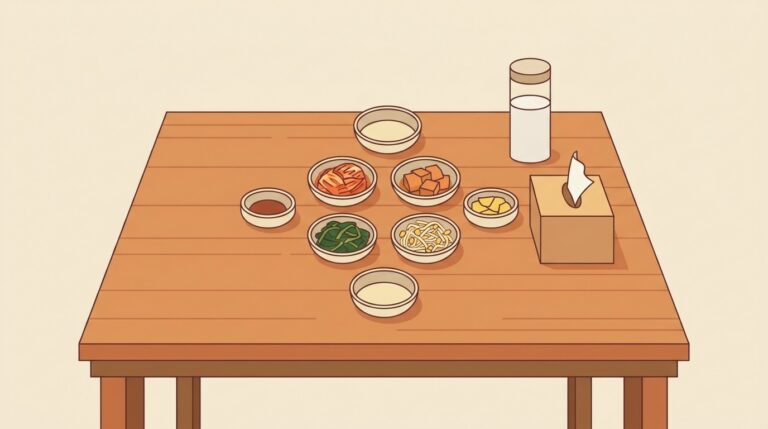
Imagine sitting at a bustling Seoul BBQ spot from your favorite K-Drama. The pork belly is sizzling, the spicy kimchi stew is bubbling, and suddenly, red sauce splashes right onto your sleeve! You look around frantically. Where are the napkins? Why is your water bottle empty? Many beginner learners freeze in this exact moment, worried about sounding rude or saying the wrong word. Based on real feedback from hundreds of our A1 students, this is the number one restaurant panic! Don’t worry, my friend. Today, you will master three effortless phrases to get napkins, water, and side dish refills like a local pro.
Phase 2: Deep Dive into 3 Core Expressions
1. 냅킨 좀 더 주세요 (Naepkin jom deo juseyo)
- Pronunciation: Naep-kin jom deo ju-se-yo (Think of “napkin” + “jome” like dome + “duh” + “juice-say-yo”)
- Meaning: Literally “Napkin a little more give please” -> “Please give me more napkins.”
- K-Culture Moment: Picture the messy mukbang scenes in Weightlifting Fairy Kim Bok-joo or Business Proposal, where characters devour spicy tteokbokki and desperately wave for more napkins!
- Editor’s Insight: The tiny word 좀 (jom) means “a little,” and it acts like magic dust in Korean. Asking without it can sound slightly demanding, while adding 좀 (jom) makes your request sound warm, soft, and polite!
- Situation Spectrum: Casual: ⚠️ (Use
줘/ jwo with close friends) | Semi-formal: ✅ (Perfect for all restaurants!) | Formal: ⚠️ (Use주시겠어요?/ jusigesseoyo in fine dining)- 🤔 Think About It: In English, we often say “Can I have…” focusing on what we get. In Korean, 주세요 (juseyo) means “please give,” focusing on the server’s kind action. How does this shift the feeling of a request?
2. 물 좀 주세요 (Mul jom juseyo)
- Pronunciation: Mool jom ju-se-yo (“Mool” like pool + “jom” like dome + “juice-say-yo”)
- Meaning: Literally “Water a little give please” -> “Please give me some water.”
- K-Culture Moment: In almost every K-Drama dinner scene, a cold water bottle hits the table first. When characters eat spicy food or get flustered on a blind date, they gulp it down and call for more!
- Editor’s Insight: Notice you don’t even need 더 (deo – more) if your table doesn’t have water yet! If you want a refill, you can easily add it: 물 좀 더 주세요 (Mul jom deo juseyo). Best of all, water is almost always free in Korea!
- Situation Spectrum: Casual: ⚠️ | Semi-formal: ✅ | Formal: ⚠️
- 🤔 Think About It: In many Western restaurants, you have to specify tap vs. sparkling water and pay for bottles. How does knowing water is free and communal change your dining experience in Korea?
3. 반찬 좀 더 주세요 (Banchan jom deo juseyo)
- Pronunciation: Bahn-chan jom deo ju-se-yo (“Bahn” like barn without the r + “chan” like chahn + “jom” + “duh” + “juice-say-yo”)
- Meaning: Literally “Side dishes a little more give please” -> “Please give me more side dishes.”
- K-Culture Moment: Remember the cozy family tables in Reply 1988 overflowing with colorful little plates of kimchi, pickled radish, and seasoned bean sprouts? Those little plates are 반찬 (banchan)!
- Editor’s Insight: If you only want one specific dish refilled, just point gently at the empty plate and say 이것 좀 더 주세요 (Igeot jom deo juseyo) (“Please give me more of this”)! Even at A1 level, pointing plus 주세요 (juseyo) makes you unstoppable.
- Situation Spectrum: Casual: ⚠️ | Semi-formal: ✅ | Formal: ⚠️
- 🤔 Think About It: In Korea, 반찬 (banchan) are placed in the middle for everyone to share and are refilled for free. How is this communal sharing different from ordering individual appetizers in your culture?
Phase 3: Textbook Korean vs. Real Korean
Situation 1: Getting the Server’s Attention
- 📖 Textbook Korean: 실례합니다, 여기 물 좀 주세요. (Sillyehamnida, yeogi mul jom juseyo. – Excuse me, please give water here.)
- 🗣️ Real Korean: 저기요! 물 좀 주세요. (Jeogiyo! Mul jom juseyo. – Excuse me over there! Water please.)
- 💡 Why the difference? 실례합니다 (Sillyehamnida) is mostly used when squeezing past someone on a crowded subway. In lively Korean restaurants, calling out 저기요! (Jeogiyo!) clearly and warmly is the natural, expected way to get service!
Situation 2: Asking for Napkins at a Local Diner
- 📖 Textbook Korean: 저는 냅킨을 더 원합니다. (Jeoneun naepkineul deo wonhamnida. – I want more napkins.)
- 🗣️ Real Korean: 휴지 좀 더 주세요! (Hyuji jom deo juseyo! – Please give me more tissues/napkins!)
- 💡 Why the difference? Textbooks love the verb 원하다 (wonhada – to want), which sounds robotic in daily conversation. Plus, Koreans very often call square paper restaurant napkins 휴지 (hyuji – tissue), so knowing both 냅킨 (naepkin) and 휴지 (hyuji) will make locals smile!
Phase 4: K-Culture Deep Dive & Non-Verbal Manners
4-1. Nunchi (눈치) & Gestures
- The Secret Table Drawer: Before calling anyone, peek right under the edge of your table! Many Korean restaurants hide spoons, chopsticks, and napkin boxes inside a pull-out drawer built into the table.
- The Call Bell & Gentle Wave: Look for a small round button on your table—that’s the 벨 (bel – call bell). Press it once, and someone will come right over! No bell? Raise one hand to shoulder height, make brief eye contact, and say 저기요! (Jeogiyo!) with a smile. Never snap your fingers or whistle.
4-2. Cultural Code Analysis: K-Food & Jeong (정)
Why are water and 반찬 (banchan) refilled for free? It all comes down to 정 (jeong)—a uniquely Korean feeling of warmth, generosity, and human connection. Feeding someone well is how Koreans show love! However, 눈치 (nunchi – social awareness) matters here too: only ask for refills you can actually finish, because leaving mountains of uneaten side dishes is frowned upon.
Phase 5: Real-Life Roleplay Scenario
Setting: A lively Samgyeopsal (Korean BBQ) restaurant in Hongdae. Smoke rises from the grill, K-Pop plays softly in the background, and your hands are sticky with sauce.
NPC: 이모님 (Imonim) — a warm-hearted, fast-moving auntie who runs the floor with motherly care.
- You: 🎭 Raises one hand gently and smiles. 저기요! (Jeogiyo!) — “Excuse me!”
- Imonim: 🎭 Walks over briskly holding a silver tray. 네, 손님! 뭐 필요하세요? (Ne, sonnim! Mwo piryohaseyo?) — “Yes, guest! What do you need?”
- You: 🎭 Points politely at the empty napkin box. 냅킨 좀 더 주세요. (Naepkin jom deo juseyo.) — “Please give me more napkins.”
- Imonim: 🎭 Places a fresh stack of napkins on your table. 여기 있어요! (Yeogi isseoyo!) — “Here you go!”
- You: 🎭 Smiles gratefully and points at the empty water bottle. 감사합니다! 그리고 물 좀 주세요. (Gamsahamnida! Geurigo mul jom juseyo.) — “Thank you! And please give me some water.”
- Imonim: 🎭 Points toward the corner of the room. 물은 셀프예요. 저기 정수기 있어요. (Mureun selpeuyeyo. Jeogi jeongsugi isseoyo.) — “Water is self-service. There’s a water purifier over there.”
- You: 🎭 Nods happily and points to your empty kimchi plate. 아, 네! 그럼 김치 반찬 좀 더 주세요. (A, ne! Geureom gimchi banchan jom deo juseyo.) — “Ah, okay! Then please give me more kimchi side dish.”
- Imonim: 🎭 Chuckles warmly. 네, 금방 갖다 드릴게요! (Ne, geumbang gatda deurilgeyo!) — “Sure, I’ll bring it right away!”
🔀 Interactive Branching Point
Imonim comes back and happily drops a generous extra plate of delicious kimchi in front of you! How do you respond?
* A: 감사합니다! 맛있게 먹겠습니다! (Gamsahamnida! Masitge meokgesseumnida!) — “Thank you! I will enjoy it!”
* B: 고마워! (Gomawo!) — “Thanks!” (Casual)
* C: 너무 많아요. 안 먹을래요. (Neomu manayo. An meogeullaeyo.) — “It’s too much. I won’t eat it.”
Feedback:
* Choice A (Best!): Gold-star manners! Saying 감사합니다 (Gamsahamnida) with enthusiasm will make Imonim’s day.
* Choice B (Risk!): 고마워 (Gomawo) is casual speech (반말, banmal) meant only for close friends or kids. Using it with an older server sounds rude!
* Choice C (Bad!): Saying you won’t eat it after it arrives feels harsh. If you want a small portion, ask beforehand: 조금만 주세요 (Jogeumman juseyo – Just a little, please)!
Phase 6: 10-Second Emotion Shadowing Drill
Read these aloud, pausing briefly at each / and matching the emotion!
[😊 Cheerfully and politely]저기요! / 냅킨 좀 / 더 주세요! (Jeogiyo! / Naepkin jom / deo juseyo!)[🥵 Desperately after spicy food]물 좀 / 주세요! / 물! (Mul jom / juseyo! / Mul!)[🥺 Politely with bright eyes]반찬 좀 / 더 / 주세요. (Banchan jom / deo / juseyo.)[😄 Warmly and gratefully]감사합니다! / 잘 먹겠습니다! (Gamsahamnida! / Jal meokgesseumnida!)
Phase 7: K-Culture Mini Dictionary
- 물 (Mul) | Water | Essential for survival at spicy Korean restaurants! Look for signs saying 물 (Mul) above self-service fridges.
- 반찬 (Banchan) | Side dishes | Complimentary small dishes served alongside rice and main courses. At Korean company dinners (회식, hoesik), junior staff often ask for 반찬 (banchan) refills to take care of seniors.
- 벨 (Bel) | Call bell | Borrowed from English “bell.” Pressing it saves your voice in noisy BBQ spots! Watch for signs saying 벨을 눌러주세요 (Bereul nulleojuseyo – Please press the bell).
- 셀프 (Selpeu) | Self-service | Short for “self.” If you see 물 셀프 (Mul selpeu) or 반찬 셀프 (Banchan selpeu), grab your own cup and head to the self-serve station!
Phase 8: Survival Kit for Travelers
Top 3 Survival Phrases
- 저기요! (Jeogiyo!) — Pro Tip: Your friendly magic wand to get any server’s attention.
- 이것 좀 더 주세요. (Igeot jom deo juseyo.) — Pro Tip: Forgot the name of a side dish? Just point politely and say “more of this, please!”
- 물 어디 있어요? (Mul eodi isseoyo?) — Pro Tip: Means “Where is the water?” Perfect when you suspect it’s self-service!
Editor’s Travel Note
Before your trip, be sure to download the Naver Map app for Korea navigation (since Google Maps walking directions don’t work well there) and install the Papago translation app to scan 셀프 (Selpeu) restaurant signs instantly with your camera. For payments, almost all restaurants accept international credit cards, while street food stalls prefer cash or Korean bank transfers—keep a little cash and a loaded T-money card in your wallet for subways and convenience stores!
Phase 9: One Step Deeper
In Korea, dining is deeply rooted in 우리 (uri – “we/our”) culture. When you sit down at a restaurant, shared 반찬 (banchan) plates and a shared water bottle remind everyone that a meal is better together. Calling out 저기요! (Jeogiyo!) isn’t seen as interrupting; it’s part of a lively, mutual rhythm between host and guest. Even if your pronunciation isn’t perfect yet, using a warm 주세요 (juseyo) shows respect for that shared table.
💬 Your Turn: Which Korean side dish (반찬, banchan) could you happily ask for three refills of? Tell us in the comments below!
Phase 10: FAQ & Common Mistakes
Q: Do I have to pay extra for napkins, water, or banchan refills?
A: No! In almost all Korean restaurants, water, napkins, and standard 반찬 (banchan) refills are completely free.
Q: Is it rude to say “Jeogiyo!” (저기요!) loudly in a restaurant?
A: Not at all! Korean restaurants are bustling and lively, so calling out 저기요! (Jeogiyo!) clearly with a friendly tone is normal and actually helpful to busy staff.
Q: What is the difference between “naepkin” (냅킨) and “hyuji” (휴지)?
A: 냅킨 (naepkin) means napkin, while 휴지 (hyuji) means tissue or toilet paper. In casual Korean diners, people very commonly use 휴지 (hyuji) for paper napkins too!
🚨 Common Mistakes TOP 3
- Mistake: Saying 고마워 (Gomawo) to the server. -> Correct Action: Always use 감사합니다 (Gamsahamnida) to stay polite!
- Mistake: Snapping your fingers or whistling to call someone. -> Correct Action: Press the table 벨 (bel) or raise one hand gently and say 저기요! (Jeogiyo!).
- Mistake: Asking servers for 반찬 (banchan) when there is a 셀프 바 (selpeu ba – self-serve bar) nearby. -> Correct Action: Glance around for 셀프 (selpeu) signs first!
Phase 11: Action Mission & Engagement
- 🥉 Bronze Mission: Say 냅킨 좀 더 주세요 (Naepkin jom deo juseyo) and 물 좀 주세요 (Mul jom juseyo) out loud five times right now!
- 🥈 Silver Mission: Snap a photo of your favorite Korean 반찬 (banchan) or share your favorite phrase from today on social media with
#DailyHangul. - 🥇 Gold Mission: Visit a local Korean restaurant this week and politely ask for a refill in Korean using 반찬 좀 더 주세요 (Banchan jom deo juseyo)!
- 🎮 K-Culture Mission: Watch an episode of Hospital Playlist or Let’s Eat and listen closely during restaurant scenes—can you catch the actors shouting 저기요! (Jeogiyo!) or asking for 물 (mul)?
Phase 12: Interactive Quiz Challenge
1. Situation Judgment: You dropped your kimchi and need more napkins. Which phrase is the warmest and most natural?
A) 냅킨 줘! (Naepkin jwo!)
B) 냅킨 좀 더 주세요. (Naepkin jom deo juseyo.)
C) 나는 냅킨을 원한다. (Naneun naepkineul wonhanda.)
Check Answer & Explanation
Correct Answer: B!
Using 좀 (jom) and 주세요 (juseyo) makes your request polite and natural. Option A is too casual for a restaurant server, and Option C sounds like a stiff textbook!
2. Fill in the Blank: Your water bottle is empty! What word goes in the blank?
____ 좀 주세요. (____ jom juseyo. – Please give me some water.)
Check Answer & Explanation
Correct Answer: 물 (Mul)!
물 좀 주세요 (Mul jom juseyo) is your go-to phrase for getting water at any Korean restaurant.
3. True or False: In Korea, you can check under the edge of the dining table in a drawer to find napkins and spoons.
Check Answer & Explanation
Correct Answer: True!
Many Korean restaurants keep spoons, chopsticks, and napkin boxes tucked neatly inside a pull-out drawer right under the table!
🎬 Watch Our Daily Videos! (Daily Hangul Official Instagram)
Review the expressions you learned in this article with our fun daily short videos! Check out native pronunciation and real-life nuances in action.
- Instagram @dailyhangul_en







