

Phase 1: The Delicious Shock of Korean Dining
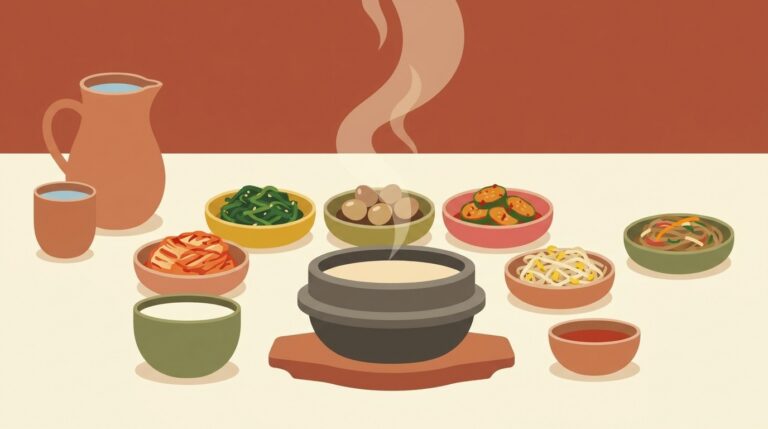
안녕하세요! 매일한글 에디터입니다. (Annyeonghaseyo! Hello from your Daily Hangul Editor!) Imagine sitting at a buzzing Seoul BBQ spot, watching sizzling pork belly hit the grill while your table disappears under ten tiny bowls of kimchi, pickled radish, and seasoned spinach. Twenty minutes later, your bowls are empty, and you freeze—worried that asking for more will double your bill! Then the smiling server sweeps by and refills everything without charging a single won. That jaw-dropping generosity is one of the biggest cultural shocks of living in Korea. Crafted from real feedback by expats and students who hesitated at first, this B1 guide gives you the exact phrases to ask for refills gracefully and share your amazement with Korean friends like a true local.
Phase 2: Deep Dive into 3 Essential Expressions
1. 여기 반찬 좀 더 주시겠어요? (Yeogi banchan jom deo jusigesseoyo?)
- Pronunciation: Yeogi banchan jom deo jusigesseoyo? (Think “yuh-gi” like “young”, “juh”/”deo” like “duh” in “duck”, and “ge-sseo-yo” like “guess-uh-yo”)
- Meaning: Literal: “Will you please give a little more side dishes here?” / Nuance: “Excuse me, could we get a little more banchan?” Adding 좀 (jom, a little) softens the request so it never sounds demanding.
- K-Culture Moment: Picture the hungry hospital squad in Hospital Playlist pausing mid-conversation over sizzling samgyeopsal as one of them casually flags down the server for extra garlic and lettuce wraps.
- Editor’s Insight: At B1 level, switching from basic 주세요 (juseyo) to -주시겠어요? (jusigesseoyo?) instantly elevates your politeness. Adding 좀 (jom) acts like a conversational cushion—Koreans love this gentle softener!
- Situation Spectrum: Casual 🚫 | Semi-formal ✅ | Formal ✅
- 🤔 Think About It: In your native language, do you say “a little more” even when you actually want a full bowl? Notice how Korean speakers downsize requests with 좀 (jom) to show humility and respect for the server’s effort.
2. 이게 다 무료라는 게 믿기지 않아요! (Ige da muryoraneun ge mitgiji anayo!)
- Pronunciation: Ige da muryoraneun ge mitgiji anayo! (Think “moo-ryoh” like a cow’s “moo” + “ryo”, and “mit-gi-ji” with a soft stop before “gi”)
- Meaning: Literal: “The fact that all of this is free is unbelievable!” / Nuance: “I still can’t believe all of this is on the house!” Perfect for expressing genuine cultural amazement.
- K-Culture Moment: Think of variety shows like Welcome, First Time in Korea? where foreign guests’ eyes go wide as water pitchers and endless side dishes arrive without appearing on the receipt.
- Editor’s Insight: Using the quoting-fact ending -라는 게 (-raneun ge, “the fact that…”) paired with 믿기지 않다 (mitgiji anta, “unbelievable”) helps you move past simple adjectives like “good” and articulate complex cultural surprises naturally.
- Situation Spectrum: Casual ⚠️ (drop 요) | Semi-formal ✅ | Formal ✅
- 🤔 Think About It: In many Western countries, tap water might be free, yet bread baskets, sauces, or extra pickles often cost extra. How does getting unlimited free extras change how welcome you feel as a guest?
3. 한국 식당은 인심이 정말 후한 것 같아요. (Hanguk sikdangeun insimi jeongmal huhan geot gatayo.)
- Pronunciation: Hanguk sikdangeun insimi jeongmal huhan geot gatayo. (Think “sik-dang” like “sick-dahng”, “jeong-mal” like “juhng-mahl”, and “hu-han” like “who-hahn”)
- Meaning: Literal: “It seems Korean restaurants’ human-heartedness is really thick/generous.” / Nuance: “Korean restaurants really have such generous hospitality.”
- K-Culture Moment: Just like the warm-hearted neighborhood restaurant owners in K-Dramas such as Reply 1988, piling extra food onto a customer’s plate is a classic display of warmth.
- Editor’s Insight: 인심 (insim) is a culturally loaded B1+ gem referring to a person’s generosity and goodwill. Pairing it with 후하다 (huhada, generous/ample) makes Korean listeners genuinely impressed by your cultural fluency!
- Situation Spectrum: Casual ⚠️ | Semi-formal ✅ | Formal ✅
- 🤔 Think About It: Does your language have a single word that connects “goodness of heart” specifically with giving plenty of food? Why do you think food generosity is tied so closely to moral warmth in Korea?
Phase 3: Textbook Korean vs. Real Korean
Situation 1: Asking for a Kimchi Refill at a Busy Diner
- 📖 교과서 한국어 (Textbook Korean): 실례지만, 김치를 조금 더 받을 수 있습니까? (Sillyejiman, gimchireul jogeum deo badeul su itseumnikka?) – “Excuse me, may I receive a little more kimchi?”
- 🗣️ 진짜 한국어 (Real Korean): 이모님, 여기 김치 리필 좀 해주세요! (Imonim, yeogi gimchi ripil jom haejuseyo!) – “Auntie, could we get a kimchi refill over here, please!”
- 💡 왜 다를까? (Why is it different?): Calling an older female server 이모님 (Imonim, auntie) or the owner 사장님 (Sajangnim, boss) creates warm rapport, and using the loanword 리필 (ripil, refill) is everyday restaurant lingo.
Situation 2: Sharing Your Shock About Free Water & Sides with Friends
- 📖 교과서 한국어 (Textbook Korean): 한국 식당에서는 물과 반찬이 무료여서 매우 놀랐습니다. (Hanguk sikdangeseoneun mulgwa banchani muryoyeoseo maeu nollatseumnida.) – “I was very surprised because water and side dishes are free at Korean restaurants.”
- 🗣️ 진짜 한국어 (Real Korean): 와, 한국은 물이랑 반찬이 다 공짜라니 대박이네요! (Wa, Hangugeun murirang banchani da gongjjarani daebagineyo!) – “Whoa, the fact that water and side dishes are all free in Korea is amazing!”
- 💡 왜 다를까? (Why is it different?): While 무료 (muryo) sounds official like a flyer, 공짜 (gongjja, freebie) feels lively and conversational, and -라니 (-rani) captures real-time emotional astonishment.
Phase 4: K-Culture Deep Dive & Non-Verbal Manners
4-1. 눈치 (Nunchi) & Table Gestures
Even when refills are unlimited, great 눈치 (nunchi, social awareness) makes you a beloved guest:
* Scan for the 셀프 코너 (selpeu koneo, self-serve bar) first: Before waving down busy staff, glance around the dining room. Many casual spots have a stainless-steel station where you can freely grab extra kimchi, pickled radish, and cold water yourself.
* Use the table bell, not loud shouting: If there’s a small button on the corner of your table, press it once and wait patiently. If there’s no bell, make brief eye contact, raise one hand slightly to shoulder height, and say 저기요! (Jeogiyo!, Excuse me!).
* Respect the zero-waste rule: Refills are free, not disposable. Leaving piles of untouched banchan triggers Korean guilt over 음식물 쓰레기 (eumsingmul sseuregi, food waste), so only ask for what you can happily finish.
4-2. Cultural Code: K-Food & K-Drama Hospitality
Why do Korean restaurants keep bringing out endless small dishes? In K-Food culture, a meal isn’t complete unless the table feels abundant—a concept tied to 정 (jeong, deep affection) and 인심 (insim, generosity). In K-Dramas like Let’s Eat or Extraordinary Attorney Woo, characters bond over bustling tables overflowing with side dishes. For Koreans, letting a guest leave hungry—or charging for a splash of water—feels stingy. Accepting refills with a bright smile and finishing your plate is the highest compliment you can give the kitchen!
Phase 5: Real-Life Roleplay Scenario
- Setting: A cozy, steamy galbi-jjim (braised beef short ribs) restaurant in Hongdae on a Friday night. You are eating with your Korean friend Minji, and a warm-hearted owner (사장님, Sajangnim) runs the floor.
- You: 민지 씨, 여기 진짜 맛있는데 반찬도 벌써 다 먹었어요. (Minji ssi, yeogi jinjjja masitneunde banjando beolsseo da meogeosseoyo.) – “Minji, it’s so good here, and we already ate all the side dishes.”
🎭 Looking sheepishly at the empty tiny bowls - Minji: 그럼 더 달라고 해요! 여기 반찬 무한 리필이에요. (Geureom deo dallago haeyo! Yeogi banchan muhan ripirieyo.) – “Then let’s ask for more! Side dishes are unlimited refills here.”
🎭 Smiling reassuringly and nodding toward the counter - You: 정말요? 물이랑 반찬이 다 공짜라니 아직도 신기해요! (Jeongmallyo? Murirang banchani da gongjjarani ajikdo singihaeyo!) – “Really? It’s still amazing to me that water and side dishes are all free!”
🎭 Widening your eyes in genuine surprise - Minji: 한국 식당은 원래 그렇죠. 사장님 불러 볼래요? (Hanguk sikdangeun wollae geureojyo. Sajangnim bulleo bollaeyo?) – “Korean restaurants are just like that. Want to try calling the owner?”
🎭 Gesturing playfully toward the call bell - You: 네! 저기요, 사장님! 여기 어묵볶음이랑 물 좀 더 주시겠어요? (Ne! Jeogiyo, Sajangnim! Yeogi eomukbokkeumirang mul jom deo jusigesseoyo?) – “Yes! Excuse me, owner! Could we get a bit more stir-fried fish cake and water here?”
🎭 Raising one hand politely and making eye contact - Sajangnim: 아유, 잘 드시네! 지금 바로 많이 갖다 드릴게요. (Ayu, jal deusine! Jigeum baro mani gatda deurilgeyo.) – “Oh my, you eat so well! I’ll bring plenty right away.”
🎭 Beaming warmly while clearing the empty plates - You: 감사합니다! 한국 식당은 인심이 정말 후한 것 같아요. (Gamsahamnida! Hanguk sikdangeun insimi jeongmal huhan geot gatayo.) – “Thank you! Korean restaurants really seem so generous.”
🎭 Giving a slight seated bow with both hands near the table - Sajangnim: 맛있게 드시고 부족하면 또 말씀하세요! (Masitge deusigo bujokamyeon tto malsseumhaseyo!) – “Enjoy your meal, and let me know if you need more!”
🎭 Setting down a generously heaped plate of fish cakes and a frosty water bottle
🔀 Interactive Branching Point: What Do You Do Next?
You just spotted a sign on the wall saying “반찬은 셀프입니다 (Side dishes are self-serve)” right after Sajangnim walks away, and you still want more kimchi.
* A) Stand up, grab a clean tongs/plate at the self-serve bar, take just enough kimchi, and smile at Sajangnim on your way back.
* B) Press the bell three times rapidly and ask Sajangnim to bring kimchi anyway because you’re feeling lazy.
* C) Leave your seat, scoop a mountain of kimchi onto your plate, and end up leaving half of it untouched.
Feedback:
* Choice A (Best!): 10/10 nunchi! Using the 셀프 코너 (selpeu koneo) when marked shows local-level awareness and respect for busy staff.
* Choice B (Bad!): Pressing the bell repeatedly after seeing a self-serve sign comes across as inconsiderate. In Korea, self-serve signs mean the kitchen is trusting you to help yourself!
* Choice C (Risk!): Taking way too much and wasting it is a big dining taboo in Korea. Some restaurants even post signs warning of a fine for leftover self-serve food to protect the environment.
Phase 6: 10-Second Emotional Shadowing Drill
Read these aloud, pausing briefly at / and matching the emotional cue:
[😊 Cheerfully & warmly]저기요, / 여기 반찬 좀 / 더 주시겠어요? (Jeogiyo, / yeogi banchan jom / deo jusigesseoyo? – Excuse me, could we get a little more banchan here?)[😲 Amazed & delighted]이게 다 무료라는 게 / 믿기지 않아요! (Ige da muryoraneun ge / mitgiji anayo! – I can’t believe all of this is free!)[🥰 Grateful & impressed]한국 식당은 / 인심이 정말 / 후한 것 같아요. (Hanguk sikdangeun / insimi jeongmal / huhan geot gatayo. – Korean restaurants seem to have such generous hospitality.)
Phase 7: K-Culture Mini Dictionary
- 밑반찬 (mitbanchan) | Basic side dishes | The pre-made staple dishes (like kimchi, bean sprouts, or fish cakes) served free with every meal. In daily life and company dinners (회식, hoesik), good 밑반찬 often decides whether coworkers pick a restaurant again.
- 인심 (insim) | Generosity / Goodwill | Warmth of heart shown through giving generously. Used when praising a neighborhood market vendor who throws in extra fruit (덤, deom) or a restaurant piling up portions.
- 셀프 코너 (selpeu koneo) | Self-serve corner | The station in casual eateries where diners refill water, cups, aprons, and banchan themselves—essential vocabulary for solo diners and budget travelers.
- 무한 리필 (muhan ripil) | Unlimited refills | Often seen on neon signs outside K-BBQ, tteokbokki, or salad buffets meaning “all-you-can-eat” for a fixed price.
Phase 8: Survival Kit for Travelers
Top 3 Survival Phrases
- 물 좀 주세요. (Mul jom juseyo.) – “Water, please.” Pro Tip: Most Korean diners serve chilled barley tea or ice water in a plastic pitcher; if your table is empty, check the self-serve water purifier (정수기, jeongsugi).
- 셀프예요? (Selpeuyeyo?) – “Is it self-serve?” Pro Tip: Point toward the side dish station or water cooler when asking—short, natural, and saves awkwardness.
- 여기 리필 되나요? (Yeogi ripil doenayo?) – “Can we get a refill here?” Pro Tip: Great for specialty items like meat, noodles, or extra cheese where you’re unsure if refills are free or paid.
Editor’s Travel Note
Before heading out to explore hidden alley restaurants in Seoul or Busan, make sure to Download the Naver Map App for Accurate Korean Restaurant Reviews and check photo menus in advance! Unlike some global map apps, Naver Map shows whether a restaurant has a self-serve bar, real local ratings, and wait times. Also, remember that most Korean restaurants don’t expect tips—your polite “잘 먹었습니다! (Jal meogeotseumnida! – Thank you for the meal!)” on the way out is the best tip you can give, and paying at the front counter (카운터, kaunteo) with a Korean transit card or credit card is seamless.
Phase 9: Go One Step Deeper
In Korea, sharing food isn’t just a business transaction—it is a quiet philosophy of community. Historically, Koreans greeted neighbors by asking “밥 먹었어요? (Bap meogeosseoyo? – Have you eaten?)” because caring for someone meant making sure their stomach was full. That spirit lives on in today’s restaurants: offering free cold water on a humid summer day and refilling kimchi without counting pennies reflects 정 (jeong), an unspoken bond between host and guest. Even in fast-paced Seoul, that small bowl of free banchan whispers, “You’re welcome here—eat until you’re full.”
💬 Your Turn: What was the biggest cultural shock you experienced at a Korean restaurant—or what’s your favorite free banchan to refill? Drop a comment below and tell us your story!
Phase 10: FAQ & Common Mistakes
Q: Are ALL side dishes and water always 100% free to refill in Korea?
A: Standard 밑반찬 (mitbanchan) and regular water are almost always free to refill. However, special items like steamed egg (계란찜, gyeranjjim), extra cheese, or bottled mineral water/sparkling water usually cost extra, so checking “이것도 무료예요? (Igeotdo muryoyeyo? – Is this free too?)” is a smart move!
Q: Do I need to leave a tip if the server refills our dishes many times?
A: No! Korea has a no-tipping culture. Leaving cash on the table might actually confuse the staff, who may chase you down the street thinking you forgot your money. A warm smile and “잘 먹었습니다! (Jal meogeotseumnida!)” is all they expect.
Q: Can I take leftover free banchan home in a takeout box?
A: Usually no. Unlimited free refills are meant to be enjoyed at the table during your meal, not packed to go (포장, pojang), unless you paid specifically for extra side dishes.
🚨 Common Mistakes TOP 3
- Calling the server “아가씨 (Agassi)” or “아줌마 (Ajumma)” casually: These can sound rude or overly blunt to strangers. Correct Action: Use 저기요 (Jeogiyo, Excuse me), 사장님 (Sajangnim, Boss/Owner), or warm-hearted 이모님 (Imonim, Auntie) in casual diners.
- Waving with a downward palm or snapping fingers: Snapping fingers is considered very disrespectful. Correct Action: Raise your open hand gently with palm facing forward or press the table bell once.
- Forgetting to check for a self-serve bar before asking: Waiting impatiently while everyone else walks to the fridge can slow things down. Correct Action: Look for a “셀프 (SELF)” sign near the kitchen first!
Phase 11: Action Mission & Engagement
- 🥉 Bronze Mission (Solo Practice): Stand in front of the mirror and practice all 3 Phase 2 phrases smoothly three times, making sure to soften your voice on 좀 (jom) and sound genuinely amazed on 믿기지 않아요 (mitgiji anayo)!
- 🥈 Silver Mission (Share Online): Post a photo of your favorite Korean meal or banchan spread on social media with the caption: “한국 식당은 인심이 정말 후한 것 같아요! (Hanguk sikdangeun insimi jeongmal huhan geot gatayo!)” and tag Daily Hangul.
- 🥇 Gold Mission (Real-World Use): Next time you visit a Korean restaurant—in Korea or in your hometown—politely ask for a side dish refill using 여기 반찬 좀 더 주시겠어요? (Yeogi banchan jom deo jusigesseoyo?)!
🎮 K-Culture Mission: Watch any food-centered scene in a K-Drama (like Hospital Playlist, Business Proposal, or Bon Appétit) and spot how many tiny banchan bowls are on the table—and listen closely when a character calls out 저기요! (Jeogiyo!) or 사장님! (Sajangnim!).
Phase 12: Interactive Quiz Challenge
1. Situational Judgment: You’re at a casual kimchi-jjigae spot, and your kimchi bowl is empty. You notice a stainless-steel station labeled “반찬 셀프” next to the water cooler. What is the best move?
A) Press the table bell repeatedly until the chef comes out.
B) Walk over to the station, take only as much kimchi as you’ll finish, and return to your seat.
C) Shout “아줌마, 리필!” across the restaurant.
Check Answer & Explanation
Correct Answer: B! “반찬 셀프” means side dishes are self-serve. Taking only what you can eat respects both the staff’s time and Korea’s food-waste etiquette.
2. Fill-in-the-Blank: Complete the B1 phrase to express cultural amazement naturally:
“이게 다 ______ 믿기지 않아요!” (I can’t believe all of this is free!)
A) 무료라는 게 (muryoraneun ge)
B) 비싸다는 게 (bissadaneun ge)
C) 셀프라는 게 (selpeuraneun ge)
Check Answer & Explanation
Correct Answer: A) 무료라는 게 (muryoraneun ge)! Combining 무료 (free) with -라는 게 (the fact that…) gives you a natural B1 sentence structure.
3. True or False Culture Quiz:
True or False: In Korea, if the server generously refills your banchan three times, it is polite to leave a 15% cash tip on the table before leaving.
Check Answer & Explanation
Correct Answer: False! Korea does not have a tipping culture. Leaving cash might make the server think you dropped your money! Saying “잘 먹었습니다! (Jal meogeotseumnida!)” is the perfect thank-you.
🎬 Watch Our Daily Videos! (Daily Hangul Official Instagram)
Review the expressions you learned in this article with our fun daily short videos! Check out native pronunciation and real-life nuances in action.
- Instagram @dailyhangul_en







