

Phase 1: The Hongdae Cafe Debate
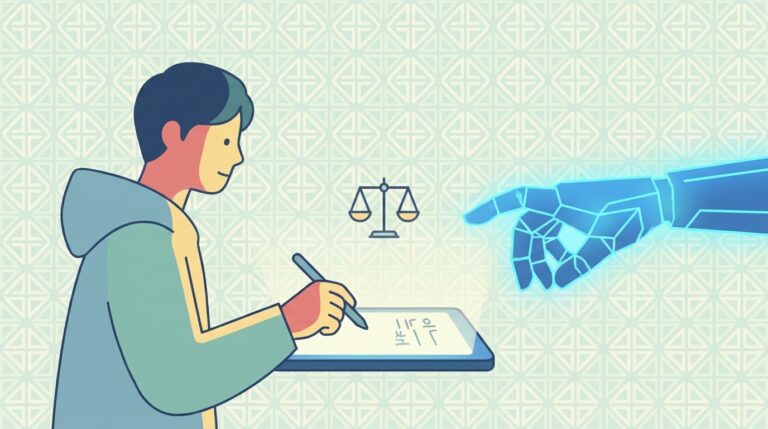
안녕하세요! 매일한글 에디터입니다. (Annyeonghaseyo! Maeil Hangeul editeoimnida. – Hello! I am the Daily Hangul editor.) Last week, I grabbed iced Americanos in Hongdae with a webtoon artist friend who looked completely drained. Someone had fed her distinct illustration style into a generative AI model without asking, sparking a heated cafe debate over technology versus creators’ rights. Many advanced learners tell us that while they handle casual K-drama chats easily, they freeze when Korean news shifts to legal clashes over AI training data and fair use. Honestly, even I needed a second espresso before untangling Korean legal jargon! Based on real learner feedback, this C1 guide equips you with sharp, nuanced expressions to debate copyright and innovation like a native.
Phase 2: Deep Dive into 3 Essential C1 Expressions
1. 공정 이용에 해당하다 (Gongjeong iyong-e haedanghada)
- Pronunciation: Gong-jeong i-yong-e hae-dang-ha-da (Think of gong like a temple gong, jeong like jung in jungle, and hae-dang like “hey, dang!”)
- Meaning: Literally “to correspond to fair use.” In practice, it is the core legal defense used by tech companies arguing that AI training on copyrighted works is legally permissible.
- K-Culture Moment: Picture a tense TV panel on JTBC Newsroom where an AI startup CEO calmly defends scraping Korean news articles and webtoons by claiming it is transformative learning.
- Editor’s Insight: At the C1 level, simply saying “법적으로 괜찮아요 (beopjeogeuro gwaenchanayo – It’s legally okay)” sounds too vague. Using ~에 해당하다 (~e haedanghada) instantly elevates your register to courtroom or boardroom precision.
- Situation Spectrum: Casual 🚫 | Semi-formal ⚠️ | Formal ✅
- 🤔 Think About It: In English, “fair use” sounds somewhat conversational, whereas Korean 공정 이용 (gongjeong iyong) feels distinctly institutional and balance-focused. How does your native language frame the balance between individual ownership and public progress?
2. 창작자의 권익을 침해하다 (Changjakjaui gwonigeul chimhaehada)
- Pronunciation: Chang-jak-ja-ui gwon-ig-eul chim-hae-ha-da (Imagine chim-hae sounding like “cheem-hey,” sharp and serious)
- Meaning: Literally “to invade the rights and interests of a creator.” Nuance: It carries moral outrage, not just a dry legal violation.
- K-Culture Moment: Imagine indie K-pop producers and webtoon illustrators holding a joint press conference in front of the National Assembly, demanding protection against unauthorized AI voice covers and style cloning.
- Editor’s Insight: Notice the word 권익 (gwonik)—a combination of 권리 (rights) and 이익 (interests/profits). Korean debates heavily emphasize livelihood alongside moral authorship, making this much stronger than simply saying 침해하다 (to infringe).
- Situation Spectrum: Casual 🚫 | Semi-formal ✅ | Formal ✅
- 🤔 Think About It: Korean distinguishes sharply between 저작인격권 (moral rights) and 저작재산권 (economic rights). Does your culture treat copying an artist’s signature style as theft, or as flattery?
3. 정면으로 충돌하다 (Jeongmyeoneuro chungdolhada)
- Pronunciation: Jeong-myeon-eu-ro chung-dol-ha-da (Chung-dol sounds a bit like “choong-doll” colliding head-on)
- Meaning: Literally “to collide head-on.” Nuance: Used when two irreconcilable principles—like AI innovation and copyright protection—leave zero room for easy compromise.
- K-Culture Moment: A sharp business podcast host summarizing why Korean media conglomerates are suing generative AI platforms instead of signing quiet licensing deals.
- Editor’s Insight: You can pair this with nouns like 이해관계 (ihaegwangye – conflicting interests) or 가치관 (gachigwan – values) to sound like an insightful Korean editorial columnist.
- Situation Spectrum: Casual ⚠️ | Semi-formal ✅ | Formal ✅
- 🤔 Think About It: Korean journalism loves vivid physical metaphors like 정면충돌 (head-on crash) or 평행선을 달리다 (running on parallel lines) for deadlocks. What physical metaphors does your language use for legal stalemates?
Phase 3: Textbook Korean vs. Real Korean
Situation 1: Describing unauthorized AI scraping
- 📖 교과서 한국어 (Textbook Korean): 인공지능이 허락 없이 제 작품을 학습 데이터로 사용했습니다. (Ingongjineungi heorak eopsi je jakpumeul hakseup deiteoro sayonghaetseumnida. – The AI used my work as training data without permission.)
- 🗣️ 진짜 한국어 (Real Korean): AI가 내 그림체를 통째로 긁어가서 복붙 수준으로 뽑아내더라고요. (AI-ga nae geurimche-reul tongjjaero geulgeo-gaseo bokbut sujuneuro ppobanaedeoragoyo. – The AI scraped my art style whole and churned out copy-paste level stuff.)
- 💡 왜 다를까? (Why is it different?): Even fluent C1 speakers sound stiff when relying only on Sino-Korean nouns like 허락 없이 (without permission). Native creators use vivid native Korean verbs like 긁어가다 (geulgeogada – to scrape/rake away) and internet slang 복붙 (bokbut – copy-paste) to express frustration naturally.
Situation 2: Pointing out that laws lag behind technology
- 📖 교과서 한국어 (Textbook Korean): 현행 저작권법은 기술 발전 속도를 따라가지 못하고 있습니다. (Hyeonhaeng jeojakgwonbeobeun gisul baljeon sokdoreul ttaragaji mothago itseumnida. – Current copyright law cannot keep up with the pace of technological development.)
- 🗣️ 진짜 한국어 (Real Korean): 기술은 저만큼 앞서가는데 법이 한참 엇박자가 나고 있죠. (Gisureun jeomankeum apseoganeunde beobi hancham eotbakjaga nago itjyo. – Tech is running way ahead, while the law is completely out of sync.)
- 💡 왜 다를까? (Why is it different?): 엇박자 (eotbakja) literally means an off-beat rhythm in music! Using rhythmic or idiomatic metaphors in C1 discussions makes your Korean feel effortlessly persuasive rather than robotic.
Phase 4: K-Culture Deep Dive & Non-Verbal Manners
4-1. Nunchi (눈치) & Debate Etiquette
When discussing heated issues like AI copyright in Korea—especially in a Pangyo tech meetup or creative studio—body language matters just as much as vocabulary. Avoid aggressive finger-pointing or interrupting mid-sentence, which breaks 눈치 (nunchi – social awareness). Instead, maintain calm eye contact, tilt your head slightly, and nod slowly while the other person finishes. Before countering, soften your disagreement with a validating bridge like “그 우려는 충분히 공감하지만… (Geu uryeoneun chungbunhi gonggamhajiman… – I fully empathize with that concern, however…)”. This signals intellectual maturity rather than hostility.
4-2. Cultural Code Analysis: K-Webtoon & K-Pop on the Frontlines
In South Korea, this debate is not abstract theory—it hits two massive cultural export engines head-on. In the K-Webtoon industry, major platforms faced intense reader boycotts (별점 테러 – star-rating backlash) when certain series were suspected of using generative AI trained on existing artists’ brushstrokes without consent. Meanwhile, in K-Pop, hyper-realistic AI voice covers of famous idol vocalists went viral on YouTube, prompting the Korea Music Copyright Association (한국음악저작권협회) and entertainment agencies to push for stricter regulations on voice cloning and 퍼블리시티권 (peobeullisitigwon – right of publicity). For Koreans, protecting art isn’t just about money; it’s about protecting the grueling human sweat (땀과 노력) behind every hit webtoon and song.
Phase 5: Real-Life Roleplay Scenario
Setting: A sunlit specialty coffee shop in Pangyo Techno Valley (Korea’s Silicon Valley). Rain taps softly against the glass while a laptop hums on the wooden table.
Characters: Min-jun (an ambitious AI startup Product Manager) and Ji-eun (an exhausted indie webtoon illustrator), discussing a new AI image model over lunch.
- Min-jun: 🎭 Leaning forward enthusiastically, tapping his tablet 지은 씨, 솔직히 생성형 AI 학습을 일일이 막으면 국내 기술 경쟁력이 뒤처지지 않을까요? (Jieun ssi, soljikhi saengseonghyeong AI hakseubeul illiri mageumyeon gungnae gisul gyeongjaengnyeogi dwicheojiji aneulkkayo? – Ji-eun, honestly, if we block generative AI training case by case, won’t domestic tech competitiveness fall behind?)
- Ji-eun: 🎭 Setting her iced tea down firmly, maintaining steady eye contact 민준 씨 말도 이해는 해요. 하지만 웹툰이나 뉴스를 무단으로 학습하는 건 명백한 창작자 권익 침해예요. (Minjun ssi maldo ihaeneun haeyo. Hajiman weptunina nyuseureul mudaneuro hakseupaneun geon myeongbaekhan changjakja gwonik chimhaeyeyo. – I understand your point, Min-jun. However, training on webtoons or news without authorization is a clear infringement of creators’ rights.)
- Min-jun: 🎭 Raising both hands gently in a conciliatory gesture AI가 작품을 그대로 복제하는 게 아니라 패턴만 추출하는 거라면, 공정 이용에 해당한다고 볼 여지도 있지 않을까요? (AI-ga jakpumeul geudaero bokjehaneun ge anira paeteonman chuchulhaneun georamyeon, gongjeong iyong-e haedanghandago bol yeojido itji aneulkkayo? – If AI isn’t copying the work verbatim and only extracts patterns, isn’t there room to view it as fair use?)
- Ji-eun: 🎭 Sighing softly, looking slightly frustrated 그 ‘패턴’이라는 게 결국 수많은 작가들이 수년간 갈아 넣은 화풍과 개성이거든요. 원저작자 동의 없는 대량 수집은 납득하기 어려워요. (Geu ‘paeteon’iraneun ge gyeolguk sumanheun jakgadeuri sunyeongan gara neoheun hwapunggwa gaeseongigeodeunyo. Wonjeojakja dongui eomneun daeryang sujibeun napdeukhagi eoryeowoyo. – Those ‘patterns’ are ultimately the style and individuality countless artists poured years of effort into. Mass collection without the original author’s consent is hard to accept.)
- Min-jun: 🎭 Nodding slowly, pausing to think 그렇죠, 창작 생태계가 무너지면 AI가 학습할 양질의 데이터 자체도 사라질 테니까요. (Geureochyo, changjak saengtaegyega muneojimyeon AI-ga hakseupal yangjirui deiteo jachedo sarajil tenikkayo. – True, because if the creative ecosystem collapses, the high-quality data for AI to learn from will disappear too.)
- Ji-eun: 🎭 Softening her tone slightly 맞아요. 기술 혁신과 저작권 보호가 정면으로 충돌하고 있는 지금이야말로 명확한 보상 체계가 필요해요. (Majayo. Gisul hyeoksingwa jeojakgwon bohoga jeongmyeoneuro chungdolhago inneun jigeumiyamallo myeonghwakhan bosang chegyega piryohaeyo. – Exactly. Right now, when tech innovation and copyright protection are clashing head-on, we desperately need a clear compensation system.)
- Min-jun: 🎭 Jotting a quick note on his tablet 그럼 데이터 제공자에게 수익을 배분하거나, 학습 거부를 선택할 수 있는 옵트아웃 제도를 도입하는 건 어떻게 보세요? (Geureom deiteo jegongjaege suigeul baebunhageona, hakseup geobureul seontaekhal su inneun opteuaut jedoreul doipaneun geon eotteoke boseyo? – Then how do you view introducing revenue-sharing for data providers or an opt-out system to decline training?)
- Ji-eun: 🎭 Smiling slightly for the first time 옵트아웃보다는 사전에 동의를 구하는 옵트인 방식이 원칙에 맞지만, 그런 대화부터 시작하는 게 중요하죠. (Opteuautbodaneun sajeone donguireul guhaneun opteuin bangsigi wonchige matjiman, geureon daehwabuteo sijakhaneun ge jungyohajyo. – An opt-in model seeking prior consent fits the principle better than opt-out, though starting that conversation is what matters.)
🔀 Interactive Branching Point: It’s Your Turn!
You’re sitting right next to them as a bilingual K-media consultant. Min-jun turns and asks your opinion. How do you respond?
- Option A: “기술 발전을 위해 어쩔 수 없으니 작가들이 그냥 양보해야죠.” (Gisul baljeoneul wihae eojjeol su eopseuni jakgadeuri geunyang yangbohaeyajyo. – Creators should just give in since it’s unavoidable for tech progress.)
- Option B: “저도 양측 입장이 팽팽히 맞서는 만큼, 투명한 데이터 출처 공개와 정당한 라이선스 계약이 절충안이라고 봅니다.” (Jeodo yangcheuk ipjangi paengpaenghi matseoneun mankeum, tumyeonghan deiteo chulcheo gonggaewa jeongdanghan raiseonseu gyeyagi jeolchunganirago bomnida. – Since both sides are tightly deadlocked, I see transparent data disclosure and fair licensing deals as the compromise.)
- Option C: “법은 모르겠고, AI 그림이 훨씬 싸고 빠르니까 무조건 좋은 거 아닌가요?” (Beobeun moreugetgo, AI geurimi hwolssin ssago ppareunikka mujogeon joheun geo aningayo? – I don’t know the law, isn’t AI art automatically better since it’s way cheaper and faster?)
Feedback:
* Option A (Bad): Too dismissive of creators’ livelihoods. In Korea’s tight-knit creative circles, saying artists should “just give in” destroys rapport instantly.
* Option B (Best!): Absolute C1 gold! Using 팽팽히 맞서다 (tightly deadlocked) and 절충안 (compromise) shows balanced critical thinking and high-level diplomacy.
* Option C (Risk): Provocative and overly simplistic. While cost efficiency is a real business factor, ignoring legal ethics in front of an artist will freeze the entire table!
Phase 6: 10-Second Emotion Shadowing Drill
Read aloud using the / marks as micro-pauses for dramatic rhythm:
[😤 단호하고 진지하게 (Firmly and seriously)]
원저작자의 동의 없는 / 무단 학습은 / 명백한 권리 침해입니다.
(Wonjeojakjaui dongui eomneun / mudan hakseubeun / myeongbaekhan gwolli chimhaeimnida. – Unauthorized training without the original author’s consent is a clear rights infringement.)-
[🤔 논리적이고 차분하게 (Logically and calmly)]
혁신도 중요하지만, / 창작 생태계가 무너지면 / 기술도 지속될 수 없어요.
(Hyeoksindo jungyohajiman, / changjak saengtaegyega muneojimyeon / gisuldo jisokdoel su eopseoyo. – Innovation matters, yet if the creative ecosystem collapses, technology cannot survive either.) -
[😮💨 답답함을 토로하며 (Expressing frustration)]
AI 기술은 빛의 속도로 발전하는데 / 법과 제도는 여전히 제자리걸음이에요.
(AI gisureun bitui sokdoro baljeonhaneunde / beopgwa jedoneun yeojeonhi jejarigeoreumieyo. – AI technology advances at light speed, yet laws and systems are still marching in place.)
Phase 7: K-Culture Mini Dictionary
- 창작 생태계 (Changjak saengtaegye) | Creative ecosystem | Used constantly in Korean media and government policy briefs to describe the interconnected network of writers, illustrators, musicians, platforms, and paying fans.
- 이차적 저작물 (Ichajeok jeojangmul) | Derivative work | A key legal term in Korean copyright disputes (e.g., turning a webtoon into a K-drama, or debates over whether AI outputs count as independent creations or unauthorized derivatives).
- 크롤링 (Keurolling) | Web crawling / scraping | A Konglish tech term used everywhere in Korean IT news when describing bots automatically harvesting news articles, blog posts, and illustrations for datasets.
- 면책 조항 (Myeonchaek johang) | Exemption / Safe harbor clause | Frequently mentioned in National Assembly debates over revising Korea’s Copyright Act (저작권법) to introduce Text and Data Mining (TDM) exemptions for AI.
Phase 8: Survival Kit for Travelers
Whether you are attending the Seoul Illustration Fair, visiting Pangyo tech meetups, or chatting at a creative hub in Seongsu-dong, keep these handy:
- 저작권 보호가 되어 있나요? (Jeojakgwon bohoga doeeo innayo? – Is this copyright-protected?)
- Pro Tip: Great to ask politely before snapping close-up photos of indie artists’ prints at Korean art fairs or pop-up stores!
- 상업적 이용은 금지되어 있습니다. (Sangeopjeok iyongeun geumjidoeeo itseumnida. – Commercial use is prohibited.)
- Pro Tip: You will see this exact phrase on signs at K-pop exhibitions, webtoon galleries, and digital art museums.
- 출처를 꼭 밝혀 주세요. (Chulcheoreul kkok balkhyeo juseyo. – Please be sure to credit the source.)
- Pro Tip: Essential etiquette when sharing Korean creators’ artwork or indie music clips on social media.
Editor’s Travel Note: Planning to explore Korea’s webtoon and tech hubs? Grab the Naver Map App Download (네이버 지도 앱 다운로드) before landing—Google Maps struggles with walking routes in Seoul and Pangyo! For reading trending Korean comics yourself, get the Naver Webtoon Official App (네이버 웹툰 공식 앱) to spot how creators discuss AI tags firsthand. When riding the Shinbundang Line straight to Pangyo Techno Valley, tap a T-money card or Apple/Samsung Pay-linked transit card, and keep KakaoPay or a global Visa/Mastercard handy for cafe debates.
Phase 9: One Step Deeper
South Korea is famously driven by 빨리빨리 (ppalli-ppalli – hurry-hurry) energy, pushing the country to adopt cutting-edge tech faster than almost anywhere else on earth. Yet beneath that hyper-speed innovation lies an equally deep cultural reverence for 장인정신 (jangin jeongsin – artisan spirit)—the belief that an artist’s unique touch is forged through years of silent discipline. When generative AI scrapes webtoons and music in seconds, it triggers more than a legal dispute; it rattles a core Korean sense of communal fairness (공정성). Seeing both sides of this tension helps you understand why Korea’s AI copyright debate feels so intensely personal.
💬 Your Turn: Where do you draw the line between inspiration and infringement in AI training? Share your thoughts—or try writing a sentence using one of today’s C1 expressions—in the comments below!
Phase 10: FAQ & Common Mistakes
Q: Does South Korea currently have a blanket ‘fair use’ exception for AI training?
A: Not as a simple free-for-all! While Korea’s Copyright Act includes a general fair use clause (Article 35-5, 공정한 이용), courts and lawmakers fiercely debate whether commercial generative AI scraping qualifies—especially when outputs compete directly with original news outlets, webtoons, or music.
Q: Can I use ‘저작권’ (copyright) for every type of intellectual property in Korean?
A: Be careful! 저작권 (jeojakgwon) covers creative works like webtoons, articles, music, and code. For logos and brand names, use 상표권 (sangpyogwon – trademark), and for tech inventions, use 특허권 (teukheogwon – patent).
Q: Is ‘무단 (mudan)’ formal or casual?
A: 무단 means “without permission/authorization” and leans semi-formal to formal. You will see it in legal debates (무단 학습 – unauthorized training) as well as everyday street signs like 무단 횡단 금지 (no jaywalking)!
🚨 Common Mistakes Warning Board
- Mistake: Saying “저작권을 부수다 (break copyright)” literally from English.
- Correct Action: Always pair copyright with 침해하다 (chimhaehada – to infringe) or 위반하다 (wibanhada – to violate).
- Mistake: Confusing 학습 (hakseup – learning/training) with 공부 (gongbu – studying).
- Correct Action: Humans do 공부, whereas AI models perform 데이터 학습 (data training).
- Mistake: Using 허락 없이 (without permission) repeatedly in formal essays.
- Correct Action: Upgrade to 무단으로 (mudaneuro) or 사전 동의 없이 (sajeon dongui eopsi – without prior consent) for C1 polish.
Phase 11: Action Mission & Engagement
- 🥉 Bronze Mission (Solo Practice): Record yourself reading Phase 6’s 10-Second Emotion Shadowing Drill three times, focusing on pausing smoothly at each
/slash. - 🥈 Silver Mission (SNS Share): Post a short summary on Threads, X, or Instagram sharing your favorite new C1 phrase—like 정면으로 충돌하다 (jeongmyeoneuro chungdolhada)—and tag a friend who works in tech or art!
- 🥇 Gold Mission (Real-World Use): Search Korean news (Naver News) or YouTube for
AI 저작권 논란 (AI copyright controversy)and leave a thoughtful two-sentence comment in Korean using 창작자의 권익 (creators’ rights) or 공정 이용 (fair use). - 🎮 K-Culture Mission: Open a Korean webtoon platform or K-pop discussion forum this week and hunt for words like AI 그림체, 크롤링, or 저작권 in the comment sections to see native speakers debating in real time!
Phase 12: Interactive Quiz Challenge
1. Situational Judgment: You are on a Korean panel discussing AI scraping of webtoons. Which response best expresses a balanced C1 viewpoint?
A) AI가 그냥 알아서 다 하게 두세요. (Just let AI do whatever it wants.)
B) 기술 혁신과 창작자 권익 보호 사이의 균형점을 찾는 것이 시급합니다. (Finding a balance between tech innovation and protecting creators’ rights is urgent.)
C) 저작권을 전부 없애야 합니다. (We should abolish all copyright.)
Click to reveal answer & explanation for Q1
Answer: B! Option B uses natural C1 collocations (균형점을 찾다 – find a balance, 시급하다 – urgent) to express an insightful stance. Option A sounds dismissive and overly casual, while Option C is unrealistic in a professional debate.
2. Fill-in-the-Blank: Complete the sentence with the right verb:
“AI 모델이 원작자의 동의 없이 뉴스를 대량 수집하는 것은 저작권을 _________ 행위입니다.” (Mass-collecting news without consent is an act that infringes copyright.)
Click to reveal answer & explanation for Q2
Answer: 침해하는 (chimhaehaneun)! Together, 저작권을 침해하는 행위 means “an act that infringes copyright.” Avoid literal translations like 부수는 (breaking).
3. True/False Cultural Quiz: In Korea, webtoon readers rarely care if an artist uses generative AI trained on other artists’ styles, as long as episodes are uploaded on time. (True / False)
Click to reveal answer & explanation for Q3
Answer: False! Korean webtoon fans take 창작 윤리 (creative ethics) and distinct artistic effort very seriously, and suspected unauthorized AI use has sparked major reader protests and boycotts on top Korean platforms.
🎬 Watch Our Daily Videos! (Daily Hangul Official Instagram)
Review the expressions you learned in this article with our fun daily short videos! Check out native pronunciation and real-life nuances in action.
- Instagram @dailyhangul_en







