

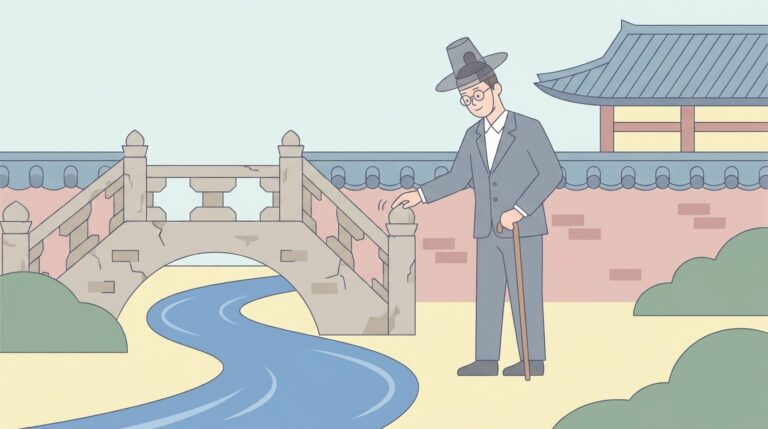
Phase 1: Empathy — Why One Ancient Stone Bridge Rules Modern Korean Boardrooms
안녕하세요! 매일한글 에디터입니다. (Annyeonghaseyo! Maeil Hangul Editor-imnida.) Hello! I’m your Daily Hangul Editor. Picture that classic K-drama boardroom scene—like in Reborn Rich or Start-Up—where a starry-eyed founder pitches a “guaranteed” deal, and the veteran CEO slowly pauses, taps the contract, and drops a chilling proverb. At the C1 level, textbook phrases won’t save you from sounding naive in high-stakes Korean talks. Based on real feedback from our advanced learners navigating Korean workplaces, mastering “Tap even a stone bridge before crossing” gives you instant credibility, cultural polish, and the smarts to voice skepticism gracefully.
Phase 2: Deep Dive into 3 Essential C1 Expressions
1. Tap even a stone bridge before crossing (돌다리도 두들겨 보고 건너라)
- Pronunciation:
doldarido dudeulgyeo bogo geonneora(Sounds like: “dohl-dah-ree-doh doo-deul-gyeo boh-goh guhn-nuh-rah” — where “eu” is that flat “uh” sound you make when mildly disgusted, and “eo” is like the “aw” in “saw” without rounding your lips.)- Meaning: Literally “Tap even a stone bridge and look before crossing.” Real nuance: Never skip due diligence—even when an investment, contract, or promise looks rock-solid.
- K-Culture Moment: In Korean corporate dramas like Misaeng or Agency, a senior director often whispers this to an overeager junior right before signing an exclusive partnership with a flashy startup.
- Editor’s Insight: Think of this as the Korean twin of “Look before you leap” mixed with “Trust, but verify.” When Koreans use it in business, they aren’t calling you reckless—they are signaling maturity, protective wisdom, and the weight of words (말의 무게, mal-ui muge).
- Situation Spectrum: Casual ✅ / Semi-formal ✅ (Use
-세요,-seyo) / Formal ⚠️ (Quote it smoothly as “There is an old saying…” rather than commanding your boss!)- 🤔 Think About It: In English, “Better safe than sorry” can sometimes sound timid or anti-entrepreneurial. In Korea, why do you think extreme caution (신중함, sinjungham) is framed as an active, physical gesture—tapping the stone—rather than passive hesitation?
2. To deliberate deeply and carefully (심사숙고하다)
- Pronunciation:
simsasuggohada(Note: Writtensimsasuggohadain strict spelling flow,simsasookgohadaintuitively — imagine “shim-sah-sook-goh-hah-dah”, like a quiet hiss “shim” followed by “sook” rhyming with “book”.)- Meaning: Literally “to examine deeply and think repeatedly” (from Hanja 審思熟考). Real nuance: Thorough, agonizingly careful reflection before making an irreversible commitment.
- K-Culture Moment: When a K-Pop idol or actor releases an official statement about renewing a contract or choosing a next project, agencies almost always say they made the choice after “deep deliberation” (심사숙고 끝에, simsasuggo kkeute).
- Editor’s Insight: Using 생각하다 (saenggakhada, to think) at C1 level sounds flat in executive discussions. Switching to 심사숙고하다 instantly elevates your register and shows you respect the gravity of the decision.
- Situation Spectrum: Casual 🚫 (Too heavy—sounds comical with close friends unless joking!) / Semi-formal ✅ / Formal ✅
- 🤔 Think About It: Korean uses four-character Sino-Korean idioms (사자성어, sajaseongeo) to compress huge ethical concepts into four syllables. Does your native language rely on Latin or classical roots in the same way to sound authoritative?
3. To leave nothing to chance / Prepare thoroughly (만전을 기하다)
- Pronunciation:
manjeoneul gihada(Sounds like: “mahn-juhn-eul gee-hah-dah” — “jeo” sounds like the “ju” in “just”, and “eu” stays flat and unrounded.)- Meaning: Literally “to aim for ten-thousand-fold perfection.” Real nuance: Conducting exhaustive risk checks and backup plans so zero loopholes remain.
- K-Culture Moment: Before a massive world tour or an international tech launch (think Samsung Galaxy Unpacked or a Netflix Korea premiere), press releases promise that the team is 만전을 기하고 있습니다 (manjeoneul gihago itseumnida, “leaving nothing to chance”).
- Editor’s Insight: While 돌다리도 두들겨 보고 건너라 warns you before you step, 만전을 기하다 describes the meticulous action you take during preparation. Pair them together in a meeting and watch native speakers nod in awe.
- Situation Spectrum: Casual 🚫 / Semi-formal ✅ / Formal ✅
- 🤔 Think About It: Notice how Korean links thoroughness with “ten thousand” (만, man)—covering every imaginable angle. How does your workplace culture balance “move fast and break things” against “leave nothing to chance”?
Phase 3: Textbook Korean vs. Real Korean
Situation 1: Expressing doubt about a “guaranteed” business deal
- 📖 Textbook Korean (교과서 한국어): 이 사업은 위험할 수 있으니까 다시 확인해야 해요. (
I saeobeun wiheomhal su isseunikka dasi hwaginhaeya haeyo.— Because this business might be risky, we have to check it again.) - 🗣️ Real Korean (진짜 한국어): 조건이 너무 좋아서 좀 걸리네요. 돌다리도 두들겨 보고 건넌다고, 리스크 검증부터 확실히 짚고 넘어가죠. (
Jogeoni neomu joaseo jom geollineyo. Doldarido dudeulgyeo bogo geonneondago, riseukeu geomjeungbuteo hwaksilhi jipgo neomeogajyo.— The terms are so good it makes me pause a bit. As the saying goes, tap even a stone bridge before crossing—let’s nail down the risk verification first before moving on.) - 💡 Why the difference? (왜 다를까?): Directly calling a colleague’s proposal “risky” (위험하다) can feel confrontational in Korean office culture. Softening it with 좀 걸린다 (“something catches on my mind”) and quoting a shared proverb shifts the blame from the person to universal wisdom.
Situation 2: Advising a friend not to rush into a seemingly easy contract
- 📖 Textbook Korean (교과서 한국어): 친구야, 조심해서 결정하는 것이 좋을 것 같아. (
Chinguya, josimhaeseo gyeoljeonghaneun geosi joeul geot gata.— Friend, I think it would be good to decide carefully.) - 🗣️ Real Korean (진짜 한국어): 야, 확실해 보여도 한 번 더 꼼꼼히 따져 봐. 돌다리도 두들겨 보고 건너라잖아. (
Ya, hwaksilhae boyeodo han beon deo kkomkkomhi ttajyeo bwa. Doldarido dudeulgyeo bogo geonneorajana.— Hey, even if it looks certain, scrutinize it one more time. You know how they say tap even a stone bridge before crossing.) - 💡 Why the difference? (왜 다를까?): Adding
-라잖아(-rajana, “you know people say…”) turns a preachy lecture into warm, insider camaraderie. Plus, 따져 보다 (to scrutinize/weigh details) carries way more street-smart punch than textbook 확인하다.
Phase 4: K-Culture Deep Dive & Non-Verbal Manners
4-1. Nunchi (눈치) & Gestures: How to Signal Prudence Without Killing the Vibe
In Korea, how you voice caution matters just as much as what you say. If someone pitches a glowing idea and you instantly cross your arms and say “No,” you shatter the bunwigi (분위기, room atmosphere). Instead, practice Korean executive nunchi: tilt your head slightly, gently tap your pen or lightly rest two fingers on your chin, and exhale softly with a thoughtful “음… 그렇군요” (Eum… geureokunyo, “Hmm… I see”). Keep your tone steady and downward—never sharp. When introducing a concern, look down at the document rather than staring straight into the speaker’s eyes; this shows you are critiquing the data, not attacking their face (체면, chaemyeon).
4-2. Cultural Code Analysis: Palli-palli Meets Doldari
Outsiders are often baffled by Korea’s dual personality. On the surface, Korea runs on 빨리빨리 (palli-palli, “hurry, hurry”)—lightning-fast deliveries, rapid tech pivots, and overnight construction. Yet inside K-dramas like Reborn Rich or The Auditors, you see the exact opposite: obsessive paranoia over hidden clauses, stamped seals (도장, dojang), and background checks. Why? Because in a hyper-competitive society where one bad deal can topple an entire team or family reputation, palli-palli only works after the stone bridge has been tapped three times. Speed in execution, extreme caution in commitment—that is the secret engine of Korean business.
Phase 5: Practical Roleplay Scenario
Setting: A sleek, glass-walled meeting room in Pangyo Techno Valley (Korea’s Silicon Valley). Outside, rain drizzles over towering tech HQs. You are a senior strategy manager meeting Team Lead Kang Min-jae (강민재 팀장님), a sharp, espresso-sipping veteran who has survived three startup busts.
- Kang Min-jae: 🎭 (Leaning back, sliding a glossy tablet across the table) 이번 신규 제휴, 상대 쪽에서 내일까지 가계약하자고 재촉하네요. 어떻게 보십니까? (
Ibeon singyu jehyu, sangdae jjogeoseo naeilkkaji gagyeyakhajago jaechokhaneyo. Eotteoke bosimnikka?— For this new partnership, the other side is pushing to sign a preliminary contract by tomorrow. How do you see it?) - You: 🎭 (Glancing down at the financial summary, pausing briefly before speaking) 조건 자체는 파격적이긴 합니다만, 일정이 너무 촉박한 감이 있습니다. (
Jogeon jacheneun pagyeokjeogigin hamnidaman, iljeongi neomu chokbakhan gami itseumnida.— The terms themselves are groundbreaking, though the timeline feels overly tight.) - Kang Min-jae: 🎭 (Raising an eyebrow slightly) 그렇죠? 저쪽은 백 퍼센트 확실한 수익 모델이라고 장담하던데요. (
Geureochyo? Jeojjogeun baek peosenteu hwaksilhan suik moderirago jangdamhadeondeyo.— Right? They’re swearing it’s a 100% guaranteed revenue model.) - You: 🎭 (Lightly tapping the edge of your notebook) 팀장님, 확실해 보일수록 돌다리도 두들겨 보고 건너야 하지 않겠습니까? (
Timjangnim, hwaksilhae boilsurok doldarido dudeulgyeo bogo geonneoya haji anketseumnikka?— Team Lead, the more certain it looks, shouldn’t we tap even the stone bridge before crossing?) - Kang Min-jae: 🎭 (A faint, approving smile crosses his face) 오, 한국 속담까지 적재적소에 쓰시네요. 구체적으로 어느 부분이 걸리나요? (
O, hanguk sokdamkkaji jeokjaejeoksoe sseusineyo. Guchejeogeuro eoneu bubuni geollinayo?— Oh, you even use Korean proverbs right on cue. Specifically, which part bothers you?) - You: 🎭 (Pointing calmly at Clause 4 on the tablet) 손해 배상 조항이 모호해서 법무팀의 철저한 사전 검증이 필요합니다. (
Sonhae baesang johangi mohohaeseo beommutim-ui cheoljeohan sajeon geomjeungi piryohamnida.— The liability clause is vague, so we need thorough prior verification from the legal team.) - Kang Min-jae: 🎭 (Nodding firmly and jotting a note) 맞습니다. 당장 오늘 오후에 리스크 점검 회의부터 잡읍시다. (
Matseumnida. Dangjang oneul ohue riseukeu jeomgeom hoeuibuteo jabeupsida.— You’re right. Let’s schedule a risk-review meeting first thing this afternoon.) - You: 🎭 (Offering a polite slight bow while seated) 네, 만전을 기해서 보고서 다시 정리하겠습니다. (
Ne, manjeoneul gihaeseo bogoseo dasi jeongnihagetseumnida.— Yes, I’ll leave nothing to chance and reorganize the report.)
🔀 Interactive Decision Point: Kang Min-jae asks if you should email the partner right now to delay the contract. What do you say?
- A) “네! 사기꾼일지도 모르니까 당장 거절 메일 보낼게요.” (
Ne! Sagikkuniljido moreunikka dangjang geojyeol meil bonaelgeyo.— Yes! They might be scammers, so I’ll send a rejection email right now.)- Feedback (Bad): Whoa, slow down! Accusing a partner of being a 사기꾼 (scammer) violates 말의 무게 (the weight of words) and burns bridges prematurely.
- B) “그냥 상대방 말을 믿고 내일 사인하는 게 빠르지 않을까요?” (
Geunyang sangdaebang mareul mitgo naeil sainhaneun ge ppareuji aneulkkayo?— Wouldn’t it be faster to just trust their word and sign tomorrow?)- Feedback (Risk): High risk! Blindly chasing palli-palli speed without due diligence makes you look reckless in front of a senior Korean manager.
- C) “먼저 추가 검토를 위해 일정 조율을 정중히 요청드리는 게 좋겠습니다.” (
Meonjeo chuga geomtoreul wihae iljeong joyureul jeongjunghi yocheongdeurineun ge jotgetseumnida.— First, it would be best to politely request a schedule adjustment for additional review.)- Feedback (Best): Spot-on C1 mastery! You protect the company’s interests while preserving dignity and professional relationships.
Phase 6: 10-Second Emotion Shadowing Drill
Read aloud with the rhythm and emotional cues! Use / for natural micro-pauses.
[🤔 Skeptical & thoughtful]아무리 확실해 보여도 / 돌다리도 두들겨 보고 / 건너야죠. (Amuri hwaksilhae boyeodo / doldarido dudeulgyeo bogo / geonneoyajyo.— No matter how certain it looks / you still have to tap the stone bridge / before crossing.)[💼 Calm yet firm]심사숙고 끝에 / 내린 결론이니 / 믿어 주세요. (Simsasuggo kkeute / naerin gyeollonini / mideo juseyo.— Since it’s a conclusion reached / after deep deliberation / please trust it.)[😌 Reassuring & wise]만전을 기해서 / 완벽하게 / 준비하겠습니다. (Manjeoneul gihaeseo / wanbyeokhage / junbihagetseumnida.— Leaving nothing to chance / I will prepare it / flawlessly.)
Phase 7: K-Culture Mini Dictionary
- 신중함 (
sinjungham) | Prudence / Discretion | A top-tier compliment in Korean interviews and performance reviews; describes someone who weighs consequences before speaking or acting. - 사전 검증 (
sajeon geomjeung) | Prior verification / Due diligence | Frequently heard in Korean news, startups, and HR hiring when vetting investments, partners, or executive candidates. - 허술하다 (
heosulhada) | Shoddy / Full of loopholes | Used to criticize a poorly checked contract, weak security, or half-baked business plan. - 경거망동 (
gyeonggeomangdong) | Rash, thoughtless behavior | A heavy, authoritative C1 idiom warning people not to act impulsively in moments of crisis or hype.
Phase 8: Survival Kit for Travelers & Business Visitors
TOP 3 Survival Expressions (For Checking Contracts, Rentals & Tours)
- 다시 한번 꼼꼼히 확인해 봐도 될까요? (
Dasi hanbeon kkomkkomhi hwaginhae bwado doelkkayo?— Could I double-check this thoroughly one more time?) — Pro Tip: Magic phrase when renting a car, checking a hotel bill, or reviewing a Jeonse/Wolse housing lease! - 혹시 추가 비용이나 숨겨진 조건은 없나요? (
Hoksi chuga biyongina sumgyeojin jogeoneun eomnayo?— By any chance, are there any extra fees or hidden terms?) — Pro Tip: Adding 혹시 (hoksi, by any chance) softens your inquiry so staff feel eager to help rather than defensive. - 조금 더 생각해 보고 결정하겠습니다. (
Jogeum deo saenggakhae bogo gyeoljeonghagetseumnida.— I’ll think it over a bit more and then decide.) — Pro Tip: Your ultimate polite shield against pushy street vendors or rushed sales pitches.
Editor’s Travel Note
Before stepping onto any Korean “bridge”—even booking a local guesthouse or buying from an online Korean seller—verify it like a pro! You can check official Korean business registration details on the Fair Trade Commission portal if you’re signing local deals, and always download Naver Map for verified Korean restaurant and transit reviews instead of relying on outdated overseas blogs. Also, for seamless local payments on buses and subways without risking extra foreign card fees, grab a T-money card at any convenience store (편의점, pyeonuijeom) and load it with cash!
Phase 9: One Step Deeper — Why Caution Is Collective in Korea
In strongly individualistic cultures, taking a blind leap is often romanticized—if you fall, you simply dust yourself off and say it was your own lesson to learn. In Korea’s deeply interconnected society, however, one person’s reckless step rarely stays private; it ripples outward to affect your team, your mentors, and your family’s standing. That is why 돌다리도 두들겨 보고 건너라 isn’t a fearful excuse to do nothing—it is an act of care toward everyone walking across the bridge behind you. Choosing prudence honors both your own credibility and the trust of your community.
💬 Your Turn: Has there ever been a moment in your life or career when tapping the “stone bridge” saved you from a huge mistake? Share your story in the comments—and try dropping one of today’s Korean phrases if you’re feeling bold!
Phase 10: FAQ & Common Mistakes
Q: Can I literally say “돌다리도 두들겨 보고 건너라” to my Korean boss? (상사에게 직접 써도 되나요?) Wait—let’s keep it crystal clear!
A: Careful! Ending with -라 (geonneora) is the plain imperative form, which sounds commanding if aimed directly at a superior. To use it respectfully with a boss or senior, wrap it as a quote: “돌다리도 두들겨 보고 건너라는 말처럼…” (Doldarido dudeulgyeo bogo geonneoraneun malcheoreom..., “Like the saying goes, tap even a stone bridge before crossing…”).
Q: What is the difference between “돌다리도 두들겨 보고 건너라” and “유비무환” (Yubimuhwan)?
A: 돌다리도 두들겨 보고 건너라 focuses on active verification right before you take a step—especially when things already look safe. 유비무환 (yubimuhwan, “preparedness prevents calamity”) focuses on stockpiling defenses in advance before any danger even appears.
Q: How do Koreans translate “Due Diligence” in real business meetings?
A: In formal finance and M&A, Koreans use the Sino-Korean term 실사 (silsa) or 리스크 검증 (riseukeu geomjeung), though English loanwords like 듀 딜리전스 (dyu dillijeonseu) also pop up in multinational firms.
🚨 Common Mistakes Warning Board
- Mistake: Saying 돌다리를 쳐 보고 건너라 (
chyeo bogo= hitting/slamming it) instead of 두들겨 보고 (dudeulgyeo bogo= tapping/knocking).- Correct Action: Always use 두들기다 (
dudeulgida, to tap gently and repeatedly), which implies listening for hollow cracks!
- Correct Action: Always use 두들기다 (
- Mistake: Using 심사숙고하다 (
simsasuggohada) for tiny everyday choices like picking lunch (점심 메뉴를 심사숙고했어요).- Correct Action: Unless you’re making a witty joke with close friends, save 심사숙고하다 for major life, career, or corporate decisions.
- Mistake: Translating “to be careful” only as 조심하다 (
josimhada) in C1 essays or meetings.- Correct Action: Upgrade to 신중을 기하다 (
sinjungeul gihada, to exercise prudence) or 만전을 기하다 (manjeoneul gihada, to leave nothing to chance).
- Correct Action: Upgrade to 신중을 기하다 (
Phase 11: Action Mission & Engagement
- 🥉 Bronze Mission (Solo Practice): Record yourself doing the Phase 6 shadowing drill once in a serious CEO voice and once in a warm friend’s voice. Listen back to check your
/pauses! - 🥈 Silver Mission (Social Share): Post a quick takeaway on Instagram, Threads, or X sharing your favorite expression from today with the hashtag
#DailyHanguland tag a friend who needs a reminder to check the fine print. - 🥇 Gold Mission (Real-World Use): The next time you chat with a Korean friend, tutor, or language partner about a big purchase or job offer, naturally drop “돌다리도 두들겨 보고 건너야죠!” (
Doldarido dudeulgyeo bogo geonneoyajyo!) and watch their face light up!
🎮 K-Culture Mission: Watch an episode of a Korean legal, business, or thriller drama (like Vincenzo, Extraordinary Attorney Woo, or Reborn Rich) or browse Korean tech news headlines on Naver—see if you can spot 신중, 검증, or 만전을 기하다 in the wild!
Phase 12: Interactive Quiz Challenge
Test your C1 instincts! Try answering before opening the spoiler toggles.
Quiz 1 (Situation Judgment): Your Korean supervisor asks if your team is 100% ready for tomorrow’s product launch. Which response sounds the most natural, polished, and C1-appropriate?
* A) 네, 걱정 마세요. 그냥 대충 다 됐어요.
* B) 네, 만전을 기해서 최종 점검까지 마쳤습니다.
* C) 네, 심사숙고해서 점심을 먹었습니다.
Click to reveal Answer & Feedback for Quiz 1
Answer: B! (Ne, manjeoneul gihaeseo choejeong jeomgeomkkaji macheotseumnida. — “Yes, leaving nothing to chance, we’ve even finished the final check.”)
* Why A is wrong: 대충 means “roughly/sloppily”—instant disaster in front of a boss!
* Why C is wrong: 심사숙고 is way too heavy for eating lunch (unless you’re doing stand-up comedy).
Quiz 2 (Fill in the Blank): Complete this natural C1 advice to a colleague: “아무리 확실해 보이는 계약이라도 [ ________ ] 보고 건너라는 말처럼 법무팀 검토를 꼭 받으세요.” (Even if a contract looks certain, just like the saying says to [tap even a stone bridge] before crossing, make sure to get legal review.)
Click to reveal Answer & Explanation for Quiz 2
Answer: 돌다리도 두들겨 (doldarido dudeulgyeo)
* Full sentence: 아무리 확실해 보이는 계약이라도 돌다리도 두들겨 보고 건너라는 말처럼 법무팀 검토를 꼭 받으세요.
Quiz 3 (True / False Cultural Quiz): In Korean business culture, directly telling a senior colleague “That plan is too risky” (그 계획은 너무 위험해요) is considered the best way to show 신중함 (prudence).
Click to reveal Answer & Cultural Note for Quiz 3
Answer: False!
* Explanation: Being blunt can hurt chaemyeon (face) and stiffen the room. Instead, C1 speakers soften skepticism with phrases like 좀 걸리네요 (“something gives me pause”) or quote 돌다리도 두들겨 보고 건너다 to advocate for 사전 검증 (prior verification) diplomatically.
🎬 Watch Our Daily Videos! (Daily Hangul Official Instagram)
Review the expressions you learned in this article with our fun daily short videos! Check out native pronunciation and real-life nuances in action.
- Instagram @dailyhangul_en







