

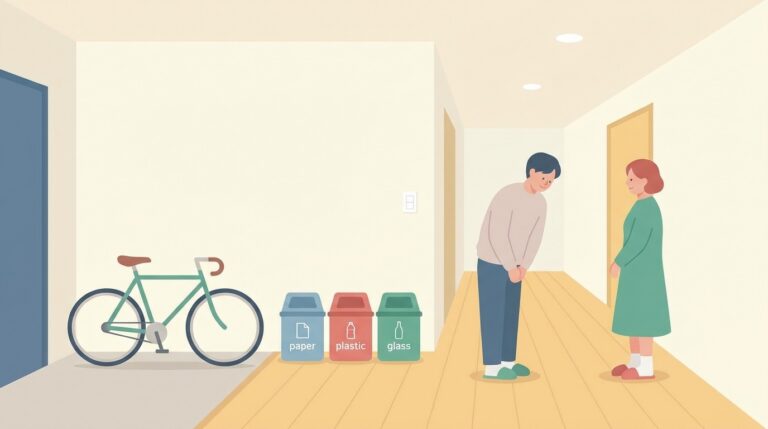
Phase 1: Why Did My Neighbor Leave a Sticky Note on My Bike?
안녕하세요! 매일한글 에디터입니다. (Annyeonghaseyo! Maeil Hangeul editeoimnida. — Hello! I am your Daily Hangul Editor.)
Imagine moving into a cozy Korean one-room just like in your favorite K-Drama. You unpack, park your shiny bicycle right outside your door in the hallway, and feel ready for Seoul life. The next morning, a polite but firm sticky note is taped to your handlebars! From recycling days to inter-floor noise, Korean shared-space rules can catch newcomers off guard. Based on real feedback from our learners in Korea, this A2 guide gives you the exact phrases to avoid awkward neighbor moments and live like a local pro.
Phase 2: Deep Dive into 3 Essential Phrases
1. 여기에 두면 안 돼요 (Yeogie dumyeon an dwaeyo)
- Pronunciation: [Yeogie dumyeon an dwaeyo] (Sounds like “Yuh-gee doo-myun ahn dweh-yo” — “dwae” rhymes with “weh” in “wedding”!)
- Meaning: Literally “If you put it here, it doesn’t work,” which naturally means “You are not allowed to leave it here.”
- K-Culture Moment: Think of a classic K-Drama scene in a cramped apartment building (like Reply 1988 or My Liberation Notes) where a building manager gently stops a new tenant from stacking moving boxes near the stairwell.
- Editor’s Insight: Using
-면 안 돼요 (-myeon an dwaeyo)is the softest, most polite way to state a rule in beginner Korean. It doesn’t sound angry—it simply states a boundary! - Situation Spectrum: Casual 🚫 (Use
두면 안 돼with close friends) | Semi-formal ✅ (Perfect for neighbors and landlords) | Formal ⚠️ (Add~습니다/ㅂ니다in official notices) - 🤔 Think About It: In your home country, is it normal to leave a stroller, shoes, or a bike outside your apartment door? Why do you think Korean apartments treat the hallway so differently?
2. 공용 공간이에요 (Gongyong gongganieyo)
- Pronunciation: [Gongyong gongganieyo] (Sounds like “Gong-yong gong-gahn-ee-eh-yo” — “gong” is rounded like the “o” in “song.”)
- Meaning: Literally “It is a public/shared space,” meaning “Everyone shares this area, so it must stay clear.”
- K-Culture Moment: In Korean variety shows where celebrities live together in a share house (like Heart Signal or I Live Alone apartment episodes), housemates remind each other to keep shared living areas tidy.
- Editor’s Insight: When Koreans hear
공용 공간 (gongyong gonggan), it immediately triggers a sense of shared responsibility and fire safety—not just neatness. - Situation Spectrum: Casual ⚠️ (Better as
공용 공간이야with peers) | Semi-formal ✅ (Ideal polite explanation) | Formal ✅ (Great for management office chats) - 🤔 Think About It: How does having a specific everyday phrase like “shared space” shape how neighbors respect hallways, elevators, and recycling stations?
3. 바로 치울게요 (Baro chiulgeyo)
- Pronunciation: [Baro chiulgeyo] (Sounds like “Bah-roh chee-ool-geh-yo” — quick “r” like a light tap on the roof of your mouth!)
- Meaning: Literally “I will clear it right away,” meaning “Sorry about that, I’ll move it immediately!”
- K-Culture Moment: Picture a friendly K-Drama protagonist bumping into the grumpy-but-kind security guard (
경비원 아저씨) in the lobby and flashing an apologetic smile while grabbing their delivery boxes. - Editor’s Insight: Adding
바로 (baro — right away)and-(으)ㄹ게요 (I will, for you)shows instant goodwill. In Korea, a fast, cheerful response melts tension in two seconds! - Situation Spectrum: Casual 🚫 (Drop
요to바로 치울게with friends) | Semi-formal ✅ (Your golden ticket with neighbors) | Formal ⚠️ (In very formal settings, say바로 치우겠습니다) - 🤔 Think About It: In Korean,
-(으)ㄹ게요includes the listener’s feelings, almost like promising “I’ll do this to make things right for you.” Does your language have a grammar ending like that?
Phase 3: Textbook Korean vs. Real Korean
Situation 1: Saying “Don’t leave your bicycle in the hallway.”
- 📖 Textbook Korean: 복도에 자전거를 놓지 마세요. (Bokdoe jajeongeoreul notji maseyo. — Please do not place a bicycle in the hallway.)
- 🗣️ Real Korean: 복도에 자전거 두시면 안 돼요. (Bokdoe jajeongeo dusimyeon an dwaeyo. — You shouldn’t leave your bike in the hallway.)
- 💡 Why is it different?: Direct negative commands (
-지 마세요) can feel a bit sharp between neighbors. Adding the honorific-시-(두시면 안 돼요) sounds much softer and more respectful.
Situation 2: Promising to move your boxes and check recycling rules.
- 📖 Textbook Korean: 죄송합니다. 제가 그것을 지금 옮기겠습니다. (Joesonghamnida. Jega geugeoseul jigeum omgigetseumnida. — I am sorry. I will move that now.)
- 🗣️ Real Korean: 아, 죄송해요! 지금 바로 치울게요. (A, joesonghaeyo! Jigeum baro chiulgeyo. — Oh, sorry! I’ll clear it right away.)
- 💡 Why is it different?: Textbooks love
옮기다 (omgida — to move/transfer), which sounds stiff for clutter. Real Koreans use치우다 (chiuda — to clear away/tidy up)when moving personal stuff out of shared paths.
Phase 4: K-Culture Deep Dive & Non-Verbal Manners
4-1. Nunchi (눈치) & Gestures
When talking to a neighbor or building manager (관리인) about hallway items, recycling days, or floor noise, your body language speaks louder than grammar:
* The Mini-Bow & Hand Gesture: Give a gentle 15-degree head nod (목례) while gesturing lightly toward your bike or box with an open palm—never point with one finger!
* The “Ah, My Mistake!” Expression: Soften your eyes and raise your eyebrows slightly as you say 아, 죄송해요! (A, joesonghaeyo! — Oh, I'm sorry!). Looking defensive makes Koreans tense, while looking cooperative makes them super warm and helpful.
* Immediate Action: Don’t just promise—reach for the handlebars or box right away while speaking. Seeing you act immediately builds instant trust.
4-2. Cultural Code Analysis: Why Korean Apartments Are So Strict
In K-Dramas like Home Alone or slice-of-life dramas set in Seoul villas and high-rise apartments (아파트), you’ll notice hallways look spotless. Why? Two huge reasons:
1. Fire Safety Law (소방법): Korean apartments are dense and high-rise. Under Korean fire regulations, stairways and hallways are emergency escape routes, so leaving bicycles, shoe racks, or recycling boxes outside can actually get the building fined!
2. Shared Living Harmony: Just like 분리수거 (bullisugeo — recycling separation) on designated days and wearing cushioned indoor slippers to prevent 층간소음 (cheunggansoeum — inter-floor noise), keeping 공용 공간 (shared spaces) clear shows you care about everyone’s safety and peace.
Phase 5: Real-Life Roleplay Scenario
Setting: Tuesday morning, 8:30 AM. The bright, tiled hallway of a Seoul officetel. You are stepping out with your trash bag when you meet Mr. Park (박 아저씨), the warm-hearted building security guard holding a clipboard.
- Mr. Park: 안녕하세요, 302호 학생! (Annyeonghaseyo, sambaegiho haksaeng! — Hello, resident in Room 302!)
🎭 Smiling warmly while adjusting his cap. - You: 안녕하세요, 아저씨! 좋은 아침이에요. (Annyeonghaseyo, ajeossi! Joeun achimieyo. — Hello, sir! Good morning.)
🎭 Bowing politely with both hands on your recycling bag. - Mr. Park: 저기 문 앞에 있는 자전거, 학생 거예요? (Jeogi mun ape inneun jajeongeo, haksaeng geoyeyo? — That bicycle in front of your door, is it yours?)
🎭 Gently gesturing toward the silver bike leaning by the stairs. - You: 네, 제 거예요. 무슨 일 있어요? (Ne, je geoyeyo. Museun il isseoyo? — Yes, it’s mine. Is something wrong?)
🎭 Looking slightly surprised and attentive. - Mr. Park: 복도나 계단은 공용 공간이에요. (Bokdona gyedaneun gongyong gongganieyo. — Hallways and stairs are shared spaces.)
🎭 Explaining kindly in a calm voice. - Mr. Park: 여기에 자전거를 두면 안 돼요. 위험해요. (Yeogie jajeongeoreul dumyeon an dwaeyo. Wiheomhaeyo. — You can’t leave a bicycle here. It’s dangerous.)
🎭 Pointing gently toward the emergency exit sign. - You: 아, 몰랐어요! 정말 죄송해요. (A, mollasseoyo! Jeongmal joesonghaeyo. — Oh, I didn’t know! I’m really sorry.)
🎭 Bowing slightly with an apologetic smile. - You: 지금 바로 집 안에 치울게요! (Jigeum baro jip ane chiulgeyo! — I’ll move it inside my room right away!)
🎭 Quickly rolling the bike toward your doorway.
🔀 Interactive Branching Point: What if Mr. Park also asks about your cardboard boxes?
Imagine you also left two delivery boxes next to your door waiting for recycling day. Choose your response:
* A) “아, 오늘 분리수거 날이 아니에요? 바로 안에 들일게요!” (A, oneul bullisugeo nari anieyo? Baro ane deurilgeyo! — Oh, isn’t today recycling day? I’ll bring them inside right away!)
* Feedback (Best ✅): Brilliant! You politely ask about the recycling schedule while taking immediate responsibility. Mr. Park will probably tell you the exact recycling day with a big smile!
* B) “그냥 잠깐 뒀어요. 괜찮잖아요.” (Geunyang jamkkan dwosseoyo. Gwaenchanchanayo. — I just left them for a bit. Isn’t it fine?)
* Feedback (Bad ❌): Too defensive! Saying 괜찮잖아요 (It's fine, isn't it?) sounds dismissive of building safety rules and can hurt neighbor relations.
* C) “내일 치울게요.” (Naeil chiulgeyo. — I’ll clear them tomorrow.)
* Feedback (Risk ⚠️): Leaving items in a shared hallway overnight risks a formal warning notice from the management office (관리사무소). Better to move them inside now!
Phase 6: 10-Second Emotion Shadowing Drill
Read these out loud! Pause briefly at each / and match the emotion!
[😊 Friendly & Polite]안녕하세요! / 오늘 / 분리수거 날이에요? (Annyeonghaseyo! / Oneul / bullisugeo narieyo? — Hello! Is today recycling day?)[😳 Flustered & Apologetic]아, / 정말 죄송해요! / 몰랐어요. (A, / jeongmal joesonghaeyo! / Mollasseoyo. — Oh, I’m really sorry! I didn’t know.)[😌 Cooperative & Helpful]여기에 두면 / 안 되죠? / 바로 치울게요! (Yeogie dumyeon / an doejyo? / Baro chiulgeyo! — I shouldn’t leave it here, right? I’ll clear it right away!)
Phase 7: K-Culture Mini Dictionary
- 공용 공간 (Gongyong gonggan) | Shared space | Used in apartments, dorms, and offices for hallways, stairs, elevators, and lobbies.
- 복도 / 계단 (Bokdo / Gyedan) | Hallway / Stairs | Essential words on apartment warning posters asking residents to keep paths clear.
- 분리수거 (Bullisugeo) | Recycling separation | Sorting plastics, paper, cans, and food waste on specific days—a major part of daily Korean life.
- 층간소음 (Cheunggansoeum) | Inter-floor noise | Footsteps, vacuuming, or furniture dragging heard by downstairs neighbors, especially after 9 PM.
Phase 8: Survival Kit for Travelers & Residents
Top 3 Survival Phrases
- 이거 어디에 버려요? (Igeo eodie beoryeoyo?) — “Where do I throw this away?” Pro Tip: Point to a plastic cup or box and ask your host or security guard!
- 조심할게요! (Josimhalgeyo!) — “I’ll be careful!” Pro Tip: Your lifesaver if a neighbor ever mentions footsteps or door noise.
- 몇 시까지 괜찮아요? (Myeot sikkaji gwaenchanayo?) — “Until what time is it okay?” Pro Tip: Great for asking when you can run the washing machine or vacuum.
Editor’s Travel Note
- Check Rules & Locations Easily: Before moving in or booking an Airbnb/guesthouse, Download the Naver Map App for Korean Addresses to check nearby convenience stores where you must buy official volume-rate garbage bags (
종량제 봉투). - Learn Local Recycling Rules: Every district (
구) in Seoul has slightly different recycling days! You can Check Official Seoul Recycling and Living Guides or check the laminated notice posted inside your building’s elevator. - Payment Tip: Official trash bags cost only a few hundred won and can be bought at the register of GS25, CU, or 7-Eleven using a T-money card or Korean debit card.
Phase 9: One Step Deeper — The Spirit of “Woori” (우리)
In Korea, apartment life runs on the beautiful concept of 우리 (woori — us/our). Because millions of people live comfortably together in tall apartment complexes, shared spaces like hallways, elevators, and recycling rooms are treated as extensions of everyone’s home—not “nobody’s space.” Keeping your bike inside and sorting your recycling on the right day might feel strict at first, especially if you come from a place with wide suburban streets. Yet once you join in, you realize these small courtesies are what keep Korean neighborhoods remarkably clean, safe, and peaceful for everyone.
💬 Your Turn: What surprised you most about apartment or house rules in Korea (or in your own country)? Drop a comment below and share your story!
Phase 10: FAQ & Myth Busting
Q: Can I leave just my umbrella or delivery boxes in the hallway for a few hours?
A: Ideally, no! While a wet umbrella stand might be overlooked briefly in some older villas, most Korean apartments strictly prohibit leaving boxes, strollers, or bikes in hallways or on stairs due to fire safety laws. Bring deliveries inside right away.
Q: How do I know my building’s recycling day (분리수거 요일)?
A: Look inside the elevator, near the lobby mailbox, or by the outdoor recycling bins (재활용품 분리수거함). Most buildings post a colorful chart showing days (often twice a week) and times.
Q: What hours should I avoid making noise (층간소음) in a Korean apartment?
A: Generally, be extra quiet between 9:00 PM and 8:00 AM. Avoid running laundry machines, vacuuming, or walking heavily on heels during late hours, and grab a pair of soft indoor slippers (실내화) from Daiso!
🚨 Common Mistakes Warning Board
- Mistake 1: Leaving flattened cardboard boxes by the door all week. -> Correct Action: Keep flattened boxes inside your entryway until your building’s designated recycling day.
- Mistake 2: Throwing all trash into one black bag. -> Correct Action: Buy district-specific
종량제 봉투 (general trash bags)and separate plastics, vinyl, paper, and food waste. - Mistake 3: Ignoring a sticky note or management notice because you’re shy about Korean. -> Correct Action: Snap a photo, translate it, move the item, and say
바로 치웠어요! (I cleared it right away!)—neighbors appreciate the effort!
Phase 11: Action Mission & K-Culture Challenge
- 🥉 Bronze Mission (Solo Practice): Stand by your front door and say
여기에 두면 안 돼요 (Yeogie dumyeon an dwaeyo)and바로 치울게요 (Baro chiulgeyo)out loud three times while gesturing politely! - 🥈 Silver Mission (Community Share): Share one surprising Korean apartment rule you learned today on Instagram or TikTok and tag
@dailyhangul! - 🥇 Gold Mission (Real-Life Use): Next time you meet your neighbor, Airbnb host, or building guard, smile and ask
오늘 분리수거 날이에요? (Oneul bullisugeo narieyo? — Is today recycling day?). - 🎮 K-Culture Mission: Watch an episode of a Korean apartment K-Drama or Korean lifestyle vlog on YouTube and spot how tidy the hallways are—plus look for the colorful recycling bins outside!
Phase 12: Interactive Quiz Challenge
Quiz 1 (Situation Judgment): You parked your electric scooter by the apartment stairs. A neighbor politely says, 복도는 공용 공간이에요. What is the BEST reply?
* A) 괜찮아요! (Gwaenchanayo! — It’s fine!)
* B) 아, 죄송해요! 바로 치울게요! (A, joesonghaeyo! Baro chiulgeyo! — Oh, sorry! I’ll move it right away!)
* C) 제 집 앞이에요. (Je jip apieyo. — It’s in front of my house.)
Click to Reveal Answer & Explanation for Quiz 1
Answer: B) 아, 죄송해요! 바로 치울게요!
Explanation: Option A dismisses the safety concern, and Option C ignores that hallways belong to everyone (공용 공간). Option B shows polite nunchi and solves the issue immediately!
Quiz 2 (Fill in the Blank): Complete the polite warning: 여기에 자전거를 _____ 안 돼요. (You shouldn’t leave a bicycle here.)
* A) 두면 (dumyeon)
* B) 먹으면 (meogeumyeon)
* C) 자면 (jamyeon)
Click to Reveal Answer & Explanation for Quiz 2
Answer: A) 두면 (dumyeon)
Explanation: From the verb 두다 (duda — to put/leave), 두면 안 돼요 means “you shouldn’t leave it.” (먹으면 = if you eat, 자면 = if you sleep.)
Quiz 3 (True or False): In Korea, leaving bicycles and boxes on apartment stairs is encouraged so your room stays spacious.
Click to Reveal Answer & Explanation for Quiz 3
Answer: False!
Explanation: Korean fire safety laws strictly require hallways and stairs (복도와 계단) to remain completely clear as emergency exit routes.
🎬 Watch Our Daily Videos! (Daily Hangul Official Instagram)
Review the expressions you learned in this article with our fun daily short videos! Check out native pronunciation and real-life nuances in action.
- Instagram @dailyhangul_en







