

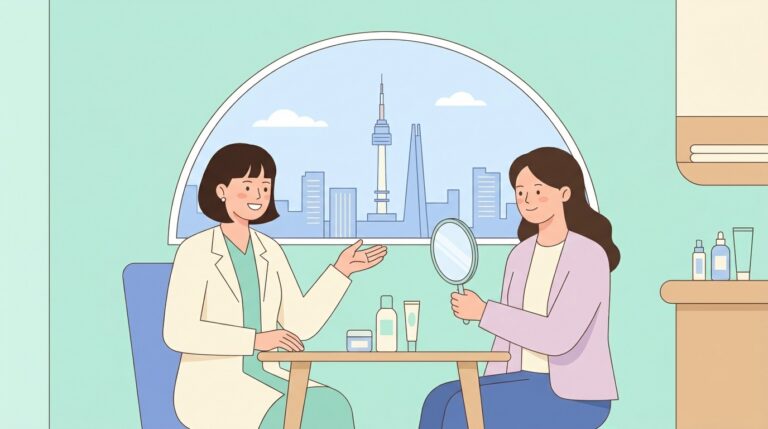
Phase 1: Why You Shouldn’t Pop That Pimple in Seoul
안녕하세요! 매일한글 에디터입니다. (Annyeonghaseyo! Hello, I’m your Daily Hangul Editor!) Imagine waking up in Seoul right before taking Life4Cuts photos with friends, only to spot a huge red pimple on your cheek. Like a panicked K-drama lead before a big date, your hand reaches for the mirror to pop it! Stop right there. After coaching hundreds of Korean learners, I’ve noticed many travelers freeze up at Korean dermatology clinics (피부과, pibugwa) because they don’t know how to explain skin trouble or ask for safe extraction. Today, you’ll learn easy, natural A2 phrases to protect your skin from scars and get pro care confidently!
Phase 2: 3 Essential Expressions for Your Skin Clinic Visit
1. 집에서 손으로 짜면 흉터가 남아요 (Jibeseo soneuro jjamyeon hyungteoga namayo)
- Pronunciation: Ji-be-seo so-neu-ro jja-myeon hyung-teo-ga na-ma-yo. Think of the jj in jjamyeon like holding your breath for a split second before saying “jam”—it comes out sharp and tight, with zero puff of air! For eo, drop your jaw slightly like saying “uh” in “cup.”
- Meaning: Literally “If you squeeze at home by hand, a scar remains.” In real life, it means “Popping pimples yourself at home leaves scars.”
- K-Culture Moment: Picture a K-beauty show host or a caring best friend in a K-drama slapping a character’s hand away from the bathroom mirror right before a blind date.
- Editor’s Insight: Koreans use the verb 짜다 (jjada – to squeeze) for DIY popping at home, which often sounds risky for skin. Saying 흉터가 남아요 (hyungteoga namayo – scars stay behind) is a super common, gentle warning phrase.
- Situation Spectrum: Casual (집에서 손으로 짜면 흉터 남아) ✅ | Semi-formal (집에서 손으로 짜면 흉터가 남아요) ✅ | Formal (집에서 손으로 짜시면 흉터가 남습니다) ⚠️ (Usually used by staff to patients)
- 🤔 Think About It: In your home country, do people mostly treat minor breakouts at home with pharmacy creams, or is visiting a skin clinic common? Why do you think Korean culture treats professional skin care like an everyday habit?
2. 병원에서 압출 받는 게 좋아요 (Byeongwoneseo apchul banneun ge joayo)
- Pronunciation: Byeong-wo-ne-seo ap-chul ban-neun ge jo-a-yo. Notice how 받 (bat) changes to ban right before 는 (neun)—just let your tongue rest softly on the roof of your mouth like saying “ban” in “banana”! The h in joayo disappears completely, sounding like “jo-ah-yo.”
- Meaning: Literally “Getting extraction at a hospital is good.” Naturally, it means “It’s better to get professional extraction at a clinic.”
- K-Culture Moment: You’ll hear this exact advice on Korean YouTube skincare vlogs when creators share how they maintain “glass skin” before filming or attending a K-pop concert.
- Editor’s Insight: 압출 (apchul) is the medical/clinic word for hygienic pore extraction. Pairing a verb with ~는 게 좋아요 (neun ge joayo – it’s good/better to…) is the ultimate A2 cheat code for giving or understanding friendly advice without sounding bossy!
- Situation Spectrum: Casual (병원에서 압출 받는 게 좋아) ✅ | Semi-formal (병원에서 압출 받는 게 좋아요) ✅ | Formal (병원에서 압출을 받으시는 게 좋습니다) ✅
- 🤔 Think About It: Korean advice often ends with “it is good” (~는 게 좋아요) instead of “you should.” How does this indirect style reflect Korean politeness compared to direct commands in English?
3. 트러블 진정 관리 받고 싶어요 (Teureobeul jinjeong gwalli batgo sipeoyo)
- Pronunciation: Teu-reo-beul jin-jeong gwal-li bat-go si-peo-yo. 트러블 (teureobeul) comes from the English word “trouble,” said with quick, flat syllables like “tuh-ruh-beul.” For 관리 (gwalli), the n sound turns into an l sound, gliding smoothly like “gwal-lee.”
- Meaning: Literally “I want to receive trouble calming management.” Real meaning: “I’d like to get a soothing treatment for my breakout.”
- K-Culture Moment: Inside a bright Gangnam or Hongdae clinic lobby, idols’ stylists or busy office workers ask for this quick 30-minute treatment during their lunch break.
- Editor’s Insight: In Korean, “skin trouble” (피부 트러블, pibu teureobeul) is the polite, everyday umbrella term for pimples, redness, or irritation. And 진정 관리 (jinjeong gwalli) means calming care (like cooling packs and LED light), which usually follows extraction!
- Situation Spectrum: Casual (트러블 진정 관리 받고 싶어) ✅ | Semi-formal (트러블 진정 관리 받고 싶어요) ✅ | Formal (트러블 진정 관리를 받고 싶습니다) ✅
- 🤔 Think About It: Koreans use the English loanword “trouble” specifically for skin breakouts. What loanwords do you use in your daily life for beauty or wellness?
Phase 3: Textbook Korean vs. Real Korean
Situation 1: Warning a friend not to pop a pimple
- 📖 Textbook Korean: 여드름을 손으로 누르면 상처가 생깁니다. (Yeodeureumeul soneuro nureumyeon sangcheoga saenggimnida. – If you press acne by hand, a wound occurs.)
- 🗣️ Real Korean: 손으로 짜면 흉터 남아요! 그냥 놔두세요. (Soneuro jjamyeon hyungteo namayo! Geunyang nwaduseyo. – If you squeeze it by hand, it’ll leave a scar! Just leave it alone.)
- 💡 Why Is It Different? Textbooks love formal -습니다 (-seumnida) endings and stiff words like “wound” (상처, sangcheo). Real Koreans use vivid, everyday words like 짜다 (to squeeze) and 흉터 (scar) in warm -요 (-yo) form.
Situation 2: Asking for extraction at the clinic
- 📖 Textbook Korean: 얼굴에 난 여드름을 치료해 주세요. (Eolgure nan yeodeureumeul chiryohae juseyo. – Please treat the acne that grew on my face.)
- 🗣️ Real Korean: 여기 트러블 압출 가능해요? (Yeogi teureobeul apchul ganeunghaeyo? – Is extraction possible for this breakout here?)
- 💡 Why Is It Different? At a Korean clinic, treatments are ordered almost like a café menu! Instead of saying “treat my disease,” locals politely point near the area and ask if a specific care step (압출, apchul) is available.
Phase 4: K-Culture Deep Dive & Non-Verbal Manners
4-1. Nunchi (눈치) & Clinic Body Language
When consulting with the clinic coordinator (실장님, siljangnim) or doctor, never poke or press your breakout directly with your bare fingers! It shows good hygiene awareness (위생, wisaeng) and nunchi to hover your finger slightly above your cheek or chin while looking in the hand mirror they give you. Keep your voice calm and soft—Korean clinic lobbies are famously quiet and spa-like. Nod gently (고개를 끄덕이다, gogaereul kkeudeogida) when they explain aftercare instructions, as this shows respect and active listening.
4-2. Cultural Code: Why Clinics Are Part of Everyday K-Beauty
In K-dramas and K-pop vlogs, you’ll notice characters casually mention “stopping by the skin clinic” (피부과에 들르다) just like grabbing coffee. In Korea, dermatology isn’t only for serious skin diseases—it’s seen as smart, preventive maintenance (관리, gwalli). Instead of waiting until a breakout leaves dark marks, locals get fast, affordable 압출 (extraction) and 진정 관리 (soothing care) so their skin stays camera-ready without heavy concealer.
Phase 5: Real-Life Roleplay Scenario
Setting: Sunny Dermatology Clinic (써니 피부과) in Hongdae, Seoul. Sunlight streams through white curtains, calming piano music plays, and a friendly coordinator named Mina smiles behind a clean white desk.
- Mina: 어서 오세요! 오늘 어디가 불편해서 오셨어요? (Eoseo oseyo! Oneul eodiga bulpyeonhaeseo osyeosseoyo?) — Welcome! What brings you in today? 🎭 (Hands you a sleek tablet and a small hand mirror with both hands.)
- You: 안녕하세요. 볼에 큰 트러블이 올라왔어요. (Annyeonghaseyo. Bore keun teureobeuri ollawasseoyo.) — Hello. A big breakout popped up on my cheek. 🎭 (Holds the mirror up and hovers a finger gently near your cheek without touching it.)
- Mina: 아, 많이 빨갛네요. 혹시 집에서 만지셨어요? (A, mani ppalganneyo. Hoksi jibeseo manjisyeosseoyo?) — Ah, it’s quite red. Did you happen to touch it at home? 🎭 (Leans in slightly to inspect the spot under the clinic lamp.)
- You: 아니요, 집에서 손으로 짜면 흉터가 남으니까 참았어요. (Aniyo, jibeseo soneuro jjamyeon hyungteoga nameunikka chamasseoyo.) — No, I held back because squeezing it by hand at home leaves scars. 🎭 (Shakes head lightly with a relieved smile.)
- Mina: 정말 잘하셨어요! 병원에서 압출 받는 게 좋아요. (Jeongmal jalhasyeosseoyo! Byeongwoneseo apchul banneun ge joayo.) — You did really well! It’s much better to get extraction at a clinic. 🎭 (Gives an encouraging nod and taps a note onto the tablet.)
- You: 오늘 바로 압출 가능해요? 트러블 진정 관리도 받고 싶어요. (Oneul baro apchul ganeunghaeyo? Teureobeul jinjeong gwallido batgo sipeoyo.) — Can I get extraction right away today? I also want a soothing treatment. 🎭 (Looks hopeful while checking the time on your watch.)
- Mina: 네, 가능해요! 압출 후에 재생 테이프도 붙여 드릴게요. (Ne, ganeunghaeyo! Apchul hue jaesaeng teipeudo buchyeo deurilgeyo.) — Yes, it’s possible! After extraction, we’ll also put a healing patch on it for you. 🎭 (Shows a small pack of round spot patches.)
- You: 감사합니다! 덕분에 안심이 돼요. (Gamsahamnida! Deokbune ansimi dwaeyo.) — Thank you! I feel relieved thanks to you. 🎭 (Bows slightly with a grateful smile.)
🔀 Interactive Branching Point
At the end of the consultation, Mina asks: “혹시 오늘 저녁에 중요한 약속 있으세요?” (Hoksi oneul jeonyeoge jungyohan yaksok isseuseyo? — Do you happen to have important plans tonight?) How do you reply?
- Option A: “네, 친구들이랑 사진 찍을 거예요. 붉은 기가 빨리 가라앉으면 좋겠어요.” (Ne, chingudeurirang sajin jjigeul geoyeyo. Bulgeun giga ppalli garaanjeumyeon jokesseoyo. — Yes, I’m taking photos with friends. I hope the redness calms down fast.)
- Feedback (🏆 Best Choice!): Super natural A2 Korean! Sharing your schedule helps the clinic choose a gentler soothing mask (진정 팩) and discreet patches so you look great for photos.
- Option B: “야! 빨리 해 줘. 나 바빠.” (Ya! Ppalli hae jwo. Na bappa. — Hey! Do it fast. I’m busy.)
- Feedback (🚫 Bad Choice!): Ouch! Calling a staff member “야 (Ya)” and using casual Banmal (hae jwo) is very rude in Korea and will create instant awkward tension.
- Option C: “내일 수영장에 갈 건데, 괜찮아요?” (Naeil suyeongjange gal geonde, gwaenchanayo? — I’m going to a swimming pool tomorrow, is that okay?)
- Feedback (⚠️ Risk Check!): Good polite Korean, and super smart to ask! However, right after extraction, doctors usually tell you to avoid pools or saunas for 24–48 hours to prevent infection—so be ready to change your plans!
Phase 6: 10-Second Emotional Shadowing Drill
Read each line aloud with the pauses (/) and emotion cues to sound 100% natural!
- [😟 Worried & Hesitant] 볼에 / 트러블이 올라왔어요. (Bore / teureobeuri ollawasseoyo. — A breakout came up on my cheek.)
- [💡 Warm & Warning] 집에서 손으로 짜면 / 흉터가 남아요. (Jibeseo soneuro jjamyeon / hyungteoga namayo. — If you squeeze it by hand at home, a scar remains.)
- [😊 Helpful & Reassuring] 병원에서 / 압출 받는 게 좋아요. (Byeongwoneseo / apchul banneun ge joayo. — It’s better to get extraction at a clinic.)
- [✨ Hopeful & Polite] 트러블 진정 관리 / 받고 싶어요! (Teureobeul jinjeong gwalli / batgo sipeoyo! — I want to get a soothing breakout treatment!)
Phase 7: K-Culture Mini Dictionary
- 압출 (apchul) | Extraction | Used everywhere in Korean clinics and skincare blogs for safely clearing clogged pores or pimples using sterile tools.
- 흉터 (hyungteo) | Scar | Used for physical marks on the skin (like acne scars, 여드름 흉터) and sometimes emotionally in K-dramas for heartbreak.
- 피부 트러블 (pibu teureobeul) | Skin trouble / Breakout | The go-to polite term in pharmacies (약국) and clinics for pimples, redness, or sudden skin reactions.
- 재생 테이프 (jaesaeng teipeu) | Healing / Hydrocolloid patch | Literally “regeneration tape.” Clinics put tiny skin-colored patches over extracted spots to protect them and help them heal fast.
Phase 8: Survival Kit for Travelers
Top 3 Survival Phrases
- 여기에 여드름이 났어요. (Yeogie yeodeureumi nasseoyo. — I got a pimple here.)
- Pro Tip: Point near the spot without touching it! Even if it’s just one pimple, this sentence works instantly.
- 가격이 얼마예요? (Gagyeogi eolmayeyo? — How much is it?)
- Pro Tip: Always confirm whether the price includes VAT (부가세 포함, bugase poham) before going into the treatment room.
- 여권 가지고 왔어요. 세금 환급 돼요? (Yeogwon gajigo wasseoyo. Segeum hwangeup dwaeyo? — I brought my passport. Can I get a tax refund?)
- Pro Tip: Many dermatology clinics in Seoul offer tax refunds for foreign tourists on eligible skincare procedures!
Editor’s Travel Note
Before heading to a clinic in Gangnam, Myeongdong, or Hongdae, use Download the Naver Map App for Clinic Directions because Google Maps doesn’t give full walking routes in Korea. You can also Explore the Official Visit Korea Medical Wellness Guide to find certified tourist-friendly clinics with English support. Most clinics accept international credit cards and KakaoPay, and taking the subway (T-money card) right to Gangnam Station or Hongik Univ. Station is the fastest way to arrive on time!
Phase 9: One Step Deeper
In Korea, taking care of your skin isn’t seen as vanity—it’s part of 관리 (gwalli), a cultural mindset of thoughtful self-maintenance. Just as friends might tell you to wear a scarf so you don’t catch a cold, telling someone “병원에서 압출 받는 게 좋아요” (it’s better to get extraction at a clinic) is a warm way of showing care. Korean society values trusting specialists early rather than waiting for a small problem to turn into a bigger scar. By learning these gentle A2 phrases, you’re not just memorizing words—you’re stepping right into Korea’s supportive, detail-loving daily culture.
💬 Your Turn: Have you ever visited a Korean skincare shop or clinic, or is a Seoul skin-care day on your bucket list? Drop a comment below and tell us what treatment you’d love to try!
Phase 10: FAQ & Common Mistakes
Q: Can I walk into a Korean dermatology clinic without an appointment?
A: Yes, many clinics accept walk-ins (당일 방문, dangil bangmun), especially in busy areas like Hongdae or Myeongdong! However, popular clinics get busy on Friday afternoons and Saturdays, so booking a time slot in advance is always safer.
Q: Is “여드름” (yeodeureum) okay to say, or is “트러블” (teureobeul) better?
A: Both are completely fine at A2 level! 여드름 (yeodeureum) specifically means acne/pimples, while 트러블 (teureobeul) sounds slightly softer and covers redness, bumps, and irritation too.
Q: Will extraction hurt, and how do I say “It hurts” in Korean?
A: Extraction can pinch a little! Just say “조금 아파요” (jogeum apayo — It hurts a little) so the nurse or doctor knows to go gentler.
🚨 Common Mistakes Warning Board
- Saying “짜 주세요” (Please squeeze it) instead of “압출해 주세요” (Please extract it).
- Correct Action: Use 압출 (apchul) at a clinic! 짜다 sounds like squeezing a lemon or popping a pimple roughly at home.
- Using casual “Banmal” with clinic staff.
- Correct Action: Always attach -요 (-yo) at the end of your sentences (like 주세요, 좋아요, 싶어요) to stay polite.
- Forgetting to ask if a patch or cream goes on afterward.
- Correct Action: Ask “재생 테이프 붙여야 돼요?” (jaesaeng teipeu buchyeoya dwaeyo? — Should I put a healing patch on?) before leaving.
Phase 11: Action Mission & Engagement
- 🥉 Bronze Mission (Solo Practice): Look in the mirror tonight and say “집에서 손으로 짜면 흉터가 남아요” (Jibeseo soneuro jjamyeon hyungteoga namayo) out loud three times before applying your skincare!
- 🥈 Silver Mission (SNS Share): Post a photo of your favorite Korean sheet mask or spot patch and tag a friend with the caption: “No popping! 병원에서 압출 받는 게 좋아요!”
- 🥇 Gold Mission (Real-Life Use): Next time you visit a Korean pharmacy (약국) or clinic—or chat with a Korean tutor—ask about 트러블 진정 관리 (trouble soothing care) or 재생 테이프 (spot patches) in Korean!
🎮 K-Culture Mission: Watch a Korean beauty creator’s “Skin Care Routine” or “Dermatology Vlog” on YouTube with Korean subtitles on. Every time you hear 트러블 (teureobeul), 압출 (apchul), or 흉터 (hyungteo), pause the video and repeat the phrase!
Phase 12: Interactive Quiz Challenge
Quiz 1: Situational Judgment
You’re at a Seoul clinic and want to ask for a soothing treatment after your extraction. Which phrase is best?
* A) 집에서 손으로 짜면 흉터가 남아요.
* B) 트러블 진정 관리 받고 싶어요.
* C) 야, 물 좀 줘.
🔍 Click to check Answer & Explanation
Answer: B) 트러블 진정 관리 받고 싶어요. (Teureobeul jinjeong gwalli batgo sipeoyo.)
* Why A is wrong: That means “Squeezing at home leaves scars”—not requesting a soothing treatment.
* Why C is wrong: Calling staff “야” in casual Banmal is very impolite, and it just asks for water!
Quiz 2: Fill in the Blank
Complete the advice: “병원에서 ______ 받는 게 좋아요.” (It’s better to get extraction at a clinic.)
* Hint: Starts with 압 (ap)!
🔍 Click to check Answer & Explanation
Answer: 압출 (apchul)
Full sentence: 병원에서 압출 받는 게 좋아요. (Byeongwoneseo apchul banneun ge joayo.)
Quiz 3: True or False Cultural Quiz
True or False: In Korea, it’s polite to poke your pimple with your bare finger while explaining it to the clinic coordinator.
🔍 Click to check Answer & Explanation
Answer: False!
Hover your finger gently near the area while looking in the mirror instead of touching the spot directly—it’s cleaner and shows great clinic etiquette!
🎬 Watch Our Daily Videos! (Daily Hangul Official Instagram)
Review the expressions you learned in this article with our fun daily short videos! Check out native pronunciation and real-life nuances in action.
- Instagram @dailyhangul_en







