

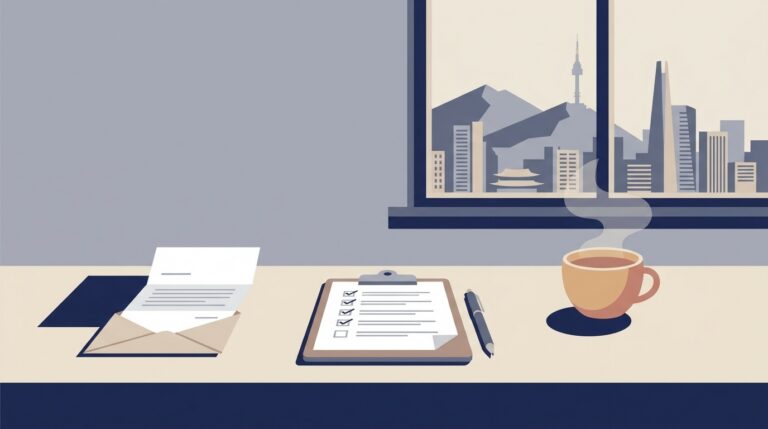
Phase 1: Why Your Recovery Matters More Than Your Mistake
Hello! This is the Daily Hangul Editor. Picture this: you just landed a huge partnership in Seoul, just like a tense boardroom scene in the hit K-Drama Misaeng. Suddenly, your phone buzzes—a shipment is delayed, and half the batch failed quality inspection! In Korean business, panic won’t save you. As our real B2 learners working with Korean suppliers shared, how you resolve a mistake and prevent recurrence reveals your true capability more than the mistake itself. Today, based on actual workplace feedback, I’ll guide you through sending official apology letters and corrective action plans in natural Korean—turning a crisis into unshakable trust!
Phase 2: Deep Dive Into 3 Essential Expressions
1. 재발 방지 대책 (Jaebal bangji daechaek)
- Pronunciation: jeh-bahl bahng-jee deh-chek (Think of “jeh” like “jealous”, “bahl” like “ball”, and “deh-chek” like “deck-check” without the first k.)
- Meaning: Literal: “re-occurrence prevention countermeasure.” Actual Nuance: The gold-standard Korean business phrase proving you have built a concrete, reliable system so the exact same error never happens again.
- K-Culture Moment: Think of K-Drama Agency (대행사) or a real-life K-Pop album defect notice—whenever an agency faces backlash over delayed merch or misprinted photocards, Korean fans and partners immediately look for the phrase 재발 방지 대책 (jaebal bangji daechaek) before deciding whether to forgive the brand.
- Editor’s Insight: Saying “I’m sorry” ten times feels empty in Korean B2B culture without this phrase. Korean clients draw a sharp line between emotional apologies and structural accountability. Presenting a clear 재발 방지 대책 (jaebal bangji daechaek) shows executive maturity.
- Situation Spectrum: Casual (🚫) / Semi-formal (⚠️) / Formal (✅)
- 🤔 Think About It: In English emails, we often say, “We will make sure this doesn’t happen again.” Why do you think Korean corporate culture relies on a heavy Sino-Korean noun phrase like 재발 방지 대책 (jaebal bangji daechaek) instead of a casual verb promise?
2. 차질 없이 수습하다 (Chajil eopsi suseupada)
- Pronunciation: chah-jeel up-shee soo-seu-pah-dah (Say “chah” like “cha-cha”, “up” like “up”, “shee” like “sheep”, and “seu” like a relaxed “uh” with flat lips.)
- Meaning: Literal: “to tidy up/manage without a hitch.” Actual Nuance: Containing and resolving an active crisis swiftly and calmly so your partner’s schedule and reputation remain protected.
- K-Culture Moment: In Misaeng: Incomplete Life, when a critical shipping invoice goes wrong at One International, the senior manager doesn’t waste time panicking—he rallies the team to 차질 없이 수습하다 (chajil eopsi suseupada) before the client feels a ripple effect.
- Editor’s Insight: At the B2 level, upgrading from basic 해결하다 (haegyeolhada, “to solve”) to 수습하다 (suseupada, “to contain damage and get things back on track”) instantly signals crisis-management competence. Pairing it with 차질 없이 (chajil eopsi, “without disruption”) reassures the client that their timeline comes first.
- Situation Spectrum: Casual (🚫) / Semi-formal (✅) / Formal (✅)
- 🤔 Think About It: How does your native language frame “fixing a business mess”? Does it emphasize speed, financial compensation, or shielding the other party from disruption?
3. 진심으로 사과의 말씀을 드립니다 (Jinsimeuro sagwaui malsseumeul deurimnida)
- Pronunciation: jeen-sheem-eu-ro sah-gwah-eh mahl-sseum-eul deu-reem-nee-dah (Pronounce “mahl-sseum” with a sharp, crisp ‘s’ sound like a quick hiss, and keep “eu” flat-lipped.)
- Meaning: Literal: “With a true heart, we offer words of apology.” Actual Nuance: The ultimate formal, sincere apology reserved for official letters (공문, gongmun) and crisis statements.
- K-Culture Moment: You will spot this exact opening line in official press releases (입장문, ipjangmun) from major Korean companies like Coupang or entertainment labels whenever a delivery delay or quality recall occurs.
- Editor’s Insight: Beginners rely on 죄송합니다 (joesonghamnida), which works fine in conversation, but looks too brief in an official Corrective Action Plan (시정조치서, sijeongjochiseo). Wrapping 사과 (apology) inside 말씀 (honored words) and 드리다 (humble verb “to give”) elevates your tone to executive grade.
- Situation Spectrum: Casual (🚫) / Semi-formal (⚠️) / Formal (✅)
- 🤔 Think About It: Korean uses humble verbs like 드리다 (deurida) to lower the speaker while elevating the client. How do you express formal humility in your native language without sounding overly defensive or weak?
Phase 3: Textbook Korean vs. Real Korean
Situation 1: Taking Ownership of a Quality Defect
📖 Textbook Korean: 실수해서 정말 죄송합니다. 다음부터 조심하겠습니다. (Silsuhaeseo jeongmal joesonghamnida. Daeumbuteo josimhagetseumnida.) — “I’m really sorry for making a mistake. I’ll be careful from next time.”🗣️ Real Korean: 이번 건은 저희 측 관리 소홀로 발생한 문제인 만큼, 책임감을 갖고 철저히 시정하겠습니다. (Ibeon geoneun jeohui cheuk gwalli sohollo balsaenghan munjein mankeum, chaegimgameul gatgo cheoljeohi sijeonghagetseumnida.) — “Since this issue occurred due to oversight on our end, we will take full responsibility and thoroughly rectify it.”💡 Why the difference?: Promising to “be careful next time” sounds like a student apologizing to a teacher. In Korean B2B culture, owning 관리 소홀 (gwalli sohol, management oversight) and committing to 시정 (sijeong, rectification) proves professional accountability.
Situation 2: Turning a Crisis Into Proof of Capability
📖 Textbook Korean: 실수를 통해 배웠고, 이제 시스템이 좋아졌습니다. (Silsureul tonghae baewotgo, ije siseutemi jowajyeotseumnida.) — “We learned through the mistake, and now our system is better.”🗣️ Real Korean: 실수 자체보다 수습하는 태도와 재발 방지 시스템이 진짜 실력을 보여 준다는 걸 뼈저리게 깨달았습니다. (Silsu jacheboda suseupaneun taedowa jaebal bangji siseutemi jinjja sillyeogeul boyeo jundaneun geol ppyeojorige kkaedaratseumnida.) — “We realized deeply that our attitude in resolving the issue and our recurrence-prevention system reveal our true capability more than the mistake itself.”💡 Why the difference?: Fluent B2 speakers use the vivid idiom 뼈저리게 깨닫다 (ppyeojorige kkaedatda, “to realize to the bone”) alongside ~보다 (“more than”) to frame an embarrassing error as a turning point in corporate maturity.
Phase 4: K-Culture Deep Dive & Non-Verbal Manners
4-1. Nunchi (눈치) & Physical Etiquette
Words are only half the battle in Korea—your physical demeanor speaks volumes before you even open your binder:
* The Sincere Bow: When entering a client’s office to deliver an apology in person, use a 30-to-45-degree bow (정중례, jeongjungnye) and hold it for two full seconds rather than giving a quick nod.
* Two-Handed Delivery: Always hand over the printed 공식 사과문 (gongsik sagwamun, official apology letter) and 시정조치서 (sijeongjochiseo, corrective action plan) with both hands, facing the text toward the client so they can read it immediately.
* Calm Eye Contact & Listening: Let the client finish voicing their frustration without interrupting or jumping straight into excuses. Keep your tone low, steady, and empathetic.
4-2. Cultural Code Analysis: The Korean “Apology Formula” in Business & Media
If you watch Korean business dramas or follow K-Pop production news, you’ll notice Korea has an unwritten 4-step “gold standard” for crisis communication: (1) Immediate acknowledgment without blaming third parties, (2) Transparent root-cause analysis (원인 분석, wonin bunseok), (3) Concrete recurrence-prevention system (재발 방지 대책, jaebal bangji daechaek), and (4) Clear follow-up or compensation. Skipping step 1 or rushing straight to excuses destroys sinroe (신뢰, trust)—the ultimate currency in Korean partnerships.
Phase 5: Real-Life Roleplay Scenario
Setting: A sleek, glass-walled meeting room in Gangnam Trade Tower. The faint aroma of iced Americano sits untouched on the table while morning sunlight hits your printed Corrective Action Plan.
Characters: You (Overseas Operations Manager) and Director Park Ji-hoon (박지훈 부장) (a sharp, detail-oriented Purchasing Director at a Korean K-Beauty brand whose packaging batch arrived 3 days late with 5% smudged labels).
- Director Park: 납품이 3일이나 지연된 데다 불량률까지 5%라니, 저희 출시 일정이 다 꼬였습니다. (Napgimi 3irina jiyeondoen deda bullyangnyulkkaji 5%rani, jeohui chulsi iljeongi da kkoyeotseumnida.) — “Not only was delivery delayed by 3 days, but there’s a 5% defect rate—our entire launch schedule is messed up.”
🎭 Leaning back, tapping a pen impatiently on the folder. - You: 박 부장님, 이번 납품 지연 및 품질 불량 건으로 큰 차질을 드려 진심으로 사과의 말씀을 드립니다. (Bak bujangnim, ibeon napgim jiyeon mit pumjil bullyang geoneuro keun chajireul deuryeo jinsimeuro sagwaui malsseumeul deurimnida.) — “Director Park, we sincerely offer our words of apology for causing major disruption due to this delivery delay and quality defect.”
🎭 Standing slightly to bow 30 degrees before handing over the report with both hands. - Director Park: 사과문은 받았습니다. 그런데 당장 내일 물류센터 입고는 어떻게 하실 겁니까? (Sagwamuneun badatseumnida. Geureonde dangjang naeil mullyusenteo ipgoneun eotteoke hasil geomnikka?) — “I’ve received your apology letter. Still, what are you going to do about tomorrow’s warehouse intake?”
🎭 Opening the folder with a skeptical frown. - You: 우선 오늘 밤까지 전수 재검수를 마치고, 정상품만 내일 오전 9시까지 항공 특송으로 차질 없이 수습하겠습니다. (Useon oneul bamkkaji jeonsu jaegeomsureul machigo, jeongsangpumman naeil ojeon 9sikkaji hanggong teuksongeuro chajil eopsi suseupagetseumnida.) — “First, we will complete a 100% re-inspection by tonight and resolve this smoothly by shipping only passing units via air express by 9 AM tomorrow.”
🎭 Pointing clearly to the urgent timeline highlighted on page 1. - Director Park: 급한 불은 끈다 쳐도, 앞으로 또 이런 일이 안 생긴다는 보장이 있습니까? (Geupan bureun kkeunda chyeodo, apeuro tto ireon iri an saenggyeondaneun bojangeun itseumnikka?) — “Even if you put out the immediate fire, what guarantee do we have that this won’t happen again?”
🎭 Looking you straight in the eye, testing your composure. - You: 맞습니다. 실수 자체보다 수습하는 태도와 재발 방지 시스템이 회사의 진짜 실력을 보여 준다는 교훈을 얻었습니다. (Matseumnida. Silsu jacheboda suseupaneun taedowa jaebal bangji siseutemi hoesaui jinjja sillyeogeul boyeo jundaneun gyohuneul eodeotseumnida.) — “You are right. We learned the lesson that our attitude in resolving a mistake and our recurrence-prevention system reveal a company’s true capability more than the mistake itself.”
🎭 Maintaining calm, respectful posture without sounding defensive. - Director Park: 말은 좋습니다. 구체적인 재발 방지 대책이 뭡니까? (Mareun jotseumnida. Guchejeogin jaebal bangji daechaegi mwomnikka?) — “That sounds good in theory. What is your specific measure to prevent recurrence?”
🎭 Flipping to page 2 of your Corrective Action Plan. - You: 공정 단계별 이중 검수 체크리스트를 의무화하고, 출하 전 3자 품질 검증 시스템을 도입했습니다. (Gongjeong dangyebyeol ijung geomsu chekeuriseuteureul uimuhwahaego, chulha jeon 3ja pumjil geomjeung siseutemeul doipaetseumnida.) — “We made a double-inspection checklist mandatory at every production stage and introduced a third-party quality verification system prior to shipment.”
🎭 Presenting the signed engineering audit sheet.
🔀 Interactive Branching Point
At Turn 5, when Director Park asks for a guarantee against future errors, what would happen if you chose differently?
* Option A (Best): “We made a double-inspection checklist mandatory and added third-party verification.” -> Feedback: Excellent! Specific structural fixes (시스템 구축) build immediate trust with Korean decision-makers.
* Option B (Bad): “Actually, our subcontractor made the printing error, not our main team.” (하청업체 실수였습니다.) -> Feedback: Fatal mistake! Passing the blame (책임 전가) signals weak management and destroys partnership credibility.
* Option C (Risk): “We’ll give you a 30% discount on your next order right away!” (다음 발주 때 30% 할인해 드리겠습니다.) -> Feedback: Risky move! Offering money before explaining the root cause makes Korean buyers worry you haven’t fixed the quality issue and that defects will keep happening.
Phase 6: 10-Second Emotion Shadowing Drill
Read these lines aloud, pausing briefly at every / mark and matching the emotional cue:
[🙇 Sincere & Steady]
이번 납품 지연으로 / 큰 불편을 드려 / 진심으로 사과의 말씀을 드립니다.
(Ibeon napgim jiyeoneuro / keun bulpyeoneul deuryeo / jinsimeuro sagwaui malsseumeul deurimnida.)
“We sincerely apologize for the great inconvenience caused by this delivery delay.”-
[🧐 Calm & Analytical]
원인을 철저히 파악하여 / 즉시 시정조치를 / 완료했습니다.
(Wonineul cheoljeohi paakayeo / jeuksi sijeongjochireul / wallyohaetseumnida.)
“We thoroughly identified the root cause and immediately completed corrective measures.” -
[🤝 Resolute & Trustworthy]
재발 방지 시스템을 통해 / 더 신뢰받는 파트너로 / 거듭나겠습니다.
(Jaebal bangji siseutemeul tonghae / deo sinroebanneun pateuneoro / geodeumnagetseumnida.)
“Through our recurrence-prevention system, we will be reborn as an even more trusted partner.”
Phase 7: K-Culture Mini Dictionary
- 시정조치서 (Sijeongjochiseo) | Corrective Action Report / Plan | A formal document detailing the root cause of a defect or delay, immediate containment, and long-term prevention steps.
- 납기 지연 (Napgi jiyeon) | Delivery Delay | Used in purchase orders and logistics emails whenever goods miss the contracted arrival date.
- 품질 불량 (Pumjil bullyang) | Quality Defect | Covers everything from damaged K-Pop album corners to factory electronics failing inspection.
- 신뢰 회복 (Sinroe hoebok) | Trust Recovery | The ultimate KPI after any crisis—rebuilding confidence so the client keeps ordering from you.
Phase 8: Survival Kit for Business Travelers in Korea
Top 3 Survival Phrases
- 급히 서류를 출력해야 하는데, 근처에 인쇄 가능한 곳이 있나요? (Geuphi seoryureul chullyeokaeya haneunde, geuncheoe inswae ganeunghan gosi innayo?) — “I need to print documents urgently; is there a place to print nearby?” Pro Tip: Look for “프린팅박스 (PrintingBox)” kiosks inside GS25 or CU convenience stores to print PDF apology letters 24/7!
- 오늘 안으로 도착하게 퀵서비스로 보내 주세요. (Oneul aneuro dochakage kwikseobiseuro bonae juseyo.) — “Please send this via same-day motorcycle courier so it arrives today.” Pro Tip: In Seoul, Quick Service delivers urgent physical documents or replacement samples across the city within 1–2 hours.
- 미팅 전에 조용히 통화할 수 있는 공간이 있을까요? (Miting jeone joyonghi tonghwahal su inneun gonggani isseulkkayo?) — “Is there a quiet space where I can take a call before the meeting?” Pro Tip: Use this at a partner’s lobby or a shared office to prep with your HQ before entering a tense negotiation.
Editor’s Travel Note
When rushing across Seoul to deliver an official corrective action report in person, timing is everything. Download Naver Map for Accurate Seoul Office Navigation because Google Maps walking and transit directions are limited in South Korea. For tight schedules between Gangnam and Yeouido, Download Kakao T for Fast Business Taxi Booking and link an international card for seamless cashless exits.
Phase 9: One Step Deeper
In Korean society, a single mistake rarely ends a relationship—avoiding responsibility does. Korean corporate culture places immense weight on chaekim-gam (책임감, sense of responsibility) and sinroe (신뢰, mutual trust), rooted in long-term relationship building rather than one-off transactions. When a supplier handles a quality defect transparently, builds a solid recurrence-prevention system, and shows genuine humility, Korean partners often become even more loyal—calling them a “믿을 수 있는 거래처” (mideul su inneun georaecheo, a partner you can truly count on). Crisis, handled well, becomes your strongest proof of character.
💬 Your Turn: Have you ever handled—or experienced—a major delivery delay or mistake where the apology actually made you trust the company more? Share your story in the comments below!
Phase 10: FAQ & Myth-Busting
Q: Should I send the official apology letter by email first, or deliver it in person?
A: Send a prompt email with the PDF of your 공식 사과문 (gongsik sagwamun, official apology letter) and initial timeline right away so the client isn’t left in the dark. For major B2B contracts, following up with a printed copy in person shows unmatched sincerity.
Q: Is it better to write “죄송합니다 (joesonghamnida)” or “사과드립니다 (sagwadeurimnida)” in an official document?
A: In written official letters and Corrective Action Plans, “사과의 말씀을 드립니다 (sagwaui malsseumeul deurimnida)” or “사과드립니다 (sagwadeurimnida)” sounds much more formal, structured, and executive than conversational 죄송합니다.
Q: What if we don’t know the exact root cause yet when the client demands an answer?
A: Never guess or make excuses! State clearly that you are conducting an urgent investigation (긴급 원인 파악 중, gingeup wonin paak jung), provide the exact time you will deliver the full 시정조치서 (corrective action report), and focus on immediate containment first.
🚨 Common Mistakes Warning Board
- Mistake: Starting your apology letter with “Because of the shipping company…” (운송사 때문에…) -> Correct Action: Own the end-to-end outcome first before mentioning logistics details.
- Mistake: Using casual endings like ~해요 (haeyo) in an official Corrective Action Plan -> Correct Action: Stick strictly to formal ~습니다 / ~ㅂ니다 endings throughout official documents.
- Mistake: Offering a vague promise like “We will work harder” (더 열심히 하겠습니다) -> Correct Action: Present measurable dates, inspection steps, and concrete 재발 방지 대책 (recurrence-prevention measures).
Phase 11: Action Mission & Engagement
- 🥉 Bronze (Solo Practice): Record yourself reading the 3 sentences in Phase 6 out loud, checking that your tone stays calm, steady, and respectful—never rushed!
- 🥈 Silver (SNS Share): Post one takeaway from today’s guide on LinkedIn or Instagram with
#DailyHanguland#KoreanBusinessCulture, sharing why systemic recovery matters more than perfection. - 🥇 Gold (Real-World Use): Draft a 4-line mock Korean apology email using 재발 방지 대책 (jaebal bangji daechaek) and 진심으로 사과의 말씀을 드립니다 (jinsimeuro sagwaui malsseumeul deurimnida) and ask a Korean colleague or tutor to review your tone!
🎮 K-Culture Mission: Watch an episode of a Korean workplace drama (like Misaeng or Agency) or check a K-Pop agency’s official notice on Weverse, and spot how many times the words 재발 방지 (recurrence prevention) or 진심으로 사과 (sincere apology) appear!
Phase 12: Interactive Quiz Challenge
Quiz 1: Situational Judgment
Your Korean client just emailed furiously about 200 defective units. Which opening sentence is most appropriate for your official written response?
A) 미안해요, 다음부터 진짜 조심할게요.
B) 저희 잘못이 아니라 공장 기계 문제였어요.
C) 이번 품질 불량 건으로 큰 차질을 드려 진심으로 사과의 말씀을 드립니다.
Click to reveal Answer & Explanation
Answer: C
Explanation: Option A uses casual speech (미안해요 / ~ㄹ게요), which is completely inappropriate in business. Option B shifts blame instead of taking accountability. Option C uses formal, respectful phrasing suitable for an official apology letter.
Quiz 2: Fill in the Blank
Complete this B2 sentence about proving true corporate capability:
“실수 자체보다 수습하는 태도와 ( ________ ) 시스템이 회사의 진짜 실력을 보여 줍니다.”
(Hint: “recurrence prevention”)
Click to reveal Answer & Explanation
Answer: 재발 방지 (jaebal bangji)
Explanation: “재발 방지 시스템” means “recurrence-prevention system,” the key phrase Korean partners look for to verify that a mistake won’t happen again.
Quiz 3: True or False Cultural Quiz
Statement: In Korean business culture, offering an immediate discount without explaining the root cause or corrective plan is the fastest way to win back trust.
Click to reveal Answer & Explanation
Answer: False
Explanation: Offering money before presenting a concrete root-cause analysis (원인 분석) and recurrence-prevention plan (재발 방지 대책) often makes Korean partners worry that you are brushing over an unresolved quality problem.
🎬 Watch Our Daily Videos! (Daily Hangul Official Instagram)
Review the expressions you learned in this article with our fun daily short videos! Check out native pronunciation and real-life nuances in action.
- Instagram @dailyhangul_en







