

Phase 1: Why Tech Korean Feels Like a Final Boss (And How to Beat It)
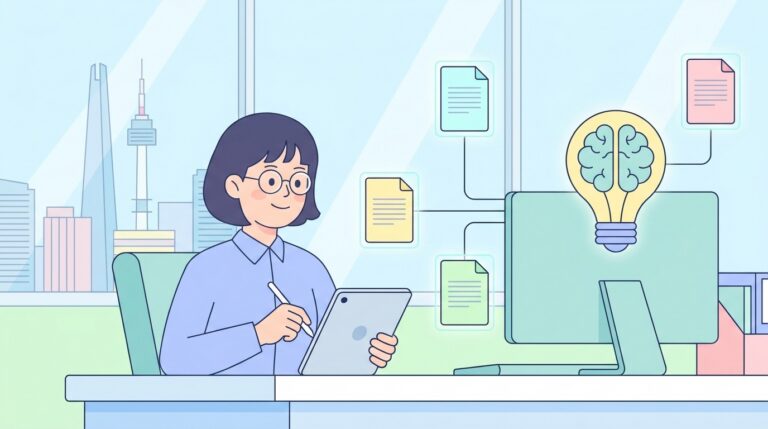
안녕하세요! 매일한글 에디터입니다. (Annyeonghaseyo! Maeil Hangeul editeoimnida. – Hello! I’m your Daily Hangul Editor.) Picture this: you are in a bustling Pangyo office, sipping an iced Americano just like a character in the K-Drama Start-Up. Suddenly, your team lead asks how you fixed the company AI chatbot’s hallucinations. You know the answer in English—you indexed internal wikis and PDF manuals into a vector database using RAG—but in Korean, your mind goes blank! Many B2 learners working in Korea told us this exact tech-meeting freeze is their biggest pain point. Based on real learner feedback, this guide equips you with natural Korean expressions to explain prompt engineering and RAG smoothly, helping you sound confident, credible, and sharp at work.
Phase 2: Deep Dive Into 3 Core Expressions
When explaining enterprise AI adoption—especially how you used Retrieval-Augmented Generation (RAG) to ground an LLM in your company’s internal wiki and PDFs—you don’t need to translate every word literally. Mastering these three B2 building blocks will make you sound like a seasoned Korean product engineer.
1. 이를 해결하기 위해 ~ 기술을 적용했어요 (Ireul haegyeolhagi wihae ~ gisureul jeogyonghaesseoyo)
- Pronunciation: [I-reul hae-gyeol-ha-gi wi-hae ~ gi-su-reul jeo-gyong-hae-sseo-yo] (Sounds like ee-reul heh-gyul-ha-gee wee-heh … gee-soo-reul juh-gyong-heh-ssuh-yo; think of jeo-gyong as a crisp “juh-gyong” like “jug-young”)
- Meaning: Literally “To solve this, we applied ~ technology.” Nuance: Structured, solution-oriented, and persuasive—ideal for explaining why you chose RAG over basic prompting.
- K-Culture Moment: Imagine the pivotal demo-day scene in Start-Up where Seo Dal-mi and Nam Do-san pitch their AI solution to skeptical investors, pivoting smoothly from problem statement to technical fix.
- Editor’s Insight: At the B2 level, using 이를 해결하기 위해 (ireul haegyeolhagi wihae – to solve this) instead of a simple 그래서 (geuraeseo – so) immediately elevates your logic. You can swap in 도입했어요 (doiphaesseoyo – we adopted/introduced) when referring to a whole system like 생성형 AI 서비스 (saengseonghyeong AI seobiseu – generative AI service).
- Situation Spectrum: Casual 🚫 | Semi-formal ✅ (team stand-ups) | Formal ✅ (executive briefings; change ending to 적용했습니다 / jeogyonghaetseumnida)
- 🤔 Think About It: In English, engineers often jump straight into “So we used RAG.” Why do Korean presentations almost always frame the action with 이를 해결하기 위해 (to solve this) first? How does highlighting the shared problem build consensus before pitching the tech?
2. 사내 문서를 벡터 DB에 색인화하다 (Sanae munseoreul bekteo DB-e saeginhwahada)
- Pronunciation: [Sa-nae mun-seo-reul bek-teo di-bi-e sae-gin-hwa-ha-da] (Note the liaison in 색인화: saek-in-hwa glides together as sae-gin-hwa, where gin sounds like “geen” in “begin”)
- Meaning: Literally “To index internal documents into a vector DB.” Nuance: Precise industry-standard phrasing used by Korean AI developers when describing data ingestion for RAG.
- K-Culture Moment: Think of an intense late-night coding montage in Silicon Valley-meets-Pangyo webtoons like Naver Webtoon office dramas, where developers whiteboard architecture diagrams while eating cold tteokbokki.
- Editor’s Insight: Many learners say 저장하다 (jeojanghada – to save), which sounds too basic for RAG pipelines. 색인화하다 (saeginhwahada – to index) comes from 색인 (saegin – index) + -화 (-hwa – -ize). If you want to sound extra natural in casual dev chats, Korean engineers also frequently mix Konglish and say 인덱싱하다 (indeksinghada – to index).
- Situation Spectrum: Casual ⚠️ (devs often say 인덱싱했어 / indeksinghaesseo) | Semi-formal ✅ | Formal ✅ (technical reports & proposals)
- 🤔 Think About It: Korean tech teams fluidly blend Hanja-based words like 색인화 (saeginhwa) with English loanwords like 벡터 데이터베이스 (bekteo deiteobeiseu). Does your native language keep tech jargon in English, or does it coin local compounds too?
3. 질문과 관련된 문서를 먼저 찾아 답변하게 하다 (Jilmungwa gwallyeondoen munseoreul meonjeo chaja dapbyeonhage hada)
- Pronunciation: [Jil-mun-gwa gwal-lyeon-doen mun-seo-reul meon-jeo cha-ja dap-byeon-ha-ge ha-da] (Watch out for 관련된: the n + r turns into a double L sound, gwal-lyeon-doen, gliding like “gwall-yun-dwen”)
- Meaning: Literally “To make it find documents related to the question first and then answer.” Nuance: Crystal-clear explanation of how RAG works for non-technical stakeholders.
- K-Culture Moment: Picture an IT team lead in an office K-Drama like Misaeng or Agency translating complex tech jargon so the old-school marketing director finally nods in relief.
- Editor’s Insight: Notice the causative pattern -게 하다 (-ge hada – to make/let something do X). You aren’t saying the AI decided to search; you engineered the pipeline to make it retrieve 사내 위키와 PDF 매뉴얼 (sanae wikiwa PDF maenyueol – internal wiki and PDF manuals) first. It shows ownership over prompt engineering and system design!
- Situation Spectrum: Casual ✅ (great for explaining to friends) | Semi-formal ✅ | Formal ✅ (client demos)
- 🤔 Think About It: Korean loves sequencing actions clearly with 먼저 ~고 (meonjeo ~go – first do X, and then…) and -게 하다 (-ge hada). How does explicitly expressing “cause and order” affect how trustworthy an AI workflow sounds to Korean stakeholders?
Phase 3: Textbook Korean vs. Real Korean
If you open a traditional business Korean textbook, you’ll sound like a 1990s news anchor. Here is how B2 speakers actually talk inside Seoul and Pangyo tech hubs.
Situation 1: Explaining Why the AI Got Something Wrong (Hallucinations)
- 📖 Textbook Korean: 인공지능이 잘못된 정보를 생성하는 문제가 발생하였습니다. (Ingongjineungi jalmotdoen jeongboreul saengseonghaneun munjega balsaenghayeotseumnida. – A problem occurred where the artificial intelligence generated incorrect information.)
- 🗣️ Real Korean: AI가 자꾸 없는 말을 지어내는 할루시네이션이 좀 있었어요. (AI-ga jakku eomneun mareul jieonaeneun hallusineisyeoni jom isseosseoyo. – The AI kept having hallucinations, making up things that aren’t there.)
- 💡 Why is it different? In real Korean dev teams, people use 인공지능 (ingongjineung) mostly in formal press releases. Day to day, everyone says AI (ei-ai) or LLM, and 없는 말을 지어내다 (eomneun mareul jieonaeda – to make up nonexistent words) vividly explains hallucinations in a relatable, human way.
Situation 2: Describing Prompt Engineering & RAG Fixes
- 📖 Textbook Korean: 질문에 대한 정확한 응답을 유도하기 위하여 프롬프트를 수정하고 검색 증강 생성을 활용하였습니다. (Jilmune daehan jeonghwakhan eungdabeul yudohagi wihayeo peurrompeuteureul sujeonghago geomsaek jeunggang saengseongeul hwaryonghayeotseumnida.)
- 🗣️ Real Korean: 프롬프트만 깎는 걸로는 한계가 있어서, 사내 문서부터 뒤져서 답하게 RAG를 붙였어요. (Peurrompeuteuman kkakneun geolloneun hangyega isseoseo, sanae munseobuteo dwijyeoseo daphage RAG-reul buchyeosseoyo. – Just polishing the prompt had its limits, so we attached RAG to make it dig through internal docs first before answering.)
- 💡 Why is it different? Look at that B2 gold: 프롬프트를 깎다 (peurrompeuteureul kkakda – literally “to carve/whittle a prompt”) is beloved Korean developer slang for endlessly tweaking prompts! And 붙이다 (buchida – to attach) is the casual, punchy way engineers talk about integrating a module like RAG.
Phase 4: K-Culture Deep Dive & Non-Verbal Manners
4-1. Nunchi (눈치) & Body Language in a Korean Tech Demo
When presenting how you solved a problem—like indexing your 사내 위키와 PDF 매뉴얼 (sanae wikiwa PDF maenyueol) into a 벡터 데이터베이스 (bekteo deiteobeiseu)—your non-verbal cues matter just as much as your code:
* Two-Handed Confidence: If you hand over a printed architecture sheet or tablet during a meeting, always offer it with both hands (or support your right forearm with your left hand). It signals deep respect.
* The “Listening Nod” (끄덕임 / Kkeudeogim): Even if a senior manager asks a non-technical question about 프롬프트 엔지니어링 (peurrompeuteu enjinieoring), nod attentively, pause for half a second, and start with 좋은 질문 감사합니다 (joeun jilmun gamsahamnida – thank you for the great question) before diving into RAG.
* Open Palm Gestures: Korean offices generally avoid aggressive finger-pointing at screens. Use an open palm when gesturing toward the dashboard or vector search flow.
4-2. Cultural Code: Pangyo’s “Ppalli-Ppalli” (빨리빨리) & K-Coffee Culture
Walk into Pangyo Techno Valley—Korea’s Silicon Valley just south of Seoul—and you’ll immediately feel the 빨리빨리 (ppalli-ppalli – hurry-hurry) spirit paired with high-craft execution. Enterprise AI adoption in Korea moves at lightning speed: companies don’t want abstract AI hype; they want 실무에 바로 쓸 수 있는 솔루션 (silmue baro sseul su inneun sollusyeon – a solution usable right away in real work). That is why RAG became huge in Korea so fast—it lets teams keep sensitive internal data secure while getting instant answers. And don’t be surprised if your entire architecture review happens over an 아아 (a-a – iced Americano) at a sleek office café—in Korean tech culture, caffeine is practically an honorary member of the engineering team!
Phase 5: Real-Life Roleplay Scenario
Setting: Tuesday morning sprint review on the 14th floor of a sunny Pangyo IT building. The aroma of roasted coffee fills the glass conference room.
NPC: 김 팀장님 (Kim Timjangnim – Team Lead Kim), a sharp, friendly 10-year veteran PM who loves practical results and hates vague buzzwords.
- 김 팀장님: 🎭 (Leaning forward, tapping his pen lightly on his iPad) 이번에 도입한 사내 챗봇, 테스트해 보니까 가끔 엉뚱한 규정을 지어내던데 어떡하죠? (Ibeone doiphan sanae chaetbot, teseuteuhae bonikka gakkeum eongttunghan gyujeongeul jieonaedeonde eotteokhajyo? – I tested the internal chatbot we adopted this time, and it sometimes makes up weird policies. What should we do?)
- You: 🎭 (Nodding calmly with an open-palm gesture toward the slide) 네, 팀장님. 일반 LLM만 쓰면 사내 최신 규정을 모르기 때문에 환각 현상이 생겨요. (Ne, timjangnim. Ilban LLM-man sseumyeon sanae choesin gyujeongeul moreugi ttaemune hwangak hyeonsangi saenggyeoyo. – Yes, Team Lead. If we only use a standard LLM, hallucinations happen because it doesn’t know our latest internal policies.)
- 김 팀장님: 🎭 (Raising an eyebrow, curious) 아, 프롬프트 엔지니어링만으로는 해결이 안 되나요? (A, peurrompeuteu enjinieoringmaneuroneun haegyeori an doenayo? – Oh, can’t that be solved with prompt engineering alone?)
- You: 🎭 (Smiling reassuringly and advancing to the architecture diagram) 프롬프트만으로는 한계가 있어요. 이를 해결하기 위해 사내 위키와 PDF 매뉴얼을 벡터 데이터베이스에 색인화했어요. (Peurrompeuteuman-euroneun hangyega isseoyo. Ireul haegyeolhagi wihae sanae wikiwa PDF maenyueoreul bekteo deiteobeiseu-e saeginhwahaesseoyo. – Prompting alone has limits. To solve this, we indexed our internal wiki and PDF manuals into a vector database.)
- 김 팀장님: 🎭 (Impressed, leaning in closer) 오, 색인화요? 그럼 질문이 들어오면 어떻게 작동하나요? (O, saeginhwayo? Geureom jilmuni deureoomyeon eotteoke jakdonghanayo? – Oh, indexed them? Then how does it work when a question comes in?)
- You: 🎭 (Tracing the search-to-answer flow smoothly on the screen) 질문과 관련된 문서를 먼저 찾아 답변하게 하는 ‘RAG(검색 증강 생성)’ 기술을 적용했어요. (Jilmungwa gwallyeondoen munseoreul meonjeo chaja dapbyeonhage haneun ‘RAG(geomsaek jeunggang saengseong)’ gisureul jeogyonghaesseoyo. – We applied ‘RAG (Retrieval-Augmented Generation)’ technology, which finds documents related to the question first and has it answer based on them.)
- 김 팀장님: 🎭 (Smiling broadly and giving a thumbs-up) 아! 근거 문서부터 찾아서 답하니까 정확도가 확 올라가겠네요! (A! Geungeo munseobuteo chajaseo daphanikka jeonghwakdoga hwak ollagagenneyo! – Ah! Since it finds the source document first and answers, accuracy must shoot right up!)
- You: 🎭 (Sitting back slightly with a confident smile) 맞아요! 출처 링크도 같이 띄워 주니까 실무자분들이 훨씬 안심하고 쓰실 수 있어요. (Majayo! Chulcheo ringkeudo gachi ttuiwo junikka silmujabundeuri hwolssin ansimhago sseusil su isseoyo. – Exactly! Since it also displays the source link, staff can use it with much more peace of mind.)
🔀 Interactive Branching Point
Right after your explanation, Team Lead Kim asks: “혹시 보안이나 업데이트 문제는 괜찮을까요? (Hoksi boanina eopdeiteu munjeneun gwaenchaneulkkayo? – What about security or update issues?)” How do you reply?
- Option A: “네! 모델 자체를 다시 학습시키는 게 아니라 벡터 DB만 업데이트하면 돼서 보안도 안전하고 최신 유지도 쉬워요.” (Ne! Model jachereul dasi hakseupsikineun ge anira bekteo DB-man eopdeiteuhamyeon dwaeseo boando anjeonhago choesin yujido swiwoyo. – Yes! Because we only update the vector DB rather than retraining the model itself, security is safe and keeping it up-to-date is easy.)
- Feedback (🏆 Best!): Clear, technically accurate, and directly addresses his pain point in natural B2 Korean!
- Option B: “그건 아직 잘 모르겠는데요. 그냥 일단 써 보시죠.” (Geugeon ajik jal moreugenneundeyo. Geunyang ildan sseo bosijyo. – I don’t really know about that yet. Let’s just try using it for now.)
- Feedback (🚫 Bad): Too blunt and dismissive. In Korean workplace culture, 그냥 일단 (just for now) around security makes stakeholders nervous.
- Option C: “보안? 문제없어요! 완벽해요!” (Boan? Munjeeopseoyo! Wanbyeokhaeyo! – Security? No problem! It’s perfect!)
- Feedback (⚠️ Risk): Saying 완벽해요 (perfect) without explaining why triggers skepticism—Korean team leads prefer brief, evidence-based reassurance.
Phase 6: 10-Second Emotional Shadowing Drill
Read these lines out loud, pausing briefly at every / and matching the emotional cue!
[🤔 Analytical and calm]
프롬프트만으로는 / 한계가 / 있어요. / (Peurrompeuteuman-euroneun / hangyega / isseoyo. – Prompting alone has its limits.)[💡 Clear and solution-oriented]
이를 해결하기 위해 / 사내 위키와 PDF 매뉴얼을 / 벡터 데이터베이스에 / 색인화했어요. / (Ireul haegyeolhagi wihae / sanae wikiwa PDF maenyueoreul / bekteo deiteobeiseu-e / saeginhwahaesseoyo.)[😊 Confident and proud]
질문과 관련된 문서를 / 먼저 찾아 답변하게 하는 / RAG 기술을 / 적용했어요! / (Jilmungwa gwallyeondoen munseoreul / meonjeo chaja dapbyeonhage haneun / RAG gisureul / jeogyonghaesseoyo!)
Phase 7: K-Culture Mini Dictionary
- 생성형 AI (Saengseonghyeong AI) | Generative AI | The formal term seen in Korean tech news, startup pitch decks, and enterprise IT proposals.
- 프롬프트 엔지니어링 (Peurrompeuteu enjinieoring) | Prompt Engineering | Used everywhere from developer Slack channels to Korean YouTube productivity tutorials on getting better outputs from AI.
- 검색 증강 생성 (Geomsaek jeunggang saengseong) | Retrieval-Augmented Generation (RAG) | While engineers casually say 래그 (raegeu) or RAG, official Korean reports always pair it with this full Korean translation.
- 사내 위키 (Sanae wiki) | Internal company wiki | 사내 (sanae) means “in-house/internal” (super useful! Also used in 사내 카페 / sanae kape for office café and 사내 규정 / sanae gyujeong for company rules).
Phase 8: Survival Kit for Tech Travelers in Korea
Heading to Seoul or Pangyo for a tech conference, workation, or startup visit? Keep these three phrases in your pocket:
- 여기에 와이파이 비밀번호가 어떻게 되나요? (Yeogie waipai bimilbeonhoga eotteoke doenayo? – What is the Wi-Fi password here?)
- Pro Tip: Essential in Pangyo cafés when your laptop runs out of hotspot data!
- 화면 잠깐 공유해도 될까요? (Hwamyeon jamkkan gongyuhaedo doelkkayo? – May I share my screen for a moment?)
- Pro Tip: Polite and smooth for hybrid Zoom/Google Meet calls or coffee chats.
- 자료는 메신저로 바로 보내드릴게요. (Jaryoneun mesinjeoro baro bonaedeurilgeyo. – I’ll send the materials right over via messenger.)
- Pro Tip: In Korea, “messenger” almost always means KakaoTalk or Slack!
Editor’s Travel Note
To navigate between Gangnam and Pangyo smoothly, make sure to download Naver Map for accurate Seoul transit routes and install Kakao T for quick Korean taxi hailing before you land, as international map apps don’t offer full walking or subway navigation in South Korea. Grab a T-money (티머니) card at any convenience store or set up WOWPASS for effortless subway rides on the Shinbundang Line—the sleek red-tagged subway line that zips straight from Gangnam to Pangyo Tech Valley in under 15 minutes!
Phase 9: One Step Deeper
Notice how our target unit uses 적용했어요 (we applied) and 사내 (in-house) rather than “I built it alone.” In Korean workplace culture, technical achievements are almost always framed through 우리 (uri – we/our)—collective ownership over the team’s problem and solution. When you pair humble, polite endings like -했어요 (-haesseoyo) with precise technical nouns like 색인화 (indexing), you balance Korean relational harmony with global engineering credibility. That’s the secret sauce of B2 business Korean!
💬 Your Turn: Have you ever tried explaining a technical concept from your job in Korean? Drop the trickiest tech word you’ve had to translate in the comments below—let’s tackle it together!
Phase 10: FAQ & Common Mistakes
Q: Do Korean developers say “RAG” in English or “검색 증강 생성” in Korean?
A: In spoken conversations and Slack messages, Korean engineers almost always say RAG (pronounced rae-geu or spelled out ar-ei-ji). However, in executive presentations, client proposals, and B2B sales meetings, introducing it once as 검색 증강 생성, 즉 RAG (geomsaek jeunggang saengseong, jeuk RAG) shows polished professional mastery.
Q: Is “할루시네이션 (hallucination)” understood in Korean offices, or is there a pure Korean word?
A: Both are widely used! Tech teams say 할루시네이션 (hallusineisyeon) constantly, while formal documents use 환각 현상 (hwangak hyeonsang). Pairing them casually—like AI 환각 현상 (AI hallucination)—is crystal clear to both developers and managers.
Q: Should I use “-했어요” or “-했습니다” when explaining our RAG project?
A: Use -했어요 (-haesseoyo) in team stand-ups, 1-on-1s, and casual demos with coworkers. Switch to -했습니다 (-haetseumnida) for C-level briefings, external client pitches, or official company-wide all-hands presentations.
🚨 Common Mistakes Warning Board
- Mistake: Saying 파일을 넣었어요 (paireul neoeosseoyo – I put the files in) for vector databases. → Correct Action: Use 색인화했어요 (saeginhwahaesseoyo – indexed) or 임베딩했어요 (imbedinghaesseoyo – embedded) for technical precision.
- Mistake: Overusing 당신 (dangsin – you) when asking if a teammate tested the prompt. → Correct Action: Use their title, like 팀장님 (timjangnim) or 대리님 (daerinim), or omit the pronoun completely!
- Mistake: Translating “to make the AI answer” with 시키다 (sikida – to order/force someone) in formal demos. → Correct Action: Use -게 하다 (-ge hada) as in 답변하게 하다 (dapbyeonhage hada), which sounds cleaner and more system-focused.
Phase 11: Action Mission & K-Culture Challenge
- 🥉 Bronze Mission (Solo Practice): Record a 15-second voice memo on your phone reading the 3 sentences from Phase 6 out loud, aiming for smooth pauses at 색인화했어요.
- 🥈 Silver Mission (Community Share): Write one Korean sentence describing a work or study problem you solved using 이를 해결하기 위해 ~ 기술을 적용했어요 and share it with a study buddy or on social media.
- 🥇 Gold Mission (Real-World Use): Next time you talk to a Korean colleague, tutor, or language partner about AI tools, drop 사내 문서 (internal docs) or 프롬프트 엔지니어링 (prompt engineering) naturally into the chat!
- 🎮 K-Culture Mission: Watch a Korean tech YouTube channel (like EO or 조코딩 / JoCoding) or an episode of Start-Up, and listen for how speakers blend English tech terms with -화하다 (-hwahada) or -을/를 적용하다 (-eul/reul jeogyonghada).
Phase 12: Interactive Quiz Challenge
Test your B2 Tech Korean instincts! Click the spoiler toggle below each question to check your answer.
Quiz 1 (Situational Judgment): You are explaining to your Korean marketing lead why your new chatbot doesn’t lie anymore. Which sentence sounds the most natural and persuasive?
A) AI한테 그냥 착하게 말하라고 했어요. (I just told the AI to speak nicely.)
B) 이를 해결하기 위해 관련 문서를 먼저 찾아 답변하게 하는 RAG 기술을 적용했어요.
C) AI가 혼자 공부해서 똑똑해졌어요. (The AI studied by itself and got smart.)
Click to reveal Quiz 1 Answer & Feedback
Answer: B!
* Why B wins: It uses the structured problem-solution frame (이를 해결하기 위해) and explains RAG clearly for a non-engineer.
* Why A & C fall short: Option A sounds playful rather than professional, and Option C is inaccurate because RAG retrieves external documents rather than retraining the model!
Quiz 2 (Fill in the Blank): Complete the phrase for indexing internal company manuals into a vector DB.
“사내 위키와 PDF 매뉴얼을 벡터 데이터베이스에 ________했어요.” (Sanae wikiwa PDF maenyueoreul bekteo deiteobeiseu-e ________haesseoyo.)
Click to reveal Quiz 2 Answer & Explanation
Answer: 색인화 (saeginhwa) — making 색인화했어요 (saeginhwahaesseoyo – indexed)!
* Bonus points if you remembered that in casual developer talk, 인덱싱 (indeksing) is also super common!
Quiz 3 (True/False Cultural Quiz): In Korean IT workplaces, it is considered polite and natural to casually say “그냥 완벽해요! (It’s just perfect!)” without explaining how data security or source retrieval works when a Team Lead asks a follow-up question.
Click to reveal Quiz 3 Answer & Explanation
Answer: False!
* Korean team leads value 근거 (geungeo – evidence/grounds) and thoroughness. Explaining why it’s safe (e.g., updating the vector DB instead of retraining the model, or showing source links) builds real trust!
🎬 Watch Our Daily Videos! (Daily Hangul Official Instagram)
Review the expressions you learned in this article with our fun daily short videos! Check out native pronunciation and real-life nuances in action.
- Instagram @dailyhangul_en







