

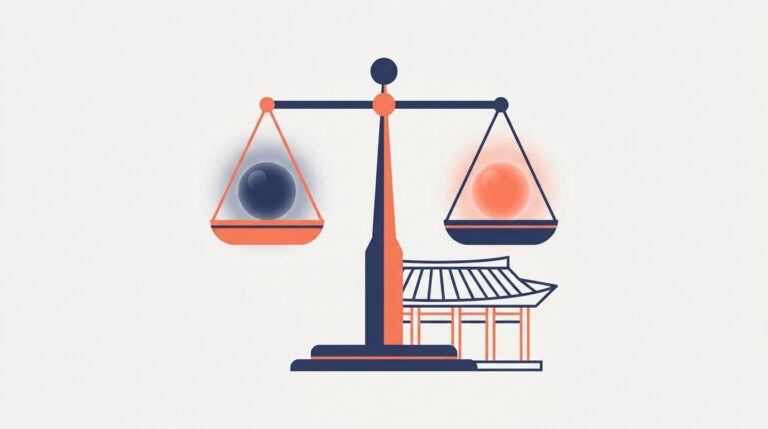
Phase 1: Why Harmonizing Rights Feels So Hard in Korean
안녕하세요! 매일한글 에디터입니다. (Annyeonghaseyo! Maeil Hangeul editeo-imnida.) Picture this: you are binge-watching a tense Korean legal thriller like Extraordinary Attorney Woo with your Korean friend. On screen, freedom of the press collides head-on with an individual’s privacy. You jump in to argue that courts shouldn’t simply erase one right, only to freeze mid-sentence! Even at C2, articulating Korean constitutional doctrine feels daunting. Built on real feedback from our advanced learners, this guide unlocks ‘규범조화적 해석’ (gyubeomjohwajeok haeseok — harmonious norm interpretation), turning you from a fluent speaker into an incisive debater.
Phase 2: Deep Dive into Top 3 Constitutional Expressions
1. 규범조화적 해석 (gyubeomjohwajeok haeseok)
- Pronunciation: gyu-beom-jo-hwa-jeok hae-seok (Think ‘gyu’ like ‘cue’ with a soft ‘g’, ‘beom’ like ‘bum’ in bumper, ‘jo-hwa’ gliding like ‘Joe-wah’, and ‘hae-seok’ like ‘hey-suck’ clipped short.)
- Meaning: Literally ‘norm-harmonizing interpretation.’ In practice, it means reconciling two clashing constitutional rights so that neither is wiped out, preserving the essential core of both.
- K-Culture Moment: In courtroom dramas like Law School and Juvenile Justice, professors grill students on how a judge balances a defendant’s right to a fair trial against media transparency without gutting either value.
- Editor’s Insight: Adapted from the German concept of praktische Konkordanz, this phrase is the gold standard in Korean Constitutional Court rulings. When you drop this in a debate, Koreans immediately know you understand the architecture of Korean jurisprudence, not just surface vocabulary.
- Situation Spectrum: Casual ⚠️ (Too academic for casual banter unless joking) / Semi-formal ✅ (Great in university seminars or serious podcasts) / Formal ✅ (Essential in legal, policy, and academic settings)
- 🤔 Think About It: Anglo-American courts often rely on strict tiers of scrutiny or balancing tests where one interest prevails. Why do you think Korean constitutional culture prizes the word ‘조화’ (johwa — harmony) so heavily when rights collide?
2. 일방적으로 폐기하지 않고 양자의 효력을 살리다 (ilbangjeogeuro pyegihaji anko yangjaui hyoryeogeul sallida)
- Pronunciation: il-bang-jeo-geu-ro pye-gi-ha-ji an-ko yang-ja-ui hyo-ryeo-geul sal-li-da (‘il-bang’ like ‘ill-bong’, ‘pye-gi’ like ‘pyeh-gee’, ‘yang-ja’ like ‘yahng-jah’, and ‘sal-li-da’ like ‘sahl-lee-dah’.)
- Meaning: Literally ‘without discarding one side unilaterally, to keep the validity of both alive.’ Practically, it conveys preserving the functional core of competing constitutional protections.
- K-Culture Moment: Imagine a heated Ssulzun-style current affairs panel debating noisy late-night protests in residential Seoul: one side argues freedom of assembly, the other argues the right to peaceful sleep, and the moderator sums up the court’s duty with this exact phrasing.
- Editor’s Insight: Notice the verb ‘살리다’ (sallida — to save/keep alive)! Even in dry constitutional prose, Korean uses an organic, almost life-giving verb instead of a cold mechanical one like ‘유지하다’ (yujihada — maintain). It signals active judicial care.
- Situation Spectrum: Casual 🚫 (Way too stiff for drinks with friends) / Semi-formal ✅ (Polished for essays and presentations) / Formal ✅ (Peak C2 elegance for debates and legal briefs)
- 🤔 Think About It: Compare ‘to preserve the core’ in English with ‘효력을 살리다’ (to bring/keep efficacy alive) in Korean. How does framing legal validity as something ‘alive’ change how a speaker perceives judicial responsibility?
3. 비례성의 원칙과 과잉금지원칙 (biryeseong-ui wonchik-gwa gwainggeumjiwonchik)
- Pronunciation: bi-rye-seong-ui won-chik-gwa gwa-ing-geum-ji-won-chik (‘bi-rye’ like ‘bee-ryeh’, ‘won-chik’ like ‘one-chick’, and ‘gwa-ing-geum-ji’ flowing like ‘gwah-ing-gum-jee’.)
- Meaning: Literally ‘the principle of proportionality and the principle prohibiting excessive restriction.’ Practically, it is the four-step constitutional test ensuring any limit on a right is legitimate, suitable, minimally intrusive, and balanced.
- K-Culture Moment: Think of the fierce public debates portrayed in The Devil Judge or real-life Korean news coverage whenever pandemic curfews or digital privacy laws face Constitutional Court review—anchors constantly invoke ‘과잉금지원칙 위반 여부’ (whether it violates the ban on excessive restriction).
- Editor’s Insight: While ‘비례성의 원칙’ frames the broad balancing philosophy, ‘과잉금지원칙’ zooms in on restraining state overreach. Native legal pros pair them seamlessly, though in everyday policy critiques ‘과잉금지’ hits harder because everyone instinctively dislikes ‘과잉’ (excess).
- Situation Spectrum: Casual ⚠️ (Used playfully when someone overreacts, e.g., ‘그건 과잉금지 위반이야!’) / Semi-formal ✅ (Common in news commentary) / Formal ✅ (Indispensable in constitutional analysis)
- 🤔 Think About It: In your native language, do citizens naturally invoke constitutional test names in everyday news chatter, or do those terms stay locked inside courtrooms?
Phase 3: Textbook Korean vs. Real Korean
Situation 1: Explaining why neither right should be completely sacrificed
- 📖 교과서 한국어 (Textbook Korean): 두 기본권이 충돌할 경우 어느 일방을 일률적으로 폐기하지 않고 양자의 효력을 모두 살리는 규범조화적 해석을 추구해야 합니다. (Du gibongwon-i chungdolhal gyeongu eoneu ilbang-eul illyuljeogeuro pyegihaji anko yangjaui hyoryeogeul modu sallineun gyubeomjohwajeok haeseogeul chuguhaeya hamnida. — When two fundamental rights clash, one must pursue harmonious norm interpretation that preserves the efficacy of both without uniformly discarding either side.)
- 🗣️ 진짜 한국어 (Real Korean): 둘 중 하나를 무조건 잘라낼 게 아니라, 양쪽 다 핵심은 지키면서 선을 잘 타야죠. (Dul jung hanareul mujogeon jallanael ge anira, yangjjok da haeksimeun jikimyeonseo seoneul jal tayajyo. — Rather than blindly cutting one of them off, you’ve got to walk the fine line while protecting the core of both sides.)
- 💡 왜 다를까? (Why the Difference?): In formal briefs, ‘일률적으로 폐기하다’ (discard uniformly) establishes objective authority. Over coffee, even Constitutional Court clerks switch to vivid tactile metaphors like ‘잘라내다’ (cut off) and ‘선을 타다’ (walk the tightrope/line) to make abstract balancing feel intuitive.
Situation 2: Pointing out that a restriction fails the proportionality check
- 📖 교과서 한국어 (Textbook Korean): 해당 조치는 최소침해성의 원칙에 반하여 비례성 심사를 통과하기 어렵습니다. (Haedang jochineun choesochimhaeseong-ui wonchige banhayeo biryeseong simsareul tonggwahagi eoryeopseumnida. — The measure in question violates the principle of least restriction and is unlikely to pass proportionality review.)
- 🗣️ 진짜 한국어 (Real Korean): 취지는 알겠는데 수단이 너무 나갔어요. 덜 건드리고도 충분히 막을 수 있었잖아요. (Chwijineun algenneunde sudani neomu nagasseoyo. Deol geondeurigodo chungbunhi mageul su isseotjanayo. — I get the intent, but the means went way too far. They could have easily prevented it with a lighter touch.)
- 💡 왜 다를까? (Why the Difference?): ‘최소침해성’ (least intrusiveness) is pure legal shorthand. In spoken Korean, ‘너무 나갔다’ (went too far) and ‘덜 건드리다’ (touch/interfere less) deliver the exact same doctrinal punch with unmistakable conversational warmth and persuasion.
Phase 4: K-Culture Deep Dive & Non-Verbal Manners
4-1. Nunchi & Gestures in High-Level Korean Debates
When Korean lawyers, academics, or sharp-tongued panelists debate clashing rights, nunchi (situational awareness) is everything. Pointing fingers or pounding the table instantly signals you’ve lost composure—and your argument. Instead, watch how Korean commentators use symmetrical, open-palm gestures (‘양손 균형 제스처’ — balancing both hands like imaginary scales) whenever they say ‘양자의 효력’ (efficacy of both). Pair this with a thoughtful half-second pause and a gentle ‘물론 상대측 입장도 타당하지만…’ (Mullon sangdaecheuk ipjangdo tadanghajiman… — Of course the opposing side’s stance is valid, however…) before introducing your proportionality critique. That micro-concession earns deep respect in Korean hierarchy-conscious spaces.
4-2. Cultural Code: Why Korean Pop Culture Loves the Constitutional Court
Unlike countries where constitutional law feels distant, South Korea’s Constitutional Court (Heonbeopjaepanso), established in 1988 after democratization, is a living cultural icon! From intense courtroom confrontations in Law School to viral news broadcasts outside Anguk Station, Koreans actively follow landmark rulings on privacy, labor rights, and free speech. Because real Korean history has been shaped by citizens filing constitutional complaints (heonbeopsowon), dramas don’t treat ‘비례성 심사’ (proportionality review) as boring trivia—they treat it as the dramatic heartbeat of fairness.
Phase 5: Real-Life Roleplay Scenario
Setting: A sunlit specialty roastery in Seocho-dong, Seoul, just blocks from the Supreme Court. Legal briefs sit beside iced Americanos.
NPC: Min-ji, a sharp, caffeine-fueled third-year Korean law student (ro-seukul-saeng) prepping for the bar exam.
- Min-ji: 🎭 (tapping her tablet stylus against a case summary) 야, 이번 모의고사 사례 진짜 골치 아프지 않아? 언론의 자유랑 사생활의 비밀이 정면충돌하네. (Ya, ibeon mouigosa sarye jinjja golchi apeuji ana? Eollon-ui jayurang sasaenghwal-ui bimiri jeongmyeonchungdolhane. — Hey, isn’t this mock exam case a total headache? Freedom of the press and privacy are colliding head-on.)
- You: 🎭 (leaning in thoughtfully) 맞아요. 이럴 때 한쪽을 일방적으로 포기할 순 없잖아요. (Majayo. Ireol ttae hanjjogeul ilbangjeogeuro pogihal sun eopjanayo. — Totally. In a case like this, you can’t just unilaterally abandon one side.)
- Min-ji: 🎭 (nodding approvingly) 오, 정확해. 그럼 판례가 취하는 핵심 해법이 뭔지 기억나? (O, jeonghwakhae. Geureom pallyega chwihaneun haeksim haebeobi mwonji gieongna? — Oh, spot on. Then do you remember the core solution precedent takes?)
- You: 🎭 (gesturing smoothly with both hands like balanced scales) 규범조화적 해석이죠. 양자의 본질적 효력을 모두 살려야 하니까요. (Gyubeomjohwajeok haeseogijyo. Yangjaui bonjiljeok hyoryeogeul modu sallyeoya hanikkayo. — Harmonious norm interpretation, right? Because the essential efficacy of both must be preserved.)
- Min-ji: 🎭 (grinning over her iced Americano) 와, C2 클래스 어디 안 가네! 그럼 구체적인 심사 기준은 어떻게 풀 거야? (Wa, C2 keullaeseu eodi an gane! Geureom guchejeogin simsa gijuneun eotteoke pul geoya? — Wow, your C2 level never misses! So how are you going to unpack the concrete review standard?)
- You: 🎭 (smiling confidently) 공익과 사익을 저울질할 때, 비례성의 원칙으로 과도한 제한인지 따져봐야죠. (Gongik-gwa saigeul jeouljilhal ttae, biryeseong-ui wonchigeuro gwadohan jehaninji ttajyeobwayajyo. — When weighing public and private interests, we have to examine whether it’s an excessive restriction using the proportionality principle.)
- Min-ji: 🎭 (raising her coffee cup in a mock toast) 완벽해. 특히 최소침해성 원칙을 건드리면 답안지 점수 싹쓸이하겠는데? (Wanbyeokhae. Teukhi choesochimhaeseong wonchigeul geondeurimyeon dabanji jeomsu ssaksseurihagenneunde? — Flawless. Especially if you hit the least-restrictive-means principle, you’d sweep full marks on the exam!)
- You: 🎭 (laughing) 오늘 서초동 커피값이 아깝지 않네요! (Oneul Seocho-dong keopigapsi akkapji anneyo! — Today’s Seocho-dong coffee was worth every won!)
🔀 Interactive Branching Point: Min-ji asks how you’d critique an overly broad privacy gag order!
How do you respond naturally and accurately?
* Option A: “취지는 공감하지만, 덜 침해적인 수단이 있었으니 과잉금지원칙에 어긋난다고 봐요.” (Chwijineun gonggamhajiman, deol chimhaejeogin sudani isseosseuni gwainggeumjiwonchige eogeunnandago bwayo. — I sympathize with the intent, but since less intrusive means existed, I view it as violating the ban on excessive restriction.)
* Option B: “그냥 언론의 자유가 더 중요하니까 사생활 권리는 폐기해야 맞지 않나요?” (Geunyang eollon-ui jayuga deo jungyohanikka sasaenghwal gwollineun pyegihaeya matji annayo? — Since press freedom is just more important, shouldn’t we discard the privacy right?)
* Option C: “비례성 심사는 법관 마음대로 하니까 이론은 별로 쓸모없어요.” (Biryeseong simsaneun beopgwan maeumdaero hanikka ironeun byeollo sseulmoeopseoyo. — Proportionality review is whatever the judge feels like, so theory is pretty useless.)
Feedback:
* Option A (Best!): Stellar C2 execution! You validate the legislative goal first (‘취지는 공감하지만’) before pinpointing the exact sub-criterion (‘덜 침해적인 수단’ — least restrictive alternative) and citing ‘과잉금지원칙’.
* Option B (Bad!): Doctrinally and culturally clumsy. Saying a fundamental right should be ‘폐기해야’ (discarded) completely violates harmonious norm interpretation and ignores the core essence (본질적 내용) safeguard.
* Option C (Risk!): Cynical bar-prep humor might get a chuckle among tired students, but phrasing it so bluntly dismisses the structured four-part proportionality test and can sound careless in serious company.
Phase 6: 10-Second Emotional Shadowing Drill
Read aloud with rhythm! Slash marks (/) indicate natural breath and emphasis pauses.
[⚖️ Calm and authoritative]
두 기본권이 충돌할 때는 / 어느 일방을 일률적으로 폐기하지 않고 / 양자의 효력을 모두 살려야 합니다.
(Du gibongwon-i chungdolhal ttaeneun / eoneu ilbang-eul illyuljeogeuro pyegihaji anko / yangjaui hyoryeogeul modu sallyeoya hamnida. — When two fundamental rights clash, we must not uniformly discard one side, but preserve the efficacy of both.)-
[🧐 Thoughtfully probing]
겉보기엔 합리적이어도 / 과연 최소침해성 원칙을 지켰는지 / 냉정하게 따져볼 필요가 있어요.
(Geotbogien hamnijeogieodo / gwayeon choesochimhaeseong wonchigeul jikyeonneunji / naengjeonghage ttajyeobol piryoga isseoyo. — Even if it looks reasonable on the surface, we need to coolly examine whether the least-restrictive principle was truly kept.) -
[🔥 Passionate yet balanced]
결국 헌법 해석의 핵심은 / 극단적인 승자 독식이 아니라 / 규범조화적 균형에 있습니다!
(Gyeolguk heonbeop haeseogui haeksimeun / geukdanjeogin seungja doksigi anira / gyubeomjohwajeok gyunhyeonge itseumnida! — Ultimately, the core of constitutional interpretation lies not in extreme winner-takes-all, but in harmonious normative balance!)
Phase 7: K-Culture Mini Dictionary
- 기본권의 충돌 (Gibongwon-ui chungdol) | Clash of Fundamental Rights | Used when two different rights holders collide (e.g., smoker’s freedom vs. non-smoker’s health right). Crucial to distinguish from ‘기본권의 경합’ (concurrence of rights held by one person).
- 법익 형량 (Beobik hyeongnyang) | Balancing of Legal Interests | Literally ‘weighing legal benefits on a scale.’ Frequently used in news editorials, business compliance talks, and policy debates when comparing public safety against individual freedom.
- 본질적 내용 침해 금지 (Bonjiljeok naeyong chimhae geumji) | Prohibition on Infringing Essential Core | Rooted in Article 37(2) of the Korean Constitution. Even when restricting a right for public welfare, you can never hollow out its core heart.
- 실제적 조화 (Siljejeok johwa) | Practical Concordance | A close synonym to ‘규범조화적 해석’ used heavily by Korean constitutional scholars and graduate seminar speakers to emphasize real-world coexistence of norms.
Phase 8: Survival Kit for Travelers
Visiting Seoul’s historic Bukchon & Anguk area? You’re steps away from the Constitutional Court of Korea (헌법재판소)! Here is your sleek C2 survival kit:
- 혹시 헌법재판소 대심판정 방청 신청은 어디서 하나요? (Hoksi Heonbeopjaepanso daesimpanjeong bangcheong sincheong-eun eodiseo hanayo?) — Where do I apply to observe the Constitutional Court’s Grand Bench?
- Pro Tip: Most public hearings allow foreign visitors with passport ID and advance reservation!
- 영문 판례 요약집이나 안내 책자가 구비되어 있나요? (Yeongmun pallye yoyakjibina annae chaekjaga gubidoeeo innayo?) — Are English case-summary booklets or brochures available?
- Pro Tip: Using ‘구비되어 있다’ (be equipped/stocked) instead of ‘있어요’ elevates your register instantly at official institutions.
- 양측의 입장을 균형 있게 다룬 자료가 인상 깊네요. (Yangcheugui ipjangeul gyunhyeong itge darun jaryoga insang gipneyo.) — The materials covering both sides in a balanced way are impressive.
- Pro Tip: A gracious compliment for museum docents or legal tour guides.
Editor’s Travel Note: Before heading to Anguk Station (Line 3, Exit 2), grab the Naver Map App Download for pinpoint walking directions past traditional hanok alleys, and bookmark the Constitutional Court of Korea Official Visitor Guide to check public oral argument schedules. Load a T-money card at any convenience store (CU or GS25) for seamless subway transfers, and keep Kakao T handy if you want a quick cab straight to Seocho-dong’s legal cafes afterward!
Phase 9: One Step Deeper
In Korean society, the concept of johwa (조화 — harmony) isn’t merely poetic fluff—it’s woven into both everyday grammar and supreme constitutional law. Just as Korean honorifics constantly calibrate distance, respect, and mutual space between speakers so no one feels erased, 규범조화적 해석 refuses to treat rights like a brutal zero-sum battleground. Instead, it asks how two legitimate freedoms can breathe in the same room without suffocating each other. Understanding this shared cultural DNA reveals why Korean speakers value hedged, balanced phrasing even in their sharpest disagreements.
💬 Your Turn: In your home country’s legal or cultural debates, do people tend to push for one absolute winner, or look for a ‘규범조화적’ middle ground? Drop your thoughts in the comments!
Phase 10: FAQ & Myth-Busting
Q: Is ‘기본권의 충돌’ (clash of rights) the exact same thing as ‘기본권의 경합’ (concurrence of rights)?
A: Not quite, and nailing this distinction is pure C2 gold! ‘기본권의 경합’ happens when one single person invokes multiple overlapping rights against the state (like free speech and artistic freedom). ‘기본권의 충돌’ happens when two different rights holders collide directly—triggering harmonious norm interpretation (규범조화적 해석).
Q: Can I use ‘비례성의 원칙’ (proportionality principle) outside of legal contexts?
A: Yes, and native Koreans do it with witty flair! Saying ‘그건 비례성의 원칙에 어긋나지 않아?’ (Doesn’t that violate proportionality?) when someone overreacts to a tiny mistake is peak sophisticated humor.
Q: Does ‘규범조화적 해석’ mean both rights must always split 50/50?
A: No! Harmonious interpretation doesn’t require mechanical equality; it requires optimal balance in the concrete situation so that neither right loses its essential core (본질적 내용).
🚨 Common Mistakes Warning Board
- Mistake 1: Saying ‘권리를 폐기하다’ in casual conversation when you just mean waiving or giving up a personal claim. -> Correct Action: Use ‘권리를 포기하다’ (pogihada — waive/give up) for personal choices; reserve ‘폐기하다’ (pyegihada — abolish/discard) for institutional abolition or invalidating norms.
- Mistake 2: Mixing up ‘규범’ (gyubeom — norm) with ‘규칙’ (gyuchik — everyday rule). -> Correct Action: Use ‘규범’ for constitutional/moral principles and ‘규칙’ for house rules, games, or office guidelines.
- Mistake 3: Overusing ‘절대적’ (jeoldaejeok — absolute) when defending a fundamental right in Korean debates. -> Correct Action: Under Article 37(2) of the Korean Constitution, almost all rights can be reasonably restricted for national security, order, or public welfare—frame arguments around ‘과잉 제한’ (excessive restriction) instead!
Phase 11: Action Mission & Engagement
- 🥉 Bronze Mission (Solo Practice): Record yourself doing the 3-sentence Phase 6 shadowing drill, paying close attention to the smooth glide in ‘규범조화적 해석’ (gyu-beom-jo-hwa-jeok hae-seok).
- 🥈 Silver Mission (SNS Share): Post your favorite C2 takeaway from today—like why Korean uses ‘효력을 살리다’ (keep validity alive)—and tag
#DailyHangul#KoreanC2! - 🥇 Gold Mission (Real-World Use): Next time you debate a hot topic (AI copyright vs. privacy, or noise vs. nightlife) with a Korean friend or language partner, drop ‘일방적으로 한쪽을 포기할 순 없죠’ (We can’t unilaterally give up one side) into the chat!
- 🎮 K-Culture Mission: Rewatch a courtroom episode of Extraordinary Attorney Woo or Law School (with Korean subtitles on!) and spot whenever a character uses ‘과잉’ (excess), ‘침해’ (infringement), or ‘형량’ (balancing/sentencing). Notice the difference between ‘법익 형량’ (balancing interests) and ‘형량’ (criminal sentence length)!
Phase 12: Interactive Quiz Challenge
1. Situational Judgment: Your Korean friend argues that noise complaints should completely ban all daytime street protests nationwide. Which response best reflects Korean constitutional logic at a C2 level?
A. “그건 규범조화적 해석이 아니라 일방적 제한이라 과잉금지원칙에 반할 소지가 커요.”
B. “맞아, 기본권은 원래 절대적이니까 하나를 완전히 폐기해야 깔끔해.”
Click to reveal Answer & Explanation for Q1
Correct Answer: A
Explanation: A blanket nationwide ban fails the least-restrictive-means prong of proportionality (‘과잉금지원칙’) and ignores harmonious norm interpretation (‘규범조화적 해석’). Option B wrongly treats one right as absolute and advocates total abolition.
2. Fill in the Blank: Complete this classic constitutional phrase with the proper Korean noun for ‘efficacy/validity’:
“두 기본권이 충돌할 때는 양자의 ( _____ )을/를 모두 살리는 해석을 추구한다.”
Click to reveal Answer & Explanation for Q2
Correct Answer: 효력 (hyoryeok)
Explanation: ‘양자의 효력을 모두 살리다’ (preserve the efficacy/validity of both) is the exact idiomatic backbone of harmonious norm interpretation in Korean constitutional doctrine.
3. True / False Cultural Quiz: True or False? Because Korean constitutional doctrine values ‘규범조화적 해석’, the Constitutional Court can never rule a law unconstitutional—it always forces a 50/50 compromise.
Click to reveal Answer & Explanation for Q3
Correct Answer: False!
Explanation: Harmonious interpretation seeks to reconcile clashing rights while protecting the essential core of both, not a blind 50/50 split. If a statute excessively infringes one right beyond what proportionality (‘비례성의 원칙’) allows, the Constitutional Court strikes it down as unconstitutional (‘위헌’)!
🎬 Watch Our Daily Videos! (Daily Hangul Official Instagram)
Review the expressions you learned in this article with our fun daily short videos! Check out native pronunciation and real-life nuances in action.
- Instagram @dailyhangul_en







