

Phase 1: Why Your Back Needs This Korean Study Hack
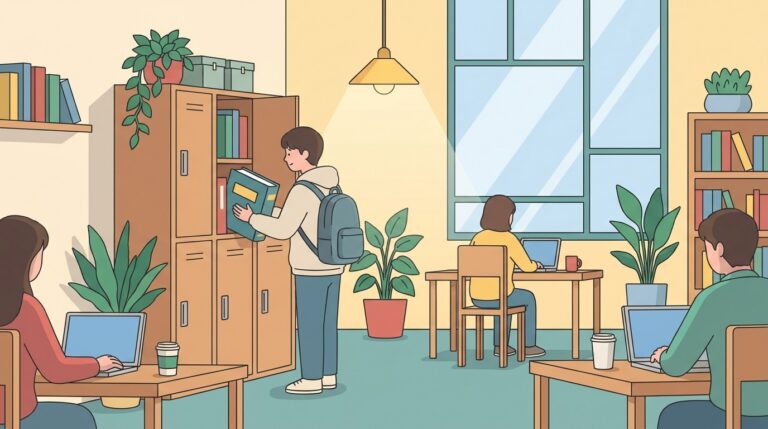
안녕하세요! 매일한글 에디터입니다. (Annyeonghaseyo! I’m your Daily Hangul editor.) Picture yourself walking up the steep hills of Seoul with a backpack full of brick-heavy textbooks, just like the exhausted students in K-dramas Law School or Reply 1988. Your shoulders ache before you even open your laptop! In Korea’s famous 24-hour study cafes (스터디카페, seuteodikape), students survive exam season by renting a locker for a month. Based on real feedback from learners who froze in front of Korean self-service kiosks, this A2 survival guide gives you the exact phrases to rent a locker, save your back, and follow local rules like a pro!
Phase 2: Deep Dive Into 3 Essential Expressions
1. 사물함을 대여하고 싶어요 (Samulhameul daeyeohago sipeoyo)
- Pronunciation: Samulhameul daeyeohago sipeoyo (Think of sa-mul like ‘saw-mule’, and dae-yeo sounds like ‘day-yuh’.)
- Meaning: Literal: ‘I want to rent a locker.’ / Nuance: A polite, clear request used at a library help desk or when messaging a study cafe manager.
- K-Culture Moment: Imagine a stressed med student in Hospital Playlist or a civil-service exam prepper in Drinking Solo claiming their monthly study basecamp in Noryangjin.
- Editor’s Insight: While you use 빌리다 (billida – to borrow) with friends, Korean uses 대여하다 (daeyeohada – to rent via a system) for official lockers, public bikes, or portable chargers.
- Situation Spectrum: Casual 🚫 / Semi-formal ✅ / Formal ✅
- 🤔 Think About It: In English, you just ‘rent’ an apartment, a car, or a locker. Why do you think Korean separates casual borrowing from official system rentals?
2. 무거운 전공 책을 넣어 두고 다녀요 (Mugeoun jeongong chaegeul neoeo dugo danyeoyo)
- Pronunciation: Mugeoun jeongong chaegeul neoeo dugo danyeoyo (Mu-geo sounds like ‘moo-guh’, and neo-eo rhymes with ‘uh-uh’.)
- Meaning: Literal: ‘I put heavy major books in and go around.’ / Nuance: Describes a smart, ongoing routine! The A2 grammar
-아/어 두다(-a/eo duda) means doing something in advance for later. - K-Culture Moment: In campus K-dramas like Cheese in the Trap, students leave thick textbooks inside lockers so they can travel light between classes and part-time jobs.
- Editor’s Insight: Adding
-고 다니다(-go danida) shows that you regularly commute back and forth without carrying that heavy load every day. - Situation Spectrum: Casual ⚠️ (drop
-요) / Semi-formal ✅ / Formal ⚠️ (change to-다닙니다) - 🤔 Think About It: English says ‘leave it there,’ focusing on the book staying put. Korean says 넣어 두다 (neoeo duda), highlighting your thoughtful preparation for your future self!
3. 한 달 이용권으로 할게요 (Han dal iyonggwoneuro halgeyo)
- Pronunciation: Han dal iyonggwoneuro halgeyo (Ggwon has a tight ‘k’ sound, like the ‘k’ in ‘sky’.)
- Meaning: Literal: ‘I will do it with a one-month pass.’ / Nuance: A natural, decisive phrase to choose your plan at a counter.
- K-Culture Moment: Just like characters in True Beauty or Crash Course in Romance, Korean students organize their lives around timed passes (이용권, iyonggwon) for study cafes and cram schools.
- Editor’s Insight:
-(으)로 할게요(-(eu)ro halgeyo) is your A2 magic wand! Use it for coffee sizes, seat types, or locker rental periods. - Situation Spectrum: Casual 🚫 / Semi-formal ✅ / Formal ✅
- 🤔 Think About It: Why do Korean study cafes sell passes by hours, days, and months instead of letting people sit for free after buying one drink?
Phase 3: Textbook Korean vs. Real Korean
Situation 1: Asking if any lockers are left
- 📖 Textbook Korean: 빈 사물함이 있습니까? (Bin samulhami itseumnikka? – Are there any empty lockers?)
- 🗣️ Real Korean: 혹시 남는 사물함 있어요? (Hoksi namneun samulham isseoyo? – By any chance, is there an available locker?)
- 💡 Why Is It Different?: Starting with 혹시 (hoksi – by any chance) and using 남는 (namneun – remaining) makes your request sound softer, warmer, and way more natural!
Situation 2: Talking about keeping books in your locker
- 📖 Textbook Korean: 저는 사물함에 책을 보관합니다. (Jeoneun samulhame chaegeul bogwanhabnida. – I store books in the locker.)
- 🗣️ Real Korean: 그냥 사물함에 쟁여 두고 다녀요. (Geunyang samulhame jaengyeo dugo danyeoyo. – I just stash them in my locker.)
- 💡 Why Is It Different?: 보관하다 (bogwanhada) sounds like a museum sign or a luggage manual! Young Koreans love 쟁여 두다 (jaengyeo duda – to stash/stock up) in casual chats.
Phase 4: K-Culture Deep Dive & Non-Verbal Manners
4-1. Nunchi (눈치) & Study Cafe Gestures
Korean study cafes are whisper-quiet, and many operate without staff! Great nunchi (social awareness) means guarding the silence. Hold the locker handle gently so the door doesn’t slam, avoid crinkling plastic bags, and keep your phone on silent (무음, mueum). If you accidentally drop your textbook, give a quick, polite head nod (목례, mongnye) toward nearby studiers to say ‘sorry’ without breaking the silence with your voice.
4-2. Culture Code: The Rise of the Korean Study Cafe
Unlike lively Western coffee shops, a Korean study cafe (스터디카페, seuteodikape) is built for deep focus. Most have two zones: a silent ‘Focus Zone’ with partitioned desks, and a ‘Laptop Zone’ where quiet typing is allowed. Free coffee, tea, and lockers make it a cozy second home where students spend months preparing for university or job exams!
Phase 5: Interactive Roleplay Scenario
Setting: A sleek, warmly lit 24-hour study cafe in Sinchon, Seoul. The smell of roasted coffee fills the break area.
NPC: Minjun (민준), a friendly part-time manager in a neat apron.
- Minjun: 어서 오세요! 스터디카페 처음이세요? (Eoseo oseyo! Seuteodikape cheoeumiseyo? – Welcome! Is this your first time at our study cafe?) 🎭 Smiles warmly and points toward the touchscreen kiosk.
- You: 네, 사물함을 한 달 동안 대여하고 싶어요. (Ne, samulhameul han dal dong-an daeyeohago sipeoyo. – Yes, I want to rent a locker for one month.) 🎭 Sets down a very heavy backpack with a sigh of relief.
- Minjun: 아, 책이 진짜 많으시네요! 12번 사물함 비어 있어요. (A, chaegi jinjja maneusineyo! Sibibeon samulham bieo isseoyo. – Oh, you really have a lot of books! Locker number 12 is empty.) 🎭 Checks the seating chart tablet.
- You: 좋아요! 무거운 전공 책을 넣어 두고 다니려고요. (Joayo! Mugeoun jeongong chaegeul neoeo dugo danyeoryeogoyo. – Great! I’m planning to keep my heavy major books inside and commute.) 🎭 Nods happily.
- Minjun: 좋죠! 좌석도 한 달 이용권으로 하실래요? (Jochyo! Jwaseokdo han dal iyonggwoneuro hasillaeyo? – Good idea! Would you like a one-month pass for a seat too?)
- You: 네, 한 달 이용권으로 할게요. 혹시 음료 반입 돼요? (Ne, han dal iyonggwoneuro halgeyo. Hoksi eumnyo banip dwaeyo? – Yes, I’ll go with the one-month pass. By any chance, are drinks allowed inside?) 🎭 Holds up a sealed tumbler.
- Minjun: 뚜껑 있는 음료만 가능하고 음식은 휴게실에서 드셔야 해요. (Ttukkeong inneun eumnyoman ganeunghago eumsigeun hyugesireseo deusyeoya haeyo. – Only drinks with lids are allowed, and food must be eaten in the break room.) 🎭 Gestures toward the snack counter.
- You: 알겠습니다! 규칙 잘 지킬게요. (Algesseumnida! Gyuchik jal jikilgeyo. – Got it! I’ll follow the rules well.) 🎭 Bows slightly.
🔀 Interactive Branching Point: What Do You Do Next?
You just bought your locker pass and get hungry while studying. What is your next move?
* A) Bring crispy fried chicken right to your desk so you don’t waste study time.
* B) Step into the 휴게실 (hyugesil – break room) to eat a quiet snack, then wipe the table.
* C) Leave your books on an unreserved seat for 3 hours while you go get lunch.
Feedback:
* Choice A (Bad ❌): Strong food smells in the study zone are the #1 way to get angry stares—or even a warning text from the owner!
* Choice B (Best ✅): Top-tier nunchi! Using the break room keeps the study air fresh and shows respect for everyone.
* Choice C (Risk ⚠️): Leaving items on a seat without checking out or paying for seat time can result in staff clearing your desk. Always reserve your seat properly!
Phase 6: 10-Second Emotion Shadowing Drill
Practice these out loud! Use the / marks to pause and match the emotion.
- [😊 Happy and relieved] 사물함을 / 한 달 동안 / 대여했어요! (Samulhameul / han dal dong-an / daeyeohaesseoyo! – I rented a locker / for a month!)
- [🤔 Curious and polite] 혹시 / 남는 사물함 / 있어요? (Hoksi / namneun samulham / isseoyo? – By any chance, / is there an available locker?)
- [😅 Apologetic and careful] 죄송해요, / 조용히 / 닫을게요! (Joesonghaeyo, / joyonghi / dadeulgeyo! – I’m sorry, / I’ll close it / quietly!)
Phase 7: K-Culture Mini Dictionary
- 키오스크 (Kioseukeu) | Kiosk | The self-service touchscreen at the entrance where you choose seats, rent lockers, and pay.
- 좌석 배치도 (Jwaseok baechido) | Seating chart | The digital map showing open seats (usually green) and occupied seats (usually gray).
- 퇴실 처리 (Toesil cheori) | Check-out process | Tapping ‘Check out’ at the kiosk or scanning your QR code before leaving so your seat becomes free.
- 무인 운영 (Muin unyeong) | Unmanned operation | 24/7 operation without on-site staff, powered by kiosks, smart locks, and CCTV.
Phase 8: Traveler’s Survival Kit
Top 3 Survival Phrases
- 사물함 비밀번호를 까먹었어요. (Samulham bimilbeonhoreul kkameogeosseoyo. – I forgot my locker password.) Pro Tip: Text the manager’s number posted near the kiosk!
- 좌석을 옮기고 싶어요. (Jwaseogeul omgigo sipeoyo. – I want to change seats.) Pro Tip: Most kiosks have a ‘좌석 이동’ (seat move) button!
- 무음으로 해 주세요. (Mueumeuro hae juseyo. – Please put it on silent.) Pro Tip: Helpful if a friend’s phone keeps buzzing next to you.
Editor’s Travel Note
Need a quiet place to study or work while visiting Korea? Check out Download Naver Map App for Finding Study Cafes and search 스터디카페 (seuteodikape) near any university station like Hongdae or Sinchon. Also, read the Seoul Metropolitan Library Visitor and Seat Guide if you prefer free public libraries! Keep in mind that some unmanned kiosks ask for a Korean phone number for QR entry—if you don’t have one, visit during staffed afternoon hours or bring a Korean T-money/credit card ready for backup.
Phase 9: One Step Deeper — Silence as Shared Respect
At first, a silent Korean study cafe might feel strict compared to a buzzing coffee shop back home. However, in Korea’s 공동체 (gongdongche – community) culture, that quietness is actually a warm form of 배려 (baeryeo – consideration for others). Everyone in that room is chasing a goal—whether it’s a university entrance exam, a license, or learning Korean. Keeping your locker quiet and respecting seat rules means you are silently cheering on your neighbor’s hard work too.
💬 Your Turn: Have you ever visited a Korean study cafe or library? Tell us in the comments what kind of seat you prefer—silent Focus Zone or cozy Laptop Zone!
Phase 10: FAQ & Common Mistakes
Q: Can foreigners rent a study cafe locker for just one month?
A: Yes! Anyone can rent a monthly locker at a study cafe using the kiosk or by asking the manager. Just check if the kiosk requires a Korean phone number for your entry code.
Q: Are Korean public libraries and study cafes the same?
A: No. Public libraries (공공도서관, gonggong doseogwan) are usually free but require a membership card to book a seat and have fixed hours. Study cafes (스터디카페) are paid, open 24/7, and include coffee, lockers, and fast Wi-Fi.
Q: What happens if I forget to tap ‘Check out’ (퇴실 처리) when I leave?
A: If you have an hourly pass, your hours might keep ticking down! Always scan your barcode or press 퇴실 (toesil – check out) at the kiosk on your way out.
🚨 Common Mistakes TOP 3
- Mistake: Saying ‘사물함을 사다’ (samulhameul sada – to buy a locker) when you mean rent.
Correct Action: Use 대여하다 (daeyeohada – to rent) so staff don’t get confused! - Mistake: Leaving trash or smelly food inside your rented locker for weeks.
Correct Action: Only store books and dry items in lockers, and throw food trash away in the break room! - Mistake: Sitting in a random empty seat without registering at the kiosk first.
Correct Action: Always pick your exact seat number on the 좌석 배치도 (seat map) before sitting down.
Phase 11: Action Mission & Engagement
- 🥉 Bronze Mission (Solo Practice): Read the 3 key phrases from Phase 2 out loud three times while pretending to tap a study cafe kiosk!
- 🥈 Silver Mission (Share Online): Take a photo of your current heavy textbooks or study desk and post it with the Korean caption:
무거운 책! 사물함 필요해요!(Heavy books! I need a locker!) - 🥇 Gold Mission (Real-World Challenge): Visit a local Korean library or study cafe (or simulate one at home) and practice checking the seat map and asking about a one-month pass.
- 🎮 K-Culture Mission: Watch an episode of a Korean ‘Study With Me’ vlog on YouTube (search
스터디카페 브이로그) and listen for words like 이용권 (iyonggwon) or 사물함 (samulham)!
Phase 12: Interactive Quiz Challenge
1. Situation Judgment: You want to tell your friend that you keep your heavy Korean textbooks in a rented locker so you don’t carry them home. Which sentence sounds most natural?
* A) 사물함을 샀어요.
* B) 무거운 책을 넣어 두고 다녀요.
* C) 도서관에서 소리를 질러요.
Click to Reveal Answer & Explanation
Answer: B! ‘무거운 책을 넣어 두고 다녀요’ (Mugeoun chaegeul neoeo dugo danyeoyo) uses ‘-아/어 두고 다니다’ to naturally describe keeping items in your locker for convenience. Option A means you bought the actual metal locker, and Option C means you scream in the library!
2. Fill in the Blank: Complete the phrase to choose a one-month pass: 한 달 ________으로 할게요. (Han dal ________euro halgeyo.)
Click to Reveal Answer & Explanation
Answer: 이용권 (iyonggwon – pass/ticket)! Put together, ‘한 달 이용권으로 할게요’ means ‘I’ll go with the one-month pass.’
3. True or False Culture Quiz: In a Korean study cafe, it is completely fine to eat hot ramyeon at your study desk as long as you don’t talk loudly.
Click to Reveal Answer & Explanation
Answer: False! Food with strong smells (like ramyeon or fried food) must be eaten in the 휴게실 (hyugesil – break room), never in the silent study zone.
🎬 Watch Our Daily Videos! (Daily Hangul Official Instagram)
Review the expressions you learned in this article with our fun daily short videos! Check out native pronunciation and real-life nuances in action.
- Instagram @dailyhangul_en







