

Phase 1: Why Staying Calm Is Your Superpower at a Korean Alba
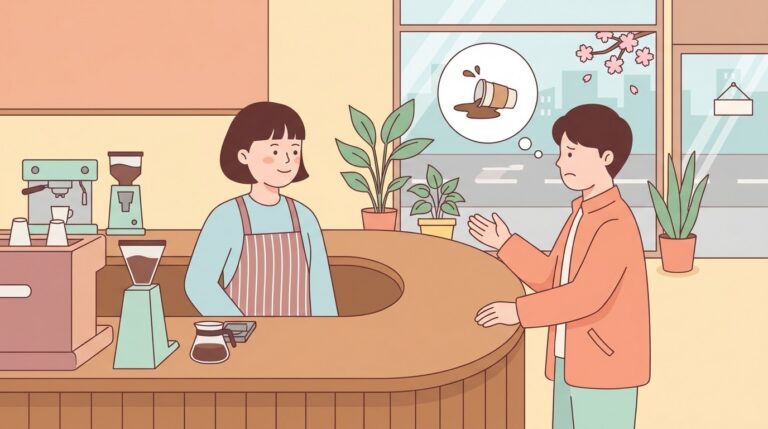
안녕하세요! 매일한글 에디터입니다. (Hello! This is your Daily Hangul Editor.) Picture this: you are working a busy shift at a trendy Seoul cafe when an angry customer slams their cup down and yells in banmal (rude casual speech), “Why is this taking so long?!” It feels just like a tense K-Drama scene, minus the background music. Your heart races, right? In Korea, reacting emotionally can escalate things fast, even when the customer is wrong. Based on real stories from foreign part-timers (알바생, alba-saeng) across Korea, this B1 guide shares calm, firm phrases to protect your peace and stay professional without backing down.
Phase 2: Top 3 Essential Phrases to De-escalate Tension
1. 손님, 진정하시고 말씀해 주세요. (Sonnim, jinjeonghasigo malsseumhae juseyo.)
- Pronunciation: Son-nim, jin-jeong-ha-si-go mal-sseum-hae ju-se-yo. (Think of “jin” like “jeans,” “jeong” like “jung” in jungle, and “malsseum” with a strong, crisp “ss” sound like a quiet hiss.)
- Meaning: Literally “Customer, please calm down and speak.” Practically, it means “Sir/Ma’am, please take a breath and tell me what happened so I can help.”
- K-Culture Moment: In K-Dramas like Itaewon Class or Business Proposal, when an entitled VIP starts shouting in a restaurant or store, the composed manager steps forward with this exact line to immediately cool down the room.
- Editor’s Insight: Notice the honorific suffix -시- (-si-) in jinjeonghasigo and the respectful verb 말씀하다 (malsseumhada) instead of malhada. Using ultra-polite grammar while someone is yelling creates an invisible shield of professionalism—it quietly reminds them to match your dignity.
- Situation Spectrum: Casual 🚫 / Semi-formal ⚠️ / Formal ✅
- 🤔 Think About It: In English, telling an angry person to “calm down” often makes them angrier! Why do you think wrapping “calm down” in Korean honorifics (진정하시고) softens the impact and sounds respectful instead of bossy?
2. 제가 다시 한번 확인해 드리겠습니다. (Jega dasi hanbeon hwaginhae deurigetseumnida.)
- Pronunciation: Je-ga da-si han-beon hwa-gin-hae deu-ri-get-seum-ni-da. (For “hwagin,” blend “hwa” quickly like “wham” without the m, and pronounce “deuri” softly with a light flap of the tongue.)
- Meaning: Literally “I will check it one more time for you.” Practically, it means “Let me double-check that right away so we can fix this.”
- K-Culture Moment: Think of those iconic Seoul convenience store or café scenes where a tired worker handles a mix-up over a receipt or discount event. Saying this buys you 10 seconds to breathe and check the POS screen.
- Editor’s Insight: The magic is in -아/어 드리겠습니다 (-a/eo deurigetseumnida), which humbles your action (“I offer to do this for you”). Even if you know the customer misread the menu, shifting immediately to “checking” redirects their anger from you onto the process.
- Situation Spectrum: Casual 🚫 / Semi-formal ✅ / Formal ✅
- 🤔 Think About It: In your home country, do customer service workers usually apologize first, or do they jump straight to checking the facts? How does promising an action (확인해 드리겠습니다) change the mood?
3. 죄송하지만, 그렇게 말씀하시면 도와드리기 어렵습니다. (Joesonghajiman, geureoke malsseumhasimyeon dowadeurigi eoryeopseumnida.)
- Pronunciation: Joe-song-ha-ji-man, geu-reo-ke mal-sseum-ha-si-myeon do-wa-deu-ri-gi eo-ryeop-seum-ni-da. (Say “eo-ryeop” like “uh-ryup,” keeping your lips relaxed, and finish “seumnida” cleanly as “seum-nee-da.”)
- Meaning: Literally “I’m sorry, but if you speak like that, it is difficult to help you.” Practically, it is a polite boundary: “If you keep yelling or using rude language, I cannot assist you.”
- K-Culture Moment: In modern Korean slice-of-life dramas and real Seoul cafes, you will often see small signs at the counter protecting workers from verbal abuse. Staff use this phrase calmly before calling a manager.
- Editor’s Insight: Using 어렵습니다 (eoryeopseumnida – it is difficult) instead of 안 됩니다 (an doemnida – no/not allowed) is peak B1 Korean diplomacy. It draws a firm red line against banmal or swearing without sounding aggressive yourself.
- Situation Spectrum: Casual 🚫 / Semi-formal ⚠️ / Formal ✅
- 🤔 Think About It: Why do Koreans prefer saying something is “difficult” (어렵다) rather than saying “I refuse” or “You can’t”? How does indirect language protect both sides in a conflict?
Phase 3: Textbook Korean vs. Real Korean
Situation 1: Asking an upset customer not to yell
- 📖 Textbook Korean (교과서 한국어): 화내지 마세요. (Hwanaeji maseyo.) — “Don’t get angry.”
- 🗣️ Real Korean (진짜 한국어): 언성을 조금만 낮춰 주시겠어요? (Eonseongeul jogeumman natchwo jusigesseoyo?) — “Could you lower your voice just a little bit?”
- 💡 Why the difference? (왜 다를까?): Telling a stranger “Don’t get angry” (화내지 마세요) sounds like a kindergarten teacher scolding a child—it will almost certainly ignite a bigger fight! In real life, Koreans focus on the volume (언성) rather than policing the customer’s emotions, asking politely with -아/어 주시겠어요?
Situation 2: Turning down an unreasonable demand
- 📖 Textbook Korean (교과서 한국어): 그것은 불가능합니다. (Geugeoseun bulganeunghamnida.) — “That is impossible.”
- 🗣️ Real Korean (진짜 한국어): 그 부분은 저희 매장 규정상 어렵습니다. (Geu bubuneun jeohui maejang gyujeongsang eoryeopseumnida.) — “That part is difficult under our store policy.”
- 💡 Why the difference? (왜 다를까?): Saying “impossible” (불가능하다) feels cold and robotic, making the customer feel personally rejected. By blaming “store policy” (매장 규정상) and saying “it’s difficult” (어렵습니다), you signal that you aren’t the enemy—the rulebook is.
Phase 4: K-Culture Deep Dive & Non-Verbal Manners
4-1. Nunchi (눈치) & Body Language Under Pressure
When a customer raises their voice or switches to banmal (informal speech), your body language speaks louder than your grammar:
* The Posture & Bow: Keep your shoulders relaxed and your hands visible at waist level or gently clasped in front of you. Never cross your arms or put hands on your hips—in Korea, that looks deeply disrespectful. Start with a slight 15-degree nod (목례, mongnye) to show you are listening.
* Eye Contact & Gestures: Avoid staring intensely into their eyes, which can feel like a challenge during an argument. Instead, soften your gaze toward their chin or shoulder area, and use open-palm gestures if pointing toward a menu or receipt. Never point with one finger!
* Vocal Tone: Lower your pitch slightly and slow your speaking speed by 20%. A steady, calm voice naturally forces a shouting customer to quiet down just to hear you.
4-2. Cultural Code: From “The Customer Is King” to Protecting Emotional Laborers
For decades, Korean retail culture lived by the motto 손님은 왕이다 (sonnimeun wangida — “The customer is king”), which sadly led to 갑질 (gapjil — abuse of power) against young part-timers. However, Korea’s culture has shifted dramatically! Thanks to public awareness and the Emotional Laborer Protection Act (감정노동자 보호법), K-Dramas and real-life cafes now highlight that service workers are someone’s precious family too. Today, staying calm and setting polite boundaries isn’t seen as weak—it is praised as high-level professionalism.
Phase 5: Real-Life Roleplay Scenario
Setting: A bustling dessert cafe in Hongdae at 2:30 PM on a Saturday. The espresso machine is hissing, K-Pop is playing softly, and a line is forming.
Characters: You (a B1 Korean learner working your weekend alba shift) and Mr. Kang (an impatient customer in his 50s whose iced Americano took 7 minutes).
- Mr. Kang: 🎭 Slams his receipt on the counter and glares. 야! 아까 주문했는데 커피가 왜 아직도 안 나와?! (Ya! Akka jumunhaenneunde keopiga wae ajikdo an nawa?!) — “Hey! I ordered a while ago, why isn’t my coffee out yet?!”
- You: 🎭 Takes a slow breath, keeps hands clasped calmly, and gives a small nod. 죄송합니다, 손님. 제가 주문 내역 다시 한번 확인해 드리겠습니다. (Joesonghamnida, sonnim. Jega jumun naeyeok dasi hanbeon hwaginhae deurigetseumnida.) — “I’m sorry, sir. Let me double-check your order details right away.”
- Mr. Kang: 🎭 Waves his hand dismissively, still using banmal. 확인은 무슨 확인이야! 알바가 일을 왜 이렇게 느리게 해! (Hwagineun museun hwaginiya! Albaga ireul wae ireoke neurige hae!) — “Check what?! Why is a part-timer working so slowly!”
- You: 🎭 Maintains a low, steady tone without raising your voice. 손님, 지금 주문이 많이 밀려서 조금 지연되었습니다. 진정하시고 잠시만 기다려 주시겠어요? (Sonnim, jigeum jumuni mani millyeoseo jogeum jiyeondoeeotseumnida. Jinjeonghasigo jamsiman gidaryeo jusigesseoyo?) — “Sir, orders are backed up right now so it was delayed a bit. Could you please calm down and wait just a moment?”
- Mr. Kang: 🎭 Raises his voice louder so other customers turn to look. 뭐? 진정해? 내가 지금 시간이 없는 거 안 보여?! 돈 내고 기다리라니 말이 돼?! (Mwo? Jinjeonghae? Naega jigeum sigani eomneun geo an boyeo?! Don naego gidarirani mari dwae?!) — “What? Calm down? Can’t you see I have no time?! Does it make sense to pay and wait?!”
- You: 🎭 Steps slightly back behind the counter, keeping an open, polite posture. 손님, 불편을 드려 죄송하지만 언성을 조금만 낮춰 주시겠어요? (Sonnim, bulpyeoneul deuryeo joesonghajiman eonseongeul jogeumman natchwo jusigesseoyo?) — “Sir, I’m sorry for the inconvenience, but could you lower your voice just a little?”
- Mr. Kang: 🎭 Huffs, realizing people are watching, and lowers his volume slightly. 에이, 진짜 답답하네. 빨리 좀 줘요. (Ei, jinjja dapdaphane. Ppalli jom jwoyo.) — “Ugh, seriously so frustrating. Just give it to me quickly.”
- You: 🎭 Hands over the freshly made iced Americano with two hands. 기다려 주셔서 감사합니다. 맛있게 드세요. (Gidaryeo jusyeoseo gamsahamnida. Masitge deuseyo.) — “Thank you for waiting. Please enjoy your drink.”
🔀 Interactive Branching Point: What Would You Do?
Imagine at Turn 5, Mr. Kang keeps yelling insults at you instead of calming down. Which reply would you choose?
* A) “손님, 계속 반말하시면 도와드리기 어렵습니다. 매니저님 불러 드릴까요?” (Sonnim, gyesok banmalhasimyeon dowadeurigi eoryeopseumnida. Maenijeonim bulleo deurilkkayo? — “Sir, if you keep using informal speech, it’s hard for me to help you. Shall I call the manager?”)
* B) “아저씨, 왜 반말하세요? 저도 기분 나빠요!” (Ajeossi, wae banmalhaseyo? Jeodo gibun nappayo! — “Mister, why are you using banmal? I feel bad too!”)
* C) “죄송합니다, 제가 잘못했어요. 무료 쿠폰 드릴게요.” (Joesonghamnida, jega jalmoshaesseoyo. Muryo kupon deurilgeyo. — “I’m sorry, it’s my fault. I’ll give you a free coupon.”)
Feedback on Your Choice:
* Choice A (Best!): Brilliant B1 mastery! You stayed completely polite (-시면, 어렵습니다), clearly named the boundary, and offered a constructive next step (calling the manager) without losing your temper.
* Choice B (Bad!): Calling an angry man 아저씨 (ajeossi) and reacting emotionally (저도 기분 나빠요) will escalate the argument immediately and could get you in trouble with your boss.
* Choice C (Risk!): Apologizing for something that isn’t your fault and handing out unauthorized free coupons can encourage bad behavior (진상) and create problems with store management.
Phase 6: 10-Second Emotional Shadowing Drill
Read these aloud three times! Follow the / pause marks and step into each emotion:
- [😌 Grounded & Steady]
손님, / 진정하시고 / 천천히 말씀해 주세요.
(Sonnim, / jinjeonghasigo / cheoncheonhi malsseumhae juseyo.)
— “Sir/Ma’am, / please calm down / and speak slowly.” -
[🤝 Helpful & Professional]
불편을 드려 죄송하지만, / 제가 다시 한번 / 확인해 드리겠습니다.
(Bulpyeoneul deuryeo joesonghajiman, / jega dasi hanbeon / hwaginhae deurigetseumnida.)
— “I’m sorry for the trouble, / let me double-check / one more time for you.” -
[🛡️ Calmly Firm]
그렇게 말씀하시면 / 저희가 도와드리기 / 어렵습니다.
(Geureoke malsseumhasimyeon / jeohuiga dowadeurigi / eoryeopseumnida.)
— “If you speak like that, / it is difficult for us / to help you.”
Phase 7: K-Culture Mini Dictionary
- 진상 손님 (jinsang sonnim) | Translation: A nightmare / difficult customer | Real-Life Usage: Used widely among part-timers and office workers to describe customers who make unreasonable demands, yell, or cause scenes over tiny issues.
- 반말 (banmal) | Translation: Informal / casual speech | Real-Life Usage: Normal among close friends, but when a stranger uses banmal to a cafe or store employee, it feels demeaning and aggressive.
- 갑질 (gapjil) | Translation: Abuse of power / bullying | Real-Life Usage: Often seen in Korean news and K-Dramas when someone in a higher position (a boss, client, or customer) mistreats a worker simply because they are paying.
- 감정노동자 (gamjeongnodongja) | Translation: Emotional laborer | Real-Life Usage: A common legal and business term in Korea for service workers (baristas, call center staff, flight attendants) whose job requires hiding stress and smiling.
Phase 8: Survival Kit for Expats & Travelers
Even if you aren’t working a part-time job yet, misunderstandings happen at busy counters! Keep these three phrases handy:
1. 잠시만요, 확인해 볼게요. (Jamsimanyo, hwaginhae bolgeyo.) — “Just a moment, I’ll check.” Pro Tip: Great for buying yourself breathing room during any awkward interaction.
2. 오해가 있으신 것 같아요. (Ohaega isseusin geot gatayo.) — “I think there is a misunderstanding.” Pro Tip: Softens blame by calling the issue an ‘ohaega’ (misunderstanding) rather than a mistake.
3. 담당자 연결해 드릴까요? (Damdangja yeongyeolhae deurilkkayo?) — “Shall I connect you with the person in charge?” Pro Tip: Works both in person and on the phone when a complaint goes above your pay grade.
Editor’s Travel & Living Note: If you are commuting to a part-time job in Seoul or navigating busy neighborhoods, Download the Naver Map App to track exact subway arrival times so you are never late for a shift. Also, keep the Papago AI Translator App on your home screen—if an angry customer speaks too fast, politely showing them a translated message like “잠시만요 (One moment)” helps prevent miscommunication. When paying at counters, remember many Korean cafes use kiosks or card-only systems (T-money or local debit cards), which speeds up lines and reduces customer wait frustration!
Phase 9: One Step Deeper — Why Polite Speech Is Your Armor
In many Western cultures, politeness feels like something you owe only to people who are polite back to you. In Korea, however, 존댓말 (jondaemal — polite speech) works very differently in a workplace: it isn’t a sign of weakness or submission, it is your professional armor. By refusing to drop down to a rude customer’s banmal, you actually keep the moral high ground and protect your own dignity. As modern Korean society increasingly stands up against gapjil, staying calm and polite shows true emotional maturity—something Koreans deeply respect.
💬 Your Turn: Have you ever dealt with a difficult customer (in Korea or back home)? How did you keep your cool? Share your story in the comments below!
Phase 10: FAQ & Common Mistakes
Q: If a Korean customer uses banmal (rude speech) to me, can I use banmal back so they stop?
A: No, never! In Korea, responding with banmal to an older or angry customer will almost always explode into a huge fight and could cost you your job. Keep using polite -요 (-yo) or -습니다 (-seumnida) endings so everyone watching knows you are the respectful one.
Q: Why do Koreans say “어렵습니다 (it is difficult)” instead of just saying “안 돼요 (no)”?
A: Saying 안 돼요 directly to an upset customer feels like slamming a door in their face. Using 어렵습니다 communicates the exact same “no,” while sounding considerate and professional.
Q: What if a customer keeps screaming or threatening me even after I ask them politely to calm down?
A: Your safety comes first! Do not argue. Calmly say, “매니저님 불러 드리겠습니다” (I will call the manager), step back from the counter, and let your manager or store owner handle it—or contact 112 (police) if there is any physical threat.
🚨 Common Mistakes Warning Board
- Mistake: Saying “왜 화내세요?” (Why are you angry?) — Sounds sarcastic and confrontational.
- Correct Action: Say “불편을 드려 죄송합니다” (I’m sorry for the inconvenience) or “어떤 부분이 불편하신가요?” (Which part is troubling you?).
- Mistake: Saying “그건 제 잘못 아니에요” (That’s not my fault) right away — Makes the customer feel unheard.
- Correct Action: Start with “확인해 드리겠습니다” (Let me check that for you) first, then gently explain the situation.
- Mistake: Raising your voice to match their volume — Triggers a shouting match.
- Correct Action: Drop your voice slightly and speak slower; people naturally quiet down to hear a calm voice.
Phase 11: Action Mission & K-Culture Challenge
- 🥉 Bronze Mission (Solo Practice): Stand in front of a mirror, set a timer for 1 minute, and practice the 3 phrases from Phase 6 with relaxed shoulders and a calm, low voice.
- 🥈 Silver Mission (Share & Lock It In): Write your favorite boundary-setting phrase on a sticky note or save it to your phone notes, and share one tip you learned today on social media with
#DailyHangul! - 🥇 Gold Mission (Real-World Use): Next time you are at a store or restaurant (even as a customer!), listen carefully to how Korean staff handle busy moments using 확인해 드리겠습니다 and 잠시만요.
- 🎮 K-Culture Mission: Watch an episode of a workplace or cafe K-Drama (like Itaewon Class, Coffee Prince, or Extraordinary Attorney Woo) and spot one moment where a character handles a difficult person calmly using -시- honorifics or 어렵습니다!
Phase 12: Interactive Quiz Challenge
Test your B1 instincts! Try answering before opening the toggles.
1. [Situational Judgment] An upset customer shouts, “이거 왜 이렇게 비싸?! 바꿔 줘!” (Why is this so expensive?! Exchange it!) even though the item is already opened and non-refundable per store policy. Which response is best?
* A) 그것은 불가능합니다. 돌아가세요.
* B) 죄송하지만 매장 규정상 교환은 어렵습니다.
* C) 화내지 마세요. 원래 비싸요.
Click to Check Answer & Explanation for Q1
Correct Answer: B!
* Why B wins: It politely cites store policy (매장 규정상) and uses the soft refusal 어렵습니다.
* Why A fails: “불가능합니다 (Impossible)” and “돌아가세요 (Go back)” sound harsh and robotic.
* Why C fails: Telling someone “화내지 마세요 (Don’t get angry)” will only make them angrier!
2. [Fill-in-the-Blank] Complete this polite de-escalation sentence:
“손님, ( __________ ) 천천히 말씀해 주세요.” (Sir/Ma’am, please calm down and speak slowly.)
Click to Check Answer & Explanation for Q2
Correct Answer: 진정하시고 (jinjeonghasigo)
* Explanation: Combining 진정하다 (to calm down) with the honorific -시- and connector -고 creates the respectful request “please calm down and…”
3. [True / False Culture Quiz]
True or False: In Korea, if a stranger uses banmal (informal speech) while yelling at you at work, using banmal back is a normal way to demand respect.
Click to Check Answer & Explanation for Q3
Correct Answer: False!
* Explanation: Never use banmal back at a customer! In Korea, keeping your polite jondaemal acts as professional armor and protects your reputation while keeping the situation from escalating.
🎬 Watch Our Daily Videos! (Daily Hangul Official Instagram)
Review the expressions you learned in this article with our fun daily short videos! Check out native pronunciation and real-life nuances in action.
- Instagram @dailyhangul_en







