

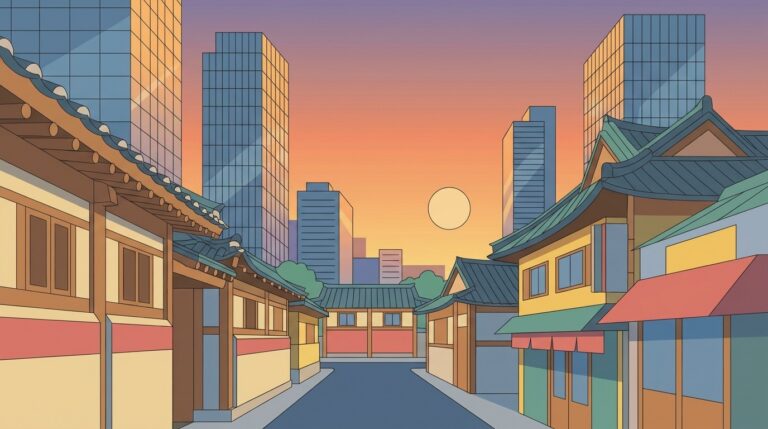
Phase 1: Finding Words for Seoul’s Vanishing Alleys
안녕하세요! 매일한글 에디터입니다. (Annyeonghaseyo! Maeil Hangeul editeo-imnida. — Hello! I’m your Daily Hangul editor.) Imagine strolling through Seoul’s Euljiro or Seongsu-dong—historic print shops and 40-year-old tteokbokki joints suddenly flanked by minimalist cafes and luxury towers. While watching K-dramas like My Mister or Our Blues, you’ve probably felt the ache of changing neighborhoods. Yet when Korean friends debate redevelopment, C1 learners often freeze, stuck using basic words like “pretty” or “expensive.” Built from real learner feedback, this guide equips you with sharp, nuanced Korean to discuss urban philosophy, heritage, and residents’ rights naturally.
Phase 2: Deep Dive Into 3 Essential C1 Expressions
1. 장소성을 상실하다 (Jangsoseongeul sangsilhada)
- Pronunciation: jang-so-seong-eul sang-sil-ha-da (Sounds like “jahng-so-sung-eul sahng-sheel-ha-da,” where seong rhymes with “sung” and sil glides smoothly like “sheel.”)
- Meaning: Literally “to lose place-ness.” In practice, it describes the heartbreaking phenomenon of placelessness, where a historic neighborhood loses its soul, memories, and unique cultural identity to cookie-cutter franchises.
- K-Culture Moment: Picture an architectural critic on a Korean humanities talk show like AlSseulSinJap walking through a newly paved alley lined with identical glass buildings, sighing that the town looks indistinguishable from anywhere else in the world.
- Editor’s Insight: Unlike the simpler word 특색이 없다 (teuksaegi eopda — lacks uniqueness), 장소성을 상실하다 carries heavy sociological weight. Using it instantly signals that you understand modern Korean urban discourse.
- Situation Spectrum: Casual ⚠️ (Feels slightly academic among close friends over beer) / Semi-formal ✅ / Formal ✅
- 🤔 Think About It: Korean uses the Sino-Korean suffix -성 (-seong), meaning “nature/essence,” to turn “place” (장소) into an abstract philosophy. How does your native language capture the difference between a mere physical space and a meaningful place?
2. 원주민이 내몰리다 (Wonjumini naemollida)
- Pronunciation: won-ju-mi-ni nae-mol-li-da (Think “wun-joo-mee-nee neh-mohl-lee-da,” blending the double-L smoothly like the middle of “million” without a y-sound.)
- Meaning: Literally “original residents are driven out.” In urban contexts, it captures the painful reality of displacement caused by gentrification, where skyrocketing rents force long-time locals and small merchants to abandon their own neighborhoods.
- K-Culture Moment: In documentaries or socially conscious K-dramas, this phrase appears when beloved neighborhood ajummas (아줌마 — middle-aged women) pack up decades-old diners because a trendy corporate landlord tripled the lease.
- Editor’s Insight: Note the passive verb 내몰리다 (to be pushed/driven out). It highlights the powerlessness of residents against impersonal market forces—much sharper and more empathetic than simply saying 이사 가다 (isa gada — to move away).
- Situation Spectrum: Casual ✅ / Semi-formal ✅ / Formal ✅
- 🤔 Think About It: In Korea, 원주민 (wonjumin) is used not just for indigenous peoples, but affectionately and empathetically for long-term neighborhood residents. Does your culture view long-time urban tenants as having a similar moral claim to a neighborhood?
3. 공존하는 도시 철학이 필요하다 (Gongjonhaneun dosi cheolhagi piryohada)
- Pronunciation: gong-jon-ha-neun do-si cheol-ha-gi pi-ryo-ha-da (Read it as “gohng-john-ha-neun doh-shee chul-ha-gee pee-ryo-ha-da,” letting the k sound in 학 link gently into 이.)
- Meaning: Literally “an urban philosophy that coexists is needed.” It expresses the core call for urban planning that balances economic vitality, cultural heritage, and residents’ rights to remain.
- K-Culture Moment: Imagine a passionate mayor candidate or urban sociologist in a Korean current-affairs debate gesturing toward a screen showing both gleaming high-rises and preserved hanok villages.
- Editor’s Insight: Koreans love pairing 공존 (gongjon — coexistence) with 상생 (sangsaeng — mutual prosperity). Dropping 도시 철학 (dosi cheolhak — urban philosophy) elevates your argument from complaining about rent to proposing a visionary alternative.
- Situation Spectrum: Casual ⚠️ (Best saved for serious late-night heart-to-hearts) / Semi-formal ✅ / Formal ✅
- 🤔 Think About It: Korean urban debates frequently contrast 개발의 경제 논리 (the economic logic of development) with 인간적인 가치 (humanistic values). Which side usually dominates city planning headlines in your home country?
Phase 3: Textbook Korean vs. Real Korean
Situation 1: Lamenting That a Trendy District Has Lost Its Old Soul
- 📖 Textbook Korean (교과서 한국어): 이 지역은 재개발로 인해 고유한 특색이 사라지고 획일화되었습니다. (I jiyeogeun jaegaeballo inhae goyuhan teuksaegi sarajigo hoegilhwa-doeeotseumnida. — Due to redevelopment, this area has lost its unique characteristics and become standardized.)
- 🗣️ Real Korean (진짜 한국어): 여기도 이제 다 프랜차이즈로 도배돼서 예전 감성이 1도 안 남았네. (Yeogido ije da peuraenchaijeuro dobaedwaeseo yejeon gamseongi ildo an namanne. — This place is plastered with franchises now too; not even 1% of the old vibe is left.)
- 💡 Why the Difference? While 획일화되다 (hoegilhwa-doeda — to become uniform) belongs in policy papers, young Seoulites talk about 감성 (gamseong — emotional vibe/aesthetic) and use 도배되다 (to be wallpapered/plastered over) to vividly criticize sterile commercial uniformity.
Situation 2: Talking About a Favorite Local Shop Being Pushed Out by Rent
- 📖 Textbook Korean (교과서 한국어): 임대료 상승으로 인해 기존 상인들의 정주권이 위협받고 있습니다. (Imdaeryo sangseungeuro inhae gijon sangindeului jeongjugwoni wihyeopbatgo itseumnida. — Due to rising rents, existing merchants’ rights to stay are being threatened.)
- 🗣️ Real Korean (진짜 한국어): 단골집 사장님도 월세 감당이 안 돼서 결국 밀려나셨대. (Dangoljip sajangnimdo wolse gamdangi an dwaeseo gyeolguk millyeonasyeotdae. — I heard even my favorite spot’s owner couldn’t handle the monthly rent and got pushed out in the end.)
- 💡 Why the Difference? In everyday Korean, people personalize gentrification through their 단골집 (dangoljip — go-to local spot) and use the visceral verb 밀려나다 (millyeonada — to get shoved out) to express genuine sadness and solidarity.
Phase 4: K-Culture Deep Dive & Non-Verbal Etiquette
4-1. Nunchi (눈치) & Body Language
When discussing redevelopment in Korea, nunchi is everything—because real estate isn’t just architecture; it’s tied to people’s life savings and family memories.
* Soften Your Enthusiasm: Never gush about how “cool and futuristic” a brand-new apartment complex looks when chatting with older residents who were displaced from that very site. Offer an empathetic nod, keep your shoulders relaxed, and match their contemplative pace.
* Open Palms Over Pointing: When gesturing toward a demolished alley or construction crane, avoid pointing with a single index finger. Use an open palm facing upward to maintain a respectful, reflective demeanor.
4-2. Cultural Code Analysis: K-Drama & K-Travel
- K-Drama (My Mister / 나의 아저씨): This masterpiece captures the quiet beauty of aging hugaedong-style back alleys, neighborhood pubs, and tight-knit 이웃사촌 (iutsachon — neighbors like family) standing firm against cold corporate ambition. The decaying staircases aren’t just set design—they symbolize memory and human warmth.
- K-Travel (The “Hipjiro” Paradox): In Seoul’s Euljiro ( nicknamed Hipjiro / 힙지로), young travelers and artists fell in love with gritty 1970s print shops and tucked-away hof bars. Ironically, that viral fame drew big capital, threatening the very artisans who created the neighborhood’s charm in the first place—a living textbook of Korean gentrification.
Phase 5: Real-World Roleplay Scenario
Setting: A drizzly Friday evening inside a cozy, 35-year-old makgeolli tavern tucked inside a narrow Seongsu-dong alley. Handwritten menus hang on weathered wood walls—and a faded redevelopment notice sits taped outside the window.
Characters: You (a C1 Korean learner passionate about urban culture) and Min-jun (민준) (34, a thoughtful architectural photographer documenting Seoul’s vanishing alleys).
- Min-jun: 여기 파전 냄새 좀 보세요. 다음 달이면 이 골목도 다 철거된다니 믿기지가 않네요. (Yeogi pajeon naemsae jom boseyo. Daeum darimyeon i golmokdo da cheolgeodoendani mitgijiga anneyo. — Smell this scallion pancake. It’s hard to believe this whole alley is getting demolished next month.)
🎭 Looking wistfully at the rain dripping past the sliding wooden door. - You: 그러게요. 오랜 세월이 담긴 공간인데, 이렇게 한순간에 사라진다는 게 너무 아쉽죠. (Geureogeyo. Oraen sewori damgin gongganinde, ireoke hansungane sarajindaneun ge neomu aswipjyo. — Right. It’s a space holding decades of history, so seeing it vanish overnight is heartbreaking.)
🎭 Lowering your cup gently onto the worn table with a sympathetic nod. - Min-jun: 솔직히 경제 논리만 따지면 새 빌딩을 올리는 게 효율적이겠죠. 하지만 너무 획일화된 느낌이에요. (Soljiki gyeongje nolliman ttajimyeon sae bildingeul ollineun ge hyoyuljeogigetjyo. Hajiman neomu hoegilhwadoen neukkimieyo. — Honestly, by pure economic logic, putting up a new building is more efficient. Still, everything feels too cookie-cutter.)
🎭 Scrolling through monochrome photos of old brick walls on his camera. - You: 맞아요. 요즘 서울 곳곳이 특색 없이 비슷해져서 장소성을 상실하고 있다는 생각이 들어요. (Majayo. Yojeum Seoul gotgosi teuksaek eopsi biseuthaejyeoseo jangsoseongeul sangsilhago itdaneun saenggagi deureoyo. — Agreed. Lately, neighborhoods across Seoul are starting to look identical, making me feel they’re losing their sense of place.)
🎭 Leaning forward slightly to view the photos on his LCD screen. - Min-jun: 게다가 여기 사장님처럼 오래 자리를 지킨 원주민들이 임대료를 못 버티고 내몰리는 게 제일 문제예요. (Gedaga yeogi sajangnimcheoreom orae jarireul jikin wonjumindeuri imdaeryoreul mot beotigo naemollineun ge jeil munjeyeyo. — Worse yet, original residents like this tavern owner who held the fort for years are being pushed out because they can’t bear the rent.)
🎭 Sighing quietly and glancing toward the kitchen where the elderly owner is flipping pancakes. - You: 결국 개발의 속도와 사람들의 삶 사이에서 균형을 잡는 게 핵심인 것 같아요. (Gyeolguk gaebalui sokdowa saramdeului sam saieseo gyunhyeongeul jamneun ge haeksimin geot gatayo. — Ultimately, striking a balance between the speed of development and people’s lives seems to be the crux of it.)
🎭 Gesturing smoothly with both open hands as if weighing a scale. - Min-jun: 딱 제 생각이에요. 그런데 만약 시에서 이곳을 전면 재개발할지, 아니면 보존할지 결정해야 한다면 뭐라고 설득하시겠어요? (Ttak je saenggageyeyo. Geureonde manyak sieseo igoseul jeonmyeon jaegaebalhalji, animyeon bojonhalji gyeoljeonghaeya handamyeon mworago seoldeukhasigesseoyo? — That’s exactly how I feel. Say the city had to decide between full redevelopment or preservation here—how would you persuade them?)
🎭 Raising an eyebrow curiously and resting his chin on his hand. - You: [Choose your response below!]
🔀 Interactive Branching Point: How Do You Respond to Min-jun?
- Option A: “개발의 경제 논리도 무시할 순 없지만, 장소의 문화 가치와 원주민의 정주권이 공존하는 도시 철학이 필요해요.” (Gaebalui gyeongje nollido musihal sun eopjiman, jangsoui munhwa gachiwa wonjuminui jeongjugwoni gongjonhaneun dosi cheolhagi piryohaeyo. — We can’t ignore economic logic, yet we need an urban philosophy where cultural value and residents’ right to stay coexist.)
- Feedback — BEST! Chef’s kiss! You gracefully acknowledged economic reality without dismissing it, then anchored your point in cultural heritage and human rights. This balanced, non-polarized C1 framing earns deep respect in Korean intellectual circles.
- Option B: “돈만 밝히는 개발업자들 때문에 다 망했어요. 옛날 건물은 무조건 하나도 부수면 안 돼요!” (Donman balkhineun gaebaleopjadeul ttaemune da manghaesseoyo. Yetnal geonmureun mujogeon hanado busumyeon an dwaeyo! — Greedy developers ruined everything. Not a single old building should ever be torn down!)
- Feedback — BAD. While passionate, 돈만 밝히다 (only chasing money) sounds overly hostile and simplistic for a C1 speaker, and 무조건 (unconditionally) ignores genuine safety and infrastructure needs in aging Korean neighborhoods.
- Option C: “글쎄요, 낡은 건물을 헐고 깔끔한 카페 거리를 만들면 외국인 관광객도 많이 오고 좋지 않을까요?” (Geulsseyo, nalgeun geonmureul heolgo kkalkkeumhan kape georireul mandeulmyeon oegugin gwangwanggaekdo mani ogo jochi aneulkkayo? — Well, if we tear down old buildings and make a neat cafe street, wouldn’t it attract lots of foreign tourists?)
- Feedback — RISK. You might accidentally trigger a tense debate! While your Korean is polite, praising demolition in front of someone mourning displacement shows poor nunchi and overlooks the deeper issue of placelessness.
Phase 6: 10-Second Emotion Shadowing Drill
Read these aloud, pausing briefly at / and channeling the emotion in brackets!
- [😔 Deeply reflective and wistful]
수십 년의 기억이 깃든 골목이 / 하루아침에 / 낯선 빌딩 숲으로 변해버렸어요.
(Susip nyeonui gieogi gitdeun golmogi / haruachime / natseon bilding supeuro byeonhaebeoryeosseoyo. — An alley steeped in decades of memories / turned overnight / into an unfamiliar forest of buildings.) - [🤝 Warm, composed, and persuasive]
무조건적인 개발보다는 / 기존의 삶과 새로운 활력이 / 공존하는 길을 찾아야 해요.
(Mujogeonjeogin gaebalbodaneun / gijonui samgwa saeroun hwallyeogi / gongjonhaneun gireul chajaya haeyo. — Rather than unconditional development / we must find a path where existing lives and new vitality / coexist.) - [🔥 Sincere and socially conscious]
도시의 진짜 경쟁력은 / 화려한 건물이 아니라 / 그곳을 지켜온 사람들의 이야기예요.
(Dosiui jinjja gyeongjaengnyeogeun / hwaryeohan geonmuri anira / geugoseul jikyeoon saramdeului iyagiyeyo. — A city’s true competitiveness / isn’t flashy buildings, / it’s the stories of the people who kept it alive.)
Phase 7: K-Culture Mini Dictionary (4 Core Keywords)
- 둥지 내몰림 (dungji naemollim) | Gentrification (lit. being pushed out of one’s nest) | Korea’s official, deeply poetic localized term for gentrification, widely used in news broadcasts, municipal policies, and civic campaigns alongside 젠트리피케이션 (jentheuripikeisyeon).
- 장소성 (jangsoseong) | Sense of place / Placeness | Used in architecture, urban geography, and art exhibitions to describe the intangible identity, memories, and atmosphere that make a spot irreplaceable.
- 정주권 (jeongjugwon) | Right to settle / Right to remain | A formal policy and human-rights term referring to residents’ right to live stably in their home community without forced displacement by skyrocketing housing costs.
- 경제 논리 (gyeongje nolli) | Economic logic / Market rationale | Frequently used in Korean debates to critique decisions made purely for profit or efficiency (경제 논리에 밀리다 — to be sidelined by economic logic).
Phase 8: Traveler’s Survival Kit
Top 3 Survival Expressions for Exploring Historic Districts
- 이 동네는 예전 모습이 잘 보존되어 있네요. (I dongneneun yejeon moseubi jal bojon-doeeo inneyo.) — “This neighborhood has preserved its old charm so well.” Pro Tip: Say this to elderly shopkeepers in Seochon or Ikseon-dong—their faces will light up!
- 여기 오래된 단골집이나 터줏대감 같은 가게가 있을까요? (Yeogi oraedoen dangoljibina teojutdaegam gateun gagega isseulkkayo?) — “Are there any long-standing local spots or heritage shops around here?” Pro Tip: 터줏대감 (teojutdaegam) affectionately refers to a founding pillar of a neighborhood.
- 재개발 예정 구역이라서 출입이 제한되나요? (Jaegaebal yejeong guyeogiraseo churibi jehandoenayo?) — “Is access restricted because this is a scheduled redevelopment zone?” Pro Tip: Essential when photographing historic alleys undergoing construction.
Editor’s Travel Note
- Navigation: Foreign map apps often miss tiny historic alleys (골목길). Get the Naver Map app download for navigating Seoul’s hidden alleys before you land, as it shows pedestrian walkways and real-time transit exits accurately.
- Urban Walks & Museums: Check out the Seoul Urban Regeneration Portal for heritage walking courses to discover community-led revitalization hubs instead of commercialized tourist traps.
- Local Transit & Cash Etiquette: Load a T-money or Climate Card at any convenience store for seamless subway and village bus (마을버스, maeul-beoseu) transfers up steep hillside towns. And keep a few 10,000-KRW bills handy—some beloved 40-year-old snack stalls still prefer cash or direct bank transfer!
Phase 9: One Step Deeper — Urban Humanities
To understand Korea’s urban debates, we must look at 압축 성장 (apchuk seongjang — compressed growth). In just half a century, South Korea transformed from post-war rubble into a hyper-modern metropolis, fostering a 빨리빨리 (ppalli-ppalli — hurry-hurry) efficiency that prioritized tearing down and rebuilding over slow preservation. That same speed birthed Korea’s “Apartment Republic,” where standardized high-rises became symbols of security and upward mobility. Yet beneath all that sleek concrete, Koreans fiercely cherish 정 (jeong — deep emotional attachment) to the places and neighbors that raised them. Today’s clash over gentrification isn’t just about real estate—it’s Korea asking how to keep its human heart beating inside a futuristic skyline.
💬 Your Turn: Has a neighborhood in your hometown—or a favorite spot in Korea—changed so dramatically that you barely recognized it? Drop a comment below telling us what disappeared and what you miss most!
Phase 10: FAQ & Common Pitfalls
Q: Is “젠트리피케이션” (jentheuripikeisyeon) understood by everyday Koreans, or should I use a native word?
A: Yes! 젠트리피케이션 is widely used in Korean news, university discussions, and podcasts. However, mixing in the Koreanized term 둥지 내몰림 (dungji naemollim) or saying 원주민이 밀려나다 (wonjumini millyeonada) makes your Korean sound remarkably thoughtful and empathetic.
Q: What is the difference between 재개발 (jaegaebal) and 재건축 (jaegeonchuk)?
A: Great C1 distinction! 재개발 (redevelopment) refers to overhauling an entire aging neighborhood—roads, infrastructure, and old houses together. 재건축 (reconstruction) means tearing down and rebuilding an existing apartment complex while keeping the surrounding public infrastructure intact.
Q: Can I use “장소성” (placelessness/sense of place) in casual conversation?
A: Because 장소성 is a humanities and urban-planning term, it shines in presentations, essays, book clubs, or deep conversations. In super casual chitchat over fried chicken, locals usually say 동네만의 색깔 (dongnemanui saekkkal — the neighborhood’s unique color) or 옛 감성 (yet gamseong — old-school vibe).
🚨 Common Mistakes Warning Board
- Mistake: Saying 원주민 (wonjumin) to mean only indigenous tribes abroad, or feeling awkward using it for Seoul residents.
- Correct Action: In Korean urban discourse, 원주민 is the standard, respectful term for long-standing neighborhood residents facing displacement.
- Mistake: Saying 도시가 발전해서 좋아요 (It’s great the city developed) right after someone mentions old shops closing.
- Correct Action: Separate physical convenience from cultural loss! Try 편리해지긴 했지만, 정든 공간이 사라져서 아쉽네요 (Pyeollihaejigin haetjiman, jeongdeun gonggani sarajyeoseo aswimneyo — It got more convenient, yet it’s sad seeing cherished spaces vanish).
- Mistake: Confusing 재생 (jaesaeng — regeneration) with 재개발 (jaegaebal — redevelopment).
- Correct Action: Use 도시 재생 (dosi jaesaeng) when talking about preserving old buildings and revitalizing communities gently, and 재개발 when old structures are demolished for new ones.
Phase 11: Action Missions & Community Challenge
- 🥉 Bronze Mission (Solo Practice): Record a 30-second voice memo summarizing why Euljiro’s transformation is bittersweet, using both 장소성을 상실하다 and 경제 논리.
- 🥈 Silver Mission (Social Share): Post a photo of a historic local shop or preserved alley in your city on Instagram or Threads, captioning it with one Korean sentence from Phase 6 and tagging
#DailyHangul! - 🥇 Gold Mission (Real-World Usage): Next time you chat with a Korean language partner or visit a retro neighborhood in Korea, ask their opinion using: 요즘 핫플레이스가 늘면서 원주민들이 내몰리는 현상에 대해 어떻게 생각하세요? (Yojeum hatpeulleiseuga neulmyeonseo wonjumindeuri naemollineun hyeonsange daehae eotteoke saenggakhaseyo? — What do you think about original residents getting pushed out as trendy hotspots multiply?)
🎮 K-Culture Mission: Watch an episode of My Mister or a Korean YouTube architecture vlog (like 셜록현준 / Sherlock Hyunjun) and catch how speakers contrast 아파트 (apartments) with 골목 (alleys) and 공존 (coexistence).
Phase 12: Interactive Quiz Challenge
Question 1 (Situational Judgment): You’re discussing a beloved 50-year-old bookstore closing due to soaring rent with a Korean urban researcher. Which response shows the sharpest C1 nuance?
* A) 책방이 망해서 슬프지만, 큰 건물이 생기면 땅값이 올라서 좋잖아요.
* B) 경제 논리도 중요하지만, 지역의 장소성과 원주민의 정주권이 공존하는 대안이 아쉽네요.
* C) 저는 오래된 서점보다 깔끔한 대형 서점이 무조건 더 편해요.
Question 2 (Fill in the Blank):
“프랜차이즈 카페만 늘어나면서 동네 고유의 기억과 정체성이 사라지는 ________ 현상이 심각합니다.” (With only franchise cafes multiplying, the phenomenon of losing a neighborhood’s unique memory and identity—losing its sense of place—is serious.)
Hint: Use the noun phrase from Expression 1 in Phase 2!
Question 3 (True/False Culture Quiz):
True or False: In Korea, 도시 재생 (urban regeneration) and 전면 재개발 (full redevelopment) mean the exact same thing—bulldozing all old houses to build high-rise apartments.
Click here to reveal the answers & explanations!
- Question 1 Answer: B. Option B gracefully balances economic reality (경제 논리) with cultural heritage (장소성) and residents’ rights (정주권). Option A comes off insensitive to displacement, and Option C sounds dismissive of cultural preservation.
- Question 2 Answer: 장소성 상실 (jangsoseong sangsil) (or 장소성을 상실하는). Placing it before 현상 (phenomenon) creates natural C1 academic fluency!
- Question 3 Answer: False! 전면 재개발 involves demolishing old areas to build anew, whereas 도시 재생 focuses on preserving existing structures, history, and community ties while gently upgrading living conditions.
🎬 Watch Our Daily Videos! (Daily Hangul Official Instagram)
Review the expressions you learned in this article with our fun daily short videos! Check out native pronunciation and real-life nuances in action.
- Instagram @dailyhangul_en







