

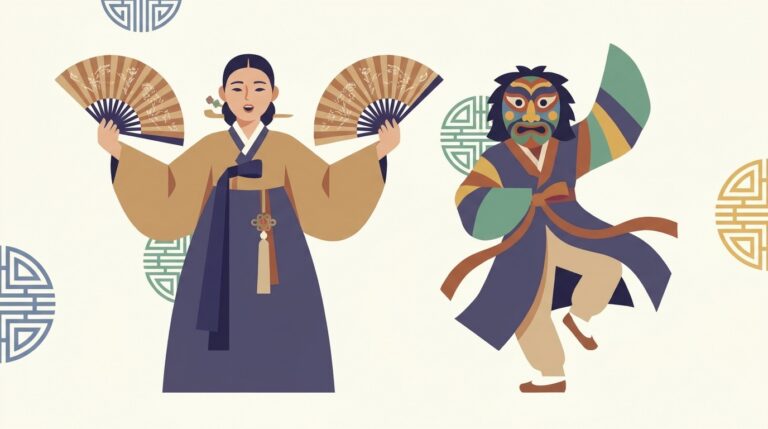
The Linguistic Democracy of Pansori: Where High Erudition Collides with Raw Marketplace Wit
Phase 1: Empathy & Immersion
안녕하세요! 매일한글 에디터입니다. (Annyeonghaseyo! This is your Daily Hangul editor.)
Have you ever settled into an authentic historical K-drama like The King and the Clown or listened to an electrifying Pansori performance like Chunhyangga (춘향가), only to experience instant cognitive whiplash? One moment, the characters are trading hyper-refined Classical Chinese poetry dripping with Confucian statecraft; the next, they explode into earthy marketplace ribaldry, lightning-fast dialect puns, and unabashed gutter slang. You pause, wondering: Did I miss a vocabulary level, or did the narrator just switch dimensions?
If you have reached the C2 tier of Korean, this linguistic crossroads is your final frontier. Standard advanced curricula often train you to write pristine, sanitized academic essays. But Joseon oral masterworks were never sterile. Pansori librettos (saseol, 사설) and folk mask dance (talchum, 탈춤) are radical arenas of ‘linguistic democracy’ (언어의 민주주의). Here, tragic grandeur (bijangmi, 비장미) and comic satire (golgyemi, 골계미) do not merely alternate—they collide. Mastering this dual register frees you from textbook stiffness, allowing you to appreciate modern Korean satire, high-level political rhetoric, and sophisticated street banter with the ear of a cultural insider.
Phase 2: Core Expressions In-Depth
1. 양반을 능멸하다 (Yangbaneul neungmyeolhada)
- Pronunciation: [Yang-ban-eul neung-myeol-ha-da] (Think of neung like “sung” with an n, and myeol like “pure” sliding into an l).
- Meaning: Literally “to insult or demean an aristocrat,” but culturally “to subversively puncture the pretensions of the ruling class through lacerating public satire.”
- K-Culture Moment: In Bongsan Talchum (봉산탈춤), the servant Malttugi introduces the noble Yangban brothers with flowery honorifics before immediately turning their aristocratic titles into obscene puns about dogs and bankrupt debtors.
- Editor’s Insight: In contemporary journalism and cultural critiques, this phrase is invoked whenever an indie creator or underdog comedian uses sharp wit to critique unaccountable corporate or political elites.
- Situation Spectrum: Casual 🚫 | Semi-formal ⚠️ | Formal/Academic ✅
- 🤔 Think About It: How does your mother tongue handle carnivalistic inversions where the servant linguistically dominates the master?
2. 어희(語戱)를 부리다 (Eohuireul burida)
- Pronunciation: [Eo-hui-reul bu-ri-da] (Eo as in “run”, hui rhymes with “we”, burida rolls like Spanish bu-ree-da).
- Meaning: Literally “to manipulate verbal play,” nuance: “to deploy virtuoso wordplay, double entendres, or homophonic puns spanning highbrow Sino-Korean and lowbrow vernacular.”
- K-Culture Moment: When a pansori sorikkun puns on the classical character 門 (mun, gate) to mean “questioning the gatekeeper’s integrity” while mimicking the neighing of a decrepit horse.
- Editor’s Insight: Unlike casual maljangnan (말장난, dad jokes or banter), eohui denotes deliberate rhetorical craft used by storytellers to slip dangerous political critiques past censors.
- Situation Spectrum: Casual ⚠️ | Semi-formal ✅ | Formal ✅
- 🤔 Think About It: What distinguishes a cheap pun from literary paronomasia in your language?
3. 비장미와 골계미가 교차하다 (Bijangmiwa golgyemiga gyocha-hada)
- Pronunciation: [Bi-jang-mi-wa gol-gye-mi-ga gyo-cha-ha-da] (Rhythmic cadence: bi-jang-mi / gol-gye-mi / gyo-cha-ha-da).
- Meaning: “The tragic aesthetic of sublime sorrow intertwines with the comic aesthetic of satirical relief.”
- K-Culture Moment: In Simcheongga (심청가), the audience weeps copiously as Sim Cheong plunges into the Indangsu sea (bijangmi), only to burst into laughter seconds later when her blind father gets swindled by a garrulous local gossip (golgyemi).
- Editor’s Insight: This is the DNA of modern Korean cinema. Directors like Bong Joon-ho (Parasite) build their worldwide acclaim precisely on this historical Korean instinct to crash tragedy into dark farce within the same breath.
- Situation Spectrum: Casual 🚫 | Semi-formal ✅ | Formal/Literary ✅
- 🤔 Think About It: Why does Korean culture historically find pure unadulterated tragedy incomplete without a cathartic laugh?
Phase 3: Textbook Korean vs. Real Native Korean
Situation 1: Calling out hypocrisy with unsparing sharpness
- 📖 교과서 한국어: 사회 지도층의 모순을 날카롭게 비판해야 합니다. (Sahoe jidocheung-ui mosun-eul nalkaropge bipanhaeya hamnida.) — “One must sharply criticize the contradictions of social leaders.”
- 🗣️ 진짜 한국어: 겉으로는 고상한 척하면서 뒤로는 호박씨 까는 권력자들의 민낯을 거침없이 까발려야 제맛이죠. (Geot-eoroneun gosanghan cheokhamyeonseo dwiro-neun hobakssi kkaneun gwallyeokjadeul-ui minnat-eul geochimeopsi kkaballyeoya jemas-ijyo.) — “It only hits home when you ruthlessly strip away the facade of power-trippers who act noble while secretly playing dirty tricks behind closed doors.”
- 💡 왜 다를까?: Traditional Pansori avoids sterile abstractions. Real native Korean achieves biting satire by using tactile idioms like hobakssi kkada (호박씨 까다, to feign innocence while indulging in underhanded acts) and kkaballida (까발리다, to lay bare completely).
Situation 2: Transitioning from crying to laughter in high-stress realities
- 📖 교과서 한국어: 우리는 깊은 절망 속에서도 유머를 잃지 않습니다. (Urineun gipeun jeolmang sogeseodo yumeoreul ilchi anseumnida.) — “Even amidst deep despair, we do not lose our humor.”
- 🗣️ 진짜 한국어: 억장이 무너져 곡소리가 나다가도 한바탕 너스레로 털어내는 게 우리 가락의 묘미잖아요. (Eokjang-i muneojyeo goksoriga nadagado hanbatang neoseulero teoreonaeneun ge uri garak-ui myomijanh-ayo.) — “Even when your heart shatters and wailing fills the air, dusting it all off with a shamelessly cheeky joke is the true magic of our rhythms.”
- 💡 왜 다를까?: Native Korean favors kinetic emotional verbs like eokjang-i muneojida (억장이 무너지다) and theatrical nouns like neoseure (너스레, garrulous good-humored banter) rather than passive loanwords like yumeo (유머).
Phase 4: K-Culture Deep Dive & Non-Verbal Manners
4-1. Nunchi & Performance Gestures
In traditional performance spaces, the boundary between performer (gwangdae, 광대) and spectator is intentionally dissolved. Notice the gwangdae‘s fan (hapjukseon, 합죽선). Snapping it shut with a crack marks a transition from rhythmic verse into earthy narrative prose (aniri, 아니리). As an audience member, showing true nunchi means offering chu-im-sae (추임새)—spontaneous exclamations like “얼씨구!” (Eolssigu!) or “좋다!” (Jota!)—precisely at the breath pause between phrases. Shouting during an active melodic phrase disrupts the sorikkun‘s danjeon (단전) breath control; dropping it right into the silence earns you a nod of profound artistic respect.
4-2. Cultural Code Analysis: The Carnivalesque Korean Soul
Mikhail Bakhtin’s theory of the “carnivalesque” found its real-world zenith in Joseon marketplaces (jangteo, 장터). While strict Neo-Confucian hierarchy governed official life, Pansori performances established temporary autonomous zones where an illiterate merchant could openly laugh at an arrogant magistrate’s linguistic blunders. In the masterwork Chunhyangga, when the corrupt magistrate Byeon Hak-do demands an impromptu Sino-Korean poetry contest, his sycophantic guests assemble incomprehensible, pompous stanzas, while the disguised undercover royal inspector uses simple folk metaphors to foretell the tyrant’s downfall. This linguistic polyphony proves that in Korean culture, real power belongs not to those with the stiffest vocabulary, but to those who can pivot effortlessly between heaven and the mud.
Phase 5: Real-World Roleplay Scenario
Setting: An intimate masterclass at the National Gugak Center in Seoul. You are discussing Pansori libretto interpretation with Master Park, an esteemed intangible cultural heritage holder.
- Master Park: 이번 대목은 양반의 위선을 폭로하는 장면인데, 자네는 이 사설의 어조를 어떻게 해석했는가? (Ibeon daemok-eun yangban-ui wiseon-eul pongnohaneun jangmyeon-inde, jane-neun i saseol-ui eojo-reul eotteoke haeseokhaenneun-ga?) [🎭 Stroking his white beard with a penetrating gaze]
- You: 양반의 근엄한 한문투 뒤에 숨은 탐욕을 장터의 비속어로 맞받아쳐 전복시키는 구성으로 보았습니다. (Yangban-ui geuneomhan hanmuntu dwie sumeun tamyog-eul jangteo-ui bisog-eoro matbadachyeo jeonboksikineun guseong-euro boasseumnida.) [🎭 Leaning forward, holding eye contact with modest confidence]
- Master Park: 오호라, 제법이군. 그렇다면 자네, 소리꾼이 갑자기 슬픔을 멈추고 관객에게 익살을 떠는 대목은 어떻게 살릴 텐가? (Ohora, jebeob-igun. Geureotamyeon jane, sorikkun-i gapjagi seulpeum-eul meomchugo gwan-gaeg-ege iksar-eul tteoneun daemok-eun eotteoke sallil ten-ga?) [🎭 Raising one eyebrow playfully]
- You: 비장미에만 매몰되면 관객이 지치므로, 골계미를 끼워 넣어 감정을 환기하고 카타르시스를 배가시키겠습니다. (Bijangmi-eman maemoldoemyeon gwan-gaeg-i jichimeuro, golgyemi-reul kkiwo neo-eo gamjeong-eul hwan-gihago katareusiseu-reul baegasikigesseumnida.) [🎭 Gently snapping wrist as if holding a fan]
- Master Park: 허허! ‘언어의 민주주의’를 아주 똑똑히 꿰뚫어 보고 있구먼 그래. (Heoheo! ‘Eoneo-ui minjujuui’-reul aju ttokttokhi kkwettureo bogo itgumeon geurae.) [🎭 Slapping his knee in delight]
- You: 선생님, 사설 속의 육두문자조차 단순한 욕설이 아니라 억압된 민중의 해방구처럼 느껴집니다. (Seonsaengnim, saseol sok-ui yukdumunjajocha dansunhan yokseor-i anira eog-apdoen minjung-ui haebanggucheoreom neukkyeojimnida.) [🎭 Smiling warmly, speaking with deep resonance]
- Master Park: 바로 그거야! 천한 말과 귀한 말이 한데 엉켜 춤추는 게 우리 판의 참맛이지. (Baro geugeoya! Cheonhan malgwa gwihan mar-i hande eongkyeo chumchuneun ge uri pan-ui chammas-iji.) [🎭 Nodding vigorously]
- You: 그 경계를 자유자재로 넘나드는 소리꾼의 호흡을 꼭 체득하고 싶습니다. (Geu gyeonggye-reul jayujajaero neomnadeuneun sorikkun-ui hoheub-eul kkok chedeukhago sipseumnida.) [🎭 Bowing head slightly with clasped hands]
🔀 Interactive Choice Point
Master Park suddenly challenges you: “Now, deliver a spontaneous chu-im-sae as I sing a line where the starving peasant curses the skies!”
- Option A: Wait for him to finish the tragic high note, then loudly yell: “얼씨구! 그렇지, 잘한다!” (Eolssigu! Geureochi, jalhanda!)
- Option B: Interrupt mid-wail with: “선생님, 음정이 조금 불안정하신 것 같습니다.” (Seonsaengnim, eumjeong-i jogeum buranjeonghasin geot gatseumnida.)
- Option C: Stay silent throughout, staring intently at the floor to show solemn Confucian obedience.
Feedback:
* Option A (Best): Perfect timing! Eolssigu transforms private lament into collective strength. Master Park will praise your innate rhythmic intuition (deum).
* Option B (Bad): Devastating social disaster. You broke the ritual illusion, insulted a master’s vocal timbre, and mistook raw vocal rasp (seongum) for bad pitch.
* Option C (Risk): While polite, it shows emotional stiffness. In a Pansori circle, silence is felt as cold indifference rather than reverence.
Phase 6: 10-Second Emotional Shadowing Drill
Pay attention to the emotional inflection and slash / pause markers:
- Line 1 [🥺 비장하고 처연하게 / Deeply tragic & sorrowful]:
만경창파 / 깊은 물에 / 가련한 이 내 몸이 / 빠져 죽은들 / 뉘라서 알리요… / (Man-gyeong-chang-pa / gipeun mur-e / garyeohan i nae mom-i / ppajyeo jukeundeul / nwiraseo alliyo… /) - Line 2 [😏 능청스럽고 익살맞게 / Cheekily satirical & playful]:
어따 이놈아! / 양반이 온다더니 / 개 뼈다귀 무는 소리만 / 사방에 요란하구나! / (Eotta i-noma! / yangban-i ondadeoni / gae ppyedagwi muneun soriman / sabang-e yoranhaguna! /)
Phase 7: K-Culture Mini Dictionary
- 사설 (Saseol) | Libretto / Dramatic Narrative Monologue | Refers to the comprehensive literary text of Pansori combining sung verses, rhythmic recitative (aniri), and stage banter.
- 골계미 (Golgyemi) | Comic/Satirical Aesthetic | The artistic beauty achieved when high social conventions are humorously exposed and inverted by lowborn wit.
- 비장미 (Bijangmi) | Tragic Grandeur / Sublime Pathos | The emotional climax evoked when human suffering or existential injustice is confronted with defiant dignity.
- 추임새 (Chu-im-sae) | Vocal Prompting / Empathic Exclamation | Spontaneous cheers uttered by the drummer or spectators to stimulate the performer’s artistic trance.
Phase 8: Traveler’s Survival Kit
Top 3 Survival Expressions for Traditional Performances
- 얼씨구 좋다! (Eolssigu jota!)
- Pronunciation: [Eol-ssi-gu jo-ta!]
- Pro Tip: Shout this when the singer resolves a prolonged tragic verse into a triumphant open cadence.
- 목소리가 참 구성지네요. (Moksoriga cham guseongjineyo.)
- Pronunciation: [Mok-sori-ga cham gu-seong-ji-ne-yo.]
- Pro Tip: Use this to praise a singer’s rich, husky, resonant tone (guseongjida is untranslatable as merely “good”).
- 추임새 좀 크게 넣어 주세요! (Chu-im-sae jom keuge neo-eo juseyo!)
- Pronunciation: [Chu-im-sae jom keu-ge neo-eo ju-se-yo!]
- Pro Tip: Tell your theater companions to hype up the room when the atmosphere feels hesitant.
Editor’s Travel Note
When heading to Seoul, don’t miss weekend matinees at the National Theater of Korea or Jeongdong Theater. To secure front-row seats where you can look right into the performer’s eyes, make sure to use the official National Gugak Center reservation portal rather than general ticketing brokers. For finding hidden outdoor madangnori stages tucked behind historical villages, install Naver Map app download to track real-time footpaths, as international map platforms frequently misplace traditional heritage amphitheaters.
Phase 9: Going One Step Deeper
In classical Joseon society, words were weapons of social stratification; honorific suffixes (jondaenmal) literally mapped out class ceilings. However, inside the circular space of the performance ring (pan, 판), this feudal hierarchy evaporated. By intertwining the King’s Chinese poetic forms with the earthy jargon of fishmongers, Pansori performed an act of linguistic revolution long before modern political democracy arrived on the peninsula. It taught generations of Koreans that no register of human speech is inherently pure, and that true cultural dignity stems from embracing both our loftiest aspirations and our basest survival instincts.
💬 Your Turn: Does your native literature feature an art form where high classical verse collides with market slang? Drop a comment below with an example!
Phase 10: FAQ & Common Mistakes
Q: Is Pansori libretto considered archaic Korean that modern locals cannot understand?
A: Yes and no. The heavy Sino-Korean vocabulary (hanmun) requires footnote study even for college-educated Koreans. However, the colloquial proverbs, puns, and emotional curses remain immediately transparent and deeply resonant to native ears.
Q: Can I shout “얼씨구” (Eolssigu) during any traditional Korean performance?
A: Definitely not. While welcome during folk music (minsogak), Pansori, and mask dances, shouting during aristocratic chamber music (jeong-ak, 정악) or royal ancestral rituals (Jongmyo Jeryeak) is considered a grave breach of etiquette.
Q: Why do Pansori singers deliberately damage their vocal cords during training?
A: They pursue seongum (수리성 / 쇠소리)—a cracked, metallic, raspy timbre capable of expressing profound han (sorrow). A voice that sounds too polished or operatic is traditionally criticized for lacking emotional grit.
🚨 Common Mistakes Warning Board
- Mistake 1: Using “양반을 능멸하다” to describe a lighthearted joke with a modern boss.
- Correct Action: Reserve this for literary, societal, or deeply satirical contexts. For workplace banter, use “장난스럽게 디스하다” (jangnanseureopge diseuhada) instead.
- Mistake 2: Assuming all lowborn speech in Pansori is vulgar.
- Correct Action: Much of it consists of brilliant proverbs (sokdam) that encapsulate acute philosophical wisdom dressed in peasant metaphors.
- Mistake 3: Shouting chu-im-sae monotonically like a machine.
- Correct Action: Match the emotional color of your exclamation to the singer’s tone—sigh softly with “아이고…” during tragedies, and cheer “얼씨구!” during comic climaxes.
Phase 11: Action Missions
- Bronze Mission (Solo Practice): Recite the Phase 6 Shadowing Drill three times, clearly modulating between high-pitched tragic grief and throat-clearing, cheeky satire.
- Silver Mission (Social Connection): Watch a YouTube clip of Madangnori (마당놀이) and post a comment using either “비장미” or “골계미” correctly.
- Gold Mission (Real-World Application): Next time you watch a historical K-drama (sageuk), spot a scene where a servant mocks an official using wordplay, write down the exchange, and analyze its social nuance.
- 🎮 K-Culture Mission: Listen to the soundtrack of LEENALCHI’s Tiger is Coming (범 내려온다) and identify which lyrics stem from classical Sino-Korean and which are colloquial animal sounds.
Phase 12: Interactive Quiz Challenge
- Situational Judgment: You are writing an academic review of a play where the protagonist uses humorous marketplace insults to challenge a corrupt politician. Which phrase best captures this aesthetic dynamic?
- A) 격조 높은 순수문학의 극치
- B) 골계미를 통한 권력 풍자와 언어의 민주주의
- C) 상호 존중과 유교적 예의범절의 구현
- Fill-in-the-Blank: 판소리에서는 지극한 슬픔을 담은 ( _____ )와/과 웃음을 자아내는 ( _____ )이/가 쉼 없이 교차한다.
-
True or False: Pansori librettos strictly separated high Sino-Korean vocabulary and vernacular slang into different chapters to prevent confusing the audience.
👉 Click to view Answers & Explanations
- Answer: B
- Explanation: The scenario directly exemplifies golgyemi (satirical aesthetic) used to subvert authority within a democratic linguistic framework. Option A ignores the comic vulgarity, and Option C misinterprets subversive mockery as Confucian propriety.
- Answer: 비장미 (Bijangmi) / 골계미 (Golgyemi)
- Explanation: Tragic pathos (bijangmi) and comic relief (golgyemi) form the central dialectic rhythm of traditional storytelling.
- Answer: False
- Explanation: The defining aesthetic brilliance of Pansori is precisely that both registers exist interwoven within the exact same stanza, creating thrilling linguistic collisions.
- Explanation: The defining aesthetic brilliance of Pansori is precisely that both registers exist interwoven within the exact same stanza, creating thrilling linguistic collisions.
🎬 Watch Our Daily Videos! (Daily Hangul Official Instagram)
Review the expressions you learned in this article with our fun daily short videos! Check out native pronunciation and real-life nuances in action.
- Instagram @dailyhangul_en






