

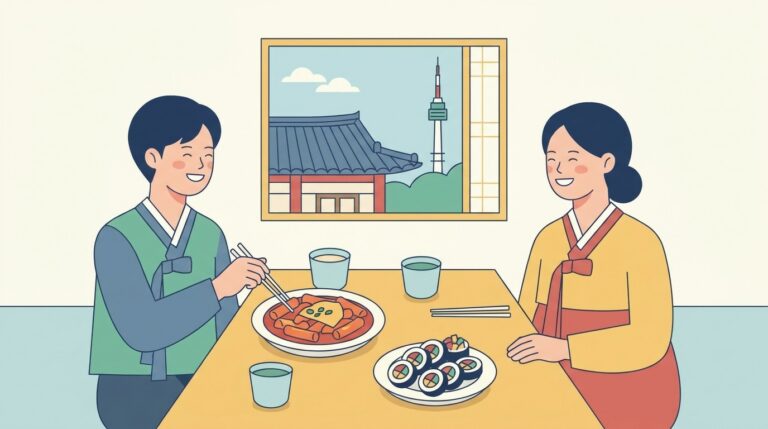
Phase 1: Why You Need a Korean Foodie Buddy
안녕하세요! 매일한글 에디터입니다. (Annyeonghaseyo! Maeil Hangeul editeoimnida. — Hello! I’m your Daily Hangul editor.) Have you ever stood outside a sizzling Korean BBQ spot in Hongdae, drooling over samgyeopsal, only to learn there is a two-person minimum order? Classic rookie pain! In K-Food culture, eating together is everything. Even in K-Dramas like Hospital Playlist, close friends bond by teasing each other with cute foodie nicknames over bubbling stews. Simply calling someone a “friend” feels too stiff when you want to split spicy tteokbokki! Based on real feedback from beginner learners who struggled to invite locals to lunch, this guide gives you the sweetest, easiest Korean nicknames to land your very own foodie buddy fast!
Phase 2: Top 3 Essential Expressions Deep Dive
1. 밥친구 (bapchingu)
- Pronunciation: bap-chin-gu (Sounds like “bop” + “chin” + “goo” — imagine saying “bop, chin, goo!” quickly with a soft “b” sound.)
- Meaning: Literally “rice friend.” In real life, it means a casual meal buddy — someone fun and comfortable to eat lunch or dinner with.
- K-Culture Moment: On Korean college campuses and office chats, people often post on community boards saying they need a 밥친구 (bapchingu) so they don’t have to eat cafeteria food alone.
- Editor’s Insight: Don’t worry, calling someone your 밥친구 (bapchingu) doesn’t mean you have to be lifelong besties yet! It is the warmest, lowest-pressure way to invite a classmate or new friend to grab a bite.
- Situation Spectrum: Casual ✅ | Semi-formal ✅ | Formal 🚫
- 🤔 Think About It: In English, we ask “Want to grab lunch?” In Korean, why do people turn rice (bap) into a whole friendship category? Food is the ultimate bridge for closeness in Korea!
2. 먹메이트 (meokmeiteu)
- Pronunciation: meok-me-i-teu (Sounds like “muk” as in muck, then “may-it-uh” — like saying “mate” with a cute Korean bounce at the end.)
- Meaning: Literally “eat-mate.” It means a foodie buddy who shares your exact cravings and loves exploring delicious restaurants with you.
- K-Culture Moment: You will hear this trendy Konglish slang all over Korean mukbang YouTube channels and foodie Instagram reels when two friends go café-hopping together.
- Editor’s Insight: While 밥친구 (bapchingu) is about not eating alone, 먹메이트 (meokmeiteu) is about enjoying amazing food together! Use it when you find someone who loves spicy food or dessert just as much as you do.
- Situation Spectrum: Casual ✅ | Semi-formal ⚠️ | Formal 🚫
- 🤔 Think About It: Koreans love mixing Korean verbs (meokda, to eat) with English nouns (mate). What food-related slang words do you and your friends mix together in your language?
3. 먹짱 (meokjjang)
- Pronunciation: meok-jjang (Sounds like “muk” + “jahng” — say “jahng” like you’re snapping your fingers with energy!)
- Meaning: Literally “eat-best.” It is a playful, affectionate nickname meaning “foodie boss” or “ultimate foodie.”
- K-Culture Moment: In Korean variety shows like I Live Alone, hosts lovingly call cast members 먹짱 (meokjjang) when they know all the secret tasty restaurants and eat with pure joy.
- Editor’s Insight: In English, calling a friend a “big eater” might sound awkward, right? In Korea, calling a close friend 먹짱 (meokjjang) is actually a huge compliment! It means they have top-tier taste and great energy at the dinner table.
- Situation Spectrum: Casual ✅ | Semi-formal 🚫 | Formal 🚫
- 🤔 Think About It: Why is enjoying food enthusiastically seen as such a lovable trait among Korean friends?
Phase 3: Textbook Korean vs. Real Korean
Situation 1: Asking a close friend to be your meal buddy
* 📖 Textbook Korean: 저와 같이 식사하실래요? (Jeowa gachi siksahasillaeyo? — Would you like to have a meal with me?)
* 🗣️ Real Korean: 우리 밥친구 할래? (Uri bapchingu hallae? — Wanna be meal buddies?)
* 💡 Why the difference? Textbook Korean sounds like a polite business email! With a friend, using 우리 (uri — we/our) and 밥친구 (bapchingu) immediately creates a cozy, best-friend vibe.
Situation 2: Praising a friend who always knows the best food spots
* 📖 Textbook Korean: 음식을 정말 잘 드시네요. (Eumsigeul jeongmal jal deusineyo. — You eat food very well.)
* 🗣️ Real Korean: 역시 우리 먹짱이야! (Yeoksi uri meokjjang-iya! — You really are our foodie boss!)
* 💡 Why the difference? Close Korean friends show affection through playful nicknames. Calling your friend 우리 먹짱 (uri meokjjang) makes them feel special and proud of their restaurant picks.
Phase 4: K-Culture Deep Dive & Non-Verbal Manners
4-1. Nunchi (눈치) & Gestures
When you want to bond with a new 밥친구 (bapchingu) at the table, your hands speak louder than words! Before taking your first bite, use both hands (or support your right forearm with your left hand) when pouring water for your friend. Gently placing a napkin and a pair of chopsticks on the table for them shows amazing nunchi (social awareness) and tells them, “I’m happy to eat with you!” Also, give a bright smile and lean slightly forward when asking what they want to order.
4-2. Cultural Code: K-Food & K-Drama Bap Culture
In Korea, “rice” (밥, bap) equals love. Even in K-Dramas, characters don’t always say “I miss you” — instead, they ask, “밥 먹었어? (Bap meogeosseo? — Did you eat?)” Sharing dishes from the middle of the table is completely normal among close friends. Once you become someone’s 먹메이트 (meokmeiteu), ordering one spicy stew and two bowls of rice to share is the fastest way to level up your friendship!
Phase 5: Real-Life Roleplay Scenario
- Setting: A cozy, bustling bunsikjip (Korean snack restaurant) near Hongik University. Steam rises from red tteokbokki pots, and K-Pop plays softly in the background.
- Characters: You (an A1 Korean learner) and Minji (your cheerful Korean language exchange buddy who loves food).
- Minji: 배고프지? 여기 떡볶이 진짜 맛있어! (Baegopeuji? Yeogi tteokbokki jinjja masisseo! — You’re hungry, right? The tteokbokki here is really delicious!) 🎭 Minji taps the menu excitedly with a bright smile.
- You: 와, 맛있겠다! 민지야, 너 진짜 먹짱이야! (Wa, masitgetda! Minji-ya, neo jinjja meokjjang-iya! — Wow, looks delicious! Minji, you’re a real foodie boss!) 🎭 You widen your eyes in delight and give her a playful thumbs-up.
- Minji: 하하, 고마워! 너도 김밥 좋아해? (Haha, gomawo! Neodo gimbap joahae? — Haha, thanks! Do you like kimbap too?) 🎭 Minji laughs and pours you a cup of cold water.
- You: 응! 나 김밥 엄청 좋아해. 우리 먹메이트 하자! (Eung! Na gimbap eomcheong joahae. Uri meokmeiteu haja! — Yeah! I love kimbap a ton. Let’s be foodie buddies!) 🎭 You lean forward warmly, holding your water cup with both hands.
- Minji: 좋아! 오늘부터 내 베프 먹메이트야! (Joa! Oneulbuteo nae bepeu meokmeiteu-ya! — Deal! Starting today, you’re my bestie foodie mate!) 🎭 Minji grins and raises her cup for a little water-cup cheer.
- You: 야호! 내일도 밥친구 할래? (Yaho! Naeildo bapchingu hallae? — Yay! Wanna be meal buddies tomorrow too?) 🎭 You cheer softly and wiggle your shoulders happily.
- Minji: 당연하지! 내일은 치킨 먹자! (Dangyeonhaji! Naeireun chikin meokja! — Of course! Let’s eat fried chicken tomorrow!) 🎭 Minji winks and waves to call the server.
- You: 최고야, 우리 먹짱 민지! (Choegoya, uri meokjjang Minji! — You’re the best, our foodie boss Minji!) 🎭 You clap lightly as the steaming food arrives.
🔀 Interactive Branching Point
Right after Minji orders, you notice she gives you the bigger piece of kimbap. How do you respond to keep the friendly nickname vibe going?
* Option A: “고마워, 역시 내 밥친구 최고! (Gomawo, yeoksi nae bapchingu choego! — Thanks, my meal buddy is the best!)”
* Option B: “왜 이거 줘요? 안 먹어요. (Wae igeo jwoyo? An meogeoyo. — Why are you giving me this? I’m not eating it.)”
* Option C: “자기야, 너무 사랑해! (Jagiya, neomu saranghae! — Honey, I love you so much!)”
Feedback:
* Option A (Best!): Smooth, warm, and natural! Using 밥친구 (bapchingu) shows appreciation and deepens your buddy bond instantly.
* Option B (Bad!): Ouch! Switching back to stiff polite endings (-yo) and rejecting food sounds cold and hurts your friend’s feelings.
* Option C (Risk!): Careful! 자기야 (jagiya — honey/babe) is usually for romantic couples. Unless you’re dating Minji, stick to 밥친구 (bapchingu) or 먹메이트 (meokmeiteu)!
Phase 6: 10-Second Emotional Shadowing Drill
Read these out loud! Pause briefly at each / and match the mood!
[😊 Happy & Excited]우리 / 밥친구 할래? (Uri / bapchingu hallae? — Wanna be meal buddies?)[🤩 Amazed & Playful]너 진짜 / 먹짱이야! (Neo jinjja / meokjjang-iya! — You’re a real foodie boss!)[🥰 Warm & Cozy]오늘부터 / 내 먹메이트야! (Oneulbuteo / nae meokmeiteu-ya! — From today, you’re my foodie buddy!)
Phase 7: K-Culture Mini Dictionary
- 단짝 (danjjak) | Bestie / Inseparable buddy | Used for two close friends who always stick together, especially at school or lunch.
- 혼밥 (honbap) | Eating alone | Short for honja bap meokgi. Knowing this helps you explain why you’re looking for a foodie buddy!
- 맛집 (matjip) | Tasty restaurant / Must-eat spot | Literally “taste house.” Every 먹메이트 (meokmeiteu) duo keeps a secret list of 맛집 (matjip)!
- 베프 (bepeu) | Best friend (BF) | Super common Konglish abbreviation used by teens and young adults in daily texts.
Phase 8: Traveler’s Survival Kit
Top 3 Survival Expressions for Eating Out:
1. 같이 먹어요! (Gachi meogeoyo!) — Let’s eat together! Pro Tip: Great to use with polite -yo ending when inviting a new acquaintance or fellow traveler.
2. 이거 주세요! (Igeo juseyo!) — This one, please! Pro Tip: Point to a photo on the menu and smile.
3. 잘 먹겠습니다! (Jal meokgetseumnida!) — I will eat well! Pro Tip: Say this before your first bite to thank the cook or your friend!
Editor’s Travel Note:
Google Maps doesn’t work well for walking directions in Korea, so Download the Naver Map App before your trip to find every hidden 맛집 (matjip) with your foodie buddy! Also, for popular brunch or BBQ spots, Download the CatchTable App to join waiting lists from your phone. Don’t forget to grab a T-money transit card at any convenience store—you can use it for subways, buses, and even paying for snacks!
Phase 9: “One Step Deeper” — Food Means Family
In Korean, there is a beautiful word for family: 식구 (sikgu), which literally translates to “mouths that eat together.” Historically, sharing a meal wasn’t just about filling your stomach; it meant you trusted someone enough to bring them into your inner circle. That is why Koreans rarely say “my” friend—they say 우리 친구 (uri chingu — “our” friend) and love giving cute food-related nicknames like 밥친구 (bapchingu). When you invite someone to share a meal in Korea, you are really saying, “Let’s share warmth and jeong (deep affection) together.”
💬 Your Turn: Who is your ultimate foodie buddy in real life, and what Korean dish would you split with them first? Drop a comment below and try calling them your 밥친구 (bapchingu)!
Phase 10: FAQ & Myth Busting
Q: Can I call my Korean teacher or boss “먹짱 (meokjjang)”?
A: No! Never use playful slang nicknames like 먹짱 (meokjjang) with teachers, bosses, or elders. Keep these terms strictly for close friends your age or younger buddies.
Q: Is “밥친구 (bapchingu)” a romantic term?
A: Not at all! 밥친구 (bapchingu) is completely friendly and platonic. It simply means someone you enjoy grabbing meals with.
Q: Do I need to add “-야 (-ya)” after a nickname?
A: Only when calling out directly to a close friend, and only if the word ends in a vowel (like 민지야, Minji-ya). If it ends in a consonant like 먹짱 (meokjjang), you add -아 (-a) to say 먹짱아 (meokjjang-a)!
🚨 Common Mistakes Alert
- Mistake 1: Calling an older friend by their first name without a title. -> Correct Action: Use 언니 (eonni — older sister for females), 누나 (nuna — older sister for males), 오빠 (oppa — older brother for females), or 형 (hyeong — older brother for males) first!
- Mistake 2: Saying “밥 먹자 (bap meokja — let’s eat)” to a stranger. -> Correct Action: Use the polite form 밥 같이 드실래요? (Bap gachi deusillaeyo?) or 같이 먹어요 (Gachi meogeoyo) until you become close.
- Mistake 3: Thinking “배불러! (baebulleo! — I’m full!)” is rude. -> Correct Action: Actually, saying 맛있게 잘 먹었어! 배불러! (Masitge jal meogeosseo! Baebulleo! — I ate deliciously! I’m stuffed!) makes your foodie buddy happy!
Phase 11: Action Mission & Participation
- 🥉 Bronze Mission: Stand in front of your mirror and say “우리 밥친구 할래? (Uri bapchingu hallae?)” 3 times with a big smile!
- 🥈 Silver Mission: Tag your real-life foodie buddy on Instagram or text them: “You are my 먹메이트 (meokmeiteu) today!”
- 🥇 Gold Mission: Use “잘 먹겠습니다 (Jal meokgetseumnida)” before your next Korean meal—bonus points if you say it to a Korean friend!
🎮 K-Culture Mission: Watch an episode of a Korean food variety show or Hospital Playlist and see how many times you hear the word 밥 (bap) or 친구 (chingu)!
Phase 12: Interactive Quiz Challenge
Quiz 1 (Situational Judgment): You want to playfully compliment your close friend who always picks the best tteokbokki spots. Which expression fits best?
A) 안녕하세요! (Annyeonghaseyo!)
B) 역시 우리 먹짱이야! (Yeoksi uri meokjjang-iya!)
C) 식사하셨어요? (Siksahasyeosseoyo?)
👉 Click to reveal Answer & Explanation for Quiz 1
Answer: B) 역시 우리 먹짱이야! (Yeoksi uri meokjjang-iya!)
* Why not A? Annyeonghaseyo is just a polite “Hello.”
* Why not C? Siksahasyeosseoyo is very formal and means “Have you eaten?”—not a playful nickname!
Quiz 2 (Fill in the Blank): Complete the sentence to invite your friend to be your meal buddy: “우리 ______ 할래? (Uri ______ hallae?)”
👉 Click to reveal Answer & Explanation for Quiz 2
Answer: 밥친구 (bapchingu) or 먹메이트 (meokmeiteu)!
Both “우리 밥친구 할래? (Uri bapchingu hallae?)” and “우리 먹메이트 할래? (Uri meokmeiteu hallae?)” are super natural ways to ask a friend to be your foodie buddy!
Quiz 3 (True or False): Calling a close Korean friend “먹짱 (meokjjang)” is considered a friendly compliment, not an insult.
👉 Click to reveal Answer & Explanation for Quiz 3
Answer: TRUE! In Korea, enjoying food wholeheartedly is adorable and lovable. Calling your buddy 먹짱 (meokjjang) praises their awesome taste and foodie energy!
🎬 Watch Our Daily Videos! (Daily Hangul Official Instagram)
Review the expressions you learned in this article with our fun daily short videos! Check out native pronunciation and real-life nuances in action.
- Instagram @dailyhangul_en







