

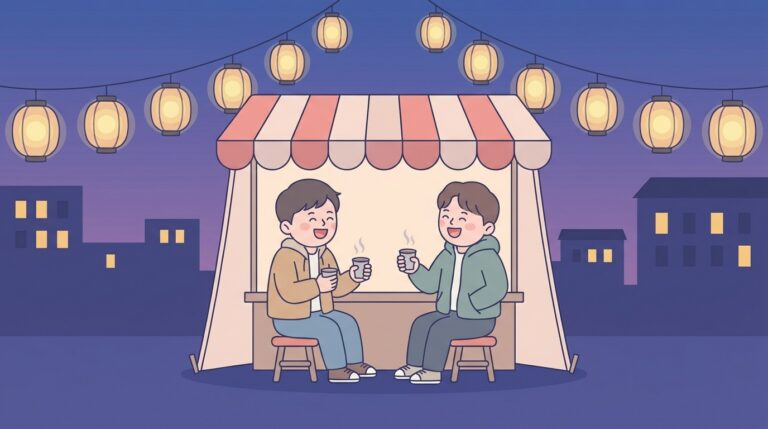
Why Your Korean Friends Roast You: The Secret Behind Fact-Bombs and Tough Love
Phase 1: Empathy — When Honesty Hits Hard
안녕하세요! 매일한글 에디터입니다.
Picture this: You are sitting with your close Korean buddy at a cozy street-side pocha in Euljiro, splitting a steaming bowl of fishcake soup and a plate of spicy tteokbokki. You have spent the last twenty minutes agonizing over a text message: “Why did they take four hours to reply with just an emoji? Does it mean they are shy?”
You secretly hope your friend pats your shoulder and gives you a comforting platitude. Instead, they look up from their chopsticks, stare dead into your eyes, and drop the ultimate hammer:
“야, 걔 너한테 관심 없어. 꿈 깨라.”
(Ya, gyae neohante gwansim eopseo. Kkum kkaera.)
“Hey, they are not interested in you. Snap out of it.”
Your jaw hits the table. Your stomach drops. In Western communication codes, such bluntness can feel like a direct slap in the face. You might wonder: “Are they trying to humiliate me? Are we actually friends?”
Take a deep breath! As an educator who has guided hundreds of international students through Korean social nuances, I can assure you that this is not malice. In Korea, unfiltered honesty—often delivered as playful banter or what locals call 팩폭 (fact-bombing)—is paradoxically the highest proof of sincere affection. Strangers will give you polite, distant smiles; only true friends who genuinely want you to thrive will hand you bitter medicine.
Mastering these banter dynamics will elevate your Korean from robotic textbook politeness to true insider intimacy. Let’s dive into how real Koreans roast, react, and bond through tough love!
Phase 2: Core 3 Expressions Deep Dive
1. 팩폭 하지 마 (Paekpok haji ma)
- Pronunciation: [Paek-pok ha-ji ma] (Sounds like “peck-pork ha-jee mah”)
- Meaning: Literal: “Don’t do fact-violence!” | Actual: “Stop hitting me with the brutal truth!” or “Don’t fact-bomb me!”
- K-Culture Moment: On popular Korean variety shows like Running Man or Knowing Bros, cast members shout this whenever someone points out an undeniable, embarrassing truth about their past mistakes or flaws.
- Editor’s Insight: 팩폭 is short for 팩트 폭행 (fact assault). It acknowledges that what the speaker said is 100% accurate, but emotionally devastating. Saying this with a playful pout signals: “You’re right, but spare my dignity!”
- Situation Spectrum:
- Casual (Friends/Peers): ✅
- Semi-formal (Colleagues of equal rank): ⚠️ (Only if very close outside work)
- Formal (Boss/Elders): 🚫
- 🤔 Think About It: In your culture, is pointing out an uncomfortable fact considered rude, or a duty of true friendship? How does calling truth a “violent attack” (폭행) turn discomfort into comedy?
2. 너 방금 긁혔지? (Neo banggeum geulkhyeotji?)
- Pronunciation: [Neo bang-geum geul-kyeot-ji?] (Sounds like “nuh bahng-geum gool-kyut-jee?”)
- Meaning: Literal: “Did you just get scratched?” | Actual: “You totally got triggered, didn’t you?” / “That touched a nerve!”
- K-Culture Moment: Flooding YouTube comment sections and Twitch Korea livestreams, gamers spam this whenever a streamer suddenly raises their voice or defends themselves too passionately after an innocent tease.
- Editor’s Insight: 긁히다 means “to be scratched.” In modern slang, your ego is the shiny car surface, and a sharp roast just left a visible mark. If someone asks you this, denying it too intensely only confirms that you were indeed scratched.
- Situation Spectrum:
- Casual (Friends/Gaming buddies): ✅
- Semi-formal: 🚫
- Formal: 🚫
- 🤔 Think About It: Why do internet communities create physical metaphors (like being “scratched”) to describe psychological vulnerability?
3. 아, 진짜 킹받네 (A, jinjja kingbanne)
- Pronunciation: [A, jin-jja king-ban-ne] (Sounds like “ah, jeen-jjah keeng-bahn-neh”)
- Meaning: Literal: “Ah, truly King-infuriated!” | Actual: “Ugh, that is so annoyingly hilarious!” / “I am so tilted right now!”
- K-Culture Moment: Webtoon creator CalmDownMan (침착맨) popularized this modern staple. When a friend delivers an infuriatingly witty comeback that leaves you speechless, this is your automatic response.
- Editor’s Insight: Formed by attaching the English prefix “King” (meaning ultimate or extreme) to 열받네 (getting heated). It conveys frustration mixed with comedic helplessness rather than actual hostility.
- Situation Spectrum:
- Casual: ✅
- Semi-formal: 🚫
- Formal: 🚫
- 🤔 Think About It: How does mixing English honorific slang (“King”) with Korean verbs change the emotional intensity of expressing anger?
Phase 3: Textbook Korean vs Real Korean
Situation 1: When a friend points out that you bought an unnecessary item on sale
- 📖 교과서 한국어: 그런 지적은 저를 다소 불편하게 만듭니다.
(Geureon jijeogeun jeoreul daso bulpyeonhage mandeumnida.)
“Such remarks make me somewhat uncomfortable.” - 🗣️ 진짜 한국어: 뼈 때리지 마! 내 돈 내산이거든?
(Ppyeo ttaeriji ma! Nae don naesan-igeodeun?)
“Stop hitting my bones! It’s my own money, okay?” - 💡 왜 다를까?: Nobody speaks like an academic debate panel over street food. Saying 뼈 때리다 (“hitting the bone” = hitting right where it hurts) playfully acknowledges their accuracy while setting a lighthearted boundary.
Situation 2: Acknowledging that someone’s blunt critique is actually for your benefit
- 📖 교과서 한국어: 당신의 비판이 저에게 도움이 될 것입니다.
(Dangsinui bipani jeoege doumi doel geosimnida.)
“Your criticism will be beneficial to me.” - 🗣️ 진짜 한국어: 다 나 잘되라고 하는 소리지? 고맙다.
(Da na jaldoerago haneun soriji? Gomapda.)
“You’re only saying this because you want me to do well, right? Thanks, buddy.” - 💡 왜 다를까?: Koreans view true support through the lens of “나 잘되라고” (wishing for my success/growth). Vocalizing this shows high emotional intelligence (Nunchi).
Phase 4: K-Culture Deep Dive & Non-Verbal Manners
4-1. 눈치 (Nunchi) & Gestures: Delivering & Receiving Tough Love
In Korean interpersonal dynamics, body language defines whether a sharp comment is perceived as affection or bullying:
* The Tongue Click & Palm Wave (혀 차기와 손사래): When delivering a fact-bomb, Koreans often click their tongue softly (Tsk) and shake their hand dismissively toward the table. It signals: “I’m shaking my head at your foolishness because I care too much to watch you fail.”
* The Smirk Defense (피식 웃기): When you are on the receiving end of a roast, do not freeze or scowl. Smirk slightly, look down, and chuckle. This shows you have the resilience to accept the tease without letting your ego shatter.
* Warm Eye Contact After the Sting: Notice what happens after a harsh comment. A true Korean friend will immediately push the best side dish toward you or pour you a drink. That physical gesture acts as the emotional cushion.
4-2. The Cultural Code of ‘정 (Jeong)’ Behind ‘쓴소리 (Bitter Words)’
Korean society is rooted in relational warmth and shared destiny. There is a famous Korean proverb:
“좋은 약은 입에 쓰다.”
(Joeun yageun ibe sseuda.)
“Good medicine tastes bitter to the mouth.”
If someone in Korea dislikes you, they will treat you with icy, flawless politeness (극존칭). They will never criticize your bad habits or warn you against a dead-end relationship—because you simply aren’t worth the social discomfort of an argument. When a Korean gives you 쓴소리 (bitter words), they are investing their emotional energy into you. They are saying: “I care enough about our bond that I am willing to risk you getting annoyed right now so that you don’t suffer later.”
Phase 5: Real-Life Roleplay Scenario
Setting: A late-night snack stall near Sinchon Station. You are with Minjun (민준), your university study partner and close confidant.
[1] 민준 (Minjun): 🎭 [Examining your open job application file and sighing deeply]
    야, 솔직히 말할게. 이 자기소개서, 마감 한 시간 전에 급하게 썼지?
    (Ya, soljikhi malhalge. I jagisogaeseo, magam han sigan jeone geubhage sseotji?)
    "Hey, I'll be honest. You whipped up this cover letter an hour before the deadline, didn't you?"

[2] You: 🎭 [Flustered, clutching your chest as if stabbed]
    헐... 어떻게 알았어? 팩폭 자제 좀 해라.
    (Heol... Eotteoke arasseo? Paekpok jaje jom haera.)
    "Whoa... How did you know? Take it easy on the fact-bombs!"

[3] 민준 (Minjun): 🎭 [Grinning mischievously, leaning across the small table]
    너 방금 표정 보니까 제대로 긁혔네! 얼굴 완전 빨개졌거든?
    (Neo banggeum pyojeong bonikka jedaero geulkhyeonne! Eolgul wanjeon ppalgaejyeotgeodeun?)
    "Looking at your face right now, you totally got scratched! Your face is bright red!"

[4] You: 🎭 [Laughing, playfully swatting the air between you]
    아, 진짜 킹받네! 나름 밤새워서 고민하고 쓴 거거든?
    (A, jinjja kingbanne! Nareum bamsaewoseo gominhago sseun geogeodeun?)
    "Ah, that is so annoyingly tilting! I actually stayed up all night pondering over this, you know!"

[5] 민준 (Minjun): 🎭 [Softening his voice, pushing a cup of warm water toward you]
    내가 왜 쓴소리하겠냐? 너 스펙 아까워서 그래. 지원 동기만 고치면 바로 서류 통과야.
    (Naega wae sseunsorihagessnya? Neo seupaek kkawo-seo geurae. Jiwon donggiman gochimyeon baro seoryu tonggwaya.)
    "Why do you think I'm giving you tough love? Because your qualifications are too good to waste. If you fix just the motivation section, you'll pass screening immediately."

[6] You: 🎭 [Relieved, nodding sincerely]
    다 나 잘되라고 하는 말이지? 팩폭 맞아도 속은 후련하다.
    (Da na jaldoerago haneun mariji? Paekpok majado sogeun huryeonhada.)
    "You're saying this because you want me to do well, right? Even though the fact-bomb hurt, I feel relieved."

[7] 민준 (Minjun): 🎭 [Smacking the table happily and pointing to the menu]
    당연하지! 내가 남 일이면 참견하겠냐? 자, 이제 수정하자. 대신 야식은 네가 쏴라!
    (Dangyeonhaji! Naega nam irimyeon chamgyeonhagessnya? Ja, ije sujeonghaja. Daesin yasigeun nega sswara!)
    "Of course! Would I meddle if you were a stranger? Come on, let's edit it. But you're buying the midnight snacks!"

[8] You: 🎭 [Grinning enthusiastically]
    오케이, 콜! 떡볶이랑 순대 내가 쏜다!
    (Okei, kol! Tteokbokkirang sundae naega ssonda!)
    "Okay, deal! Spicy rice cakes and blood sausage are on me!"
🔀 Interactive Decision Point
How would you respond in Turn 4 if you wanted to maintain the playful energy without escalating any tension?
- Option A: “너나 잘하세요. 내 인생에 참견하지 마.” (Mind your own business. Don’t interfere in my life.)
- Option B: “아, 킹받네 진짜! 인정하기 싫지만 네 말이 다 맞아서 반박을 못 하겠다.”
- Option C: “정말 죄송합니다. 제가 너무 게을렀습니다. 반성하겠습니다.” (I apologize deeply. I was too lazy. I will reflect.)
Feedback on Your Choices:
- Option A [Bad]: This cross-cuts playful banter and introduces actual cold aggression (너나 잘하세요 is an iconic movie line used to cut people off). It will freeze the room instantly.
- Option B [Best]: Brilliant! You acknowledge the teasing slang (킹받네), admit defeat with humor (반박을 못 하겠다 – I can’t even refute it), and reinforce mutual trust.
- Option C [Risk]: Far too solemn and formal for a friend over street food. It will make your friend feel guilty for being honest with you.
Phase 6: 10-Second Emotion Shadowing Drill
Practice these natural cadence patterns. Pay attention to the pause markers (/) and internalize the emotional tags:
[😤 살짝 억울하지만 인정하며 - Mildly exasperated yet conceding defeat]
아, 진짜 팩폭 하지 마! / 인정하는데 / 뼈 맞아서 아프단 말이야.
(A, jinjja paekpok haji ma! / Injeonghaneunde / ppyeo majaseo apeudan mariya.)
“Ah, stop fact-bombing me! / I admit it, / but it hit my bone and it hurts!”-
[😏 능글맞고 장난스럽게 - Smug and teaseful]
너 방금 / 살짝 긁혔지? / 목소리 톤 올라간 거 다 티 나거든?
(Neo banggeum / saljjak geulkhyeotji? / Moksori ton ollagan geo da ti nageodeun?)
“Did you just / get a little scratched? / It’s super obvious because your vocal pitch jumped up!” -
[🥺 츤데레처럼 툴툴대면서도 고마워하며 - Grumpy on the outside, deeply grateful inside]
다 나 잘되라고 / 하는 쓴소리인 거 아니까… / 이번만 봐준다!
(Da na jaldoerago / haneun sseunsoriin geo anikka… / Ibeonman bwajunda!)
“Since I know / this tough love is for my own good… / I’ll let you off the hook this time!”
Phase 7: K-Culture Mini Dictionary
| Term (Hangul + Romanization) | Translation | Real-Life / Social Context |
|---|---|---|
| 팩트 폭행 (Paektu Pokhaeng) | Fact Assault / Brutal Honesty | Shorthand: 팩폭. Used when cold, undeniable logic destroys someone’s wishful thinking or self-deception in conversation. |
| 긁히다 (Geulkhida) | To be scratched / triggered | Slang originating from gaming subcultures. Describes visible agitation when an opponent or peer hits a soft spot in your self-esteem. |
| 킹받다 (Kingbatda) | Mega-annoyed (hilariously) | A playful way to express exasperation. Indicates frustration at a friend’s cheeky behavior while keeping the atmosphere buoyant. |
| 쓴소리 (Sseunsori) | Bitter talk / Tough love | Genuine, constructive critique given from an elder, mentor, or devoted friend who cares about your long-term success. |
Phase 8: Traveler’s Survival Kit
Survival Expressions TOP 3
- 뼈 때리지 마세요! (Ppyeo ttaeriji maseyo!)
Meaning: “Don’t hit my bones! / Don’t call me out so hard!”
Pro Tip: Use this semi-politely with friendly Korean coworkers over post-work barbecue when they tease you about overeating or working too late. - 장난인 거 알죠? (Jangnan-in geo aljyo?)
Meaning: “You know I’m joking, right?”
Pro Tip: If you accidentally deliver a fact-bomb that feels a bit too sharp, instantly deliver this line with a warm smile to relieve tension. - 마상 입었어요. (Masang ibeosseoyo.)
Meaning: “I received emotional damage.” (Short for 마음의 상처)
Pro Tip: Clutch your heart dramatically while saying this. It lightens the mood whenever someone makes a witty joke at your expense.
Editor’s Travel Note: Conquering Late-Night Banter Hotspots
To witness authentic banter in the wild, skip the formal dining spots and head to outdoor dining alleys like the Euljiro Nogari Alley or the Pocha tent streets near Jongno 3-ga.
- Navigation Guide: Always save your locations ahead of time using the 네이버 지도 앱 다운로드 (Naver Map App Download). Google Maps often has outdated footpaths in dense Korean backalleys.
- Payment Manners: In Korean culture, if someone delivers genuine life guidance or critiques your portfolio/Korean pronunciation for an hour, it is customary courtesy to pick up the snack tab or buy the next round of drinks with a cheerful: “제가 낼게요! (I’ll pay!)”.
Phase 9: “One Step Deeper” (Reflective Essay)
In Western communication paradigms, boundaries are often drawn around the sovereign individual—to critique someone’s personal choice uninvited is frequently deemed an intrusion. However, in Korean culture, close relationships are bound by the collective identity of 우리 (Uri – We / Us). When you enter a Korean friend’s inner circle, your life choices cease to be solely your own; your victories are their pride, and your stagnation is their anxiety. Delivering 쓴소리 (tough love) is an exhausting emotional labor that Koreans only expend on people they refuse to give up on. The next time a Korean friend playfully roasts you, realize that beneath the stinging humor lies a fierce, unwavering loyalty.
💬 Your Turn: Have you ever experienced a moment where a friend’s harsh words actually saved you from a huge mistake? How do you say “tough love” in your native language? Share your story in the comments below!
Phase 10: FAQ & Common Mistakes
Q: Can I use “팩폭 하지 마” or “킹받네” with my Korean language teacher?
A: Generally, no. These terms belong firmly to casual peer slang (반말 zone). Using them with an instructor or an elder can make you sound insolent. However, if your teacher is joking around and you add an honorific ending like “선생님, 뼈 때리지 마세요~ (Teacher, don’t hit my bones!)”, it can create a charming, endearing classroom moment.
Q: How do I know if someone’s comment is genuine bullying or friendly tough love?
A: Pay attention to what follows the comment. Malice is followed by emotional exclusion, silence, or gossip. Affectionate tough love is followed by practical advice, checking up on you, or offering food. In Korea, roasting you at the table while putting meat on your rice bowl is the golden standard of Jeong.
Q: What is the fastest way to deflect being teased with “너 긁혔지?” (Did you get triggered)?
A: The best defense is complete, nonchalant agreement. If you say, “어, 완전히 긁혀서 피 난다 (Yeah, I’m so scratched I’m bleeding)” with a deadpan expression, you steal their momentum and transform their roast into shared laughter.
🚨 흔한 실수 (Common Mistakes) Warning Board
- Mistake 1: Translating “I’m offended” as “기분 나빠요 (Gibeun nappayo)” during casual banter.
Why it fails: Saying 기분 나빠요 sounds like an official complaint that ends the fun immediately.
Correct Action: Say “아, 마상 입었다! (Ah, emotional damage!)” or “너무 팩폭이다! (Too much fact-bombing!)”. - Mistake 2: Using “너 긁혔지?” on someone older than you.
Why it fails: Accusing an elder of being triggered is seen as mocking their maturity.
Correct Action: Keep this expression strictly between peers of the exact same age or to younger friends. - Mistake 3: Taking constructive 쓴소리 as personal rejection.
Why it fails: You risk distancing yourself from Koreans who are trying to welcome you into their inner circle.
Correct Action: Smile, thank them for looking out for you (“신경 써줘서 고마워”), and turn it into motivation.
Phase 11: Action Mission & Engagement
Ready to transform theory into habit? Complete these three action tiers:
- 🥉 Bronze Mission (Solo Practice): Look into the mirror and practice the emotion shadowing drill from Phase 6 three times. Focus on exaggerating your facial expressions.
- 🥈 Silver Mission (Social Media): Find a clip of your favorite K-pop idols or K-drama characters teasing each other on YouTube. Leave a Korean comment using: “ㅋㅋㅋ 팩폭 제대로 맞아서 긁혔네 (Lol, they got fact-bombed so hard they got totally triggered)”.
- 🥇 Gold Mission (Real-Life Connection): The next time a Korean language exchange partner or friend gives you honest advice on your pronunciation or grammar, do not just say thank you. Say: “다 나 잘되라고 해 주는 말이지? 고마워! (You’re saying this so I improve, right? Thank you!)”.
🎮 K-Culture Mission: Watch an episode of Running Man (런닝맨) or Workman (워크맨). Spot how many times the graphic subtitles flash words like 팩폭, 킹받음, or 뼈 맞음. Write down the timestamps in your study notebook!
Phase 12: Interactive Quiz Challenge
Test your situational mastery below! Check your answers using the drop-down toggle.
1. Situational Judgment
Your Korean friend notices you buying your fifth cup of iced Americano today and says: “너 그러다 위장 다 뚫린다. 커피 그만 마셔.” (Your stomach lining is going to dissolve. Stop drinking coffee.) What is the most natural, banter-friendly response?
* (A) 즉각 사과드리겠습니다. (I will apologize immediately.)
* (B) 아, 진짜 팩폭 자제 좀 해라! 근데 맞는 말이라 반박은 못 하겠네. (Ah, spare the fact-bombs! But you’re right so I can’t even refute it.)
* (C) 당신이나 잘하세요. (Mind your own business, sir.)
2. Fill-in-the-Blank
Fill in the missing slang term describing someone getting emotionally triggered by a sharp tease:
민수: “너 어제 게임에서 지고 울 뻔했다며?”
지호: “아니거든?! 내가 언제 울었다고 그래?!”
민수: “오호라, 목소리 떨리는 거 보니까 너 지금 제대로 [ ______ ]구나?”
3. True / False Cultural Check
- Statement: In Korean friendship culture, giving someone 쓴소리 (tough love / bitter words) indicates that you are losing respect for them and plan to break off communication.
- (True / False)
👉 Click to reveal answers & explanations!
- Answer: (B)
Explanation: Option B embraces the playful friction of 팩폭 while acknowledging their genuine concern. Option A is absurdly stiff, and Option C is an aggressive insult. -
Answer: 긁혔 (geulkhyeot)
Full sentence: “너 지금 제대로 긁혔구나?” (You’re totally triggered right now, aren’t you?) -
Answer: False
Explanation: It is the exact opposite! Giving 쓴소리 requires emotional investment and relational courage. In Korea, ignoring someone’s mistakes is a sign of distance; correcting them with affectionate bluntness is a sign of deep connection (Jeong).
🎬 Watch Our Daily Videos! (Daily Hangul Official Instagram)
Review the expressions you learned in this article with our fun daily short videos! Check out native pronunciation and real-life nuances in action.
- Instagram @dailyhangul_en







