

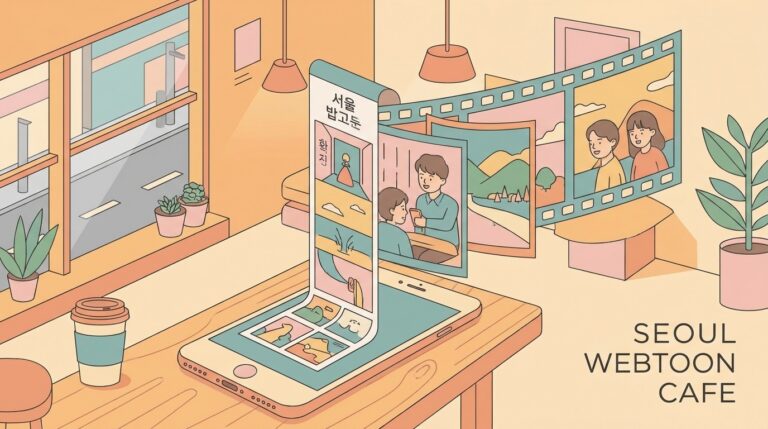
Mastering the Grammar of Korean Webtoons and Transmedia Super IPs
Phase 1: Empathy (Immersion & The K-Culture Pivot)
안녕하세요! 매일한글 에디터입니다. (Hello! This is your Daily Hangul editor.)
Picture this: You are sitting in an artisanal roastery in Seongsu-dong, Seoul’s creative epicenter. Two tables down, a pair of media development producers are huddled over an iPad, dissecting storyboards for an upcoming multi-million dollar streaming adaptation. You lean in and catch snippets of their debate: the pacing of the scrolling panels, whether the protagonist’s emotional payoff works, and how the original web novel’s lore will translate to the small screen.
You love webtoons. You have spent countless late nights swiping through Naver Webtoon and KakaoPage, mesmerized by how vertical scrolling builds palpable suspense in thrillers or sparks instant dopamine hits in romance fantasy. You understand the cinematic genius of Korean digital comics. Yet, when you try to discuss your favorite series with Korean friends or colleagues, you find yourself defaulting to elementary phrases like “이 웹툰 진짜 재미있어요” (This webtoon is really fun) or “그림이 예뻐요” (The art is pretty).
It feels frustrating, doesn’t it? As an advanced Korean learner (C1), you want to express nuanced critiques: analyzing the narrative architecture of vertical scrolling, evaluating the transmedia expansion of super IPs into global K-dramas, and debating whether an adaptation remained faithful to the source material.
This guide was forged from real feedback from our advanced learners in media, entertainment, and translation. By the end of this module, you will not just speak about webtoons; you will command the vocabulary of contemporary Korean creative directors, moving seamlessly between industry jargon and authentic fan lingo. Let’s dive into the visual and textual powerhouse transforming global storytelling.
Phase 2: Core Expressions in Depth (핵심 표현 3선)
1. 세로 스크롤의 문법 (Sero seukeurol-ui munbeop)
- Pronunciation: [Sero seukeurol-ui munbeop] (Sound analogy: Say “Sero” like *Sarah with a soft rolled ‘r’, followed by the English “scroll”, and “moon-beop” rhymes with a sharp “book cup” sound)*
- Meaning: Literally “the grammar of vertical scrolling.” Contextually, it refers to the deliberate narrative and cinematic pacing created exclusively through top-to-bottom continuous mobile scrolling.
- K-Culture Moment: Used by directors, webtoonists, and culture critics when explaining how Korean webtoons departed from traditional paginated manga to invent an entirely new visual pacing—using panel gutter spacing to control the reader’s heartbeat.
- Editor’s Insight: In Korean digital culture, 문법 (grammar) is widely used beyond linguistics to mean an established “industry standard” or “structural aesthetic.” When you refer to webtoon pacing as a 문법, you immediately sound like a seasoned cultural analyst.
- Situation Spectrum:
- Casual: ⚠️ (Slightly formal for casual chat, better to say 스크롤 연출)
- Semi-formal: ✅
- Formal / Professional: ✅
- 🤔 Think About It: In Western print comics, the fundamental unit of suspense is the “page turn.” In Korean webtoons, it is the “speed of the reader’s thumb.” How does shifting agency from the physical page to the infinite digital canvas alter narrative tension in your native language?
2. 원천 IP의 확장성 (Woncheon IP-ui hwakjangseong)
- Pronunciation: [Won-cheon IP-ui hwak-jang-seong] (Sound analogy: “Won” like won currency, “cheon” like *chunk without the k, “IP” as in Intellectual Property, “hwak-jang-seong” sounds like hwahk-jahng-sung)*
- Meaning: Literally “the scalability/expandability of source Intellectual Property.” Nuance: The capacity of a single foundational story (webtoon/web novel) to effortlessly mutate into dramas, films, animations, merchandise, and games.
- K-Culture Moment: Constant headline material in Korean business and entertainment press discussing mega-hits like Itaewon Class, Moving, or Solo Leveling, where a vertically scrolled narrative proved itself as a global multimedia goldmine.
- Editor’s Insight: 원천 means “fountainhead” or “original wellspring.” Using 원천 IP highlights that the story is not just content, but an organic seed capable of branching across multiple media formats.
- Situation Spectrum:
- Casual: 🚫 (Too academic; say 원작이 대박 나서)
- Semi-formal: ✅
- Formal / Industry: ✅
- 🤔 Think About It: Why has the Korean production pipeline prioritized pre-validated digital webtoons over traditional original screenplays in recent years? What does this say about risk mitigation in modern entertainment?
3. 떡밥을 회수하다 (Tteokbap-eul hoesuhada)
- Pronunciation: [Tteok-bbap-eul hoe-su-ha-da] (Sound analogy: “Tteok” like Korean rice cake, “bbap” like cooked rice, “hoe-su” rhymes with *sway-sue)*
- Meaning: Literally “to retrieve the fish bait.” Figurative & Actual Nuance: To resolve foreshadowing, tie up loose narrative threads, or pay off complex plot clues planted earlier in a long-running series.
- K-Culture Moment: Flooding the real-time comments section (댓글창) of fantasy and mystery webtoons when an ambiguous detail from Chapter 12 suddenly becomes the master key that solves the mystery in Chapter 150.
- Editor’s Insight: 떡밥 originally meant fishing bait, then shifted online to mean “enticing clues/hints.” When an author resolves them, they 회수하다 (collect/reclaim). If an author forgets or abandons them, netizens lament: 떡밥을 유기했다 (They abandoned the bait!).
- Situation Spectrum:
- Casual: ✅
- Semi-formal: ✅
- Formal: ⚠️ (Use ‘복선을 회수하다’ in strictly formal essays)
- 🤔 Think About It: Is online collective speculation a prerequisite for storytelling today? How does the immediacy of webtoon comments influence an author’s ability to pull off intricate foreshadowing?
Phase 3: Textbook Korean vs. Real Korean (교과서 한국어 vs 진짜 한국어)
Situation 1: Expressing agonizing suspense at a cliffhanger
- 📖 교과서 한국어: 다음 회차가 너무 기다려지고 긴장감이 넘칩니다. (I look forward to the next chapter very much and it is full of tension.)
- 🗣️ 진짜 한국어: 작가님, 이 타이밍에 절단신공을 쓰시면 일주일을 어떻게 버텨요? (Author-nim, pulling off a lethal cliffhanger right at this moment… how on earth am I supposed to survive the week?)
- 💡 왜 다를까?: Traditional textbooks teach sterile descriptive sentences. Native webtoon enthusiasts employ martial arts slang—specifically 절단신공 (Jeoldan-singong: the divine martial art of cutting off right at the climax)—to playfully express dramatic tension.
Situation 2: Praising a successful live-action drama adaptation
- 📖 교과서 한국어: 원작 만화와 비교했을 때 드라마가 매우 훌륭하게 제작되었습니다. (Compared to the original comic, the drama was produced very excellently.)
- 🗣️ 진짜 한국어: 이건 진짜 원작 초월이네요. 원작 뼈대는 완벽히 살리면서 각색을 완전 찰떡같이 해냈어요. (This is a legitimate transcendence of the original. They kept the foundational spine of the source intact while adapting it with absolute perfection.)
- 💡 왜 다를까?: C1 Korean conversation thrives on expressive compound words and sensory idioms: 원작 초월 (surpassing the original) and 찰떡같이 (fitting seamlessly, like sticky rice cakes).
Phase 4: K-Culture Deep Dive & Non-Verbal Manners
4-1. 눈치 (Nunchi) & Non-Verbal Etiquette in Media Discussions
When discussing serial webtoons in Korea, 스포일러 방지 (spoiler prevention) is an unwritten sacred rule. Because paid readers can preview upcoming chapters via digital tokens (called 쿠키 on Naver), discussing plot twists in public requires subtle 눈치 (situational perceptiveness).
* The Visual Gaze & Lowered Pitch: When revealing a plot point, Koreans lower their vocal register slightly and tilt their head forward, prefacing with: “혹시 미리보기 분량 보셨어요?” (Did you happen to read the advance preview chapters?). If the other person blinks or hesitates, you immediately pull back.
* The Thumb Rhythm: Observe Koreans on Line 2 of the Seoul Subway during rush hour. Notice how the vertical thumb movement dictates attention: a slow scroll indicates reading dense dialogue; rapid, rhythmic flicking signals scanning dynamic action sequences. Mirroring this physical pacing when demonstrating webtoon scenes builds instant camaraderie.
4-2. Cultural Code Analysis: The “Snack Culture” Engine
Korean webtoons pioneered modern digital “snack culture” (스낵컬처)—consuming bite-sized cultural products within 3 to 10 minutes during transit. However, Korean creators transformed this ephemeral format into a springboard for deep, multi-layered universes.
Unlike traditional American superhero comics or Japanese weekly tankōbon prints, webtoons are born on high-resolution OLED mobile displays. This birthed the cinematic “infinite canvas.” A vertical jump down a cliff can extend over several screens of black space, evoking actual vertigo in the reader. The democratization of production platforms (such as Naver Challenge League) allowed unconventional sub-genres to flourish: reincarnation fantasy (회귀물), villainess redemption stories (빙의물), and hyper-realistic corporate revenge sagas. When Korean streaming platforms adapt these works, they inherit not just a script, but a storyboard pre-tested by millions of active mobile critics.
Phase 5: Real-World Roleplay Scenario (실전 롤플레이)
Setting: A minimalist creative studio lounge in Sangam DMC, Seoul’s media powerhouse district. You are analyzing new production properties with Min-woo (민우), a sharp Senior Webtoon Planning Producer at a major entertainment conglomerate.
- 민우 (Min-woo): [진지하게 태블릿을 넘기며] 이번에 런칭한 웹툰, 세로 스크롤 연출이 아주 발군이에요. 컷 사이 여백을 써서 주인공의 고립감을 극대화했더라고요.
(Ibeone reonchinghan wep-tun, sero seukeurol yeonchuri aju balgunieyo. Keot sai yeobaeg-eul sseoseo juin-gong-ui goripgam-eul geukdaehwa-haetdeoragoyo.)
“[Flipping through the tablet with a focused gaze] The vertical-scroll direction in this newly launched webtoon is exceptional. They maximized the protagonist’s isolation by utilizing the gutters between panels.” -
You (학습자): 🎭 맞장구를 치며 살짝 고개를 끄덕인다. 맞아요. 게다가 컷과 컷 사이의 호흡을 아주 영리하게 조절해서 몰입감을 확 끌어올렸더군요.
(Maj-ayo. Gedaga keot-gwa keot sai-ui hoheup-eul aju yeongnihage jojeolhaeseo moripgam-eul hwak kkeureo-ollyeotdeogunyo.)
“🎭 Nodding slightly in enthusiastic agreement. Exactly. On top of that, they brilliantly calibrated the breathing room between panels, dialing the immersion way up.” -
민우 (Min-woo): [고개를 번쩍 들며 감탄한 표정으로] 오, 호흡 조절까지 보셨네요! 역시 보는 눈이 남다르세요. 이 정도 완성도면 원천 IP로서 영상화 확장성도 충분해 보이죠?
(O, hoheup jojeol-kkaji bosyeotneyo! Yeoksi boneun nuni namdareuseyo. I jeongdo wanseongdomen woncheon IP-roseo yeongsanghwa hwakjangseongdo chungbunhae boijyo?)
“[Looking up with an impressed smile] Oh, you noticed the pacing calibration too! You truly have an eye for this. With this level of polish, don’t you think it has plenty of transmedia scalability for a screen adaptation?” -
You (학습자): 🎭 진지한 톤으로 턱을 괴며 분석하듯. 충분합니다. 다만 초반에 심어둔 떡밥들이 워낙 방대해서, 16부작 드라마로 압축할 때 떡밥 회수가 제대로 될지가 관건일 것 같아요.
(Chungbunhamnida. Daman chobane simeodun tteokbapdeuri wonak bangdaehaeseo, sibyukbujak deuramaro apchukhal ttae tteokbap hoesuga jedaero doeljjiga gwangeon-il geot gat-ayo.)
“🎭 Resting chin on hand thoughtfully with an analytical tone. Definitely. However, since the hints planted in early chapters are so vast, whether they can pull off the narrative payoff cleanly when condensing into a 16-episode series will be the critical tipping point.” -
민우 (Min-woo): [깊이 공감하며 무릎을 탁 친다] 아, 뼈를 때리는 지적이네요! 원작 팬덤의 기대치가 높아서 각색이 삐끗하면 바로 민심이 돌아설 테니까요.
(A, ppyeoreul ttaerineun jijeogineyyo! Wonjak paendeom-ui gidae-chiga nop-aseo gakseogi ppikkeuthamyeon baro minsimi doraseol tenikkayo.)
“[Slapping his knee in deep resonance] Ah, that hits the nail on the head! The expectations of the original fandom are sky-high, so if the adaptation slips even slightly, the sentiment will turn instantly.” -
You (학습자): 🎭 미소를 띠며 대안을 제시한다. 그래서 요즘은 웹소설 원작을 웹툰으로 검증하고, 그 검증된 팬덤을 바탕으로 OTT 시리즈로 가는 트랜스미디어 공식이 가장 안전한 문법으로 자리 잡은 것 같아요.
(Geuraeseo yojeumeun wep-soseol wonjag-eul wep-tun-euro geomjeunghago, geu geomjeungdoen paendeom-eul batang-euro OTT sirijeu-ro ganeun teuraenseu-midieo gongsigi gajang anjeonhan munbeob-euro jari jabeun geot gat-ayo.)
“🎭 Smiling while offering a strategic insight. That is precisely why these days, the transmedia formula of validating a web novel via a webtoon first, and then pivoting that verified fandom into an OTT series, has settled into the safest grammar.” -
민우 (Min-woo): [눈을 반짝이며 메모한다] 동감입니다. 혹시 그럼 다음 주 IP 기획 회의 때 이 분석 프레임워크로 같이 발표해 주실 수 있나요?
(Donggam-imnida. Hoksi geureom daeum ju IP gihoek hoeui ttae i bunseok peureim-wokeu-ro gachi balpyohae jusil su innayo?)
“[Eyes lighting up, jotting notes] Fully agreed. By any chance, could you co-present this analysis framework with me at next week’s IP planning summit?” -
You (학습자): 🎭 자신감 넘치는 눈빛으로. 물론이죠! 원작의 매력 포인트를 짚어내는 비교 분석 자료를 준비해 오겠습니다.
(Mollon-ijyo! Wonjak-ui maeryeok pointeureul jipeonaeneun bigyo bunseok jaryoreul junbihae ogesseumnida.)
“🎭 With a confident look. Absolutely! I will prepare a comparative study highlighting the core appeal points of the source work.”
🔀 Interactive Branching Point
Min-woo suddenly pauses and asks your opinion on a polarizing controversial trend:
“요즘 유행하는 회귀/빙의/환생(이른바 회빙환) 클리셰가 너무 과도하다는 비판에 대해선 어떻게 생각하세요?” (What are your thoughts on the critique that the currently trending ‘Regression/Possession/Reincarnation’ clichés are overly saturated?)
- Option A: “클리셰가 많으면 지루하니까 무조건 새로운 장르를 시도해야 합니다.” (Since clichés are boring, creators must try new genres unconditionally.)
- Option B: “클리셰는 독자와의 즉각적인 교감 장치입니다. 문법을 빠르게 인지시킨 후 변주를 주는 것이 K-웹툰의 독보적인 강점 아닐까요?” (Clichés serve as instant shorthand with the audience. Isn’t establishing the grammar rapidly and then delivering subversions the unrivaled strength of Korean webtoons?)
- Option C: “한국 웹툰은 이제 클리셰 때문에 망할 것 같아요. 일본 만화가 더 독창적입니다.” (I think Korean webtoons will fail because of clichés. Japanese manga is much more original.)
Branch Feedback:
- Option A (Bad): Oversimplified and ignores commercial dynamics. In the fast-scrolling economy, instant genre literacy is a deliberate storytelling mechanism.
- Option B (Best!): Flawless C1 cultural insight! Demonstrates an understanding of “cliché as narrative shorthand” followed by clever subversion (변주), showcasing strategic industry acumen.
- Option C (Risk): Culturally dismissive and conversational suicide in an industry creative meeting. Comparing creative ecosystems without nuance damages rapport.
Phase 6: 10-Second Emotion Shadowing Drill (10초 감정 섀도잉 드릴)
Practice reading these out loud, observing the rhythmic breath marks (/) and internalizing the exact emotional posture.
[🔥 날카롭고 분석적인 톤으로]
세로 연출의 진가는 / 단순히 위아래로 내리는 게 아니라, / 스크롤 속도로 독자의 긴장감을 쥐락펴락하는 데 있어요.
(Sero yeonchul-ui jin-ganeun / dansunhi wiaraero naerineun ge anira, / seukeurol sokdoro dokja-ui ginjanggam-eul jwirakpyeorakhaneun de isseoyo.)
“The true caliber of vertical direction / is not merely scrolling up and down, / but commanding the reader’s suspense through the pacing of the scroll.”-
[🤩 감탄과 몰입감이 넘치며]
와, 이번 에피소드 마지막 컷 보셨어요? / 스크롤을 내리는 순간 / 소름이 쫙 돋았어요!
(Wa, ibeon episodeu majimak keot bosyeosseoyo? / Seukeuroreul naerineun sungan / soreumi jjwag dodasseoyo!)
“Wow, did you see the final panel of this episode? / The split second I scrolled down, / I got literal goosebumps!” -
[🤔 냉철한 미디어 전략가의 어조로]
웹툰이 글로벌 원천 IP로 부상한 이유는 / 이미 수백만 독자의 실시간 피드백을 통해 / 시장성이 완벽히 검증되었기 때문입니다.
(Wep-tuni geulleobeol woncheon IP-ro busanghan iyuneun / imi subaekman dokja-ui silsigan pideubaeg-eul tonghae / sijangseongi wanbyeokhi geomjeung-doeeotgi ttaemun-imnida.)
“The reason webtoons emerged as global source IPs / is that through the real-time feedback of millions of readers, / their marketability has already been thoroughly validated.”
Phase 7: K-Culture Mini Dictionary (K-컬처 미니 사전)
-
쿠키를 굽다 (Kukireul gupda)
- Literal Translation: Baking cookies.
- Cultural Meaning: Purchasing digital tokens (named ‘Cookie’ on Naver Webtoon) with real money to unlock advance chapters before their weekly public release.
- Real-world Usage: “어제 새벽에 결말이 너무 궁금해서 나도 모르게 쿠키를 20개나 구웠잖아.” (I was dying to know the ending at dawn yesterday, so without realizing it, I ‘baked’ 20 cookies.)
- 정주행 (Jeongjuhaeng)
- Literal Translation: Driving straight forward without stopping.
- Cultural Meaning: Binge-reading or binge-watching an entire series from Chapter/Episode 1 to the current release.
- Real-world Usage: “주말에 약속 다 취소하고 완결 웹툰 하나 처음부터 끝까지 정주행 달렸어.” (I canceled all weekend plans and ran a nonstop binge-read of a completed webtoon from start to finish.)
- 작붕 (Jakbung – Abbreviation of 작화 붕괴)
- Literal Translation: Drawing collapse / Art collapse.
- Cultural Meaning: A sudden, noticeable degradation in artwork quality, character proportions, or coloring, usually resulting from grueling weekly serialization deadlines.
- Real-world Usage: “시즌 2 후반부로 갈수록 작붕이 너무 심해져서 몰입이 깨지더라고요.” (As it went toward the latter half of Season 2, the art collapse became so severe it broke my immersion.)
- 갓작 (Gatjak – Compound of God + 작/作)
- Literal Translation: God-level masterpiece.
- Cultural Meaning: A webtoon that excels simultaneously in visual art, narrative depth, pacing, and emotional catharsis.
- Real-world Usage: “이 웹툰은 초반 10화만 버티면 그때부터 인생 갓작으로 등극합니다.” (If you can hold out through the first 10 chapters, this webtoon ascends into a lifetime god-tier masterpiece.)
Phase 8: Traveler & Culture Enthusiast’s Survival Kit (여행자를 위한 생존 키트)
Survival Expressions TOP 3
- “혹시 이 웹툰 단행본이나 굿즈 입고되었나요?”
(Hoksi i wep-tun danhaengbon-ina gutjeu ipgodoeeonnayo?)
Meaning: “Excuse me, has the physical volume or official merchandise for this webtoon arrived in stock?”
Pro Tip: Essential when visiting comic megastores like Kyobo Book Centre Gwanghwamun or Animate in Hongdae. -
“여기는 웹소설 원작 단행본 코너가 어디에 있어요?”
(Yeogineun wep-soseol wonjak danhaengbon koneoga eodie isseoyo?)
Meaning: “Where is the corner for physical editions of the original web novels located?”
Pro Tip: Use this when navigating multi-floor bookstores in Seoul where web novels and webtoons are categorized in dedicated separate zones. -
“이 팝업스토어 현장 예약 마감됐나요?”
(I papeop-seutoeo hyeonjang yeyak magam-dwaennayo?)
Meaning: “Has on-site registration for this pop-up store closed for the day?”
Pro Tip: Hit webtoon pop-ups (e.g., at The Hyundai Seoul) require scanning QR reservation slots early in the morning.
Editor’s Travel Note: The Modern Manhwa Connoisseur’s Seoul Itinerary
If you want to experience where the webtoon ecosystem breathes in real life, skip the generic tourist spots and head straight to Hongdae and Hapjeong.
- Experiencing Korean Manhwa Cafes (만화카페): Visit upscale manhwa cafes like Beoltoon (벌툰) or Komic Bongbbang. You rent a private honeycomb-style nook, order iced tea and tteokbokki via digital kiosks, and binge both physical print webtoons and digital releases in quiet comfort.
- Essential Digital Utility: Download the 네이버 웹툰 공식 앱 (Naver Webtoon Official App) and KakaoPage. Even if you use international versions, navigating the domestic Korean storefront exposes you to the real-time comment culture (베댓) which is where half the cultural humor lives.
- Pop-Up Store Intel: Major IP activations happen frequently at The Hyundai Seoul (더현대 서울) in Yeouido. They operate strictly via the Catchtable app or morning queues. If you wish to visit an exclusive webtoon pop-up, arrive by 9:30 AM before doors open to register your phone number for on-site queue notifications.
Phase 9: “One Step Deeper” Humanities Reflection (한 발 더 깊이)
The global explosion of Korean webtoons is rarely just about vivid digital panels; it reflects Korea’s hyper-dense communal energy. In physical print culture, reading is solitary and contemplative. In Korean webtoons, the “Best Comments” (베댓 – Bedat) section transforms reading into a live, interactive town square.
Readers actively police pacing, celebrate foreshadowing, comfort characters in distress, and directly bargain with creators. This creates a relentless, participatory feedback loop. The author writes not in isolation, but in real-time dialectic dialogue with millions of thumbs. In this ecosystem, the “speed” of Korean society (빨리빨리) is mirrored in the continuous, kinetic vertical scroll. A story never stands still; it descends continuously, demanding motion, reaction, and evolution.
💬 Your Turn: What is your favorite Korean webtoon or drama adaptation, and how did its visual pacing or storytelling differ from digital media produced in your home country? Share your critique in the comments below using today’s vocabulary! (여러분이 가장 좋아하는 한국 웹툰은 무엇인가요? 오늘 배운 표현을 사용해 감상을 남겨주세요!)
Phase 10: FAQ & Common Mistakes (자주 묻는 질문 & 실수 교정)
Q: Why do Koreans refer to webtoon readers as “readers” (독자) instead of “viewers” (시청자)?
A: Even though webtoons are fundamentally visual and cinematic, Korean culture considers them an evolution of serial literature. Readers are called 독자 (Dokja), emphasizing their engagement with text, dialogue, and internal monologues. In fact, the protagonist of the legendary webtoon Omniscient Reader’s Viewpoint is literally named Kim Dokja (김독자), an overt homage to the active power of the reader.
Q: What is the difference between “원천 IP” and “원작”?
A: While both refer to the source, 원작 (Wonjak) simply means the “original work” upon which an adaptation is based (e.g., “이 드라마의 원작은 웹툰이다”). On the other hand, 원천 IP (Woncheon IP) is an intellectual property and business term describing the foundational asset positioned to spawn a broad multi-platform ecosystem—encompassing dramas, movies, merchandise, music, and theme park rides.
Q: Is it rude to tell an author in the comments that a chapter feels too short?
A: While common, writing “분량이 너무 적어요” (The chapter is too short) can come across as demanding. Native readers prefer humorous, affectionate expressions such as “스크롤 내리다가 손가락이 울었어요” (My finger wept while scrolling down) or “숨 한 번 쉬었더니 끝나버렸네요” (I took a single breath and it was already over), which praises the intense immersion without devaluing the creator’s labor.
🚨 흔한 실수 (Common Mistakes) 경고판
- Mistake: Calling all digital comics simply “만화” (Manhwa) in an industry context.
- Correction: While technically true, use 웹툰 (Webtoon) specifically for mobile vertical-scroll media. In industry settings, 만화 often connotes traditional horizontal paginated prints or Japanese manga.
- Mistake: Translating “cliffhanger” literally as “절벽에 매달림” or generic words.
- Correction: Use the natural terms 절단신공 (Jeoldan-singong) for a humorous, dramatic cutoff, or 결말부 텐션 (tension at the ending) in professional discussions.
- Mistake: Confusing 각색 (Gaksaek – Adaptation/Dramatization) with 표절 (Pyojeol – Plagiarism).
- Correction: When praising an adaptation that tweaked the plot for TV, say “각색을 훌륭하게 해냈다” (They executed the adaptation brilliantly). Never use 모방 or ambiguous terms that might imply illicit copying.
Phase 11: Action Missions (실천 미션)
- 🥉 Bronze Mission (Solo Shadowing): Open the Naver Webtoon or KakaoPage app. Choose one chapter of any series. Practice scrolling vertically at three different speeds while observing how panel size alters your emotional suspense. Speak the Phase 6 shadowing sentences aloud three times.
- 🥈 Silver Mission (Community Engagement): Go to the comment section of a webtoon chapter you recently finished. Find a “베댓” (Best Comment) that mentions foreshadowing (떡밥) or adaptation (원작). Write a short response in Korean using the phrase: “원작의 매력을 잘 살린 연출이네요!” (The direction really brought out the charm of the original work!).
- 🥇 Gold Mission (Industry Synthesis): Write a 4-to-5 sentence critique of a webtoon-adapted K-drama (like Business Proposal, All of Us Are Dead, or Moving) on your personal blog or social media. Incorporate at least three key terms: 세로 스크롤 연출, 원천 IP, and 원작 초월.
🎮 K-Culture Bonus Mission: In your next K-drama binge, check the opening credits sequence! Spot the text that says “원작: 네이버웹툰 [제목] (작가명)”. Take a screenshot and note how the drama recreates the signature vertical frames of the original comic’s iconic moments.
Phase 12: Interactive Quiz Challenge (인터랙티브 퀴즈)
Test your mastery of Korean webtoon transmedia discourse! Click on the toggle bars to reveal the solutions and explanations.
Question 1: Situation Judgment
You are having lunch with a Korean drama scriptwriter who just signed an option deal for a trending webtoon. You want to praise their decision by highlighting that the web novel and webtoon already established an enormous, dedicated audience. Which sentence is the most professional and native-sounding?
- 웹툰 그림이 너무 예쁘니까 드라마도 무조건 대박 날 거예요.
- 이미 독자들에게 검증된 원천 IP인 만큼, 탄탄한 팬덤을 바탕으로 영상화 시너지가 매우 클 것 같습니다.
- 만화책 내용이 길어서 대본 쓰기가 아주 쉬우시겠어요.
🔍 정답 및 해설 보기 (Click to reveal answer)
Correct Answer: 2번
Explanation: Option 2 demonstrates sophisticated C1 industry Korean, highlighting 검증된 원천 IP (validated source IP) and 영상화 시너지 (cinematic adaptation synergy). Option 1 is too simplistic, and Option 3 is inadvertently patronizing to a screenwriter.
Question 2: Fill-in-the-Blank
Complete the sentence using the correct idiomatic phrase:
“이 작가님은 1화에 뿌려둔 미스터리 단서들을 100화에 이르러서 완벽하게 ( ) 감탄을 자아냈다.”
- 쿠키를 구워
- 떡밥을 회수하여
- 작붕을 일으켜
🔍 정답 및 해설 보기 (Click to reveal answer)
Correct Answer: 2번 (떡밥을 회수하여)
Explanation: 떡밥을 회수하다 means to resolve earlier foreshadowed clues and plot hints cleanly. Option 1 refers to in-app purchases, and Option 3 refers to declining art quality.
Question 3: Cultural True or False
Statement: Korean webtoons use the same horizontal panel layout and right-to-left reading flow as classic Japanese manga print volumes, simply transferred onto a digital PDF.
* (True / False)
🔍 정답 및 해설 보기 (Click to reveal answer)
Correct Answer: False
Explanation: Korean webtoons completely revolutionized digital storytelling by creating an infinite vertical-scroll canvas (세로 스크롤 방식) engineered specifically for top-to-bottom reading on smartphones, fundamentally breaking away from traditional paginated manga layouts.
🎬 Watch Our Daily Videos! (Daily Hangul Official Instagram)
Review the expressions you learned in this article with our fun daily short videos! Check out native pronunciation and real-life nuances in action.
- Instagram @dailyhangul_en






