

Phase 1: Empathy (Story-Driven Opening)
안녕하세요! 매일한글 에디터입니다. (Hello! This is your Daily Hangul editor.)
Picture this: You are standing on the 123rd-floor observation deck of Lotte World Tower, marveling at the boundless neon arteries of Seoul, or walking through the hyper-aesthetic warehouse cafes of Seongsu-dong. If you happen to be standing next to an older Korean colleague or watching a period K-drama like Reborn Rich (재벌집 막내아들) or Reply 1988 (응답하라 1988), you will inevitably hear someone sigh softly and whisper: “여기가 예전엔 다 뽕나무 밭이었는데…” (“This whole place used to be mulberry fields…”).
Just fifty years ago, Jamsil was a flood-prone silt island, and Gangnam was a quiet patchwork of pear orchards and cabbage patches. For many advanced learners, when witnessing this astonishing transformation, the instinct is to say, “서울이 정말 많이 바뀌었어요” (“Seoul changed a lot”). While grammatically spotless, it barely scratches the surface of the profound nostalgia, awe, and existential vertigo Koreans feel toward their country’s lightning-fast modernization.
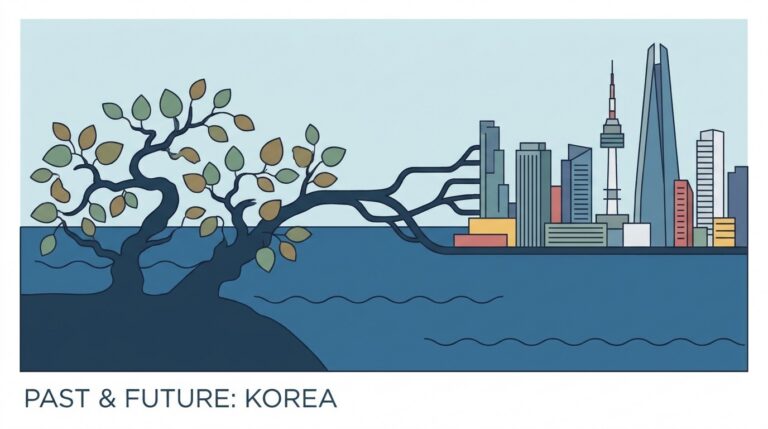
In our C1 Masterclass, learners constantly ask: “How do I express not just change, but the breathtaking shock of an entire era being rewritten?” The answer lies in Korea’s timeless four-character idioms (사자성어, sajaseongeo). Today, we unpack 상전벽해 (桑田碧海, Sangjeonbyeokhae)—the poetic imagery of humble mulberry fields turning into the boundless blue ocean. Master this expression, and you will bridge the gap between being a mere speaker of Korean and becoming an empathetic connoisseur of modern Korean history and sentiment.
Phase 2: Core Expressions Deep Dive
1. 상전벽해 (桑田碧海)
- Pronunciation: Sang-jeon-byeok-hae (sahng-juhn-byuhk-heh)
- Meaning:
- Literal: Mulberry fields (桑田, Sangjeon) turn into the deep blue ocean (碧海, Byeokhae).
- Nuance: A colossal, almost unrecognizable transformation of physical landscapes, cities, institutions, or entire eras.
- K-Culture Moment: In Reborn Rich, when protagonist Jin Do-jun secures barren land in Bundang and Sangam before their explosive development, the older tycoons later gaze at the gleaming metropolis in utter bewilderment, muttering: “그야말로 상전벽해로구나…” (“It is truly mulberry fields turned into the sea…”).
- Editor’s Insight: Mulberry trees historically represented agrarian subsistence (silk farming). Watching dry, quiet farmland submerge beneath an ocean illustrates a shift so profound that the original contours are completely erased. Use this when the change is structural, visual, and immense.
- Situation Spectrum: Casual ⚠️ | Semi-formal ✅ | Formal ✅ (In casual speech, native speakers pair it playfully with hyperbole, while in business and journalism, it is the gold standard for describing industry disruption).
- 🤔 Think About It: Does your native culture compare historic change to natural catastrophes, cycles of the seasons, or divine shifts? Why do you think Korean uses agrarian-to-ocean imagery?
2. 격세지감 (隔世之感)
- Pronunciation: Gyeok-se-ji-gam (gyuhk-seh-jee-gahm)
- Meaning:
- Literal: The feeling (感, Gam) of being separated (隔, Gyeok) by an entire generation or era (世, Se).
- Nuance: A bittersweet realization of how much time has slipped away, triggered by technological leaps or generational divides.
- K-Culture Moment: Seen frequently on variety shows like Hangout with Yoo (놀면 뭐하니?) when 1st-generation K-pop idols (like Lee Hyori) observe 4th/5th-generation idols holding virtual fan sign-events and using AI vocal synthesizers: “스마트폰으로 팬미팅을 한다니, 격세지감이다.” (“Having fan meetings on smartphones… I truly feel like eras have shifted.”)
- Editor’s Insight: While Sangjeonbyeokhae focuses outward on physical or structural changes, Gyeokse-jigam focuses inward on the subjective shock of time dilation—realizing the world moves faster than your memories.
- Situation Spectrum: Casual ✅ | Semi-formal ✅ | Formal ✅
- 🤔 Think About It: What modern invention makes you feel like an ancient relic compared to Gen Z or Gen Alpha?
3. 인생무상 (人生無常)
- Pronunciation: In-saeng-mu-sang (een-sahng-moo-sahng)
- Meaning:
- Literal: Human life (人生, Insaeng) has no permanence (無常, Musang).
- Nuance: The melancholy realization that worldly glory, youth, wealth, and power are transient and fleeting as morning dew.
- K-Culture Moment: Sageuk (historical) dramas like Mr. Queen or The Red Sleeve, where former ministers or fallen monarchs stare at fallen autumn leaves in exile and reflect on their brief moment at the zenith of power.
- Editor’s Insight: Rooted deeply in Buddhist philosophy, this idiom is neither entirely cynical nor pessimistic; rather, it is a contemplative acknowledgment of impermanence that encourages mindfulness and detachment.
- Situation Spectrum: Casual ⚠️ | Semi-formal ✅ | Formal ✅ (Avoid using it over trivial disappointments like dropping your ice cream, as it holds philosophical weight).
- 🤔 Think About It: How does accepting transience alter the way we appreciate rapid, modern urban achievements?
Phase 3: Textbook Korean vs. Real Native Korean
Situation 1: Visiting a Redeveloped Trend Hotspot (e.g., Seongsu-dong)
- 📖 교과서 한국어 (Textbook Korean):
- 여기가 옛날에 비해서 정말 많이 발전하고 변했네요. (Yeogiga yennare bihaeseo jeongmal mani baljeonhago byeonhaenneyo.)
- “Compared to the past, this place has developed and changed a lot.”
- 🗣️ 진짜 한국어 (Real Native Korean – C1):
- 성수동 옛날 철공소 골목 생각하면 완전 상전벽해예요. (Seongsudong yennal cheolgongso golmok saenggakhamyeon wanjeon sangjeonbyeokhaeyeyo.)
- “When I think back to Seongsu-dong’s old ironworks alleyways, it’s an absolute sea change—completely unrecognizable.”
- 💡 왜 다를까? (Why the Difference?): Textbook phrasing relies on generic descriptive verbs (변하다, 발전하다). A C1 native speaker frames the current state against a specific historical snapshot (ironworks) and drops 상전벽해 as a definitive punchline.
Situation 2: Reflecting on Generational & Technological Leaps
- 📖 교과서 한국어 (Textbook Korean):
- 새로운 기술이 너무 빨리 생겨서 예전과 아주 다르게 느껴져요. (Saeroun gisuri neomu ppalli saenggyeoseo yejeongwa aju dareuge neukkyeojyeoyo.)
- “Because new technologies appear so fast, it feels very different from before.”
- 🗣️ 진짜 한국어 (Real Native Korean – C1):
- 생성형 AI 발전 속도 보면 진짜 격세지감이 들어요. (Saengseonghyeong AI baljeon sokdo bomyeon jinjja gyeoksejigami deureoyo.)
- “Looking at how fast generative AI is advancing, I truly feel separated by an entire era.”
- 💡 왜 다를까? (Why the Difference?): Advanced natural Korean merges high-register Sino-Korean idioms seamlessly with contemporary topics, compressing complex sentiment into elegant, emotionally mature sentences.
Phase 4: K-Culture Deep Dive & Non-Verbal Manners
4-1. 눈치 (Nunchi) & Gestures
When using 상전벽해 or 격세지감, your non-verbal cues must reflect reverent wonder rather than flippant cheerfulness:
* The Gaze & Slow Nod: Gaze out across the landscape or horizon, blink slowly, and give a measured, downward nod.
* The Soft Exhalation (한숨 아닌 감탄): Let out a subtle, warm breath of awe before speaking. Rushing the idiom with high-pitched excitement robs it of its philosophical depth.
* Posture: If discussing past hardships or rapid growth with Korean elders or senior colleagues (선배/부장님), keep hands resting respectfully together in front of you. It signals that you honor the sweat and toil that built today’s skyline.
4-2. Cultural Code: The Paradox of “Compressed Growth” (압축성장)
Korea leaped from the ashes of the Korean War to an OECD tech titan in roughly two generations—a phenomenon scholars call “compressed modernity.” Because changes that took centuries in the West happened in five decades in Korea, modern Koreans live with an innate sense of temporal vertigo. When a grandparent and a grandchild walk down Gangnam Boulevard, they are inhabiting the exact same GPS coordinates, but mentally walking through two entirely different civilizations. Using 상전벽해 acknowledges this collective emotional memory, showing you understand the monumental sacrifice beneath Korea’s neon glaze.
Phase 5: Real-World Roleplay Scenario
- Setting: Walking along the sparkling glass towers of Teheran-ro in Gangnam after a team dinner.
- Character: Park Bu-jang (박 부장), your 55-year-old team leader who grew up in Seoul during the 1970s.
Dialogue:
- 박 부장: 내가 신입사원 시절만 해도 이 테헤란로에 빈 땅이 수두룩했어요. (Naega sinipsawon sijeolman haedo i teheranroe bin ttangi sudurukhaesseoyo.)
- “Back when I was a rookie employee, this Teheran-ro had empty plots of land all over the place.”
- 🎭 Looking up at the skyscrapers with nostalgic eyes, hands behind his back.
- Learner (You): 정말요? 지금은 세계적인 IT 기업들이 다 모여 있어서 상상이 잘 안 가요. (Jeongmallyo? Jigeumeun segyejeogin IT gieopdeuri da moyeo isseoseo sangsangi jal an gayo.)
- “Really? Now that world-class IT companies are all gathered here, it’s hard to imagine.”
- 🎭 Looking around at the luminous high-rises with genuine curiosity.
- 박 부장: 그때는 비만 오면 온 사방이 진흙탕이라 장화를 신고 출근했지. (Geuttaeneun biman omyeon on sabangi jinheuktang-ira janghwareul singo chulgeunhaetji.)
- “Back then, whenever it rained, everywhere turned into mud, so we had to wear rubber boots to work.”
- 🎭 Chuckling softly with a hint of bittersweet memory.
- Learner (You): 진흙탕 길에서 이런 첨단 밸리로 거듭나다니, 그야말로 상전벽해네요. (Jinheuktang gireseo ireon cheomdan baelliro geodeubnadani, geuyamallo sangjeonbyeokhaeneyo.)
- “To be reborn from muddy paths into this cutting-edge valley, it is truly a sea change beyond recognition.”
- 🎭 Nodding thoughtfully, matching his contemplative pace.
- 박 부장: 허허, 자네 입에서 ‘상전벽해’라는 말이 나오니 참 신기하네. (Heoheo, jane ibeseo ‘sangjeonbyeokhae’raneun mari naoni cham singgihane.)
- “Haha, hearing the phrase ‘Sangjeonbyeokhae’ from your lips feels truly delightful and remarkable.”
- 🎭 Smiling broadly and tapping your shoulder approvingly.
- Learner (You): 한국의 발전 역사를 배울 때마다 그 말이 가장 먼저 떠오르더라고요. (Hangguk-ui baljeon yeoksareul baeul ttaemada geu mari gajang meonjeo tteooreudeoragoyo.)
- “Every time I study Korea’s development history, that idiom comes to my mind first.”
- 🎭 Maintaining polite eye contact with modest confidence.
- 박 부장: 맞아. 가끔은 너무 빨리 변해서 내 고향이 맞나 싶을 때가 있어. (Maja. Gakkeumeun neomu ppalli byeonhaeseo nae gohyangi manna sipeul ttaega isseo.)
- “That’s right. Sometimes it changed so quickly that I wonder if this is even my hometown.”
- 🎭 Sighing quietly, touched by your historical empathy.
- Learner (You): 급변하는 풍경 속에서도 부장님 같은 분들의 노력이 남아 있으니 의미가 깊은 것 같습니다. (Geupbyeonhaneun punggyeong sogeseodo bujangnim gateun bundeurui noryeogi nama isseuni uimiga gipeun geot gatseumnida.)
- “Amid the rapidly shifting landscape, the dedication of people like you remains embedded here, which makes it deeply meaningful.”
- 🎭 Smiling warmly with sincere professional respect.
🔀 Interactive Branching Choice
How would you respond if Park Bu-jang sighed, “스마트폰 하나로 모든 걸 처리하는 세상이 되니, 가끔은 옛날 아날로그 시절이 그립네요” (“Now that a single smartphone handles everything, sometimes I miss the old analog days”)?
- Option A: “요즘 아날로그 쓰면 불편해서 업무 효율이 안 나오잖아요!” (Efficiency matters most!)
- Option B: “정말 격세지감이 느껴지실 것 같아요. 가끔은 느리던 시절의 온기가 그립기도 하죠.” (Empathize with the generational shift and analog warmth.)
- Option C: “인생무상인데 그냥 지금 기술에 만족하시는 게 좋지 않을까요?” (It’s transient anyway, so just enjoy the tech.)
Detailed Feedback:
* Option A (Bad): Overly pragmatic and tone-deaf. It dismisses the elder’s nostalgic emotion and sounds confrontational.
* Option B (Best): Perfection! You accurately validate his feeling of Gyeokse-jigam (격세지감) while gracefully acknowledging emotional depth.
* Option C (Risk): Misuses Insaengmusang in an overly blunt and dismissive manner, making you sound patronizing or nihilistic.
Phase 6: 10-Second Emotional Shadowing Drill
Practice these lines out loud. Respect the emotional pause marks (/) to build authentic cadence!
- [😮 경탄과 존경을 담아 / With deep admiration and reverence]
- 흙먼지 날리던 허허벌판이 / 이렇게 변하다니 / 그야말로 상전벽해네요.
- Heungmeonji nallideon heoheobeolpani / ireoke byeonhadani / geuyamallo sangjeonbyeokhaeneyo.
- (To think that this dusty wasteland / turned into this / it’s truly a sea change beyond recognition.)
- [🥺 아련함과 세월의 덧없음을 느끼며 / With tender wistfulness and nostalgia]
- 삐삐 차고 다니던 시절이 엊그제 같은데 / 스마트폰 세상이라니 / 진짜 격세지감이에요.
- Bpi-ppi chago danideon sijeori eotgeuje gateunde / seumateupon sesang-irani / jinjja gyeokse-jigam-ieyo.
- (It feels like just yesterday we wore beepers on our belts / but now it’s a smartphone world / I truly feel an era has passed.)
- [😌 깊은 사색과 여운을 남기며 / With calm, philosophical contemplation]
- 영원할 것 같던 영광도 / 결국 흘러가는 물결 같은 / 인생무상 아닐까요.
- Yeong-wonhal geot gatdeon yeong-gwangdo / gyeolguk heulleoganeun mulgyeol gateun / insaengmusang anilkkayo.
- (Even the glory that seemed everlasting / isn’t it the transience of life / like passing waves in the end?)
Phase 7: K-Culture Mini Dictionary
- 상전벽해 (Sangjeonbyeokhae – 桑田碧海)
- Translation: Mulberry fields turning into the blue sea.
- Usage: Used in urban development, economic miracles, corporate turnarounds, and breathtaking architectural evolutions.
- 격세지감 (Gyeokse-jigam – 隔世之感)
- Translation: Feeling as though separated by generations.
- Usage: Used when reflecting on past lifestyle customs, obsolete technology, or watching young generations adopt new cultural trends.
- 인생무상 (Insaengmusang – 人生無常)
- Translation: The transience and impermanence of human life.
- Usage: Evoked during philosophical conversations, contemplation of history, sudden shifts in fortune, or admiring fading autumn foliage.
- 압축성장 (Apchuk-seongjang – 壓縮成長)
- Translation: Compressed economic growth.
- Usage: The premier socio-economic term explaining Korea’s post-war miracle; indispensable background knowledge for C1 discussions on modern Korean society.
Phase 8: Traveler’s Survival Kit
Top 3 Survival Expressions for City Explorers
- “예전 모습이 전혀 기억나지 않을 만큼 완전히 바뀌었네요.”
- Yejeon moseubi jeonhyeo gieongnaji aneul mankeum wanjeonhi bakkwieonneyo.
- Pro Tip: Use this when visiting places like Seoul Forest or Songdo International City. It sets up the perfect runway for 상전벽해.
- “이 동네의 옛날 사진이나 기록을 볼 수 있는 곳이 있나요?”
- I dongne-ui yennal sajina girokeul bol su inneun gosi innayo?
- Pro Tip: Fantastic for local museum curation desks, such as the Donuimun Museum Village or the Seoul Museum of History.
- “격세지감이 든다는 말이 딱 맞네요.”
- Gyeokse-jigami deundaneun mari ttak manneyeo.
- Pro Tip: The best validation phrase when an older shopkeeper or tour guide describes the town’s past.
Editor’s Travel Note
- Explore the Archive Firsthand: Take the Subway Line 5 to Gwanghwamun Station and explore the National Museum of Korean Contemporary History. Standing on its rooftop terrace looking at Gyeongbokgung Palace framed by contemporary glass towers illustrates 상전벽해 better than any textbook.
- Smart Navigation: When tracing historical landmarks against new hyper-modern buildings, download and use the Naver Map app for ultra-accurate walking routes and historical street-view checks.
Phase 9: “One Step Deeper” (Critical Thinking)
In the West, dramatic urban change is often recorded through slow, continuous centuries of preservation mixed with gentle renewal. In Korea, however, decades felt like compressed centuries. The sudden disappearance of beloved brick alleys and mom-and-pop bakeries to make way for high-rise apartment complexes produces a unique Korean cultural mood: a simultaneous thrill over technological convenience coupled with a sharp, collective sorrow over erased childhood landscapes. This tension between blinding advancement and poignant longing is the very heartbeat of Sangjeonbyeokhae.
💬 Your Turn: Is there a neighborhood or district in your hometown that underwent a Sangjeonbyeokhae transformation? Drop your story in the comments below using today’s idiom!
Phase 10: FAQ & Common Pitfalls
Q: Can I use ‘상전벽해’ to describe a person who lost a lot of weight or changed their style?
A: It is generally unnatural to use 상전벽해 for personal cosmetic changes. 상전벽해 is reserved for monumental, macro-level shifts—such as whole cities, economies, landscapes, or entire technological ecosystems. For a person’s dramatic makeover or personal evolution, use the four-character idiom 괄목상대 (刮目相對, Gwalmoksangdae), which means “rubbing one’s eyes in astonishment at another person’s improvement.”
Q: What is the emotional nuance of ‘격세지감’? Is it negative?
A: Not at all! 격세지감 is neutral to bittersweet. It does not mean the past was strictly superior; rather, it reflects genuine bewilderment and wonder at the dizzying march of human progress and generational habits.
Q: Can ‘인생무상’ be used when comforting a friend going through a tough breakup?
A: Be very careful! Telling a heartbroken friend “인생무상이야” (“Life is impermanent”) can sound emotionally detached and dismissive, as if saying “Nothing matters anyway.” Reserve 인생무상 for self-reflection, philosophical discourse, or historical contemplation.
🚨 Common Mistakes Warning Board
- ❌ Mistake 1: Saying “상전벽해하게 변했어요.” (Using it as a clumsy adverb).
- 👉 Correct Action: Say “그야말로 상전벽해예요” or “상전벽해라고 할 수 있죠.”
- ❌ Mistake 2: Using 상전벽해 for a temporary seasonal change (e.g., flowers blooming in spring).
- 👉 Correct Action: The change must be irreversible or historically permanent. For seasons, use 환절기 or 계절의 변화.
- ❌ Mistake 3: Pronouncing ‘벽해’ as byeok-kae.
- 👉 Correct Action: Maintain crisp separation: [Byeok-hae]. In fast speech, the ‘h’ sound softens slightly, but do not drop the aspirated glide.
Phase 11: Action Missions & Engagement
- 🥉 Bronze Mission (Solo Practice): Stand by your window or look at an old family photograph. Say out loud in Korean: “10년 전과 비교하면 정말 상전벽해예요.” (Compared to 10 years ago, it’s an absolute transformation.)
- 🥈 Silver Mission (Social Connection): Search for a historical photo of Seoul (e.g., Gangnam in 1970 vs 2024) and post it on your Instagram Stories or Language Exchange app with the caption: “그야말로 상전벽해 (桑田碧海)! ✨”
- 🥇 Gold Mission (Real-World Application): When conversing with a Korean teacher, colleague, or friend, mention a district undergoing urban renewal (like Euljiro, Seongsu, or Magok) and smoothly insert: “공장 지대가 핫플이 된 걸 보면 완전 상전벽해 같아요.”
- 🎮 K-Culture Mission: Watch an episode of a retro K-drama (like Reply 1988 or Twenty-Five Twenty-One) and spot three everyday items (pagers, rotary phones, cassette tapes) that would evoke 격세지감 today.
Phase 12: Interactive Quiz Challenge
Test your mastery of Korean idioms on transience and transformation!
1. Situational Judgment:
You are chatting with your Korean business partner about how Songdo transformed from reclaimed mudflats into a global smart eco-city in just 15 years. Which expression lands with maximum C1 elegance?
* (A) 송도가 살을 많이 뺐네요.
* (B) 갯벌이 스마트시티가 되다니, 그야말로 상전벽해입니다.
* (C) 송도가 변한 걸 보니 인생무상이라 허무하네요.
2. Fill-in-the-Blank:
“스마트폰 대신 삐삐(무선호출기)로 연락을 주고받던 시절 이야기를 들으니 정말 ( )이/가 느껴진다.”
* Hint: Idiom describing feeling separated by generations.
3. True or False:
상전벽해 (Sangjeonbyeokhae) can be naturally applied when your friend changes their hair color from black to blonde. (True / False)
👉 Click here for Answers & Explanations
- 1. Answer: (B)
- Explanation: Transforming from coastal mudflats into an international smart city is the textbook definition of 상전벽해. (A) refers inappropriately to human weight loss, and (C) is overly nihilistic and gloomy for an economic triumph.
- 2. Answer: 격세지감 (Gyeokse-jigam)
- Explanation: Remembering beepers in the age of 5G smartphones triggers a profound realization of generational transition, making 격세지감 the ideal phrase.
- 3. Answer: False
- Explanation: Personal grooming or cosmetic shifts do not qualify as Sangjeonbyeokhae. It must describe large-scale, epochal, or territorial transformations!
- Explanation: Personal grooming or cosmetic shifts do not qualify as Sangjeonbyeokhae. It must describe large-scale, epochal, or territorial transformations!
🎬 Watch Our Daily Videos! (Daily Hangul Official Instagram)
Review the expressions you learned in this article with our fun daily short videos! Check out native pronunciation and real-life nuances in action.
- Instagram @dailyhangul_en






