

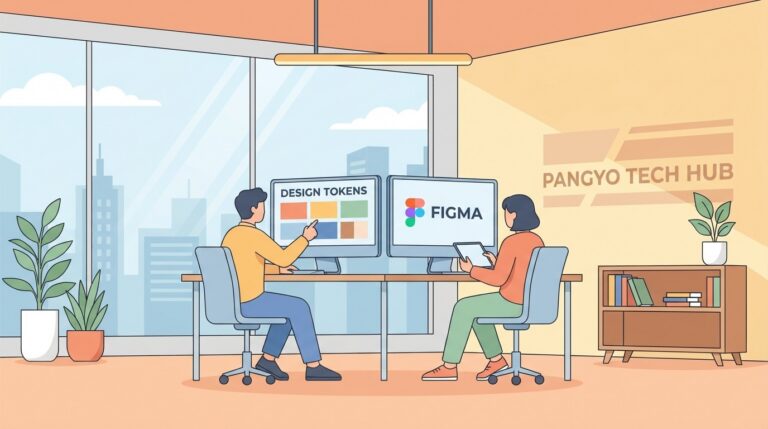
Phase 1: Empathy (Immersive Storytelling Opening)
안녕하세요! 매일한글 에디터입니다.
Imagine this scenario: You are sitting in an airy, glass-walled conference room in Pangyo Techno Valley—South Korea’s vibrant Silicon Valley where giants like Kakao, Naver, and hyper-growth startups build next-generation tech. You’ve been working for weeks on a unified design system. The sprint review starts, your screen is mirroring Figma, and across the table sit your Korean front-end developers, product managers, and team lead, all watching with warm Americanos in hand, just like a scene out of the K-drama Start-Up (스타트업).
You clear your throat and want to present the foundation of your entire sprint: “First, we defined brand colors, typography, spacing, and shadows as shared ‘Design Tokens’ used identically in design and code.”
Suddenly, your mind freezes. You know the English words, but how do modern Korean product teams naturally articulate “design tokens,” “shared naming conventions,” and smooth cross-functional handoffs without sounding like an outdated Google Translate sentence from 2012? If you translate word-for-word, your developers might tilt their heads in polite confusion.
Communicating technical concepts in Korean at an intermediate (B2) level isn’t about memorizing archaic vocabulary; it is about mastering the exact workplace vernacular, conversational loanwords, and collaborative cadence used daily by Korean tech innovators. This masterclass is built directly from real coaching sessions with global designers and engineers thriving inside Seoul’s tech hubs. By the time you finish this guide, you will pitch your architectural design decisions with effortless precision and genuine team camaraderie.
Phase 2: Deep Dive into 3 Core Expressions
1. 공통으로 부르는 ‘디자인 토큰’으로 정의했어요 (Gongtong-euro bureuneun ‘dijain tokeun’-euro jeong-uihaesseoyo)
- Pronunciation: [Gong-tong-eu-ro bu-reu-neun di-ja-in to-keun-eu-ro jeong-ui-hae-sseo-yo] (Sound analogy: Gong-tong sounds like hitting a bronze gong twice with a soft “tong”, followed by bu-reu-neun similar to “boo-reun”)
- Meaning: Literal: “We defined [them] as ‘design tokens’ that are called in common.” / Real Nuance: “We established unified ‘design tokens’ as our shared source of truth across both design and code.”
- K-Culture Moment: In modern Korean workplace dramas like Search: WWW (검색어를 입력하세요 WWW), senior PMs and UX leads use this phrasing during all-hands updates when establishing company-wide foundational logic.
- Editor’s Insight: The phrase
공통으로 부르는(~that we call in common) is the secret sauce here. Rather than saying “We created tokens,” emphasizing that the naming convention is shared prevents the dreaded designer-versus-developer silo.- Situation Spectrum:
- Casual (with close peers over Slack): ⚠️ (Slightly formal; in chat, say “토큰으로 싱크 맞췄어요”)
- Semi-formal (Sprint planning / Stand-up): ✅
- Formal (Executive demo / Client presentation): ✅
- 🤔 Think About It: In English, we often say “we standardized tokens.” Korean often personalizes the consensus:
부르는(how we call it together). How does framing technical rules as shared speech reflect Korea’s relationship-first culture?2. 디자인과 코드의 싱크를 맞추다 (Dijain-gwa kodeu-ui singkeureul matchuda)
- Pronunciation: [Di-ja-in-gwa ko-deu-ui sing-keu-reul mat-chu-da] (Sound analogy: Sing-keu sounds like “sync” with a sharp clean “k”, and matchuda sounds like lighting a “match” followed by “chu-da”)
- Meaning: Literal: “To match the synchronization of design and code.” / Real Nuance: “To keep design specs and production code 100% aligned.”
- K-Culture Moment: Walk past any scrum board in Pangyo or Seongsu-dong, and you will hear engineers say: “그 컴포넌트 싱크 맞췄어요?” (Did you sync that component?). It’s the unofficial mantra of agile Korea.
- Editor’s Insight: While the pure Korean verb
일치시키다(to make consistent) exists, using싱크를 맞추다instantly signals that you understand real startup workflow.맞추다conveys active alignment and care.- Situation Spectrum:
- Casual: ✅
- Semi-formal: ✅
- Formal: ⚠️ (In board meetings, use
일치시키다or정합성을 확보하다)- 🤔 Think About It: Why do modern Korean work environments readily absorb Konglish terms like sync (싱크) combined with active native verbs (
맞추다) instead of rigid Sino-Korean idioms?3. 핸드오프 문서를 정리해 두었습니다 (Haendeu-opeu munseoreul jeongnihae dueotseumnida)
- Pronunciation: [Haen-deu-o-peu mun-seo-reul jeong-ni-hae du-eot-seum-ni-da] (Note the nasalization:
정리is pronounced jeong-ni, not jeong-ri! Sound analogy: Jeong as in “young”, ni as in “knee”)- Meaning: Literal: “I have organized and put down the handoff document.” / Real Nuance: “I’ve prepped and finalized the handoff specs so development can proceed seamlessly.”
- K-Culture Moment: Heard when handing over Figma redlines before a Friday deployment freeze in high-stakes Korean IT agencies.
- Editor’s Insight: The auxiliary grammatical form
-어 두다(-eo duda) indicates completing an action in advance for someone else’s future convenience. It carries deep professional thoughtfulness (배려, baeryeo).- Situation Spectrum:
- Casual: ⚠️ (A bit stiff; casually say “핸드오프 정리해 뒀어요”)
- Semi-formal: ✅
- Formal: ✅
- 🤔 Think About It: Notice how
-어 두다subtly reassures the other person that their future workflow was anticipated. How does consideration for others shape Korean workplace grammar?
Phase 3: Textbook Korean vs. Real-World Korean
Situation 1: Explaining unified color and spacing parameters
- 📖 교과서 한국어 (Textbook):
우리는 색상과 간격의 수치를 규격화하여 통일하였습니다. (Uri-neun saeksang-gwa gangyeok-ui suchireul gyugyeokhwayeo tong-ilhayeotseumnida. / “We standardized and unified numerical values of colors and spacing.”) - 🗣️ 진짜 한국어 (Real Startup Korean):
먼저 브랜드 핵심 컬러랑 간격 값을 디자인 토큰으로 맞춰 뒀어요. (Meonjeo beuraendeu haeksim keolleorang gangyeok gapseul dijain tokeun-euro matchwo dwosseoyo. / “First, we got the core brand colors and spacing values synced up as design tokens.”) - 💡 왜 다를까? (Why the difference?):
Textbook Korean relies on heavy Sino-Korean nouns (규격화,수치,통일). Real developers and designers prefer dynamic particle pairing (컬러랑,값을) and practical verbs like맞춰 두다that sound agile, collaborative, and friendly.
Situation 2: Asking developers if they can inspect and implement the specs
- 📖 교과서 한국어 (Textbook):
개발 부서에서 디자인 명세서를 열람하고 구현할 준비가 되었습니까? (Gaebal buseo-eseo dijain myeongseoseoreul yeollamhago guhyeonhal junbiga doe-eotseumnikka? / “Is the development department prepared to inspect design specifications and implement them?”) - 🗣️ 진짜 한국어 (Real Startup Korean):
피그마 핸드오프 확인해 보시고, 바로 마크업 들어가실 수 있을까요? (Pigeuma haendeu-opeu hwaginhae bosigo, baro makeueop deureogasil su isseulkkayo? / “Could you check the Figma handoff and see if you can jump straight into markup?”) - 💡 왜 다를까? (Why the difference?):
Nobody says명세서를 열람하다(inspect specifications) in contemporary offices. They refer directly to tool names like Figma (피그마) and process milestones like마크업 들어가다(jump into coding/markup).
Phase 4: K-Culture Deep Dive & Non-Verbal Manners
4-1. Nunchi (눈치) & Meeting Non-Verbal Etiquette
In a Korean cross-functional tech review, technical clarity is only half the battle; emotional reading of the room (눈치, Nunchi) is the other half.
* The Screen-Sharing Posture: When presenting your screen in a hybrid meeting, avoid zooming in and out erratically. Korean developers appreciate calm, methodical navigation. Always announce: “화면 공유 먼저 띄우겠습니다” (Hwamyeon gong-yu meonjeo tti-ugetseumnida / “I will bring up screen sharing first”).
* The Collaborative Nod: When a developer flags an edge case (e.g., “이 그림자 값 안드로이드에서 렌더링 이슈 있을 것 같아요”), never counter immediately with “아닌데요?” (No, that’s not right). Instead, nod gently, tilt your head slightly in understanding, and say: “아, 그 부분 고려를 못 했네요. 토큰 값 한번 확인해 볼게요” (Ah, I hadn’t considered that part. Let me check the token value).
* Name Titles: Never call your teammate by just their first name. Always append 님 (Nim) even to colleagues younger than you: “민수 님, 이 타이포 토큰 어떠세요?” (Min-su Nim, what do you think of this typography token?).
4-2. Cultural Code: The ‘Ppallli-Ppalli’ (빨리빨리) vs. Design System Balance
Korea is internationally renowned for its Ppalli-Ppalli (fast-paced) execution. However, in modern tech ecosystems like Coupang, Toss, and Danggeun (Karrot), teams have realized that moving too fast without a design system creates catastrophic technical debt. Creating design tokens is framed not as a delay, but as the ultimate engine for sustainable speed. When you explain tokens in Korean, highlight that this upfront standardization will make future feature sprints twice as fast—your Korean stakeholders will instantly love you for it.
Phase 5: Real-Life Roleplay Scenario
Setting: A sunlit sprint room at a fintech startup in Seongsu-dong. Sticky notes dot the glass partition, mechanical keyboards clack, and Julian (Product Designer) is presenting component tokens to Min-su (Lead Front-end Developer).
- Turn 1 (Julian):
민수 님, 피그마에 디자인 시스템 1차 정리 끝났어요. 화면 공유 한번 봐주시겠어요?
(Minsu Nim, pigeuma-e dijain siseutem il-cha jeongni kkeunnatseoyo. Hwamyeon gong-yu hanbeon bwajusigetseoyo?)
“Min-su Nim, the first pass of the design system in Figma is complete. Could you take a look at my screen share?”
🎭 Opening his laptop and pointing with an open palm toward the screen. -
Turn 2 (Min-su):
네, 공유 잘 보입니다! 컴포넌트 구조가 깔끔하네요. 토큰 세팅도 다 하신 건가요?
(Ne, gong-yu jal boimnida! Keomponeonteu gujoga kkalkkeumhaneyo. Tokeun setingdo da hasin geon-gayo?)
“Yes, I can see the share clearly! The component hierarchy looks super clean. Did you set up all the tokens as well?”
🎭 Leaning forward, adjusting his glasses with genuine curiosity. -
Turn 3 (Julian):
네! 먼저 브랜드의 핵심 색상과 타이포그래피, 간격(Spacing), 그림자 값을 디자인과 코드에서 공통으로 부르는 ‘디자인 토큰’으로 정의했어요.
(Ne! Meonjeo beuraendeu-ui haeksim saeksang-gwa taipogeuraepi, gangyeok, geurimja gapseul dijain-gwa kodeu-eseo gongtong-euro bureuneun ‘dijain tokeun’-euro jeong-uihaesseoyo.)
“Yes! First, we defined brand colors, typography, spacing, and shadows as shared ‘Design Tokens’ used identically in design and code.”
🎭 Smiling with confidence, highlighting the global variable sheet in Figma. -
Turn 4 (Min-su):
오, 대박이네요! 개발 쪽 CSS 변수명이랑 토큰 네이밍 싱크가 거의 완벽하게 맞겠어요.
(O, daebag-ineyol Gaebal jjok CSS byeonsumyeong-irang tokeun neiming singkeuga geoui wanbyeokhage matgetseoyo.)
“Oh, awesome! The token naming will sync almost perfectly with our development CSS variable names.”
🎭 Nodding approvingly and jotting notes into a Slack canvas. -
Turn 5 (Julian):
다행이네요. 개발하실 때 헷갈리지 않게 간격 토큰은 4px 배수로 전부 맞춰 뒀습니다.
(Dahaeng-ineyol Gaebalhasil ttae hetgalliji anke gangyeok tokeuneun 4px baesuro jeonbu matchwo dwotseumnida.)
“What a relief. To prevent any confusion during development, I aligned all spacing tokens to 4px multiples in advance.”
🎭 Zooming in to display the grid layout and padding guides. -
Turn 6 (Min-su):
디테일 최고네요. 다크모드 대응하는 시맨틱 컬러 토큰도 분리되어 있나요?
(Dite-il choegoneyo. Dakeumodeu dae-eunghaneun simaentik keolleo tokeundo bunridoeeo innayo?)
“Incredible attention to detail. Are the semantic color tokens for dark mode support separated as well?”
🎭 Tilting his head with an inquisitive smile. -
Turn 7 (Julian):
네, 글로벌 토큰 밑에 시맨틱 레이어를 따로 둬서 다크모드 스위칭도 바로 가능해요.
(Ne, geullobeol tokeun mite simaentik reieoreul ttaro dwoseo dakeumodeu seuwichingdo baro ganeunghaeyo.)
“Yes, we established a semantic layer right below global tokens, so dark mode switching can happen instantaneously.”
🎭 Toggling between light and dark modes to demonstrate the live component swap. -
Turn 8 (Min-su):
완벽합니다, 줄리안 님! 핸드오프 바로 넘겨주시면 오늘 오후부터 바로 스프린트 반영할게요.
(Wanbyeokhamnida, Jullian Nim! Haendeu-opeu baro neomgyeojusimyeon oneul ohu-buteo baro seupeurinteu banyeonghalgeyo.)
“Flawless, Julian Nim! Once you hand this off, I’ll incorporate it into our active sprint starting this afternoon.”
🎭 Giving a friendly thumbs-up and smiling warmly.
🔀 Interactive Branching Decision Point
Min-su asks: “혹시 버튼 컴포넌트 상태별(Hover, Disabled) 스타일도 토큰 매핑 끝났나요?” (By the way, have the state styles for buttons like Hover and Disabled been token-mapped as well?) How do you respond?
- Option A: “아직 안 했는데, 개발자분이 알아서 만들어 주시면 안 돼요?” (I haven’t done it yet, can’t you developers just figure it out and build it?)
- Option B: “상태별 컬러 토큰까지 전부 정리해서 핸드오프 문서에 링크 걸어 두었습니다!” (I organized all the state color tokens as well and linked them right in the handoff document!)
- Option C: “버튼 상태는 디자인할 필요가 없다고 생각합니다.” (I think there’s no need to design button states.)
Outcome Analysis:
* Option A (Bad): 🚨 Severe cultural and professional blunder. Asking developers to “figure it out arbitrarily” (알아서 해달라) shatters cross-functional trust and violates collaborative decorum.
* Option B (Best): 🏆 Ideal! Demonstrates professionalism, mastery of -어 두다 grammar, and provides clear, immediate links for the developer to work efficiently.
* Option C (Risk): ⚠️ Demonstrates a fundamental lack of UX understanding. In Korean tech teams, interactive states are paramount for accessibility and user retention.
Phase 6: 10-Second Emotion Shadowing Drill
Train your intonation muscle memory with these three pacing drills. Pay special attention to breath pauses marked by /.
- Drill 1:
[😊 자신감 넘치고 명확하게 / Confident and crisp]
먼저 / 브랜드의 핵심 색상과 타이포그래피를 / 디자인 토큰으로 정의했어요.
(Meonjeo / beuraendeu-ui haeksim saeksang-gwa taipogeuraepireul / dijain tokeun-euro jeong-uihaesseoyo.) -
Drill 2:
[🤝 협력적이고 정중하게 / Collaborative and respectful]
디자인이랑 코드 쪽에서 / 공통으로 부를 수 있게 / 싱크를 맞춰 뒀습니다.
(Dijain-irang kodeu jjok-eseo / gongtong-euro bureul su itge / singkeureul matchwo dwotseumnida.) -
Drill 3:
[💡 안도하며 든든하게 / Reassuring and prompt]
핸드오프 문서 링크 / 슬랙으로 바로 공유해 드릴게요!
(Haendeu-opeu munseo ringkeu / seullaek-euro baro gong-yuhae deurilgeyo!)
Phase 7: K-Culture Mini Dictionary
| No. | Keyword (Hangul + Romanization) | English Meaning | Tech / Real-World Context |
|---|---|---|---|
| 1 | 디자인 토큰 (Dijain Tokeun) | Design Token | Values like color hex codes, font sizes, and padding stored as reusable variables in both Figma and code repos. |
| 2 | 싱크를 맞추다 (Singkeureul Matchuda) | To get in sync / align | The go-to verb phrase used across Korean agile teams whenever specs, schedules, or Git branches need alignment. |
| 3 | 핸드오프 (Haendeu-opeu) | Designer-Developer Handoff | The milestone where UI specs, asset exports, and interaction rules are delivered to engineering. |
| 4 | 컴포넌트화하다 (Keomponeonteu-hwahada) | To componentize / build modularly | Turning recurring UI elements (buttons, modals, input fields) into reusable master components. |
Phase 8: Survival Kit for Tech Professionals & Expats
Top 3 Survival Phrases in Korean Tech Meetings
- 수정 사항 바로 반영해 두겠습니다.
(Sujeong sahang baro banyeonghae dugetseumnida.)
Pro Tip: “I’ll reflect the revision right away.” Saying this with a gentle nod during sprint retrospectives makes you look exceptionally reliable. - 이 컴포넌트 재사용 가능한가요?
(I keomponeonteu jaesayong ganeunghangayo?)
Pro Tip: “Is this component reusable?” Essential during backlog grooming when debating between custom design vs. design system components. - Figma 링크 슬랙 스레드에 남겨드릴게요.
(Pigeuma ringkeu seullaek seuredeu-e namgyeodeurilgeyo.)
Pro Tip: “I’ll drop the Figma link in the Slack thread.” The definitive polite phrase to wrap up any async technical discussion.
✈️ Editor’s Tech & Travel Note
Heading to Seoul for work or networking with local tech communities? You will likely visit hubs like Pangyo Techno Valley (Bundang line), Gangnam Teheran-ro, or the trendy agency studios in Seongsu-dong. Remember that Google Maps offers limited transit navigation in South Korea due to domestic mapping regulations. Make sure to complete the Naver Map app download for local transit routing before your first business sprint in Seoul!
Phase 9: “One Step Deeper” (Cultural Philosophy Reflection)
In Western software culture, design systems are frequently framed through strict mechanical terms: governance, automated pipelines, and strict rule enforcement. However, in Korean startup culture, standardization is viewed through the lens of community consensus—what sociologists call Korean collective solidarity (공동체 의식, gongdongche uisik).
When you announce, “공통으로 부르는 디자인 토큰으로 정의했어요”, the emotional weight lies in the words 공통으로 부르는 (what we call together). In Korea, adopting a common system is an act of consideration (배려) toward your engineering peers. It prevents late-night overtime (야근, yageun) caused by pixel discrepancies and fosters genuine mutual respect across departments.
💬 Your Turn: How does your home country’s work culture handle handoffs between designers and developers? Is it rule-based, or relationship-driven like in Korea? Share your experiences in the comments below!
Phase 10: FAQ & Misconception Buster
Q: Can I use the English word ‘Design Token’ directly in Korean meetings?
A: Yes, absolutely! Almost all digital product teams in Korea pronounce it phonetically as 디자인 토큰 (dijain tokeun). Trying to translate it artificially into pure Korean like 디자인 표식 will confuse people. Stick to 디자인 토큰.
Q: What is the polite way to ask a developer when an implemented component will be ready?
A: Avoid blunt questions like “언제 끝나요?” (When does it finish?). Instead, ask softly with intermediate nuance: “혹시 이 컴포넌트 개발 반영은 대략 언제쯤 확인 가능할까요?” (Approximately when might we be able to review the development deployment for this component?).
Q: Why do people say ‘맞춰 뒀어요’ instead of just ‘맞췄어요’?
A: Adding -어 두다 (dueotseoyo / dwosseoyo) emphasizes that you completed the action in advance to ensure the next person’s workflow runs smoothly. It conveys thoughtfulness and proactive teamwork.
🚨 Common Mistakes Alert!
- Mistake 1: Translating “Handoff” literally as
손 넘기기(Son neomgigi).- Correct Action: Keep it as the accepted industry term
핸드오프(haendeu-opeu).
- Correct Action: Keep it as the accepted industry term
- Mistake 2: Addressing teammates as
당신(Dangsin) or bare first names in tickets.- Correct Action: Always use
[First Name] 님(e.g.,민수 님,지훈 님).
- Correct Action: Always use
- Mistake 3: Saying
우리가 정했습니다(We commanded/decided it) in a haughty tone.- Correct Action: Soften your consensus delivery using
~로 정의했어요(We defined it as~) or~로 합의했습니다(We reached agreement on~).
- Correct Action: Soften your consensus delivery using
Phase 11: Action Mission & Engagement
- 🥉 Bronze Level: Stand in front of your mirror and practice shadow-drilling: “디자인과 코드의 싱크를 맞춰 뒀습니다” 5 times with a bright, confident tone.
- 🥈 Silver Level: Next time you comment in Figma or Slack with Korean colleagues, replace English “Design tokens synced” with: “디자인 토큰 싱크 맞춰 두었습니다!”
- 🥇 Gold Level: Deliver a 3-minute mock presentation introducing your component design tokens in Korean to your Daily Hangul study partner or Korean colleague.
- 🎮 K-Culture Mission: Watch Episode 5 of the K-drama Start-Up (스타트업). Observe how Nam Do-san (developer) and Seo Dal-mi (CEO) navigate technical vocabulary and team consensus when aligning their platform specifications.
Phase 12: Interactive Quiz Challenge
Test your real-world B2 tech Korean intuition!
Quiz 1. Situational Judgment
During a design handoff, you want to inform the frontend developer that you already separated the typography tokens so they don’t have to calculate font sizes manually. Which sentence is the most natural and professional?
A. 타이포그래피 토큰을 이미 분리해 뒀으니 편하게 쓰세요.
B. 타이포그래피 토큰 내가 했으니까 그냥 코드 치세요.
C. 타이포그래피는 개발자가 직접 알아서 계산하십시오.
정답 확인하기 (Check Answer)
Correct Answer: A
Explanation: Option A uses the considerate grammar pattern -어 두다 (분리해 뒀으니) and ends with a polite suggestion (편하게 쓰세요). Option B is overly blunt/informal, and Option C is excessively demanding and impolite.
Quiz 2. Fill-in-the-Blank
Complete the sentence to say: “First, we defined brand colors as shared design tokens used identically in design and code.”
먼저 브랜드 색상을 디자인과 코드에서 [ ] 부르는 디자인 토큰으로 정의했어요.
정답 확인하기 (Check Answer)
Correct Answer: 공통으로 (Gongtong-euro / in common, jointly)
Explanation: 공통으로 부르는 captures the core concept of a “shared naming convention” between cross-functional partners.
Quiz 3. True / False Cultural Check
In a Korean agile tech startup, using loanwords like 핸드오프 (Handoff), 스프린트 (Sprint), and 싱크 (Sync) combined with polite Korean honorifics is considered improper grammar and frowned upon.
정답 확인하기 (Check Answer)
Correct Answer: False (F)
Explanation: Modern Korean tech ecosystems actively celebrate domain-specific global terminology. Combining tech terms with respectful native grammar (such as -해 두었습니다) is the gold standard of professional startup communication in South Korea!
🎬 Watch Our Daily Videos! (Daily Hangul Official Instagram)
Review the expressions you learned in this article with our fun daily short videos! Check out native pronunciation and real-life nuances in action.
- Instagram @dailyhangul_en







