

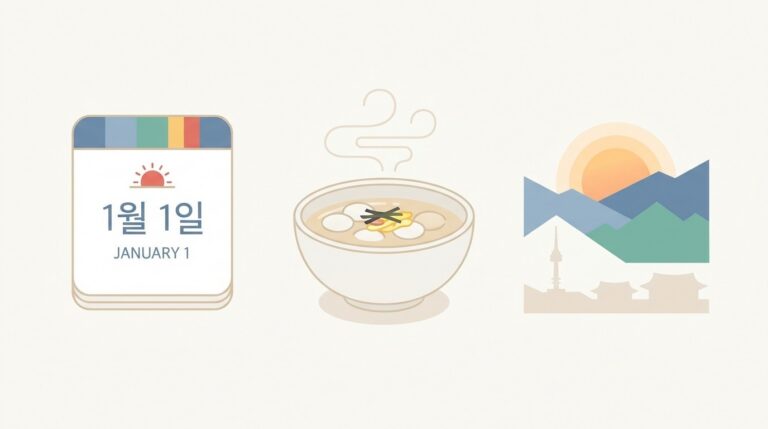
Master Korean Calendar Dates: How to Say January 1st Like a Local
Phase 1: 공감 (Story-Driven Opening)
안녕하세요! 매일한글 에디터입니다.
Imagine this: It is midnight in Seoul. You are tuned into your favorite K-pop group’s live stream, clutching your hot yuja tea as digital countdown numbers tick backward on screen. 3, 2, 1… suddenly, the chat erupts with heart emojis and endless streams of text: “1월 1일 시작!”, “새해 첫날이에요!” You look at your phone screen and freeze. You learned that ‘1’ is ‘일’ (il), but as the idol speaks, it doesn’t sound like “il-wol il-il” at all. It flows like silk: “I-rwol i-ril!”
Many beginner Korean learners hit an invisible brick wall when reading dates. Korean has two complete number systems—Sino-Korean and Native Korean—and calendar dates strictly rely on Sino-Korean numbers intertwined with tricky sound-linking (연음) rules. You might wonder: Why can’t I just read the numbers separately? Why does the calendar feel like a tongue twister?
Don’t worry! Based on hundreds of tutoring sessions with real beginners at Daily Hangul, we have distilled everything you need into this friendly guide. In just a few minutes, you will confidently say “January 1st is New Year’s Day” in natural Korean, understand Korea’s fascinating double New Year traditions, and impress your Korean friends effortlessly!
Phase 2: 핵심 표현 3선 심층 분석
1. 1월 1일 (I-rwol i-ril)
- Pronunciation: [I-rwol i-ril] (Sounds like: “Ee-rwol ee-reel”—imagine saying “Ear-wall ear-reel” smoothly without stopping between words)
- Meaning: Direct translation: “Month 1, Day 1” | Actual nuance: January 1st.
- K-Culture Moment: When the historic Bosingak bell rings 33 times in downtown Seoul at midnight on New Year’s Eve, broadcast anchors shout: “드디어 1월 1일 새해가 밝았습니다!” (Finally, January 1st, the new year has dawned!).
- Editor’s Insight: When written, it looks like “1-wol 1-il”. But in Korean phonology, when the bottom consonant ‘ㄹ’ (batchim) meets a silent placeholder ‘ㅇ’, the ‘ㄹ’ slides over into the next syllable. That is why it sounds like [이뤌 이릴] rather than [일-월 일-일].
- Situation Spectrum:
- Casual: ✅ (Used in everyday chatting)
- Semi-formal: ✅ (Standard calendar conversation)
- Formal: ✅ (Official news broadcasts and paperwork)
- 🤔 Think About It: In English, dates use ordinal numbers like “First” or “Twenty-third”. In Korean, dates simply use cardinal Sino-Korean numbers (일, 이, 삼…). Which system feels more straightforward to your brain?
2. 새해 첫날이에요 (Saehae cheotnarieyo)
- Pronunciation: [Sae-hae cheon-na-ri-e-yo] (Sounds like: “Say-hay chun-nah-ree-eh-yo”)
- Meaning: Direct translation: “It is the new year’s first day” | Actual nuance: “It’s the first day of the new year!”
- K-Culture Moment: In Korean holiday family dramas, parents wake up early on January 1st and gather the whole family around the table, saying cheerfully: “새해 첫날이니 떡국 먹어야지!” (It’s the first day of the new year, so we must eat tteokguk!).
- Editor’s Insight: Break it down: 새해 (Saehae = New Year) + 첫날 (Cheotnal = First day) + 이에요 (ieyo = is/polite ending). Note that the ‘ㅅ’ in ‘첫’ changes to an ‘n’ sound before ‘날’, making it sound like [천날 – cheon-nal]!
- Situation Spectrum:
- Casual: ✅ (You can drop ‘이에요’ and use ‘이야’ with close friends)
- Semi-formal: ✅ (Polite and warm with anyone)
- Formal: ✅ (Add ‘-입니다’ for formal meetings: 새해 첫날입니다)
- 🤔 Think About It: While many Western cultures view January 1st as a day to sleep in after partying, traditional Korean culture sees “첫날” as a sacred slate where waking up early sets the rhythm for the next 365 days.
3. 새해 복 많이 받으세요 (Saehae bok mani badeuseyo)
- Pronunciation: [Sae-hae bok ma-ni ba-deu-se-yo] (Sounds like: “Say-hay boke mahn-ee bah-deu-say-yo”)
- Meaning: Direct translation: “Please receive a lot of New Year’s fortune/blessings” | Actual nuance: “Happy New Year!”
- K-Culture Moment: Every idol group uploads their annual New Year greeting video wearing pastel-colored Hanbok (traditional attire), bowing deeply while chanting this phrase in unison.
- Editor’s Insight: Koreans don’t just wish each other happiness; they wish for tangible 복 (Bok)—good fortune, health, prosperity, and blessings. Notice that ‘많이’ sounds like [마니 – mani].
- Situation Spectrum:
- Casual: ⚠️ (To same-age close friends or children, say “새해 복 많이 받아!”)
- Semi-formal: ✅ (Perfect for coworkers, neighbors, and baristas)
- Formal: ✅ (Used with elders and company bosses)
- 🤔 Think About It: Why do you think Korean wishes someone to “receive” fortune rather than simply saying “be happy”? It reflects an ancient collective belief that fortune is a gift shared among community members.
Phase 3: 교과서 한국어 vs 진짜 한국어
Situation 1: Asking what today’s date is
- 📖 교과서 한국어: 오늘이 몇 월 며칠입니까? (Oneuri myeot wol myeochirimnikka?) — “What month and what day is today?”
- 🗣️ 진짜 한국어: 오늘 며칠이에요? (Oneul myeochirieyo?) — “What day is it today?”
- 💡 왜 다를까?: In real life, everyone knows what month it currently is! Native speakers rarely ask for the month unless filling out formal paperwork. Asking simply “며칠이에요?” sounds ten times more natural and relaxed.
Situation 2: Talking about January 1st as a public holiday
- 📖 교과서 한국어: 신정은 법정 공휴일입니다. (Sinjeongeun beopjeong gonghyuirimnida.) — “Solar New Year is a statutory public holiday.”
- 🗣️ 진짜 한국어: 1월 1일은 빨간 날이에요! (I-rwol i-rireun bpal-gan narieyo!) — “January 1st is a red day (holiday)!”
- 💡 왜 다를까?: In Korea, public holidays and Sundays are printed in red ink on physical calendars. Hence, native speakers affectionately call any day off work or school a “빨간 날” (bpal-gan nal = red day).
Phase 4: K-Culture 딥다이브 & 비언어적 매너
4-1. 눈치 (Nunchi) & Polite Gestures on New Year’s Day
When wishing someone “새해 복 많이 받으세요” in a daily setting (like entering a shop or greeting a landlord), never deliver the phrase with hands stuffed in your pockets! Even in casual modern Korea, keep both arms loosely clasped in front of your stomach or hands resting gently at your thighs. Pair the phrase with a gentle, polite 15-degree head bow (목례) and eye contact before and after the bow. If someone is an elder, do not offer a Western casual high-five or fist bump—it breaks the respectful warmth of the season.
4-2. Culture Code: The Tale of Two New Years
Did you know that Koreans celebrate two New Years?
1. 신정 (Sinjeong – Solar New Year): Celebrated on January 1st according to the Gregorian calendar. It is a one-day national holiday where friends gather, count down, and hike hills to watch the first sunrise.
2. 구정 / 설날 (Gujeong / Seollal – Lunar New Year): Celebrated over three days based on the lunar calendar (typically in late January or February). This is the major traditional holiday with ancestral rites (차례), deep bowing (세배), and family reunions.
On January 1st, many people travel early in the morning to places like Jeongdongjin on the east coast to see the sunrise (해돋이) and make wishes for the upcoming year!
Phase 5: 실전 롤플레이 시나리오
- Background: A trendy, warm coffee shop in Yeonnam-dong on the chilly morning of January 1st. Soft lo-fi music plays while the aroma of freshly roasted beans fills the room.
- Characters:
- Minho (민호): A cheerful Korean barista wearing a festive knit sweater.
- You (Foreign Traveler/Student): Bundled in a winter coat, seeking a hot morning coffee.
[Dialogue]
1. Minho: 어서 오세요! 새해 복 많이 받으세요! (Eoseo oseyo! Saehae bok mani badeuseyo!)
“Welcome! Happy New Year!”
🎭 Wiping down the espresso machine and offering a bright, genuine smile.
2. You: 새해 복 많이 받으세요! 오늘 1월 1일 맞죠? (Saehae bok mani badeuseyo! Oneul i-rwol i-ril matjyo?)
“Happy New Year! Today is January 1st, right?”
🎭 Pulling down your knitted scarf and bowing politely with both hands clasped.
3. Minho: 네, 맞아요! 1월 1일 새해 첫날이에요. (Ne, majayo! I-rwol i-ril saehae cheotnarieyo.)
“Yes, that’s right! January 1st is the first day of the new year.”
🎭 Pointers proudly to the newly hung wall calendar showing ‘1월 1일’ in bold red.
4. You: 오늘 카페 문 열어서 다행이에요! (Oneul kape mun yeoreoseo dahaengieyo!)
“I’m so relieved the cafe is open today!”
🎭 Breathing a warm sigh of relief as you walk up to the wooden counter.
5. Minho: 하하, 빨간 날이지만 손님들을 위해 열었어요. 떡국 드셨어요? (Haha, bpal-gan narijiman sonnimdeureul wihae yeoreosseoyo. Tteokguk deusyeosseoyo?)
“Haha, it’s a red day (holiday), but we opened for our guests. Did you eat tteokguk?”
🎭 Tilts head curiously while picking up a takeaway cup.
6. You: 아직이요. 떡국 먹으면 한 살 더 먹는 거죠? (Ajigiyo. Tteokguk meogeumyeon han sal deo meongneun geojyo?)
“Not yet. If I eat tteokguk, I gain another year of age, right?”
🎭 Giggling and counting one year up with your fingers.
7. Minho: 정답이에요! 따뜻한 커피 드시면서 새해 계획 세워보세요. (Jeongdabieyo! Ttatteutan keopi deusimyeonseo saehae gyehoek seowoboseyo.)
“Spot on! Enjoy your hot coffee and make your New Year’s plans.”
🎭 Handing over the steaming cup with two hands on the cardboard sleeve.
8. You: 고마워요! 올해도 행복한 한 해 되세요! (Gomawoyo! Olhaedo haengbokan han hae doeseyo!)
“Thank you! May you have a happy year as well!”
🎭 Receiving the cup with both hands and smiling warmly.
🔀 인터랙티브 분기점 (Interactive Choice)
Minho suddenly asks: “오늘 특별한 계획 있으세요?” (Do you have special plans today?) How will you respond?
- Choice A: “친구랑 일출 보러 남산타워 갈 거예요!” (Going to Namsan Tower with a friend to watch the sunrise!)
- Feedback [Best]: Excellent! Mentioning sunrise watching (일출) is culturally spot on. Minho will be thrilled and advise you to bundle up extra warmly!
- Choice B: “오늘 일요일이에요? 몰라요.” (Is today Sunday? I don’t know.)
- Feedback [Bad]: A bit cold and confuses the day of the week with the holiday spirit. Minho might look confused.
- Choice C: “나이 먹기 싫어서 떡국 안 먹을래요!” (I don’t want to get older, so I won’t eat tteokguk!)
- Feedback [Risk]: A very witty Korean joke! But make sure to say it with a playful smile and polite ending (-요) so it doesn’t sound blunt.
Phase 6: 10초 감정 섀도잉 드릴
Read each sentence out loud. Pause briefly at the / marks and embody the assigned emotion:
[🎉 신나고 힘차게 - Excited and Energetic]
1월 1일은 / 새해 첫날이에요!
(I-rwol i-ri-reun / sae-hae cheon-na-ri-e-yo!)-
[ 따뜻하고 공손하게 - Warm and Polite]
새해 복 / 많이 받으세요!
(Sae-hae bok / ma-ni ba-deu-se-yo!) -
[ 쉬고 싶고 홀가분하게 - Relieved and Relaxed]
오늘은 / 빨간 날이에요!
(O-neul-eun / bpal-gan na-ri-e-yo!)
Phase 7: K-Culture 미니 사전
- 1월 (I-rwol) | January
Formed by combining Sino-Korean number 1 (일 – il) and Month (월 – wol). Used for all calendars, reservations, and business dates. - 첫날 (Cheotnal) | First Day
A combination of ‘첫’ (first) and ‘날’ (day). Pronounced [cheon-nal]. Frequently used for the first day of the year, first day of school, or day one of a trip. - 떡국 (Tteokguk) | Sliced Rice Cake Soup
The quintessential New Year dish. The clear beef broth and oval white rice cakes symbolize purity, a clean slate, and coins (wishing for prosperity). - 빨간 날 (Bpal-gan nal) | Red Day (Public Holiday)
Everyday slang for legal holidays and days off, because dates on Korean calendars are traditionally printed in bold red ink.
Phase 8: 여행자를 위한 생존 키트
서바이벌 표현 TOP 3
- “오늘 빨간 날이에요?” (Oneul bpal-gan narieyo? – “Is today a public holiday?”)
Pro Tip: Use this when checking whether banks, neighborhood pharmacies, or clinics are open. - “새해 첫날 영업해요?” (Saehae cheotnal yeongeophaeyo? – “Are you open on New Year’s Day?”)
Pro Tip: Call small indie restaurants or vintage stores on Instagram before visiting to confirm holiday hours. - “새해 복 많이 받으세요!” (Saehae bok mani badeuseyo! – “Happy New Year!”)
Pro Tip: Greet your taxi driver or convenience store clerk with this on January 1st to receive radiant smiles.
Editor’s Travel Note
Public transport runs reliably on January 1st in Seoul, though schedules follow holiday timetables. Avoid relying on global map apps, which often lack accurate Korean holiday business updates. Always use the 네이버 지도 앱 다운로드 to verify real-time subway routes and search for restaurants explicitly tagged with holiday hours. Also, keep your T-money transit card topped up with cash the night before, as convenience stores can get crowded near sunrise vantage points!
Phase 9: “한 발 더 깊이” (생각 질문)
In Western cultures, the turn of the new year often peaks at midnight with loud celebrations, parties, and fireworks. In Korea, while countdown parties do exist, the heart of the holiday is quietly centered on the morning light. Waking up in the brisk dawn air, gazing at the first sunrise, and enjoying a steaming bowl of homemade tteokguk highlights the Korean value of quiet renewal and shared generational respect. It is a moment of taking a collective breath before life restarts.
💬 Your Turn: In your home country, do you usually stay awake all night to celebrate, or do you prefer to start early on the morning of January 1st? Tell us your traditions in the comments!
Phase 10: FAQ & 오해 방지
Q: Why is 1월 1일 pronounced “I-rwol i-ril” and not “Il-wol il-il”?
A: Korean has a natural linking rule (연음 법칙). When a syllable ending in the final consonant ‘ㄹ’ (batchim) is immediately followed by a syllable starting with the empty consonant ‘ㅇ’, the ‘ㄹ’ shifts to the next sound. Thus, 일+월 becomes [이뤌 – I-rwol] and 일+일 becomes [이릴 – I-ril]. Flow it together in one breath!
Q: Do Koreans celebrate January 1st or Lunar New Year (Seollal)?
A: Both! January 1st (신정) is a national holiday celebrated with countdowns, sunrise viewings, and personal resolutions. Seollal (구정) is the major traditional holiday held across several days, where families wear hanbok, perform ancestral rituals, and travel to hometowns.
Q: How do I say the other months in Korean?
A: Simply attach ‘월’ (wol) after the Sino-Korean numbers 1 through 12! But watch out for two special phonetic exceptions: June is 유월 (Yu-wol), not 육월 (Yuk-wol), and October is 시월 (Si-wol), not 십월 (Sip-wol). The final consonants are dropped to make pronunciation smooth.
🚨 흔한 실수 (Common Mistakes) 경고판
- Mistake 1: Reading each number with a robot pause (“Il. Wol. Il. Il.”)
Correct Action: Let the consonants glide: “이뤌 이릴” (I-rwol i-ril). - Mistake 2: Using Native Korean numbers for months (e.g., saying “하나월” for January)
Correct Action: Always use Sino-Korean numbers for calendar dates: 1월 (일월), 2월 (이월), 3월 (삼월)… - Mistake 3: Saying “새해 복 많이 받아” to elders, teachers, or staff.
Correct Action: That is informal banmal (반말)! Always attach “-세요” to ensure politeness: “새해 복 많이 받으세요!”
Phase 11: 액션 미션 & 참여 유도
- 🥉 Bronze Mission (Solo Practice): Stand in front of your mirror, smile, and say: “1월 1일은 새해 첫날이에요!” three times in a row without stumbling on the ‘ㄹ’ sound.
- 🥈 Silver Mission (Social Share): Post a photo of your desk, journal, or morning tea on Instagram/X with the Korean caption: “새해 복 많이 받으세요! Happy New Year!”
- 🥇 Gold Mission (Real Connection): On January 1st, send a KakaoTalk message to a Korean penpal or tutor: “선생님, 새해 복 많이 받으세요! 행복한 1월 보내세요!”
- 🎮 K-Culture Mission: Search for “보신각 타종 행사” (Bosingak Bell Ceremony) on YouTube. Watch the countdown and listen for how many times the crowd and anchors shout “새해 복 많이 받으세요”!
Phase 12: 인터랙티브 퀴즈 챌린지
Q1. [Situation Judgement] You enter a Korean bakery on the morning of January 1st. What is the most natural, polite greeting to give the baker?
* A) 안녕 새해! (Annyeong saehae!)
* B) 새해 복 많이 받으세요! (Saehae bok mani badeuseyo!)
* C) 오늘 몇 월 며칠입니까? (Oneul myeot wol myeochirimnikka?)
Q2. [Fill in the Blank] Fill in the missing word meaning ‘first day’:
“1월 1일은 새해 [ ]이에요.”
Q3. [True or False] In Korean, June is pronounced “육월” (Yuk-wol) and October is pronounced “십월” (Sip-wol).
* A) True
* B) False
👉 Click here to reveal answers and explanations!
- Q1 Answer: B) 새해 복 많이 받으세요!
Explanation: This is the universal, polite New Year greeting for anyone in daily life. Option A is unnatural banmal, and Option C is overly stiff. - Q2 Answer: 첫날 (Cheotnal)
Explanation: ‘첫’ means first, and ‘날’ means day. Remember the pronunciation sounds like [천날 – cheon-nal]! - Q3 Answer: B) False!
Explanation: June and October are the famous phonetic exceptions in Korean calendar dates: June is 유월 (Yu-wol) and October is 시월 (Si-wol).
🎬 Watch Our Daily Videos! (Daily Hangul Official Instagram)
Review the expressions you learned in this article with our fun daily short videos! Check out native pronunciation and real-life nuances in action.
- Instagram @dailyhangul_en






