

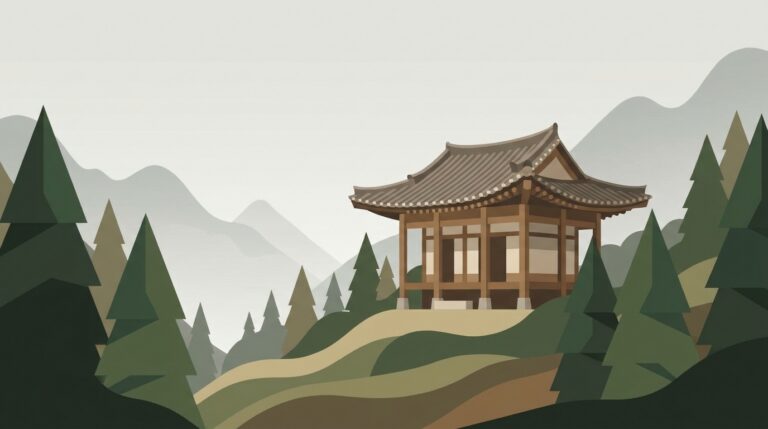
Beyond Anthropocentrism: How Ancient Korean Philosophy Unlocks Modern Planetary Wisdom
Phase 1: Empathy & Immersion (Opening)
안녕하세요! It’s your Daily Hangul editor and cultural navigator.
Picture this: You are sitting in an intimate, book-lined salon in the quiet alleys of Seochon, Seoul. Outside, the granite peaks of Mount Inwang cast long shadows over modern glass high-rises. Inside, a group of Korean ecological thinkers, climate activists, and writers are debating the Anthropocene—the geological epoch defined by human disruption of Earth’s ecosystems. You want to contribute to the discussion. You want to move beyond superficial green slogans like “환경을 보호해야 합니다” (We need to protect the environment) and delve into deep civilizational critique.
Yet, you find yourself grappling with vocabulary. How do you articulate that nature is not merely a resource to be managed, but a sacred web of reciprocal relations? Many advanced learners tell me: “I know Western environmental theory inside out, but when I try to converse with Korean academics or cultural figures, I lack the philosophical lexicon rooted in East Asian cosmology.”
Mastering East Asian ecological paradigms—such as Confucian Cheoninhab-il (天人合一), Daoist Muwi-jayeon (無爲自然), Buddhist Yeongiseol (緣起說), and Donghak’s Gyeongmul (敬物)—will elevate your Korean to a near-native C2 mastery. You will speak directly to the intellectual and ethical heart of Korean contemporary thought.
Phase 2: Deep Dive into 3 Core Expressions
1. 천인합일의 경지 (Cheon-in-hab-il-ui gyeong-ji)
- Pronunciation: Cheon-in-hab-il-ui gyeong-ji (Sounds like: chuhn-een-hahb-il-wee gyuhng-jee)
- Meaning: Literal: “The realm where Heaven and humanity become one” vs. Actual Nuance: A profound state of ontological harmony where humanity transcends self-centered detachment and attunes itself organically to cosmic order.
- K-Culture Moment: Seen in reflective K-Dramas like Mr. Sunshine or highbrow Korean art documentaries where architectural historians explain why traditional Joseon Hanok pavilions do not disturb natural cliff lines but rather enter “천인합일의 경지” (the realm of oneness between Heaven and human).
- Editor’s Insight: In Confucian cosmology, ‘Heaven’ (천) is not a detached transcendent deity, but the moral-ecological vitality of the cosmos. When you use this phrase, you reject Western Cartesian mind-matter dualism.
- Situation Spectrum: Casual 🚫 | Semi-formal ⚠️ | Formal ✅
- 🤔 Think About It: Does your native tongue distinguish between “preserving nature from the outside” and “realizing you are fundamentally indistinguishable from nature”?
2. 무위자연에 순응하다 (Mu-wi-ja-yeon-e sun-eung-ha-da)
- Pronunciation: Mu-wi-ja-yeon-e sun-eung-ha-da (Sounds like: moo-wee-jah-yuhn-eh soon-eung-hah-dah)
- Meaning: Literal: “To adapt to non-action and nature” vs. Actual Nuance: To align oneself with effortless, spontaneous cosmic flow without manipulative ego, exploitative engineering, or artificial coercion.
- K-Culture Moment: Frequently articulated on contemplative travel essays or slow-life healing programs like Three Meals a Day (삼시세끼) or temple stay features when an elder or monk advises letting gardens flourish without chemical micro-management.
- Editor’s Insight: Mu-wi (無爲) is often mistranslated as passive “doing nothing.” In reality, it signifies non-anthropocentric action—refusing to impose human vanity upon an ecosystem that already possesses its own self-ordering intelligence.
- Situation Spectrum: Casual ⚠️ | Semi-formal ✅ | Formal ✅
- 🤔 Think About It: How does “acting without forcing” challenge the hyper-efficient, fast-paced ppalli-ppalli (빨리빨리) culture of modern industrialized society?
3. 뭇 생명을 경물하다 (Mut saeng-myeong-eul gyeong-mul-ha-da)
- Pronunciation: Mut saeng-myeong-eul gyeong-mul-ha-da (Sounds like: moot seng-myuhng-eul gyuhng-mool-hah-dah)
- Meaning: Literal: “To revere all multitude of beings and things” vs. Actual Nuance: Extending absolute ontological and moral reverence to non-human lives and everyday inanimate matter, dismantling the human monopoly on personhood.
- K-Culture Moment: Resonates strongly in contemporary Korean eco-novels (such as Han Kang’s philosophical works) and indigenous Donghak retrospectives where reformers proclaim that even the humble grain of rice embodies the divine cosmos.
- Editor’s Insight: Derived from the indigenous 19th-century Korean Donghak movement’s triad: Gyeongcheon (revere Heaven), Gyeong-in (revere humans), and Gyeongmul (revere objects/matter). It is one of Korea’s most radical contributions to planetary post-humanism.
- Situation Spectrum: Casual 🚫 | Semi-formal ⚠️ | Formal ✅
- 🤔 Think About It: If everyday household objects and non-human animals possess sacred dignity, how does that transform your consumer habits and disposal practices?
Phase 3: Textbook Korean vs. Real Korean (C2 Level)
Situation 1: Deconstructing Anthropocentrism
- 📖 교과서 한국어:
- 인간 중심적인 생각을 버리고 환경을 보호해야 합니다.
- (Ingan jungsimjeogin saenggakeul beorigo hwangyeongeul bohohaeya hamnida.)
- “We must discard human-centered thinking and protect the environment.”
- 🗣️ 진짜 한국어 (High-Register Critical Discourse):
- 인간중심주의적 발상을 탈피하고 만물과의 상생과 호혜적 순환에 주목해야 해요.
- (Inganjungsimjueuijeok balsangeul talpihago manmulgwaui sangsaenggwa ho-hyejeok sunhwane jumokhaeya haeyo.)
- “We must break away from anthropocentric paradigms and fixate our attention on coexistence and reciprocal circulation with all of creation.”
- 💡 왜 다를까? C2-level ecological critique avoids generic elementary verbs like ‘버리다’ (throw away) or ‘보호하다’ (protect). Instead, it adopts epistemological vocabulary such as ‘탈피하다’ (shed/break away), ‘상생’ (mutual thriving), and ‘호혜적 순환’ (reciprocal circulation).
Situation 2: Analyzing the Roots of Ecological Breakdown
- 📖 교과서 한국어:
- 사람들이 자연을 너무 많이 개발해서 기후 위기가 왔어요.
- (Saramdeuri jayeoneul neomu mani gaebalhaeseo gihu wigiga wasseoyo.)
- “People developed nature too much, so the climate crisis arrived.”
- 🗣️ 진짜 한국어 (High-Register Critical Discourse):
- 자연을 일방적 수탈과 대상화의 도구로 삼아온 근대적 개발주의의 필연적 귀결이죠.
- (Jayeoneul ilbangjeok sutalgwa daesanghwaui doguro sama-on geundaejeok gaebaljueuiui piryeonjeok gwigyeor-ijyo.)
- “It is the inevitable consequence of modernist developmentalism that has reduced nature to a mere instrument of unilateral extraction and objectification.”
- 💡 왜 다를까? Educated Korean speakers deconstruct historical and structural causality. Phrases like ‘대상화의 도구’ (instrument of objectification) and ‘필연적 귀결’ (inevitable culmination) ground your arguments in rigorous humanities analysis.
Phase 4: K-Culture Deep Dive & Non-Verbal Manners
4-1. 눈치 (Nunchi) & Intellectual Posture
When engaging in high-level intellectual dialogues in Korea, intellectual brilliance must always be wrapped in somatic modesty (겸양). Avoid grandiloquent hand gestures or confrontational cross-examination.
* Gaze & Posture: Keep your chin slightly lowered and maintain a soft, receptive gaze. When an interlocutor speaks, demonstrate deep engagement with slow, deliberate head nods (묵묵한 수긍).
* Vocal Modulation: Lower your vocal pitch slightly and maintain measured pacing. In Korean intellectual spheres, speaking too rapidly or loudly is often perceived as defensive vanity rather than scholarly passion.
4-2. Cultural Code: Temple Food & Balwoogongyang (발우공양)
Korean Buddhist ecological wisdom is not abstract theory; it is performed bodily through Balwoogongyang—the monastic ritual of mindful communal eating. Grounded in Yeongiseol (연기설, Pratītyasamutpāda/Dependent Origination), every practitioner receives four wooden bowls (Balwoo). Not a single grain of rice, vegetable scrap, or drop of water is wasted. At the end of the meal, a pickled radish is used with clean water to wipe the wooden bowl immaculate, and that water is then consumed. This ritual embodies the truth that human survival is inextricably entangled with the sun, cloud, soil, and the farmer’s labor.
Phase 5: Real-Life Roleplay Scenario
Setting: An intimate academic symposium held in an open-air courtyard of a Hanok institute in Bukchon, Seoul. Breezes rustle through bamboo screens.
Characters:
* Elena (엘레나): A visiting environmental philosophy scholar (You, speaking at C2 proficiency).
* Professor Min (민 교수): A renowned Joseon intellectual historian and ecocritic.
1. 민 교수: 엘레나 박사님, 서구의 기술 관료적 기후 위기 해법은 왜 계속 한계에 부딪힌다고 보십니까?
(Elena baksanim, seogu-ui gisul gwanryojeok gihu wigi haebeobeun wae gyesok hangyee budichindago bosimnikka?)
“Dr. Elena, why do you think Western technocratic solutions to the climate crisis continually hit a wall?”
2. 엘레나: 🎭 차분하게 찻잔을 내려놓으며 근대 이원론에 기반한 인간중심주의적 발상을 답습하고 있기 때문입니다.
(Chabunhage chatjaneul naeryeonoeumyeo. Geundae iwonrone gibanhan inganjungsimjueuijeok balsangeul dapseuphago itgi ttaemun-imnida.)
“🎭 Setting down the teacup calmly. Because they persistently copy an anthropocentric paradigm grounded in Cartesian dualism.”
3. 민 교수: 정확한 지적이십니다. 대상을 지배와 관리의 객체로만 규정하는 한, 진정한 치유는 불가능하지요.
(Jeonghwakhan jijeogisimnida. Daesangeul jibwaegwa gwanri-ui gaekchero-man gyujeonghaneun han, jinjeonghan chiyuneun bulganeunghajiyo.)
“An accurate observation. As long as one defines nature merely as an object of domination and administration, authentic healing remains impossible.”
4. 엘레나: 🎭 교수님의 눈을 응시하며 조용히 고개를 끄덕인다 맞습니다. 반면 우리 동양 사상은 이미 수천 년 전부터 만물의 상호의존성을 꿰뚫어 보았죠.
(Gyosunim-ui nuneul eungshihamyeo joyonghi gogaereul kkeudeog-inda. Matseumnida. Banmyeon uri dongyang sasangeun imi sucheon nyeon jeonbuteo manmul-ui sangho-uijonseongeul kkwetteureo boatjyo.)
“🎭 Looking at the professor and nodding quietly. Precisely. Conversely, East Asian traditions saw right through to the mutual interdependence of all things millennia ago.”
5. 민 교수: 그렇다면 엘레나 박사님께서는 동학의 ‘경물(敬物)’ 사상을 현대 지구 생태 위기에 어떻게 접목할 수 있다고 보시나요?
(Geureotdamyeon Elena baksanimkkesoneun donghak-ui ‘gyeongmul’ sasangeul hyeondae jigu saengtae wigie eotteoke jeommokhal su itdago bosinayo?)
“In that case, Dr. Elena, how do you envision applying Donghak’s philosophy of ‘Gyeongmul’ to our contemporary planetary ecological crisis?”
6. 엘레나: 🎭 양손을 단정히 모으고 나지막하지만 확신에 찬 목소리로 물질을 단순한 자원이 아니라 영성을 지닌 공존의 주체로 대우하는 ‘존재론적 전회’가 필요하다고 봅니다.
(Yangsoneul danjeonghi mo-eugo najimak-hajiman hwaksine chan moksoriro. Muljireul dansunhan jawoni anira yeongseongeul jinin gongjon-ui juche-ro dae-uhaneun ‘jonjaeronjeok jeonhoe’ga piryohadago bomnida.)
“🎭 Clasping hands neatly, in a low yet resolute tone. I believe we require an ‘ontological turn’ that treats matter not as mere resources, but as coexisting subjects possessing intrinsic spiritual dignity.”
7. 민 교수: 🎭 무릎을 가볍게 치며 감탄한다 ‘존재론적 전회’라! 동학의 시천주(侍天主)를 물(物)의 영역까지 확장하자는 탁견이십니다.
(Mureupeul gabyeopge chimyeo gamtanhada. ‘Jonjaeronjeok jeonhoe’ra! Donghak-ui sicheonjureul mul-ui yeongyeokkkaji hwakjanghajaneun takgyeon-isimnida.)
“🎭 Tapping his knee lightly in admiration. ‘An ontological turn’! What a brilliant insight to expand Donghak’s Sicheonju into the realm of material entities!”
8. 엘레나: 과찬이십니다. 이제는 천인합일과 무위자연의 지혜를 구체적인 제도와 일상의 실천으로 체화해야 할 때입니다.
(Gwachan-isimnida. Ijeneun cheon-in-hab-ilgwa mu-wi-ja-yeon-ui jihyereul guchejeogin jedowa ilsang-ui silcheon-euro chehwahaeya hal ttae-imnida.)
“You flatter me. Now is the historic moment to embody the wisdom of Cheoninhab-il and Muwi-jayeon into tangible institutions and daily praxis.”
🔀 Interactive Decision Point
If Professor Min challenges you on how to convince ordinary modern urbanites who care only about real estate and convenience, what is your best response?
* Option A: “도시에 사는 사람들은 원래 이기적이라 동양 철학을 이해하기 어렵습니다.” (Urbanites are inherently selfish, so they cannot comprehend East Asian philosophy.)
* 🚫 Bad: Blames the public, appears arrogant, and violates Korean academic etiquette.
* Option B: “일상에서 발우공양처럼 소비를 최소화하고 자연의 순환을 자각하는 미시적 실천부터 확산시켜야 합니다.” (We must propagate micro-practices starting from daily life, like Balwoogongyang, minimizing consumption and cultivating awareness of natural cycles.)
* ✅ Best: Pragmatic, empathetic, culturally resonant, and intellectually robust.
* Option C: “정부 규제를 강화해서 법으로 강제하면 사람들이 따를 것입니다.” (If the government strictly enforces regulations, people will have to obey.)
* ⚠️ Risk: Relies purely on legalistic state coercion (법가 사상), contradicting the spontaneous ethos of Muwi-jayeon.
Phase 6: 10-Second Emotion Shadowing Drill
Read aloud, matching the slashes / for natural philosophical pauses and immersing yourself in the emotional markers.
[🌱 경건하고 성찰적으로 - Solemn and introspective]
천인합일이란 / 인간이 자연을 관리하는 것이 아니라 / 자연의 운행 질서에 / 온전히 스며드는 것입니다.
(Cheon-in-hab-il-iran / ingani jayeoneul gwanrihaneun geosi anira / jayeon-ui unhaeng jilseoe / onjeonhi seomyeodeuneun geosimnida.)-
[💡 단호하고 학술적인 무게감으로 - Resolute and academic]
무위자연의 핵심은 / 인위적인 조작을 멈추고 / 생태계 본연의 자생력을 / 신뢰하는 데 있습니다.
(Mu-wi-ja-yeon-ui haeksimeun / in-wijeogin jojageul meomchugo / saengtaegye bon-yeon-ui jasaengryeogeul / sinroehaneun de itseumnida.) -
[🌏 열린 마음으로 깊은 영감을 전하며 - Inspired and expansive]
불교의 연기설에 따르면 / 우리는 독존하는 개체가 아니라 / 뭇 생명과의 상호의존성 속에서만 / 존재할 수 있습니다.
(Bulgyo-ui yeongiseore ttareumyeon / urineun dokjonhaneun gaechega anira / mut saengmyeonggwaui sangho-uijonseong sogeseoman / jonjaehal su itseumnida.)
Phase 7: K-Culture Mini Dictionary
- 천인합일 (天人合一, Cheon-in-hab-il) | Heaven-Human Unity | In Korean intellectual dialogue, this concept is utilized to critique Western dualism and advocate for sustainable architecture, traditional permaculture, and holistic wellness.
- 무위자연 (無爲自然, Mu-wi-ja-yeon) | Daoist Spontaneous Naturalness | Beyond Daoist texts, Koreans frequently use this term to describe art that is unpretentious, organic agriculture free of chemical forcing, and a lifestyle uncluttered by vanity.
- 연기설 (緣起說, Yeongiseol) | Buddhist Dependent Co-Arising | Used in environmental ethics and psychology to underscore that no entity possesses isolated independent reality; everything exists as a web of systemic relationality.
- 경물 (敬物, Gyeongmul) | Reverence for Things and Beings | Donghak’s egalitarian tenet asserting that all material beings and non-human creatures carry cosmic dignity. Often quoted in modern Korean zero-waste and circular economy initiatives.
Phase 8: Traveler’s Survival Kit
Top 3 Intellectual Travel Expressions
- 이 공간은 자연과의 조화가 참 돋보이네요.
(I gongganeun jayeongwaui johwaga cham dotbo-ineyyo.)
Pro Tip: Use this when admiring a Hanok temple, modern eco-gallery, or garden to flatter your Korean hosts. - 생태계의 자생력을 살리는 방식이 인상적입니다.
(Saengtaegye-ui jasaengryeogeul sallineun bangsigi insangjeogimnida.)
Pro Tip: Ideal for commenting on organic Korean farms, reforestation projects, or sustainable tea plantations in Boseong/Hadong. - 작은 생명 하나도 소홀히 대하지 않는 철학이 느껴져요.
(Jageun saengmyeong hanado soholhi daehaji anneun cheolhagi neukkyeojyeoyo.)
Pro Tip: A compliment for Buddhist temple stay curators or traditional artisans practicing circular craftwork.
Editor’s Travel Note
When venturing across Korea to explore eco-philosophical roots, skip standard tourist hotspots and immerse yourself in Korea’s sacred landscapes. Book a weekend retreat through the Templestay Official Reservation Portal to experience authentic Balwoogongyang first-hand. To traverse ancient mountain sanctuaries without a rental car, consult the Naver Map Public Transit App which accurately details temple-bound provincial buses. Remember: inside temple boundaries, maintain low voices (묵언 practice) and avoid stepping on thresholds of wooden halls, which symbolizes respecting the boundary of living architecture.
Phase 9: “One Step Deeper” (Reflective Essay)
In traditional Korean thought, the self is never an isolated island. It is defined by the profound concept of Sai (사이)—the relational space “between” beings. In Western modernity, freedom is frequently conceived as autonomy from others and mastery over non-human nature. In stark contrast, East Asian ecological wisdom interprets authentic freedom as the conscious attunement to relational webs. When Confucianism speaks of Cheoninhab-il and Donghak speaks of Gyeongmul, they remind us that the human crisis in the Anthropocene is fundamentally a crisis of disconnectedness. By rediscovering that soil, stream, and sparrow are our extended organs, environmental preservation ceases to be a burdensome moral duty; it transforms into an intuitive act of self-care.
💬 Your Turn: How does your cultural background conceptualize the relationship between humanity and nature? Drop a comment below in Korean utilizing one of our core concepts!
Phase 10: FAQ & Common Mistakes
Q: Isn’t ‘무위자연’ (Muwi-jayeon) an excuse for passive fatalism or doing nothing about climate change?
A: Absolutely not. In classical Daoism and contemporary Korean philosophy, Mu-wi (無爲) does not denote indolence (게으름). It signifies the cessation of egotistical, anthropocentric interference. It means stepping back so that the regenerative capacity (자생력) of the ecosystem can restore balance without human hubris.
Q: Can I use ‘천인합일’ (Cheoninhab-il) in casual everyday conversations, such as when enjoying a picnic?
A: It can be used playfully with close friends, but because it is an elevated philosophical idiom, doing so casually might sound melodramatic or sarcastic (e.g., “내가 이 치킨과 천인합일이 되었다” – I have achieved Heaven-Human unity with this fried chicken). Reserve it for genuine artistic, natural, or intellectual appreciation.
Q: How does Donghak’s ‘경물’ (Gyeongmul) differ from modern Western environmental ethics?
A: Most Western environmental ethics remain either utilitarian (save nature for future human use) or biocentric (focusing only on living organisms). Donghak’s Gyeongmul takes a radical step forward into pan-spiritual materialism: it recognizes that even non-living matter (물, 物) is an embodiment of Heaven, demanding ethical reverence.
🚨 Common Mistakes Alert
- Mistake 1: Translating “protecting nature” literally as “자연을 통제하다” (controlling nature).
- Correction: Use “자연과 공존하다” (coexisting with nature) or “생태계와 상생하다” (mutually thriving with the ecosystem).
- Mistake 2: Confusing 무위 (Mu-wi: effortless natural action) with 무관심 (Mu-gwan-sim: apathy/indifference).
- Correction: Emphasize that Mu-wi is an active, mindful restraint.
- Mistake 3: Treating 연기 (Yeon-gi) solely as theatrical “acting”.
- Correction: In ecological and philosophical contexts, Yeongi (緣起) refers strictly to Buddhist Dependent Origination, not stage performance!
Phase 11: Action Mission & Engagement
- 🥉 Bronze Mission (Solo Practice): Read the Phase 6 Shadowing Drill aloud three times. Focus on shifting your vocal register from everyday conversation to an authoritative, resonant C2 academic cadence.
- 🥈 Silver Mission (Community Dialogue): Write a 3-sentence commentary on a social media post regarding global warming, incorporating either “인간중심주의적 발상” or “호혜적 순환”.
- 🥇 Gold Mission (Real-World Application): Attend a Korean intellectual lecture, book club, or post in a Korean forum (such as Brunch or Naver Blog), discussing how Donghak’s Gyeongmul or Daoist Muwi-jayeon can offer an antidote to modern consumerist alienation.
- 🎮 K-Culture Mission: Watch Bong Joon-ho’s film Okja or read Cho Nam-joo’s essays, and identify scenes where industrial objectification clashes with traditional relational ethics.
Phase 12: Interactive Quiz Challenge
Test your mastery of Korean ecological philosophy and high-register discourse!
- Context Judgment: You are presenting at an eco-humanities conference at Seoul National University. Which sentence best critiques technocratic climate solutions?
- (a) 날씨가 너무 더워져서 에어컨을 더 많이 틀어야 합니다.
- (b) 기술 관료적 접근은 자연을 여전히 대상화의 도구로 취급하는 인간중심주의의 한계를 벗어나지 못합니다.
- (c) 환경 단체에 돈을 많이 기부하면 모든 환경 문제가 저절로 해결될 것입니다.
- Fill-in-the-Blank:
동학의 ( ________ ) 사상은 사람뿐만 아니라 뭇 사물과 비인간 존재까지도 하늘처럼 공경해야 한다는 생태적 평등관을 담고 있다. -
True or False (Cultural Nuance):
‘무위자연’은 아무런 노력도 하지 않고 기후 재난을 방관하는 체념의 태도를 의미한다. ( T / F )
👉 Click here for answers and explanations!
- Answer: (b)
Explanation: Option (b) utilizes sophisticated C2 academic vocabulary (‘기술 관료적 접근’, ‘대상화의 도구’, ‘인간중심주의’) suited for a formal symposium. Options (a) and (c) are simplistic and counter-productive. -
Answer: 경물 (敬物)
Explanation: Gyeongmul is Donghak’s revolutionary concept of extending reverence from Heaven and humanity down to all material objects and non-human beings. -
Answer: False (F)
Explanation: Mu-wi-ja-yeon (無爲自然) refers to dynamic non-interference and harmony with natural processes, entirely distinct from passive nihilism or indifference.
🎬 Watch Our Daily Videos! (Daily Hangul Official Instagram)
Review the expressions you learned in this article with our fun daily short videos! Check out native pronunciation and real-life nuances in action.
- Instagram @dailyhangul_en






