

Stranded with a Flat Tire in Rural Korea? How Roadside Assistance Saves You in 20 Minutes
Phase 1: Empathy (Story-Driven Opening)
안녕하세요! 매일한글 에디터입니다. (Hello! I’m your Daily Hangul editor.)
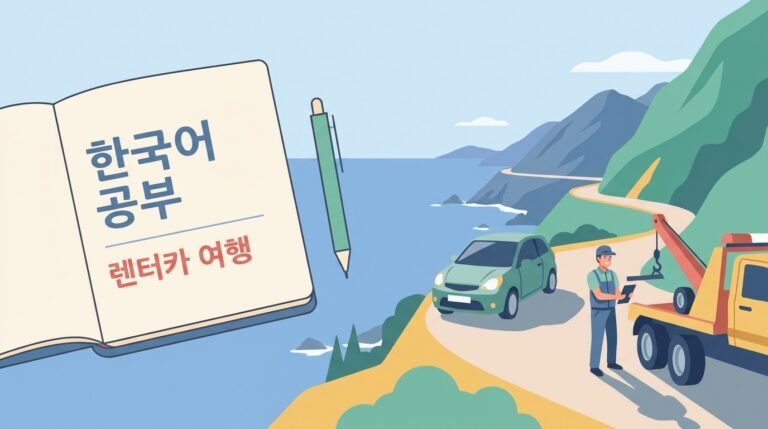
Picture this: You’ve rented a sleek SUV to take the ultimate K-Drama style road trip along the coastal cliffs of Gangwon-do or the volcanic backroads of Jeju Island. The sunset is painting the horizon in tangerine hues, your favorite indie K-ballad playlist is humming on the speakers, and you feel like the main character in Hometown Cha-Cha-Cha. Then, suddenly—THUMP-THUMP-THUMP-SHHH. The steering wheel violently shudders, pulling toward the ditch. You pull over onto the narrow gravel shoulder. Outside, chilly wind howls through pine trees, and your rear tire is completely shredded. There is not a soul, convenience store, or gas station in sight.
Your stomach drops. In many countries, being stranded on an isolated rural road means hours of waiting, exorbitant towing fees, or trying to flag down a passing truck while shivering in the dark. But take a deep breath: You are in South Korea.
Here, when you call your rental agency’s emergency insurance dispatch, a tow truck or mobile repair technician doesn’t just promise to come—they typically pull up right beside you in under 20 minutes, armed with professional tire plugs, high-tech jacks, and a warm thermos of canned coffee. You do not need native fluency to summon this miracle; you just need three key phrases and the right local know-how. Based on feedback from hundreds of Daily Hangul road-trippers who navigated real-life breakdowns, this guide will turn what could be a vacation nightmare into your favorite travel triumph story.
Phase 2: Core Expressions In-Depth
Here are the three life-saving phrases you need when you’re stuck on the road.
1. 타이어에 펑크가 났어요 (Taieoe peongkeuga nasseoyo)
- Pronunciation: Tah-ee-yuh-eh pung-keu-gah nah-ssuh-yo (Think of the English word puncture, but popped like a balloon: peong-keu!)
- Meaning: Literal: “A puncture occurred in the tire.” | Actual Nuance: “I’ve got a flat tire / My tire blew out.”
- K-Culture Moment: You hear this in suspense thrillers whenever characters are chasing a suspect into rural farmland and their tire dramatically blows out, forcing them to run on foot.
- Editor’s Insight: Notice that in Korean, you don’t say “내가 타이어를 펑크 냈어요” (“I flattened the tire”)—the event is treated as an external misfortune that happened (
났어요, from나다, to occur/arise). It removes personal blame immediately.- Situation Spectrum: Casual ⚠️ | Semi-formal ✅ | Formal ✅
- 🤔 Think About It: In English, we often say “I have a flat tire,” making yourself the subject possessing the problem. Why do you think Korean attributes the action to the tire and circumstance instead?
2. 긴급출동 좀 보내주세요 (Gingeupchuldong jom bonaejuseyo)
- Pronunciation: Geen-geup-chool-dong jom bo-nae-joo-seh-yo (Gingeup sounds snappy and urgent, like a sudden snap of an elastic band).
- Meaning: Literal: “Please send emergency dispatch a little.” | Actual Nuance: “Please send roadside emergency assistance right away.”
- K-Culture Moment: This is the magic phrase uttered into the car Bluetooth phone system in corporate K-Dramas when a CEO’s sedan breaks down en route to a high-stakes countryside factory inspection.
- Editor’s Insight: The tiny word 좀 (jom) literally means “a little,” but here it is a crucial politeness buffer. Leaving it out makes you sound demanding, while adding 좀 signals respectful urgency.
- Situation Spectrum: Casual 🚫 | Semi-formal ✅ | Formal ✅
- 🤔 Think About It: How does your native language soften an urgent emergency demand without losing the seriousness of the situation?
3. 위치 문자로 찍어드릴게요 (Wichi munjaro jjigeodeurilgeyo)
- Pronunciation: Wee-chee moon-jah-ro jjee-guh-deu-ril-geh-yo (The jji in jjigeo has an explosive, crisp ‘jj’ sound, like clicking a shutter).
- Meaning: Literal: “I will stamp my location to you via text.” | Actual Nuance: “I will text you my exact GPS pin / map location.”
- K-Culture Moment: Used constantly by delivery drivers, rideshare users, and anyone trying to meet up along unmarked roads in rural Jeju.
- Editor’s Insight: The verb 찍다 (jjikda) means to stamp, dot, or click. In modern smartphone vernacular, it means sending a GPS pin or link from KakaoMap or Naver Map.
- Situation Spectrum: Casual ⚠️ | Semi-formal ✅ | Formal ✅
- 🤔 Think About It: Notice how digital navigation tools in Korea have birthed dynamic new verb meanings like “stamping a location” rather than “giving an address.”
Phase 3: Textbook Korean vs Real Korean
Let’s compare stiff dictionary phrasing with how real drivers talk to insurance call centers.
Situation 1: Describing the flat tire
- 📖 교과서 한국어 (Textbook):
제 자동차 바퀴에 구멍이 생겼습니다.
(Je jadongcha bakwie gumeongi saenggyeotseumnida.)
“A hole has occurred in my automobile wheel.” - 🗣️ 진짜 한국어 (Real-World):
외진 길인데 타이어 펑크 났어요.
(Oejin girinde taieo peongkeu nasseoyo.)
“I’m on a remote road and my tire went flat.” - 💡 왜 다를까? (Why is it different?):
Textbook phrases use overly formal words like구멍(hole) and바퀴(wheel). Native speakers instantly use the Konglish term타이어 펑크(tire puncture), which dispatch operators immediately categorize in their dispatch ticketing system.
Situation 2: Asking for the technician
- 📖 교과서 한국어 (Textbook):
사고 현장에 정비 직원을 파견해 주십시오.
(Sago hyeonjange jeongbi jigwoneul pagyenghae jusipsio.)
“Please dispatch maintenance personnel to the accident site.” - 🗣️ 진짜 한국어 (Real-World):
기사님 좀 빨리 보내주실 수 있나요?
(Gisanim jom ppalli bonaejusil su innayo?)
“Could you please send a technician over quickly?” - 💡 왜 다를까? (Why is it different?):
Calling a field specialist직원(employee) feels cold and corporate. In real Korean interpersonal communication, calling service professionals 기사님 (gisanim – honorable driver/technician) creates instant warmth and motivates the dispatcher to prioritize your case.
Phase 4: K-Culture Deep Dive & Non-Verbal Manners
4-1. 눈치 (Nunchi) & Roadside Etiquette
When your car breaks down on an isolated Korean road, body language and safety procedures matter just as much as spoken Korean:
* Hazard Blinkers First: Immediately activate your 비상깜빡이 (bisangkkambbaki – hazard flashers). In Korean driving culture, hazard lights are also used as an apology and a universal “pardon me” sign to alert trailing cars.
* Step Behind the Guardrail: Never stand in the road lane to flag people down. Walk behind the steel safety barrier (가드레일) or up onto the grassy embankment before dialing the dispatch center.
* The Phone Bow: When speaking on the phone with the customer agent, you will instinctively see Koreans bowing slightly while saying “네, 네! 부탁드립니다” (Yes, yes! Please help me). It conveys genuine sincerity that comes through in your vocal tone.
4-2. The “Ppalli-Ppalli” Safety Net
Korea’s renowned 빨리빨리 (ppalli-ppalli – hurry, hurry) speed culture isn’t just about lightning-fast high-speed rail and instant delivery; it powers the world’s most responsive vehicle roadside assistance network. Because South Korea has a hyper-dense national highway web and insurance companies compete ruthlessly on response times, insurance dispatchers have contract tow trucks and mobile mechanics stationed in nearly every township (Eup and Myeon). Even if you are stranded on a deserted mountain pass in Gangwon Province, your 20-minute countdown starts the moment they confirm your coordinates!
Phase 5: Real-World Roleplay Scenario
Setting: Alex is driving a rental sedan near a coastal village in Namhae when the right front tire suddenly deflates on an empty country road. Alex dials the 24-hour rental insurance hotline printed on the car key fob.
Character: Agent Park Min-ji (상담원 박민지) – Polite, swift, and safety-focused insurance coordinator.
- Agent Park: 네, 매일렌터카 사고접수센터 박민지입니다. 고객님, 다치신 곳은 없으세요?
(Ne, Maeil Renteoka sagojopsusenteo Park Min-ji-imnida. Gogaeknim, dachisin goseun eopseuseyo?)
🎭 차분하고 또렷한 목소리로 신속하게 응대하며
“Yes, this is Park Min-ji at Daily Rental Car Accident Center. Customer, are you unhurt?” -
Alex: 네, 다치진 않았는데 외진 길에서 타이어 펑크가 났어요.
(Ne, dachijin anneunde oejin gireseo taieo peongkeuga nasseoyo.)
🎭 가슴을 쓸어내리며 안도 반, 걱정 반 섞인 어조로
“Yes, I’m not hurt, but I got a flat tire on an isolated road.” -
Agent Park: 다행입니다. 비상깜빡이 켜시고 안전한 곳으로 대피하셨나요?
(Dahaeng-imnida. Bisangkkambbaki kyeosigo anjeonhan goseuro daepihasyeonnayo?)
🎭 안전을 거듭 확인하며 시스템에 메모를 입력하는 소리
“Thank goodness. Have you turned on your hazard lights and moved to a safe spot?” -
Alex: 네, 갓길 가드레일 뒤에 서 있어요. 긴급출동 좀 보내주세요.
(Ne, gat-gil gadeureil dwie seo isseoyo. Gingeupchuldong jom bonaejuseyo.)
🎭 휴대폰을 꼭 쥐고 주위를 둘러보며
“Yes, I am standing behind the shoulder guardrail. Please send emergency dispatch.” -
Agent Park: 고객님 현재 정확한 위치를 알 수 있을까요? 주변에 큰 건물이나 표지판이 있나요?
(Gogaeknim hyeonjae jeonghwakhan wichireul al su isseulkkayo? Jubyeone keun geonmurina pyojipani innayo?)
🎭 지도를 조회하며 위치 확인을 유도하며
“Could we know your exact location? Are there any large buildings or road signs nearby?” -
Alex: 건물은 없고 산길이에요. 제가 위치 문자로 찍어드릴게요.
(Geonmureun eopgo sanggirieyo. Jega wichi munjaro jjigeodeurilgeyo.)
🎭 지도 앱의 현재 위치 공유 버튼을 누르며
“There are no buildings, just a mountain road. I will text you my GPS location pin.” -
Agent Park: 감사합니다! 문자 확인되는 대로 20분 내로 기사님 도착하도록 배차하겠습니다.
(Gamsahamnida! Munja hwagindoeneun daero isipbun naero gisanim dochakhadorok baechahagetseumnida.)
🎭 안심시키는 상냥한 목소리로
“Thank you! As soon as we verify the text, we will dispatch a technician to arrive within 20 minutes.” -
Alex: 네, 링크 보냈습니다. 조심히 빨리 와주세요!
(Ne, ringkeu bonaesseumnida. Josimhi ppalli wajuseyo!)
🎭 깊은 숨을 내쉬며 고마움을 표현하며
“Yes, I just sent the link. Please come safely and quickly!”
🔀 Interactive Decision Branch
What would you say next if the agent asks for identification details?
- Option A: “지금 당장 오세요! 왜 이렇게 물어보는 게 많아요?” (Jigeum dangjang oseyeo! Wae ireoke mureoboneun ge manayo?)
- Outcome (Risk): Rude and counterproductive. In Korea, road assistance cannot dispatch without vehicle registration verification and exact GPS validation.
- Option B: “차량 번호판 찍어서 사진으로 같이 보낼게요.” (Charyang beonhopan jjigeoseo sajineuro gachi bonaelgeyo.)
- Outcome (Best!): Flawless native-level handling! Sending a photo of the license plate confirms your rental contract instantly and speeds up dispatch.
- Option C: “그냥 제가 타이어 교체해볼게요. 오지 마세요.” (Geunyang jega taieo gyochehaebolgeyo. Oji maseyo.)
- Outcome (Bad): Dangerous! Rental cars rarely carry spare jacks, and working on an unlit road shoulder is unsafe. Always let the professional service take care of it.
Phase 6: 10-Second Emotion Shadowing Drill
Practice these lines out loud with feeling! Notice the / pause markers:
- [😰 Panic & Urgent Distress]
외진 길인데 / 타이어가 펑크 나서 / 차가 꼼짝을 안 해요!
(Oejin girinde / taieoga peongkeu naseo / chaga kkomjjageul an haeyo!)
“I’m on a remote road / and my tire blew out / the car won’t budge!” -
[🙏 Polite & Earnest Plea]
가드레일 뒤에 서 있는데 / 기사님 도착까지 / 얼마나 걸릴까요?
(Gadeureil dwie seo inneunde / gisanim dochakkkaji / eolmana geollilkkayo?)
“I’m standing behind the guardrail / until the technician arrives / how long will it take?” -
[😌 Relief & Grateful Warmth]
진짜 20분 만에 오셨네요! / 기사님 덕분에 / 살았습니다.
(Jinjja isipbun mane osyeonneyo! / Gisanim deokbune / saratseumnida.)
“You really arrived in 20 minutes! / Thanks to you, technician / I’m saved.”
Phase 7: K-Culture Mini Dictionary
- 긴급출동 (Gingeupchuldong)
- Meaning: Emergency Dispatch Service.
- Context: 24/7 roadside rescue service provided by automobile insurers in Korea covering flat tires, battery drain, lockout, and fuel shortage.
- 갓길 (Gat-gil)
- Meaning: Road shoulder / Verge.
- Context: Highway emergency strip. Korean law strictly mandates clearing the driving lane and pulling onto the 갓길 in case of a breakdown.
- 지렁이 (Jireong-i)
- Literal: Earthworm | Automotive Meaning: Tire plug strip.
- Context: Mechanics call the rubber vulcanizing string used to plug tire punctures a “지렁이” due to its brown, worm-like appearance.
- 전신주 전주번호 (Jeonsinju jeonjubeonho)
- Meaning: Utility pole identification coordinates.
- Context: If your phone GPS fails in rural Korea, reading the 8-digit alpha-numeric code stenciled onto the nearest concrete electric pole gives emergency services your exact coordinates down to meters!
Phase 8: Traveler’s Survival Kit
Top 3 Survival Phrases
- Phrase 1: 렌터카 보험 긴급출동 맞죠? (Renteoka boheom gingeupchuldong matjyo?)
- Meaning: “This is the rental car insurance emergency roadside service, right?”
- Pro Tip: Always double-check you called your rental’s official partner insurer, not a predatory private wrecker.
- Phrase 2: 지렁이로 때울 수 있는 크기인가요? (Jireong-iro ttae-ul su inneun keugi-ingayo?)
- Meaning: “Is the hole small enough to be patched with a tire plug?”
- Pro Tip: Small nail punctures are patched in 5 minutes with a jireong-i without replacing the whole wheel!
- Phrase 3: 견인해야 하나요? (Gyeon-inhaeya hanayo?)
- Meaning: “Does it need to be towed?”
- Pro Tip: Rental contracts usually include free towing up to 10–50km depending on your insurance tier.
Editor’s Travel Note & Survival Apps
Before setting out on Korean highways, never rely solely on foreign map apps that lack rural navigation detail. Make sure to download the Naver Map Navigation App and the KakaoMap Korea Transit & Navigation App. Both apps permit you to tap and hold your blue GPS location dot and select “Share Current Location via SMS” directly to the roadside assistance operator. Also save the Korean emergency police number (112) and Korea Expressway Corporation toll-free helpline (1588-2504) for free safety towing off expressways.
Phase 9: “One Step Deeper” (Reflective Cultural Essay)
In Western countries, calling roadside breakdown services often feels like an adversarial bureaucracy of automated menus, distance surcharges, and open-ended wait times. In Korea, however, the roadside dispatch system reflects the profound cultural principle of 상부상조 (Sangbusangjo – mutual assistance within community) coupled with competitive digital infrastructure.
When a technician rushes across dark provincial roads to your stranded car, they view you not merely as a ticket number, but as someone in immediate vulnerability who belongs to the collective safety sphere. The swift speed is an ethical commitment to restore your peace of mind before panic sets in.
💬 Your Turn: Have you ever experienced a travel emergency abroad? How would you feel knowing assistance in Korea arrives within 20 minutes? Share your thoughts in the comments below!
Phase 10: FAQ & Misconceptions
Q: Does calling emergency roadside dispatch cost a lot of money in Korea?
A: Generally, no! Almost all Korean rental car contracts include comprehensive insurance packages (CDW / 자차보험) that offer 3 to 5 free emergency callouts during your rental period for common mishaps like flat tire repairs, battery jumpstarts, and minor towing.
Q: What should I do if the dispatcher cannot speak English?
A: Stay calm and state your key words clearly: “렌터카 (Rental car)”, “타이어 펑크 (Tire puncture)”, and “위치 문자 (Location text)”. You can also request interpretation assistance by calling the Korea Travel Hotline at 1330 on a three-way call.
Q: Can I accept help from a private tow truck that suddenly appears?
A: Be cautious! Independent private tow trucks (사설 렉카) often monitor police radio frequencies and arrive uninvited within minutes. Politely refuse by saying: “보험사 불렀어요. 손대지 마세요 (I already called my insurance. Please do not touch the car).” Only allow your rental company’s officially dispatched truck to service your car.
🚨 Common Mistakes Warning Board
- Mistake: Remaining inside the car on the shoulder of a high-speed rural expressway.
- Correct Action: Turn on hazard lights, get out through the passenger door, and stand outside behind the safety barrier.
- Mistake: Trying to pronounce complex rural village addresses phonetically over the phone.
- Correct Action: Text them the GPS map link or read the number printed on a nearby utility pole.
- Mistake: Leaving the car and walking away to find help on unlit country roads.
- Correct Action: Stay near your vehicle within sight of the guardrail; the technician needs to verify your identity and keys on arrival.
Phase 11: Action Mission & Engagement
- 🥉 Bronze Level: Stand in front of your mirror and practice reciting: “타이어에 펑크가 났어요. 긴급출동 좀 보내주세요!” three times with urgent emotion.
- 🥈 Silver Level: Open your Naver Map or KakaoMap app right now, drop a pin on a remote spot along the Jeju coast, and practice copying the coordinates to your clipboard.
- 🥇 Gold Level: During your next trip to Korea, identify the utility pole numbers (전주번호) along a quiet street and teach the trick to your travel partner!
- 🎮 K-Culture Mission: Watch an episode of a road-trip variety show like 2 Days & 1 Night or a drama like Crash Landing on You and see if you spot car breakdown scenes or hazard blinker etiquette.
Phase 12: Interactive Quiz Challenge
Test your real-world emergency skills below!
1. Situational Judgment
You are stuck on a rural road with a flat tire. A private tow truck arrives out of nowhere and offers to tow you immediately. What is the smartest response?
* (A) Let them tow your car right away.
* (B) Tell them “보험사 불렀어요” and wait for your official rental dispatch.
* (C) Leave the keys in the ignition and walk to a convenience store.
2. Fill-in-the-Blank
“I don’t know the address, so I will text you my location pin:”
제가 주소는 모르는데, 위치 _______ 찍어드릴게요.
3. Cultural True or False
True or False: In Korea, roadside emergency technicians usually take more than 2 hours to reach rural roads because of mountain geography.
👉 Click here to reveal answers & explanations!
- Answer: (B)
- Explanation: Always wait for your verified rental insurance roadside technician. Private wreckers may charge hundreds of thousands of won that rental insurance will not reimburse.
- Answer: 문자로 (munjaro – via text)
- Explanation: 문자로 찍어드릴게요 means texting the digital GPS pin directly.
- Answer: False
- Explanation: Korea’s hyper-efficient insurance coverage network typically deploys local technicians within 15 to 25 minutes, even along remote countryside routes!
- Explanation: Korea’s hyper-efficient insurance coverage network typically deploys local technicians within 15 to 25 minutes, even along remote countryside routes!
🎬 Watch Our Daily Videos! (Daily Hangul Official Instagram)
Review the expressions you learned in this article with our fun daily short videos! Check out native pronunciation and real-life nuances in action.
- Instagram @dailyhangul_en







