

Phase 1: Empathy (Story-Driven Opening)
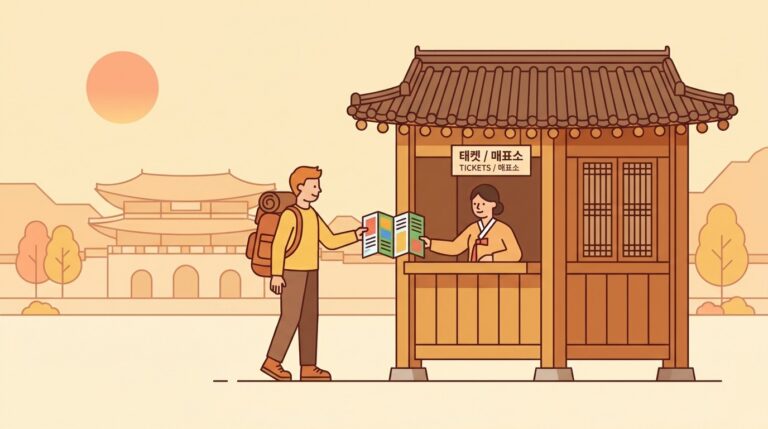
안녕하세요! 매일한글 에디터입니다. Have you ever stood right in front of the majestic gates of Gyeongbokgung Palace, holding your ticket tightly, suddenly feeling overwhelmed? You look around and see centuries of history, but the complex signs look like a maze of unfamiliar letters. You spot a tidy wooden information counter with colorful stacks of paper. You desperately want an English guide to know where the King’s throne room is, but your tongue freezes up. “Will they understand English? How do I politely ask for a guide brochure in Korean without awkward pointing?” Thousands of our first-time travelers experience this exact moment of hesitation. Today, we will master one magic sentence structure that makes you feel confident, prepared, and welcomed anywhere in Korea!
Phase 2: Core 3 Expressions Deep Dive
1. 영어 팸플릿 있어요? (Yeongeo paempllit isseoyo?)
- Pronunciation: [Yeon-geo paem-pleet ees-seo-yo?] (Sounds like: Young-uh pam-fleet is-saw-yo?)
- Meaning: “Do you have an English brochure?” (Literally: English + pamphlet + exists/have?)
- K-Culture Moment: Seen in travel variety shows like 2 Days & 1 Night when cast members explore regional heritage sites and check the visitor center for maps.
- Editor’s Insight: Koreans use the loanword 팸플릿 (paempllit) or 리플릿 (ripleullit) constantly. Pair the language name with 있어요? (isseoyo?) to instantly ask if materials in that language are available.
- Situation Spectrum: Casual (with close friends): ⚠️ (use 반말 있어?) | Semi-formal (Attraction staff): ✅ | Formal: ✅
- 🤔 Think About It: In English, we ask “Could you provide me with…”. In Korean, you simply state the object and ask if it exists: “Does [item] exist?” How does this shift focus from the person to the presence of the object?
2. 한국어 안내 책자 주세요. (Hangugeo annae chaekja juseyo.)
- Pronunciation: [Han-guk-eo an-nae chaek-ja joo-seh-yo] (Sounds like: Hahn-goog-uh ahn-neh check-jah joo-say-yo)
- Meaning: “Please give me a Korean guide brochure/booklet.”
- K-Culture Moment: The polite go-to phrase for studious drama characters entering an art exhibition or museum.
- Editor’s Insight: 안내 책자 (annae chaekja) is the authentic Sino-Korean term for a guide booklet (안내 = guidance, 책자 = small book). Adding 주세요 (juseyo – please give me) creates a gentle, polite request.
- Situation Spectrum: Casual: 🚫 | Semi-formal: ✅ | Formal: ✅
- 🤔 Think About It: Why is 주세요 (juseyo) often called the ultimate “magic word” for beginners traveling across Korea?
3. 지도 있어요? (Jido isseoyo?)
- Pronunciation: [Ji-do ees-seo-yo?] (Sounds like: Jee-doh is-saw-yo?)
- Meaning: “Do you have a map?”
- K-Culture Moment: When tourists navigate sprawling palace grounds or scenic folk villages like Bukchon.
- Editor’s Insight: Short, punchy, and essential. When brochures run out, asking directly for a 지도 (jido – map) saves the day.
- Situation Spectrum: Casual: ⚠️ | Semi-formal: ✅ | Formal: ✅
- 🤔 Think About It: Notice how repeating 있어요? (isseoyo?) lets you ask for dozens of different items just by swapping the first noun!
Phase 3: Textbook Korean vs Real Korean
Situation 1: Inquiring about foreign language pamphlets
- 📖 교과서 한국어 (Textbook): “관광 안내 책자를 얻을 수 있을까요?” (Gwangwang annae chaekjareul eodeul su isseulkkayo? – May I obtain a tourism guide booklet?)
- 🗣️ 진짜 한국어 (Real-life): “영어 팸플릿 있어요?” (Yeongeo paempllit isseoyo? – Do you have an English brochure?)
- 💡 왜 다를까? (Why the difference?): Real-life Korean at ticket booths values clear, concise communication. Long grammatical patterns sound overly stiff and unnatural.
Situation 2: Asking if an English version is available
- 📖 교과서 한국어 (Textbook): “영어 번역본이 구비되어 있습니까?” (Yeongeo beon-yeokboni gubidoeeo isseumnikka? – Is an English translation equipped?)
- 🗣️ 진짜 한국어 (Real-life): “영어 버전 있어요?” (Yeongeo beojeon isseoyo? – Do you have the English version?)
- 💡 왜 다를까? (Why the difference?): Everyday Korean eagerly adopts everyday loanwords like 버전 (version) for quick mutual understanding.
Phase 4: K-Culture Deep Dive & Non-Verbal Manners
4-1. 눈치 (Nunchi) & Gestures
When approaching the information window at a historic site:
* The Two-Handed Receive (두 손 받기): When the staff hands you the brochure, accept it using both hands or support your right wrist lightly with your left hand. It conveys immense respect.
* The Friendly Nod (목례): Give a subtle 15-degree head bow accompanied by a warm 감사합니다 (Gamsahamnida – Thank you).
4-2. Culture Code Analysis: The Joy of Stamp Tours (스탬프 투어)
In Korea, historical spots like palaces, Bukhansan national parks, and even quaint neighborhoods feature a 스탬프 투어 (stamp tour). Pick up your 안내 팸플릿 (guide brochure) at the front counter—inside, you will often find designated blank circles. As you discover each pavilion or gate, stamp your booklet with red ink! It turns your simple brochure into a personal, tangible travel souvenir.
Phase 5: Real-World Roleplay Scenario
- Setting: The ticket booth entrance of Gyeongbokgung Palace on a crisp autumn morning.
- Characters: You (excited visitor) & Minji (helpful ticket agent).
- You: 🎭 (Approaching the counter with a smile) 안녕하세요! (Annyeonghaseyo! – Hello!)
- Minji: 🎭 (Bowing slightly) 안녕하세요! 입장권 드릴까요? (Annyeonghaseyo! Ipjang-gwon deurilkkayo? – Hello! Shall I give you admission tickets?)
- You: 🎭 (Pointing to the entrance sign) 네, 성인 한 장 주세요. (Ne, seong-in han jang juseyo. – Yes, one adult ticket, please.)
- Minji: 🎭 (Handing over the printed ticket) 3,000원입니다. (Samcheon-won-imnida. – That is 3,000 won.)
- You: 🎭 (Paying and spotting the brochure stand) 저기요, 영어 팸플릿 있어요? (Jeogiyo, yeongeo paempllit isseoyo? – Excuse me, do you have an English brochure?)
- Minji: 🎭 (Looking through the shelf) 아, 영어 팸플릿은 다 나갔어요. 한국어는 있어요! (A, yeongeo paemplliteun da nagasseoyo. Hangugeoneun isseoyo! – Ah, English brochures are all out. We have Korean ones!)
- You: 🎭 (Nodding enthusiastically) 좋아요! 한국어 안내 책자 주세요. (Joh-ayo! Hangugeo annae chaekja juseyo. – Sounds good! Please give me the Korean guide brochure.)
- Minji: 🎭 (Handing over the guide with both hands) 여기 있습니다. 즐거운 관람 되세요! (Yeogi itseumnida. Jeulgeoun gwallam doeseyo! – Here it is. Have a wonderful visit!)
🔀 Interactive Choice Point
What should you say after Minji hands you the brochure?
* Option A: “땡큐!” (Ttaengkyu!)
* Option B: “감사합니다!” (Gamsahamnida!) with a polite nod.
* Option C: Turn around immediately and walk away while reading.
- Feedback:
- Option A (Risk): While understandable, using English when you just spoke Korean misses a golden chance to show genuine cultural warmth.
- Option B (Best!): Perfect! Delivering 감사합니다 (Gamsahamnida) with two hands on the brochure creates the best impression.
- Option C (Bad): Turning away abruptly feels slightly dismissive after a friendly exchange.
Phase 6: 10-Second Emotion Shadowing Drill
Practice these lines with rhythm and emotion! Pay attention to the pauses (/).
[😊 Politely inquiring]
저기요, / 영어 팸플릿 / 있어요? ↗
(Jeogiyo, / yeongeo paempllit / isseoyo?)-
[🤗 Friendly & Requesting]
한국어 안내 책자 / 하나 주세요! ↘
(Hangugeo annae chaekja / hana juseyo!) -
[😄 Delighted & Grateful]
네! / 지도도 / 같이 주세요. 감사합니다! ↗
(Ne! / Jidodo / gachi juseyo. Gamsahamnida!)
Phase 7: K-Culture Mini Dictionary
- 팸플릿 (Paempllit) | Pamphlet / Brochure | The most widespread word used at counters for paper guides and event leaflets.
- 안내소 (Annaeso) | Information Center | Look for this signage at subway stations, palaces, and tourist streets.
- 매표소 (Maepyoso) | Ticket Office / Box Office | The booth where you purchase entry tickets before entering an attraction.
- 스탬프 투어 (Seutaempeu tueo) | Stamp Tour | A popular sightseeing activity where visitors collect ink stamps in their brochure as they visit landmarks.
Phase 8: Traveler’s Survival Kit
Top 3 Survival Phrases
- 영어 있어요? (Yeongeo isseoyo?) – Do you have English? (Pro Tip: Use this short phrase anywhere when you need English menus, signs, or audio devices).
- 지도 주세요. (Jido juseyo.) – Please give me a map. (Pro Tip: Keep this handy at massive spots like Seoul Grand Park or Nami Island).
- 여기 어디예요? (Yeogi eodiyeyo?) – Where is this place? (Pro Tip: Point to a spot on your brochure map when asking staff for directions).
Editor’s Travel Note
Before heading to palaces or museums, download the Naver Map Navigation App. While Google Maps has limited walking directions in South Korea due to local mapping regulations, Naver Map provides bilingual routes and details whether ticket counters have foreign language services.
Phase 9: One Step Deeper (Reflection)
In Korean, the ending -요 (-yo) is your ultimate passport to politeness. Notice how adding -요 transforms a plain statement into a respectful inquiry: 있어 (isseo – exists) becomes 있어요? (isseoyo? – does it exist?). This reflects Korea’s relational culture, where showing care and modesty towards the person serving you creates instant connection and mutual goodwill.
💬 Your Turn: Which historical site or museum in Korea do you want to explore first with your Korean brochure? Tell us in the comments below!
Phase 10: FAQ & Common Mistakes
Q: Can I say “브로셔 (beurosyeo)” instead of “팸플릿 (paempllit)”?
A: Yes! Both are recognized loanwords, but 팸플릿 (paempllit) or 안내 책자 (annae chaekja) are far more common among booth staff.
Q: What if they only have Korean brochures left?
A: That is actually a great learning opportunity! Take the Korean one and use your translation app camera to practice reading key vocabulary like 화장실 (restroom) and 출구 (exit).
Q: How do I ask for two brochures?
A: Just insert the number counter: 영어 팸플릿 두 개 주세요 (Yeongeo paempllit du gae juseyo – Please give me two English pamphlets).
🚨 Common Mistakes Board
- ❌ Mistake 1: Dropping the politeness particle and saying “영어 팸플릿 있어?” (Yeongeo paempllit isseo?).
- 👉 Correct Action: Always include -요 (-yo) -> “있어요?” (Isseoyo?) when speaking to staff.
- ❌ Mistake 2: Using “책 (chaek)” (thick book) instead of “안내 책자 (annae chaekja)” or “팸플릿 (paempllit)”.
- 👉 Correct Action: Say 팸플릿 (paempllit) for thin fold-out pamphlets.
- ❌ Mistake 3: Grabbing brochures abruptly from behind the desk without asking.
- 👉 Correct Action: Always ask first with “이거 가져가도 돼요?” (Igeo gajyeogado dwaeyo? – May I take this?) or “팸플릿 주세요” (Paempllit juseyo).
Phase 11: Action Missions
- 🥉 Bronze Mission: Stand in front of your mirror and say “영어 팸플릿 있어요?” three times out loud with a bright smile.
- 🥈 Silver Mission: Save a picture of your dream Seoul attraction on your phone, write “안내 책자 주세요!” on it, and save it as your wallpaper.
- 🥇 Gold Mission: On your next trip (or at a local Korean cultural center), step up to the front desk and ask for a guide brochure entirely in Korean!
- 🎮 K-Culture Mission: Watch an episode of a Korean travel vlog or variety show and spot the paper brochures visitors hold at palace gates.
Phase 12: Interactive Quiz Challenge
1. Situational Judgment:
You are at the ticket desk of N Seoul Tower. You want a guide brochure in English. What is the most natural sentence?
* A) 영어 책 주세요. (Yeongeo chaek juseyo.)
* B) 영어 팸플릿 있어요? (Yeongeo paempllit isseoyo?)
* C) 안내 책자 없어요? (Annae chaekja eopseoyo?)
2. Fill-in-the-Blank:
“Excuse me, please give me a map.” -> “저기요, [ ] 주세요!”
3. True or False:
Accepting a brochure with both hands is considered respectful etiquette in Korean tourist venues. (True / False)
👉 Click to reveal answers & explanations!
- Answer: B | 영어 팸플릿 있어요? is the natural, polite way to inquire about English brochures. Option A asks for an English reading book, and Option C asks if they don’t have brochures.
- Answer: 지도 (Jido) | Complete phrase: 저기요, 지도 주세요! (Jeogiyo, jido juseyo!)
- Answer: True | Receiving items with both hands (or with one hand supporting the wrist) is standard polite Korean body language.
🎬 Watch Our Daily Videos! (Daily Hangul Official Instagram)
Review the expressions you learned in this article with our fun daily short videos! Check out native pronunciation and real-life nuances in action.
- Instagram @dailyhangul_en







