

Phase 1: Empathy & Story Opening
안녕하세요! 매일한글 에디터입니다. (Annyeonghaseyo! It is your Daily Hangul editor.)
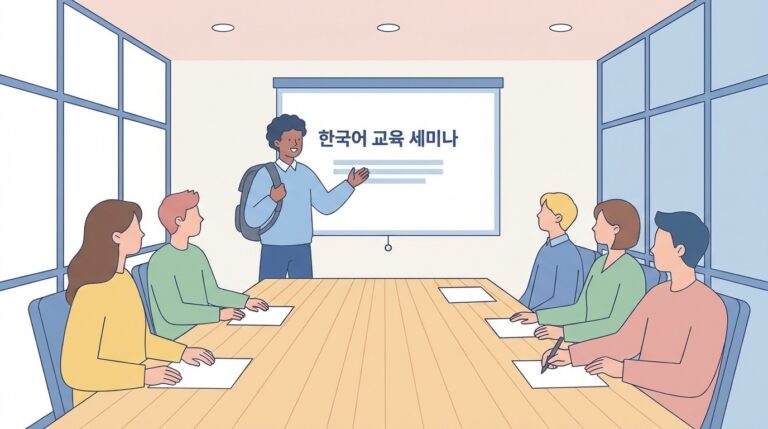
Picture this: It is Thursday afternoon in a high-floor seminar room at a university in Sinchon. The autumn breeze taps against the window, but inside, the air is thick with tension and the bitter aroma of half-finished Mega Coffee iced Americanos. Your professor, known for an eagle-eyed attention to methodology, sits at the head of the mahogany table, jotting notes with a fountain pen. Across from you, your fellow graduate peers (hag-u-deul) flip through a 30-page research dossier. Today, you are not just a quiet participant sitting in the corner—you are the balje-ja (발제자), the designated seminar presenter tasked with synthesizing two dense academic papers and leading a 40-minute critical discussion in Korean.
Your palms sweat. Back home, you were celebrated for sharp, aggressive critiques: “The author completely misses the mark here, and the data is flawed.” But in a Korean graduate seminar, bludgeoning a peer-reviewed text with blunt statements like “이 논문은 틀렸습니다” (This paper is wrong) can cause an awkward chill to sweep across the room. How do you critically analyze prior literature (seonhaeng yeongu) while maintaining the polite, collegial harmony (ye-ui) expected in Korean academic discourse?
If you have ever felt your voice tremble while presenting your seminar paper (balje-mun), you are in the right place. Based on real feedback and battle-tested strategies from international graduate students across Korea, this comprehensive guide will give you the exact B2-level academic formulas, subtle hedging phrases, and cultural navigation tools you need to command your seminar table with effortless confidence.
Phase 2: Core Expressions Breakdown
Here are the top three academic powerhouses you need when leading an academic discussion.
1. 선행 연구의 한계점을 보완할 필요가 있습니다.
- Pronunciation: [Seonhaeng yeongu-ui hangyejeom-eul bowanhal piryoga itseumnida]
- Sound analogy: Think “sun-hang young-goo-wee han-gye-jum-eul bo-wan-hal pee-ryo-ga eet-seum-nee-da”. The bo-wan glides like saying “bow and” quickly.
- Meaning: “There is a need to supplement the limitations of prior research.” (Actual nuance: “While this study laid important groundwork, its shortcomings provide a natural springboard for future inquiry.”)
- K-Culture Moment: Seen in campus dramas like Law School or Cheese in the Trap, where a student points out a theoretical blind spot during moot court or research group debates without directly insulting the prior scholar.
- Editor’s Insight: Notice the verb 보완하다 (to supplement/complement) instead of 비판하다 (to criticize). In Korean academia, critiques are framed as “filling an empty glass” rather than “shattering the glass.”
- Situation Spectrum: Casual 🚫 | Semi-formal ⚠️ | Formal ✅
- 🤔 Think About It: In Western academic debates, scholars often pride themselves on dismantling an argument point by point. Why do you think Korean academic etiquette prefers framing critique as “supplementing” (bowan) rather than “refuting” (banbak)?
2. 이 논문에서 주목할 만한 시사점은 다음과 같습니다.
- Pronunciation: [I nonmun-eseo jumokhal manhan sisajeom-eun daeumgwa gatseumnida]
- Sound analogy: “Ee non-moon-eh-suh joo-mok-hal man-han she-sa-jum-eun da-oom-gwa gat-seum-nee-da”.
- Meaning: “The notable implications of this paper are as follows.” (Actual nuance: “Here is why this research actually matters to our field and why we should pay close attention.”)
- K-Culture Moment: The staple phrase used by policy think-tank researchers and graduate students when transitioning from mere summary into high-level analytical contribution.
- Editor’s Insight: 시사점 (sisajeom, implications/takeaways) is the golden ticket word for graduate presentations. It signals to your professor that you are thinking beyond the text and grasping its broader academic or real-world resonance.
- Situation Spectrum: Casual 🚫 | Semi-formal ⚠️ | Formal ✅
- 🤔 Think About It: Contrast “takeaway” with “시사점” (literally: pointing points that give suggestions). It gently prompts the audience to reflect together.
3. 이에 대해 학우분들은 어떻게 생각하시는지 궁금합니다.
- Pronunciation: [I-e daehae hagubundeul-eun eotteoke saenggakasineunji gunggeumhamnida]
- Sound analogy: “Ee-eh dae-hae ha-goo-boon-deul-eun uh-ttoh-keh sang-gak-ha-she-noon-jee goong-goom-ham-nee-da”.
- Meaning: “I am curious to know what our fellow classmates think regarding this.” (Actual nuance: “The floor is now open, and I warmly invite your perspectives to deepen our discussion.”)
- K-Culture Moment: Used by a skilled seminar leader (balje-ja) who turns a monologue into an engaging roundtable dialogue, making eye contact across the room.
- Editor’s Insight: Calling your graduate classmates 학우분들 (hagu-bundeul, fellow scholars/classmates) adds an elevated, mutual respect that instantly elevates the academic atmosphere.
- Situation Spectrum: Casual 🚫 | Semi-formal ✅ | Formal ✅
- 🤔 Think About It: Notice how the speaker says “궁금합니다” (I am curious) instead of “말씀해 주십시오” (Please speak). Curiosity lowers defenses and fosters collaborative inquiry.
Phase 3: Textbook Korean vs. Real Korean
Leveling up to B2 means ditching stiff, dictionary-translated phrases and adopting the natural hedging style of native Korean academics.
Situation 1: Pointing out sampling bias or methodological limits
- 📖 Textbook Korean: 이 연구의 방법론은 잘못되었습니다. (I yeongu-ui bangbeobnon-eun jalmotdoe-eotseumnida.) — “The methodology of this research is wrong.”
- 🗣️ Real Korean: 방법론적 측면에서 표본의 대표성에 다소 아쉬운 점이 남습니다. (Bangbeobnon-jeok cheungmyeon-eseo pyobon-ui daepyoseong-e daso aswium-i namseumnida.) — “Methodologically speaking, there remains a somewhat regrettable limitation regarding the representativeness of the sample.”
- 💡 Why it differs: Native scholars rarely declare something “wrong” (jalmotdoeda). Instead, they soften the blow using modal hedges like 다소 (daso, somewhat/rather) and 아쉬운 점이 남다 (aswium-i namda, leaves room for regret/improvement).
Situation 2: Transitioning between the two assigned papers
- 📖 Textbook Korean: 이제 두 번째 논문을 보겠습니다. (Ije du beonjjae nonmun-eul bogetseumnida.) — “Now, we will look at the second paper.”
- 🗣️ Real Korean: 앞서 살펴본 논문과 연계하여, 두 번째 논문의 핵심 논점을 짚어보겠습니다. (Apseo salpyeobon nonmun-gwa yeongye-hayeo, du beonjjae nonmun-ui haeksim nonjeom-eul jipeobogetseumnida.) — “In connection with the paper examined prior, let us highlight the core arguments of the second paper.”
- 💡 Why it differs: Using connectors like ~와 연계하여 (in connection with) and verbs like 짚어보다 (to point out/examine) demonstrates sophisticated conceptual weaving expected at the B2-C1 graduate level.
Phase 4: K-Culture Deep Dive & Non-Verbal Manners
4-1. Nunchi (눈치) & Academic Gestures
Leading a graduate seminar in Korea requires keen situational awareness (nunchi). When critiquing a prior paper:
* The Open-Palm Gesture: When gesturing toward your slide or presentation handout (balje-mun), never point with an index finger. Use an open palm facing slightly upward (du son-euro an-nae or single open hand). It conveys deference to the scholarship and your audience.
* The Triangle Eye Contact: Divide your visual focus in a 50-30-20 ratio: 50% toward the professor (gyosu-nim), 30% scanning your fellow classmates (hagu-deul), and 20% down toward your outline notes. Lingering solely on your slides makes you look unprepared, while staring only at the professor excludes your peers.
* The Humble Head-Nod (Gogae Kkeudog-im): When the professor interjects mid-presentation, pause instantly, listen with your torso inclined slightly forward, and nod gently. Never speak over an interjection; allow two beats of silence before responding.
4-2. Cultural Code: The Laboratory & Seminar Culture (Yeongusil Munhwa)
In Korean graduate schools, seminars are not simply dry academic exercises; they are social pacts. Research labs (yeongusil) operate as tight-knit communities where academic reputation (che-myeon, social face) matters deeply. A critique that sounds too personal or arrogant can damage collaborative relationships. Hence, constructive critique is treated as an offering to collective intellectual growth (haksuljeok gi-yeo), framed with maximum politeness to safeguard everyone’s scholarly dignity.
Phase 5: Real-Life Roleplay Scenario
Setting: A quiet seminar room at Korea University. Professor Park (Park Gyo-su-nim) sits with a steaming mug of green tea. Senior student Min-ho (Min-ho Seonbae) has his laptop ready. You are the balje-ja standing beside the projector screen.
1. You (Presenter):
안녕하십니까. 오늘 세미나 발제를 맡은 김지우입니다. 지정 논문 두 편을 비교 검토한 내용을 발표하겠습니다.
(Annyeonghasimnikka. Oneul semina balje-reul mateun Kim Ji-woo-imnida. Jijeong nonmun du pyeon-eul bigyo geomtohan naeyong-eul balpyohagetseumnida.)
“Good afternoon. I am Ji-woo Kim, the presenter for today’s seminar. I will present a comparative review of the two assigned papers.”
🎭 Both hands clasping presentation notes lightly at chest height, making respectful eye contact with the professor, then sweeping across the room.
2. Professor Park:
네, 지우 씨. 두 논문이 방법론에서 꽤 상반된 접근을 취하고 있죠. 발제문 준비하느라 고생 많았어요. 시작해 봐요.
(Ne, Ji-woo ssi. Du nonmun-i bangbeobnon-eseo kkwae sangbandwoen jeopgeun-eul chwihago itjyo. Baljemun junbihaneura gosaeng manasseoyo. Sijakhae bwayo.)
“Yes, Ji-woo. The two papers take quite contrasting methodological approaches. You must have worked hard preparing the handout. Please begin.”
🎭 Smiling gently, taking off glasses, and folding hands on top of the printed handouts.
3. You (Presenter):
감사합니다. 첫 번째 논문은 정량적 데이터를 통해 설득력 있는 분석을 제시하지만, 질적 맥락을 포괄하는 데는 다소 한계가 있습니다.
(Gamsahamnida. Cheot beonjjae nonmun-eun jeongryangjeok de-iteo-reul tonghae seoldeungnyeok inneun bunseok-eul jesihajiman, jiljeok maeknak-eul pogwalhaneun de-neun daso hangye-ga itseumnida.)
“Thank you. While the first paper presents a persuasive analysis through quantitative data, it has certain limitations in encompassing qualitative context.”
🎭 Indicating Slide 3 with an open right palm, nodding calmly.
4. Min-ho Seonbae:
그렇다면 두 번째 논문이 그 질적 한계를 어떻게 보완해 주고 있다고 보시나요?
(Geureotdamyeon du beonjjae nonmun-i geu jiljeok hangye-reul eotteoke bowanhae jugo itdago bosinayo.)
“In that case, how do you see the second paper compensating for those qualitative limitations?”
🎭 Typing a quick note into his laptop, leaning forward with genuine curiosity.
5. You (Presenter):
좋은 질문 감사드립니다. 바로 그 지점에서 두 번째 논문은 심층 면담을 활용하여 구조적 공백을 훌륭히 메워주고 있습니다.
(Joeun jilmun gamsadeurimnida. Baro geu jijeom-eseo du beonjjae nonmun-eun simcheung myeondam-eul hwalyonghayeo gujojeok gongbaek-eul hullyunghi meweojugo itseumnida.)
“Thank you for the insightful question. Precisely at that point, the second paper utilizes in-depth interviews, brilliantly bridging that structural gap.”
🎭 Acknowledging the senior with a slight nod before addressing both him and the professor.
6. Professor Park:
흥미롭네요. 그렇다면 현시점에서 우리 연구실 과제에 적용할 수 있는 시사점은 뭐라고 보나요?
(Heungmiromneyo. Geureotdamyeon hyeonsijeom-eseo uri yeongusil gwaje-e jeokyonghal su inneun sisajeom-eun mworago bonayo.)
“Interesting. Then, at this juncture, what do you see as the practical implications applicable to our lab’s project?”
🎭 Tapping his pen rhythmically against the desk, assessing your critical synthesis.
7. You (Presenter):
이 논문에서 도출할 수 있는 시사점은, 단일 방법론에 의존하기보다 혼합 연구 방식을 채택해야 한다는 점입니다.
(I nonmun-eseo dochulhal su inneun sisajeom-eun, dan-il bangbeobnon-e uijonhagiboda honhap yeongu bangsik-eul chaetaekhaeya handaneun jeom-imnida.)
“The implication derived from these papers is that rather than relying on a single methodology, we ought to adopt a mixed-methods approach.”
🎭 Delivering the line with calm, steady voice tone and shoulders relaxed.
8. You (Presenter):
발제를 마치며 질문을 드리고 싶습니다. 이에 대해 학우분들은 실제 현장 적용 가능성을 어떻게 평가하시는지 궁금합니다.
(Balje-reul machimyeo jilmun-eul deurigo sipseumnida. I-e daehae hagubundeul-eun silje hyeonjang jeokyong ganeungseong-eul eotteoke pyeong-gahasineunji gunggeumhamnida.)
“As I conclude my presentation, I would like to pose a question. I am curious to hear how fellow classmates evaluate the feasibility of applying this in the field.”
🎭 Stepping back slightly, gesturing smoothly to both sides of the seminar table to open the floor.
🔀 Interactive Decision Point
The professor turns to you and asks: “Which of the two papers has a more problematic experimental design in your view?”
- Option A: “첫 번째 논문은 완전히 엉터리입니다. 데이터 샘플이 너무 작아서 신뢰할 수 없습니다.” (Paper 1 is a total mess. The sample size is too small to trust.)
- Feedback (Bad): Extreme danger! Words like 엉터리 (mess/nonsense) break academic decorum and make you appear confrontational and unprofessional.
- Option B: “둘 다 완벽해서 굳이 비판할 부분은 없는 것 같습니다.” (Both are perfect, so I don’t think there is anything to criticize.)
- Feedback (Risk): Weak response. Graduate seminars demand critical inquiry. Claiming everything is “perfect” suggests you did not read critically.
- Option C: “두 논문 모두 의의가 크지만, 첫 번째 논문의 경우 표본의 크기 면에서 일반화하기에 다소 조심스러운 측면이 있습니다.” (While both have great merit, the first paper warrants some caution regarding generalization due to sample size.)
- Feedback (Best!): Flawless academic diplomacy. You affirm scholarly value while precisely isolating empirical constraints using polite modal hedges (다소 조심스러운 측면이 있습니다).
Phase 6: 10-Second Emotion Shadowing Drill
Practice these lines out loud. Match the pacing marked by slashes (/) and internalize the emotional markers!
[🧐 차분하고 전문적이게 (Calm & Professional)]
선행 연구의 의의를 / 충분히 인정하면서도, / 방법론적 한계점을 / 균형 있게 검토해야 합니다.
(Seonhaeng yeongu-ui uiui-reul / chungbunhi injeonghamyeonseodo, / bangbeobnon-jeok hangyejeom-eul / gyunhyeong itge geomtohaeya hamnida.)
“While fully acknowledging the significance of prior research, / we must review methodological limitations in a balanced manner.”-
[🤝 겸손하면서도 예의 바르게 (Humble & Courteous)]
제가 이해한 바가 맞는지 / 다소 조심스럽습니다만, / 이 지표는 재해석의 여지가 / 있다고 사료됩니다.
(Jega ihaehan ba-ga matneunji / daso josimseureopseumnidamyeon, / i jipyo-neun jaehaeseok-ui yeoji-ga / itdago saryodoemnida.)
“While I am cautious as to whether my understanding is entirely accurate, / it is considered that this metric leaves room for reinterpretation.” -
[💡 지적인 호기심을 유도하며 (Intellectually Stimulating)]
두 저자의 상반된 시각을 / 바탕으로, / 우리 논의를 한 단계 더 / 확장해 볼 수 있을 것 같습니다.
(Du jeoja-ui sangbandwoen sigak-eul / batangeuro, / uri non-ui-reul han dangye deo / hwakjanghae bol su isseul geot gatseumnida.)
“Based on the opposing viewpoints of both authors, / it seems we can expand our discussion / one step further.”
Phase 7: K-Culture Mini Dictionary
-
발제 (Balje)
- Translation: Academic Presentation / Presentation of Research Points.
- Usage: Unlike a general business pitch (PT), balje specifically refers to presenting a digested summary and debate agenda (balje-mun) in graduate or academic seminars.
- 선행 연구 (Seonhaeng Yeongu)
- Translation: Prior Literature / Preceding Research.
- Usage: Fundamental for any thesis or paper. You use this when performing literature reviews (seonhaeng yeongu geomto).
- 시사점 (Sisajeom)
- Translation: Implications / Key Takeaways.
- Usage: The analytical “so what?” of any paper. You will hear professors ask every week: “그래서 이 논문의 시사점이 뭡니까?” (So what are the implications of this paper?).
- 한계점 (Hangyejeom)
- Translation: Limitations / Constraints.
- Usage: The boundaries of a study. Acknowledging limitations demonstrates scholarly maturity rather than weakness.
Phase 8: Campus Survival Kit
Top 3 Academic Survival Phrases
- 발제문 출력 어디서 해요? (Baljemun chulryeok eodiseo haeyo?)
- Meaning: “Where can I print out the seminar handout?”
- Pro Tip: Korean seminar etiquette usually expects printed copies for everyone (the professor plus all registered students), often printed in double-sided “2-in-1” format before class begins.
- 교수님, 논의에 앞서 질문 하나 드려도 되겠습니까? (Gyosunim, non-uie apseo jilmun hana deuryeodo doegesseumnikka?)
- Meaning: “Professor, before we move to discussion, may I ask one clarifying question?”
- Pro Tip: Shows great respect by requesting permission before diverting discussion flow.
- 다음 주 발제 순서가 어떻게 되나요? (Daeum ju balje sunseoga eotteoke doenayo?)
- Meaning: “What is the seminar presentation roster for next week?”
- Pro Tip: Crucial for planning your reading schedule weeks in advance.
Editor’s Campus Life Note
- Need to locate thesis papers and PDF downloads in Korea? Make sure to bookmark RISS 학술정보서비스 논문 검색 공식 사이트 for seamless domestic master’s and doctoral research.
- Want to find printing labs or book used seminar textbooks from fellow graduate seniors? Download the 에브리타임 대학생 커뮤니티 앱 to tap into campus-specific tips and printing spot hours.
Phase 9: One Step Deeper
In Western debate traditions, dialectics often thrive on confrontation: thesis meets antithesis to produce synthesis. However, in Korean graduate seminars influenced by long-standing academic relationality, the line between 비판 (bipan, constructive critique) and 비난 (binan, personal criticism) is zealously guarded. When you critique a scholar’s prior paper, you are addressing an extended intellectual elder. Using hedging constructs like “~라고 사료됩니다” (it is considered that…) or “~한 측면이 없지 않습니다” (it is not without aspects of…) protects intellectual integrity without breaching community solidarity. True academic fluency in Korean is not simply possessing extensive terminology; it is mastering the art of disagreeing while preserving communal respect.
💬 Your Turn: How does academic critique work in your home country? Do scholars value sharp, direct confrontation, or is there a similar emphasis on diplomatic hedging? Let’s discuss in the comments below!
Phase 10: FAQ & Common Mistakes
Q: Can I use informal politeness (해요체) when presenting a graduate seminar paper?
A: While conversational forms like ~인 것 같아요 (it seems to be) are common in everyday life, seminar presentations strictly require the formal deferential style (하십시오체, such as ~합니다, ~사료됩니다, ~발표하겠습니다). Switch to polite 해요체 only during casual post-seminar discussions or dinner (hoesik).
Q: What is the exact difference between 요약 (Summary) and 발제 (Presentation/Briefing)?
A: A yoyak (요약) is simply condensing what the author wrote. A balje (발제) requires three distinct parts: a concise summary, your critical evaluation of its methodology/limitations, and thoughtful discussion questions (to-ron juj-e) directed to the class.
Q: How do I politely say I did not understand a complex section of the paper?
A: Never say “이 부분은 말이 안 됩니다” (This part makes no sense). Instead, say: “이 부분의 논리적 전개는 제가 완전히 소화하기에 다소 난해한 부분이 있었습니다. 교수님의 고견을 여쭙고 싶습니다.” (The logical flow in this section was somewhat difficult for me to fully digest; I would love to seek your valued perspective, Professor.)
🚨 Common Mistakes Alert
- Mistake 1: Saying “이 논문은 틀렸어요” (This paper is wrong).
- Correct Action: Replace it with: “이 논문은 특정 맥락을 간과한 측면이 있습니다.” (This paper has aspects that overlook specific contexts.)
- Mistake 2: Referring to your classmates as “너희들” or “당신들”.
- Correct Action: Address them as “학우분들” (fellow scholars) or “선후배님들” (senior and junior peers).
- Mistake 3: Starting sentences with direct personal opinion markers like “내 생각에는” (In my opinion).
- Correct Action: Elevate to: “제가 검토한 바에 따르면…” (According to what I have reviewed…) or “본 발제자의 견해로는…” (From this presenter’s standpoint…).
Phase 11: Action Missions
- 🥉 Bronze Mission (Solo Practice): Pick one academic article in your field. Stand in front of your mirror and practice reciting: “선행 연구의 한계점을 보완할 필요가 있습니다” five times with steady eye contact.
- 🥈 Silver Mission (Social Sharing): Write a 2-sentence summary of an article or news topic using the academic phrase “주목할 만한 시사점은 다음과 같습니다” and share it with your study partner or post it in our comment section below.
- 🥇 Gold Mission (Real Field Application): In your next university seminar or group project meeting, use “이에 대해 학우분들은 어떻게 생각하시는지 궁금합니다” to smoothly open the floor for discussion!
- 🎮 K-Culture Bonus Quest: Watch Episode 1 of the drama Law School or a university seminar scene in Cheese in the Trap. Spot how graduate students address their professor and whether they use open palms when handling presentation papers.
Phase 12: Interactive Quiz Challenge
Test your mastery of Korean graduate seminar etiquette!
- Situational Judgment: You want to point out that the sample size in the author’s survey was too small. Which phrasing is most appropriate for a graduate seminar presentation?
- A) 이 설문 조사는 데이터가 너무 적어서 엉터리입니다.
- B) 표본의 크기가 다소 협소하여 일반화에는 신중을 기할 필요가 있습니다.
- C) 저자가 게을러서 데이터를 많이 안 모은 것 같습니다.
- Fill-in-the-Blank: Complete the formal sentence introducing key takeaways:
- 이 연구가 우리 분야에 던져주는 가장 중요한 (________)은 학제 간 융합의 필요성입니다.
- True or False: In Korean academic seminars, pointing directly at the slide text with your index finger is considered polite and authoritative.
👉 Click here to reveal answers and explanations!
- Answer: B
- Explanation: Option B uses delicate academic hedging (다소 협소하여, 신중을 기할 필요가 있습니다). Options A and C contain informal and disrespectful attacks on the researcher.
- Answer: 시사점 (Sisajeom)
- Explanation: Sisajeom refers to analytical implications or constructive takeaways.
- Answer: False
- Explanation: Using an open, upward-facing palm gesture (du son-euro an-nae or open palm) is the polite standard in Korean academic and business presentations; index-finger pointing is perceived as aggressive and rude.
- Explanation: Using an open, upward-facing palm gesture (du son-euro an-nae or open palm) is the polite standard in Korean academic and business presentations; index-finger pointing is perceived as aggressive and rude.
🎬 Watch Our Daily Videos! (Daily Hangul Official Instagram)
Review the expressions you learned in this article with our fun daily short videos! Check out native pronunciation and real-life nuances in action.
- Instagram @dailyhangul_en







