

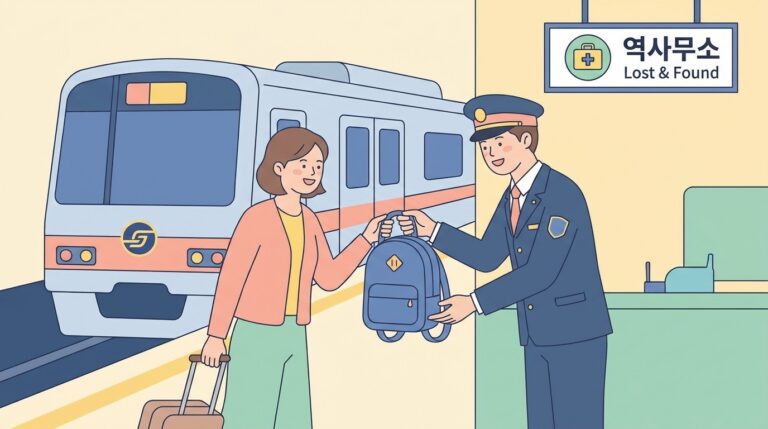
Phase 1: Empathy (A Heart-Dropping Moment on Line 2)
안녕하세요! 매일한글 에디터입니다! (Hello! I’m your Daily Hangul editor!)
Imagine this: You just spent an unforgettable evening in Hongdae, hopping between buzzing street performances, eating piping-hot tteokbokki, and singing your soul out at a coin noraebang. You hop on the green Line 2 subway train back to your hotel, feeling like the main character in your favorite K-drama. But as the train pulls away from your stop and the doors chime shut, your stomach drops.
Your tote bag—with your passport, hotel key, and that limited-edition K-pop photocard you waited two hours to buy—is still resting comfortably on the overhead metal rack inside the train car.
Before you panic or assume it’s gone forever, take a deep breath. Korea’s public transit system is legendary for its safety and civic honesty. In fact, thousands of lost items are cataloged every single day, waiting safely for their owners. But to get your item back, you need to navigate the system, communicate with station staff, and know the magic sentence: “신분증을 가지고 분실물 센터로 방문하시면 찾을 수 있어요” (You can pick it up by visiting the Lost and Found center with your ID).
This guide was built with real questions from our beginner students who faced this exact scare. By the end of this lesson, you will walk into any Seoul metro office with head-held-high confidence, ready to reclaim your belongings like a local!
Phase 2: Core 3 Expressions Deep Dive
1. 신분증 가지고 오셨어요? (Sinbunjeung gajigo osyeosseoyo?)
- Pronunciation: Sin-boon-jeung gah-jee-go oh-syeo-sso-yo? (Think of “sin” like in sincere, “boon” like moon with a ‘b’, and “jeung” rhymes with sung).
- Meaning: Literal: “Did you come having your ID card?” / Real Nuance: “Did you bring your identification?”
- K-Culture Moment: You’ll hear this in administrative K-drama scenes—like a detective in Signal verifying someone’s identity or a bank clerk asking a customer for verification.
- Editor’s Insight: “신분증” (sinbunjeung) refers to any official government ID. As an international traveler or resident, your foreign passport or Alien Registration Card (ARC) fits this perfectly. Notice “가지고 오다” (to bring / to come with)—a handy verb combo you’ll use constantly in daily Korean!
- Situation Spectrum: Casual: ⚠️ (Use ‘신분증 가져왔어?’ with friends) | Semi-formal: ✅ | Formal: ✅
- 🤔 Think About It: In many Western countries, people just say “Do you have your ID?” In Korean, it’s often framed around movement (“Did you come bringing it?”). Why do you think Korean often links actions with spatial movement verbs like 오다 (to come) and 가다 (to go)?
2. 분실물 센터가 어디에 있어요? (Bunsilmul senteoga eodie isseoyo?)
- Pronunciation: Boon-sheel-mool sen-teo-gah oh-dee-eh eess-oh-yo? (Sounds like boon-sheel-mool where ‘mul’ rhymes with bull).
- Meaning: Literal: “Where is the lost item center?” / Real Nuance: “Where is the Lost and Found?”
- K-Culture Moment: Think of wandering through the massive labyrinth of stations like Seoul Station or Express Bus Terminal—asking this gets you pointed in the right direction immediately by station staff.
- Editor’s Insight: “분실물” (bunsilmul) breaks down into Hanja roots: 紛 (disorder/lose) + 失 (lose) + 物 (thing). Another term you will see on signs is “유실물 센터” (yusilmul senteo). Both mean the exact same thing!
- Situation Spectrum: Casual: 🚫 (Sounds awkward to ask a stranger casually) | Semi-formal: ✅ | Formal: ✅
- 🤔 Think About It: Notice how “센터” (center) is a loanword from English, but “분실물” is pure Sino-Korean. Korean frequently balances traditional roots with modern loanwords—can you spot other words like this in your daily life?
3. 물건 찾으러 왔어요. (Mulgeon chajeureo wasseoyo.)
- Pronunciation: Mool-guhn chah-jeu-ruh wah-sso-yo. (‘Chajeu’ sounds like cha as in charm + jeu like the start of just).
- Meaning: Literal: “I came in order to find [my] thing.” / Real Nuance: “I’m here to pick up my lost item.”
- K-Culture Moment: A character walks into a dry cleaner or post office in a slice-of-life drama like Reply 1988 and says this exact phrase to claim their package.
- Editor’s Insight: The pattern -(으)러 오다/가다 means “to come/go in order to do something.” It is an essential A2 grammar cornerstone. If the verb ends in a consonant (like 찾다), attach -으러. If it ends in a vowel, attach -러.
- Situation Spectrum: Casual: ⚠️ (물건 찾으러 왔어) | Semi-formal: ✅ | Formal: ✅
- 🤔 Think About It: In English, we say “pick up” or “claim,” but Koreans say “find” (찾다). In Korean thinking, retrieving your item is an active continuation of your search until it is safely back in your hands!
Phase 3: Textbook Korean vs. Real Korean
Situation 1: Asking if anyone turned in your item
- 📖 Textbook Korean: 저의 잃어버린 가방이 여기에 있습니까? (Jeoui ileobeorin gabangi yeogie isseumnikka? – “Is my lost bag here?”)
- 🗣️ Real Korean: 혹시 가방 들어온 거 있나요? (Hoksi gabang deureoon geo innayo? – “By any chance, has a bag been turned in?”)
- 💡 Why the difference? Textbook phrasing sounds robotic and stiff. Real Koreans soften inquiries with “혹시” (by any chance) and use the active idiom “들어오다” (to come in / be received) when checking inventory.
Situation 2: Stating your reason for visiting the office
- 📖 Textbook Korean: 저는 분실물을 수령하기 위하여 방문했습니다. (Jeoneun bunsilmureul suryeonghagi wihayeo bangmunhaesseumnida. – “I visited in order to receive lost goods.”)
- 🗣️ Real Korean: 분실물 찾으러 왔는데요. (Bunsilmul chajeureo wanneundeyo. – “I came to pick up a lost item…”)
- 💡 Why the difference? Words like “수령” (formal receipt) belong in legal paperwork. In real speech, ending a sentence with “~는데요” gently trails off, inviting the officer to ask follow-up questions without sounding demanding.
Phase 4: K-Culture Deep Dive & Non-Verbal Manners
4-1. 눈치 (Nunchi) & Polite Gestures
When you step into a Seoul Metro Customer Service Center or Lost and Found office:
1. Two-Hand Rule (두 손): When handing over your passport or ID card, hold it with both hands or support your right wrist/forearm with your left hand. Doing this with one hand can appear careless or dismissive.
2. The Polite Nod: A slight 15-to-30-degree bow when greeting the officer instantly builds goodwill and shows respect for their assistance.
3. Clarity over Speed: Korean transit workers are remarkably efficient. Have your train details (which line, direction, approximate time, and car number—often marked as numbers like 4-2 on the train doors) typed out on your phone screen.
4-2. The “Cafe Laptop” Phenomenon & Transit Safety
You have probably seen viral TikToks of people in Seoul leaving their MacBooks and wallets unattended on cafe tables to go use the restroom. Korea boasts one of the lowest theft rates in the world, backed by extensive CCTV networks and a deep cultural mindset that considers stealing someone’s personal belongings shameful.
This same civic honor code applies to the subway. If you leave a bag on a train, it is usually handed directly to station staff by fellow passengers or collected during the train’s end-of-line sweep. However, reclaiming it requires strict protocol to ensure it returns to the rightful owner—which is why your ID is non-negotiable!
Phase 5: Real-Life Roleplay Scenario
Setting: City Hall Station (시청역) Lost and Found Center.
Characters:
* You (A2 Korean learner): Anxious but polite, holding your passport.
* Mr. Park (Subway Staff): Calm, wearing a navy Seoul Metro vest, sitting behind an organized wooden desk with logbooks.
Turn 1
* You: 🎭 Nods head respectfully while walking to the counter.
안녕하세요! 분실물 찾으러 왔는데요.
(Annyeonghaseyo! Bunsilmul chajeureo wanneundeyo.)
“Hello! I came to pick up a lost item…”
Turn 2
* Mr. Park: 🎭 Looks up from his computer screen with a gentle smile.
네, 안녕하세요. 어떤 물건 잃어버리셨어요?
(Ne, annyeonghaseyo. Eotteon mulgeon ileobeorisyeosseoyo?)
“Yes, hello. What kind of item did you lose?”
Turn 3
* You: 🎭 Shows a photo of the bag on your phone.
2호선에서 검은색 가방을 두고 내렸어요.
(I-hoseoneseon geomeunsaek gabangeul dugonaeryeosseoyo.)
“I left a black bag behind on Line 2.”
Turn 4
* Mr. Park: 🎭 Types on his keyboard and checks the shelf behind him.
아, 혹시 안에 파란색 지갑 들어있었나요?
(A, hoksi ane paransaek jigap deureoisseonnayo?)
“Ah, was there a blue wallet inside by any chance?”
Turn 5
* You: 🎭 Eyes light up with relief.
네! 맞아요! 파란색 지갑 있어요!
(Ne! Majayo! Paransaek jigap isseoyo!)
“Yes! That’s right! There is a blue wallet!”
Turn 6
* Mr. Park: 🎭 Retrieves the bag and places it on the desk counter.
다행이네요. 본인 확인을 위해 신분증 가지고 오셨어요?
(Dahaeng-ineyoyo. Bon-in hwagineul wihae sinbunjeung gajigo osyeosseoyo?)
“What a relief. Did you bring your ID for identity verification?”
Turn 7
* You: 🎭 Hands over your passport using both hands.
네, 여기 여권 있어요. 확인해 주세요.
(Ne, yeogi yeogwon isseoyo. Hwaginhae juseyo.)
“Yes, here is my passport. Please check it.”
Turn 8
* Mr. Park: 🎭 Checks the passport against the paperwork and hands back both item and passport.
확인되었습니다. 여기에 서명해 주시면 됩니다. 조심히 가세요!
(Hwagindoeeotseumnida. Yeogie seomyeonghae jusimyeon doemnida. Josimhi gaseyo!)
“Verified. You just need to sign here. Take care on your way!”
🔀 Interactive Decision Branch
What would you say if the officer asked for your ID, but you left your passport at the hotel?
- Choice A: “지금 신분증이 없는데, 사진으로 보여드려도 될까요?” (I don’t have my physical ID right now, could I show you a photo of it on my phone?)
- Feedback (Best!): Polite, offers a practical alternative while acknowledging the rule.
- Choice B: “신분증 없어요. 그냥 제 가방 주세요.” (I don’t have an ID. Just give me my bag.)
- Feedback (Bad!): Sounds blunt and demanding. Staff cannot legally hand over items without proof.
- Choice C: “가방 안에 제 이름 써 있으니까 열어보세요!” (My name is written inside the bag, so open it!)
- Feedback (Risky!): While understandable, it forces the officer to violate handling protocols unless you maintain a very polite tone.
Phase 6: 10-Second Emotion Shadowing Drill
Practice these lines out loud! Follow the pause markers (/) and channel the designated emotion:
[😰 긴장되고 간절하게 - Anxious and earnest]
저기요… / 지하철에 / 가방을 두고 내렸어요.
(Jeogiyo… / ji-ha-cheol-e / ga-bang-eul du-go nae-ryeo-sseo-yo.)
“Excuse me… / on the subway / I left my bag behind.”-
[😊 안도하며 정중하게 - Relieved and polite]
네! / 신분증 가지고 왔어요! / 여기 있습니다.
(Ne! / sin-bun-jeung ga-ji-go wa-sseo-yo! / yeo-gi ik-seum-ni-da.)
“Yes! / I brought my ID! / Here it is.” -
[🙏 깊이 감사하며 - Deeply grateful]
찾아주셔서 / 정말 감사합니다! / 수고하세요!
(Cha-ja-ju-syeo-seo / jeong-mal gam-sa-ham-ni-da! / su-go-ha-se-yo!)
“For finding it / thank you so much! / Have a good day!”
Phase 7: K-Culture Mini Dictionary
-
신분증 (Sinbunjeung)
Meaning: Identification Card.
Usage: Covers passports (여권), Alien Registration Cards (외국인등록증), or local driver’s licenses. Essential when dealing with government offices, banks, SIM cards, or lost property. -
분실물 (Bunsilmul) / 유실물 (Yusilmul)
Meaning: Lost item / Property left behind.
Usage: “분실물 센터” is the consumer-facing term, while legal notices often use “유실물”. Both are clearly signposted in subway transfer hubs. -
보관 (Bogwan)
Meaning: Storage / Safekeeping.
Usage: You’ll see this word at luggage locker stations (물품보관함) and lost property centers. Items are typically stored locally for a few days before being transferred to the police lost-and-found system. -
수령 (Suryeong)
Meaning: Collection / Receiving / Claiming.
Usage: Formal term used in SMS notifications informing you that your item is ready for pickup (“본인 수령 가능”).
Phase 8: Traveler’s Survival Kit
Survival Expressions TOP 3
- “제 가방 혹시 들어왔어요?” (Je gabang hoksi deureowasseoyo?)
Pro Tip: Use this over the phone or at the desk to check if your bag arrived. - “몇 시까지 운영해요?” (Myeot sikkaji un-yeong-haeyo?)
Pro Tip: Lost and found centers close earlier than normal subway service hours (usually around 6:00 PM on weekdays). - “여권으로 본인 확인 되나요?” (Yeogwoneuro bonin hwagin doenayo?)
Pro Tip: Confirms instantly if a foreign passport is acceptable for release.
Editor’s Travel Note
- Where to Look: Subway lines in Seoul are run by different operators! Lines 1-8 are managed by Seoul Metro, while Line 9 and Airport Railroad (AREX) have dedicated centers.
- Track Online: Search the nationwide police lost item system via the Lost112 National Police Lost and Found Portal or pinpoint nearby offices on the Naver Map Subway Station Guide.
- Keep That Transit Card: If you tapped your physical T-money card or credit card, note the exact exit gate and time. Station staff can pull the exact train car number you rode in within minutes!
Phase 9: “One Step Deeper” (Cultural Reflection)
In many global megacities, losing a wallet on a crowded train means saying goodbye to it forever. In Korea, however, recovering lost valuables is the expected norm rather than an exception. This phenomenon is rooted in a deeply interconnected communal conscience known as jeong (정) paired with modern digital transparency. Koreans view public spaces as an extension of shared civic trust: taking something that doesn’t belong to you brings a sense of personal moral discomfort.
💬 Your Turn: Have you ever lost a personal item while traveling abroad? How did your home country’s recovery process compare to Korea’s subway Lost and Found? Let’s chat in the comments below!
Phase 10: FAQ & Avoiding Misunderstandings
Q: Can I use a clear photo of my passport on my smartphone to claim an item?
A: While policies vary slightly by station manager, most subway centers strictly require physical ID (a real passport or ARC). If you only have a photo, explain that your physical passport is in your hotel, show your hotel key/booking confirmation, and be prepared to write down your hotel address.
Q: How long does the subway station keep lost items before transferring them?
A: Subway centers hold items for approximately 7 days. If unclaimed, items are transferred to the National Police Agency (경찰청), where they remain cataloged on the Lost112 database for up to 9 months before being auctioned or discarded.
Q: What if I lost my item late at night when the Lost and Found center is closed?
A: Go directly to the Customer Information Station (고객안내센터) at the subway station where you exited. Station attendants on duty can call the terminal station depot where your train terminates for the night.
🚨 Common Mistakes (흔한 실수) Warning Board
- Mistake: Searching randomly without knowing your train direction.
Correct Action: Note your starting station and destination station (e.g., “Line 2, heading toward Gangnam”). - Mistake: Waiting days before inquiring.
Correct Action: Ask within 2 hours! Trains get inspected at the final terminal stop after every route completion. - Mistake: Leaving without getting the direct phone number.
Correct Action: Ask the station master for the direct telephone extension of that specific line’s center before leaving.
Phase 11: Action Missions
- 🥉 Bronze Mission (Solo Practice): Say aloud three times: “신분증 가지고 분실물 센터로 갈게요” (I will go to the lost and found center with my ID).
- 🥈 Silver Mission (Social Share): Open your voice memo app, record the Phase 6 shadowing sentences, and post your pronunciation practice to Instagram Stories tagging
@DailyHangul! - 🥇 Gold Mission (Real or Imagined Challenge): Look up your nearest transit station on your phone map, identify where the “유실물센터” (Lost and Found) is located, and write down the subway line number in Korean.
- 🎮 K-Culture Mission: Watch a subway scene in any Korean drama (like Extraordinary Attorney Woo or My Liberation Notes) and try to spot the digital signs indicating station customer offices!
Phase 12: Interactive Quiz Challenge
Test your knowledge before you hit the train platforms!
1. Situation Judgment: You arrived at City Hall Lost and Found to pick up your airpods. Which phrase is the most natural way to explain your visit?
* A) 비행기 표 보여주세요. (Show me the airplane ticket.)
* B) 분실물 찾으러 왔어요. (I came to pick up a lost item.)
* C) 신분증을 버렸어요. (I threw away my ID.)
2. Fill-in-the-Blank: Complete the sentence with the correct particle meaning “in order to”:
“제 가방을 찾____ 왔어요.” (I came in order to find my bag.)
3. True or False: Subway lost-and-found offices keep your lost items indefinitely for multiple years.
* [True / False]
👉 Click to view answers and explanations!
- Answer: B (분실물 찾으러 왔어요). Option A means asking for a plane ticket, and Option C means you threw your ID away!
- Answer: -으러 (찾으러). Since the verb stem “찾-” ends in a final consonant (받침), we attach “-으러”.
- Answer: False. Subways store items for about 7 days before transferring them to the National Police Lost and Found facility.
🎬 Watch Our Daily Videos! (Daily Hangul Official Instagram)
Review the expressions you learned in this article with our fun daily short videos! Check out native pronunciation and real-life nuances in action.
- Instagram @dailyhangul_en







