

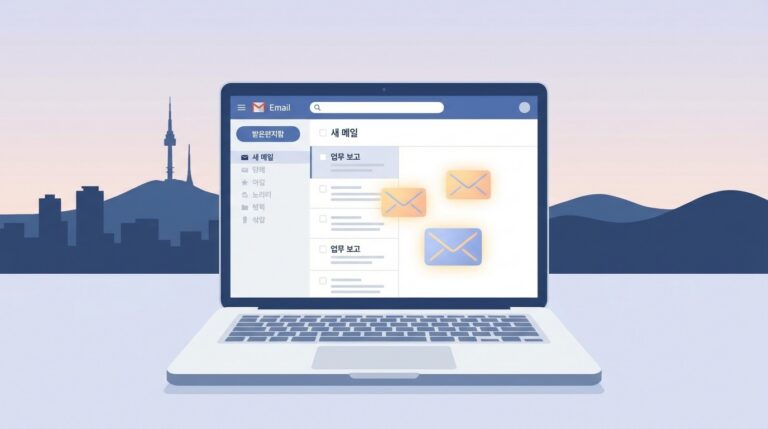
Master Korean Business Email Etiquette: The Lifesaving Power of BCC (숨은참조)
Phase 1: Empathy (Story-Driven Opening)
안녕하세요! 매일한글 에디터입니다. (Hello! I’m your Daily Hangul editor.)
Picture this: You just landed your dream position at a trendy tech agency in Pangyo, Korea’s Silicon Valley. It’s Friday afternoon, 5:40 PM. Your team leader asks you to send out a tender announcement regarding next quarter’s project to twenty rival subcontracting vendors. You carefully draft the text, attach the files, copy and paste all twenty vendor email addresses straight into the “To” (수신) field, and hit Send. Five seconds later, an icy silence falls over the office. Your team leader’s eyes widen in horror: you’ve just exposed every single competing vendor’s private contact details to each other in one single click. If this were an episode of Misaeng (미생) or Agency (대행사), this would be the dramatic cliffhanger right before the commercial break!
In the fast-paced, high-stakes Korean corporate world, email missteps aren’t just minor typos; they directly affect professional trust and can even violate strict personal data laws (개인정보보호법). Today, we’re unpacking the critical etiquette of 참조 (CC) and 숨은참조 (BCC), giving you the polished phrasing and cultural radar (눈치) needed to communicate like a seasoned Korean professional.
Phase 2: Core Phrases Top 3 In-Depth Analysis
1. 개인정보 보호를 위해 숨은참조(BCC)로 발송해 드립니다.
- Pronunciation: [Gae-in-jeong-bo bo-ho-reul wi-hae sum-eun-cham-jo-ro bal-song-hae deu-rim-ni-da] (Pronunciation tip: Gae-in rhymes with ‘rain’, wi-hae sounds like ‘we-hay’, and sum-eun flows like ‘soom-oon’.)
- Meaning: Literal: “For the protection of personal information, I am sending this via hidden reference (BCC).” / Real Nuance: “Heads up: I am deliberately using BCC to protect everyone’s private contact information, so please don’t be alarmed that you cannot see other recipients.”
- K-Culture Moment: Seen frequently in agency dramas like Search: WWW when PR leads send mass press releases or RFP notices to external journalists without revealing their private rosters.
- Editor’s Insight: Korean business culture values explicit courtesy. Rather than silently sending a mass email via BCC, writing this sentence at the very top of your email preempts confusion and shows high-level consideration (배려).
- Situation Spectrum: Casual 🚫 | Semi-formal ⚠️ | Formal ✅
- 🤔 Think About It: In your home country, is it customary to explicitly state that you are using BCC in the email body, or is it considered self-evident?
2. 업무에 혼선을 드리지 않도록 관련 부서를 참조에 포함하였습니다.
- Pronunciation: [Eom-mu-e hon-seon-eul deu-ri-ji an-to-rok gwan-ryeon bu-seo-reul cham-jo-e po-ham-ha-yeot-seum-ni-da] (Think: Eom-mu sounds like ‘Uhm-moo’, hon-seon like ‘hone-sun’.)
- Meaning: Literal: “I included the relevant department in reference so as not to give confusion to the work.” / Real Nuance: “I’ve looped in the related team in CC to keep everyone on the same page and prevent miscommunication.”
- K-Culture Moment: This is the bread and butter of daily corporate life depicted in Misaeng. Whenever rookie worker Jang Geu-rae loops in Manager Oh, he uses this humble yet bulletproof sentence.
- Editor’s Insight: Notice the use of
혼선을 드리다(to cause confusion, using the humble auxiliary verb 드리다). It shows ownership while gracefully explaining why extra people are tagged. - Situation Spectrum: Casual 🚫 | Semi-formal ✅ | Formal ✅
- 🤔 Think About It: Why does Korean corporate communication prefer passive and deferential terms like
혼선을 줄이기 위해over direct expressions like정보 공유를 위해?
3. 수신인 정보 보호 차원에서 개별 발송 처리되었습니다.
- Pronunciation: [Su-sin-in jeong-bo bo-ho cha-won-e-seo gae-byeol bal-song cheo-ri-doe-eot-seum-ni-da] (Pronunciation tip: Su-sin-in sounds like ‘Soo-sheen-een’, cheo-ri like ‘chuh-ree’.)
- Meaning: Literal: “From the perspective of recipient information protection, individual sending processing has been done.” / Real Nuance: “This notice has been batched individually/via BCC to safeguard client privacy.”
- K-Culture Moment: Commonly spotted in system notification emails from major Korean portals (Naver, Kakao) or university administrative offices informing foreign exchange students of scholarship results.
- Editor’s Insight: The phrase
~ 차원에서(from the dimension/standpoint of…) instantly elevates your writing to B2/C1 executive-level Korean. - Situation Spectrum: Casual 🚫 | Semi-formal ⚠️ | Formal ✅
- 🤔 Think About It: How does institutional phrasing like
~처리되었습니다build customer trust compared to active, personal phrasing?
Phase 3: Textbook Korean vs. Real Korean
Situation 1: Telling a colleague you looped them into an email thread
- 📖 교과서 한국어 (Textbook Korean): 저는 김 대리를 이메일에 참조했습니다. (Jeoneun Kim daerireul imeire chamjohaesseumnida. / “I referenced Assistant Manager Kim in the email.”)
- 🗣️ 진짜 한국어 (Real Korean): 김 대리님 참조로 넣어서 메일 회신드렸습니다. (Kim daerinim chamjoro neoheoseo meil hoesindeuryeosseumnida. / “I replied to the email with Assistant Manager Kim looped in on CC.”)
- 💡 왜 다를까?: In real Korean offices, nobody says
김 대리를 참조했다(which drops the indispensable title님and sounds robotic). Instead, Koreans use the lively corporate idiom참조로 넣다(to insert as CC) paired with the humble verb회신드리다(to reply back).
Situation 2: Informing your team why you hid client contacts
- 📖 교과서 한국어 (Textbook Korean): 비밀 유지를 위해 숨은참조를 썼습니다. (Bimil yujireul wihae sum-eunchamjoreul sseosseumnida. / “I used hidden reference to maintain confidentiality.”)
- 🗣️ 진짜 한국어 (Real Korean): 업체 리스트 노출 방지 차원에서 숨은참조 걸어뒀습니다. (Eopche riseuteu nochul bangji cha-woneseo sum-eunchamjo georeodwotseumnida. / “I set them on BCC to prevent exposing the vendor list.”)
- 💡 왜 다를까?: While
비밀 유지(maintaining secrecy) sounds like you’re handling classified military espionage,노출 방지 차원(preventing exposure) is professional corporate language. Koreans naturally say숨은참조를 걸다(to set BCC).
Phase 4: K-Culture Deep Dive & Non-Verbal Etiquette
4-1. Nunchi (눈치) & Email Posture: The Art of the CC Hierarchy
In Korea, hierarchy does not vanish behind digital screens; it becomes magnified. When you add multiple internal colleagues to 참조 (CC), the order matters immensely! Standard Nunchi rule: list recipients from highest organizational rank down to the lowest (e.g., 상무님 Executive Director → 팀장님 Team Leader → 과장님 Section Chief → 대리님 Assistant Manager). Putting your intern before your director can ruffle feathers in traditional conglomerates (Chaebol).
Furthermore, avoid the nightmare known as 전체 답장 (Reply All) unless strictly necessary. Replying all to a company-wide announcement will trigger collective collective sighs across the entire floor.
4-2. Cultural Code: The Horror of the “메일 참사” (Email Disaster)
Korean media loves portraying office blunders where a rookie mistakenly sends an unvetted vendor pitch using CC rather than BCC. Due to the strict enforcement of the Personal Information Protection Act in South Korea, inadvertently sharing vendor email addresses can lead to formal corporate apologies, blacklisting, and compliance hearings. Mastering 숨은참조 (BCC) is literally your shield against corporate disaster.
Phase 5: Real-World Roleplay Scenario
Setting: Friday afternoon at Mirae Creative, an advertising agency in Gangnam. Min-jun (Assistant Manager, your mentor) is reviewing your draft before you send out a project tender to five competing photography studios.
- 민준 (Min-jun):
지수 씨, 다음 분기 룩북 촬영 입찰 공지 메일 다 작성했어요?(Jisu ssi, daeum bungi rukbuk chwaryeong ipchal gongji meil da jakseonghaesseoyo?)
🎭 Checking his wristwatch while peering over your shoulder.
“Jisu, have you finished drafting the tender announcement email for next quarter’s lookbook shoot?” -
지수 (You):
네, 민준 대리님. 본문 검토 마치고 이제 막 발송하려던 참입니다.(Ne, Minjun daerinim. Bonmun geomto machigo ije mak balsongharyeodeon cham-imnida.)
🎭 Pointing your cursor proudly at the ‘Send’ button.
“Yes, Assistant Manager Min-jun. I finished reviewing the body text and was just about to hit send.” -
민준 (Min-jun):
잠깐만요! 스톱! 수신란에 다섯 개 스튜디오 이메일 주소를 다 직접 넣은 건가요?(Jamkkanmanyo! Seutop! Susinrane daseot gae seutyudio imeil jusoreul da jikjeop neoeun geongayo?)
🎭 Eyes widening in sudden panic, holding his hand up.
“Wait a second! Stop! Did you put all five studios’ email addresses directly into the ‘To’ field?” -
지수 (You):
앗... 공지 메일이라 한 번에 확인하시라고 수신에 다 넣었는데요...(At… gongji meirira han beone hwaginhasirago susine da neoeonneundeyo…)
🎭 Shrinking back slightly as your fingers freeze over the mouse.
“Ah… since it’s an announcement, I put them all in ‘To’ so they could check it at once…” -
민준 (Min-jun):
경쟁 업체들끼리 서로 메일 주소가 다 노출되면 큰일 나요! 이건 무조건 숨은참조로 돌려야 해요.(Gyeongjaeng eopchedeulkkiri seoro meil jusoga da nochuldoemyeon keunil nayo! Igeon mujogeon sum-eunchamjoro dollyeoya haeyo.)
🎭 Patting his chest in relief that you hadn’t pressed send yet.
“If competing agencies see each other’s email addresses, we’re in big trouble! This must strictly be sent via BCC.” -
지수 (You):
아, 그렇군요! 그럼 수신자 정보 보호 문구도 메일 본문에 추가하겠습니다.(A, geureokgunyo! Geureom susinja jeongbo boho munggu-do meil bonmune chugahagessumnida.)
🎭 Nodding briskly and quickly opening the edit window.
“Ah, I see! Then I will also add the recipient privacy clause into the email text.” -
민준 (Min-jun):
맞아요. 그렇게 써두면 상대방도 '아, 숨은참조로 왔구나' 하고 안심하거든요. 센스 굿!(Majayo. Geureoke sseodumyeon sangdaebangdo ‘a, sum-eunchamjoro watguna’ hago ansimhageodeunyo. Senseu gut!)
🎭 Giving an approving thumbs-up with a proud smile.
“Exactly. If you write that down, the recipient feels reassured, thinking, ‘Ah, it was sent via BCC.’ Great business sense!” -
지수 (You):
수정 완료했습니다! 본문에 '개인정보 보호를 위해 숨은참조로 발송해 드립니다' 넣었습니다.(Sujeong wanryeohaesseumnida! Bonmune ‘gaeinjeongbo bohoreul wihae sum-eunchamjoro balsonghae deurimnida’ neoeotseumnida.)
🎭 Smiling with newfound confidence.
“Changes complete! I added: ‘For personal information protection, this is sent via BCC.'”
🔀 Interactive Branching Choice
What should Jisu put in the “To” (받는사람) field when all external vendors are moved to BCC?
- Choice A: Put your own work email (or the team announcement address) in “To” and place all vendors in “BCC”.
- Choice B: Leave the “To” field completely blank and only fill the “BCC” field.
- Choice C: Pick the most prominent vendor and put them in “To”, then place the other 4 vendors in “BCC”.
Decision Feedback:
* Choice A (Best): 🏆 Perfect! Many enterprise mail servers reject emails with a blank recipient field as spam. Putting your own address in “To” ensures safe delivery while keeping everyone anonymous.
* Choice B (Risk): ⚠️ Dangerous. Some email systems will automatically mark emails without a main recipient as spam or refuse delivery entirely.
* Choice C (Bad): ❌ Catastrophic! That one chosen vendor will see their name front and center, while the other vendors will wonder why they are secretly lurking behind that specific competitor.
Phase 6: 10-Second Emotion Shadowing Drill
Practice reading these lines aloud with the appropriate cadence and emotion:
[💼 정중하고 단호하게 - Professional & Reassuring]
개인정보 보호를 위해 / 숨은참조로 발송해 드립니다.
(Gae-in-jeong-bo bo-ho-reul wi-hae / sum-eun-cham-jo-ro / bal-song-hae deu-rim-ni-da.)-
[🤝 정중하게 안내하며 - Polite looping in]
원활한 업무 조율을 위해 / 유관 부서를 참조에 포함하였습니다.
(Won-hwal-han eom-mu jo-yul-eul wi-hae / yu-gwan bu-seo-reul / cham-jo-e po-ham-ha-yeot-seum-ni-da.) -
[😅 식은땀 닦으며 다행스러워하듯 - Relieved recovery]
발송 직전에 확인해서 / 메일 참사를 막았어요!
(Bal-song jik-jeon-e hwa-gin-hae-seo / me-il cham-sa-reul / ma-gat-seo-yo!)
Phase 7: K-Culture Mini Dictionary
- 숨은참조 (Sum-eun-cham-jo) | Noun | Blind Carbon Copy (BCC). Literally translates to “hidden reference.” Essential when emailing multiple external parties or vendors.
- 참조 (Cham-jo) | Noun | Carbon Copy (CC). Literally “reference.” Used to keep stakeholders informed without demanding direct action.
- 전체 답장 (Jeon-che dap-jang) | Noun | Reply All. A function that requires high Nunchi; accidental usage is a frequent meme in Korean corporate comedy.
- 메일 참사 (Me-il cham-sa) | Noun | Email disaster/catastrophe. Slang used by modern white-collar workers for embarrassing email errors (e.g., exposed CC lists, unsent attachments, or rogue typos to executives).
Phase 8: Expat & Professional Survival Kit
Top 3 Business Email Phrases
본 메일은 수신 전용 메일입니다.(Bon meireun susin jeonyong meirimnida. / “This email is for incoming announcements only.”)
Pro Tip: Perfect for automatic mass notifications.참조 담당자님, 검토 부탁드립니다.(Chamjo damdangjanim, geomto butakdeurimnida. / “Colleagues in CC, please review at your convenience.”)
Pro Tip: Polished callout to loop-ins.혹시 모를 혼선을 방지하고자 공유드립니다.(Hoksi moreul honseoneul bangjihagoja gongyudeurimnida. / “Sharing this to prevent any potential miscommunication.”)
Pro Tip: The ultimate polite justification for broad CC additions.
Editor’s Travel & Expat Note
If you work with Korean clients, setting up an account on Korean web portals can be helpful. You can refer to the official 네이버 메일 서비스 소개 (Naver Mail Web Portal) to familiarize yourself with terms like 받는사람 (To), 참조 (CC), and 숨은참조 (BCC). In Naver and Daum/Kakao mail, the BCC field is usually folded by default—click the tiny arrow next to 참조 to reveal 숨은참조 before sending bulk inquiries!
Phase 9: A Step Deeper (한 발 더 깊이)
Korean business correspondence reflects the delicate balance between Jeong (정 – communal unity) and Gyeokshik (격식 – formal propriety). While Korean workplace culture thrives on collective teamwork where keeping everyone informed through CC is praised, external relations demand strict protection of corporate boundaries. Exposing a client’s email address is seen not just as a technical slip, but as a breach of corporate modesty and respect (예의). By deliberately writing that you’ve used BCC out of respect for their privacy, you show that you possess both technical competence and deep interpersonal refinement.
💬 Your Turn: Have you ever received an email where the sender accidentally exposed everyone’s private addresses in CC? How would your boss react if that happened at your company? Share your thoughts below!
Phase 10: FAQ & Common Mistakes
Q: Can I just leave the “To” field empty when using BCC in Korea?
A: Technically yes on some clients, but it is considered poor etiquette and frequently triggers aggressive spam filters in Korean corporate domains (like @samsung.com or @naver.com). Always insert your own company email or an official distribution list in the “To” field, and put your external partners in BCC.
Q: How do I address multiple vendors if they are all in BCC?
A: Since individual names won’t be visible to each other, use inclusive, respectful collective titles such as: 협력사 담당자님들께 (To our valued partner representatives) or 거래처 관계자 여러분께 (To all involved business partners).
Q: What is the difference between “참조 (CC)” and “숨은참조 (BCC)” in terms of follow-up etiquette?
A: In 참조 (CC), looped-in colleagues are expected to observe the communication without replying directly unless specifically addressed. In 숨은참조 (BCC), the hidden party must never hit “Reply All,” as doing so immediately reveals that they were secretly observing the conversation!
🚨 Common Mistakes Warning Board
- Mistake: Putting external rival vendors in CC so they can see each other’s addresses.
Correct Action: Always put multiple external vendors in 숨은참조 (BCC) and note it in the body. - Mistake: Forgetting to add honorifics to colleagues listed in email text (
김 대리 참조❌).
Correct Action: Always use their workplace title plus 님 (김 대리님 참조✅). - Mistake: Hitting “전체 답장 (Reply All)” when merely saying “감사합니다 (Thank you).”
Correct Action: Reply solely to the sender unless everyone on the thread genuinely requires your confirmation.
Phase 11: Action Missions
- 🥉 Bronze Mission (Solo Practice): Open your email client. Draft an imaginary tender email in Korean and locate the hidden BCC button. Write down the phrase:
개인정보 보호를 위해 숨은참조(BCC)로 발송해 드립니다. - 🥈 Silver Mission (Social Share): Share this phrase on your language learning social media or flashcards (Quizlet/Anki) and record yourself practicing the cadence with our Phase 6 shadowing drill.
- 🥇 Gold Mission (Real-World Execution): The next time you email multiple Korean contacts (classmates, vendors, or event participants), successfully place them in BCC and include an opening courtesy disclaimer!
- 🎮 K-Culture Mission: Watch an episode of a Korean office drama (like Misaeng, Gaus Electronics, or Agency). Listen closely for the word
참조(CC) or회신(reply) during their frantic office scenes!
Phase 12: Interactive Quiz Challenge
Quiz 1: Situational Judgment
You need to send an urgent schedule change notice to 10 independent freelance graphic designers who do not know each other. Which method is the most professional?
* A) Put all 10 designers in “To” (받는사람) so they see who is participating.
* B) Put your own project email in “To”, add all 10 designers in “BCC” (숨은참조), and write a notice in the email body stating that BCC was used for privacy.
* C) Send 10 individual emails manually one by one without mentioning anything.
👉 Click to see the answer and explanation
Correct Answer: B
Explanation: Putting all recipients in BCC protects their personal contact information from being leaked to competitors, and adding the polite disclaimer prevents any confusion. Option C is technically safe but excessively time-consuming.
Quiz 2: Fill in the Blank
Complete this natural corporate sentence used when looping in your team leader on an email thread:
“업무에 혼선을 드리지 않도록 팀장님을 _________에 포함하였습니다.”
* A) 답장 (Dap-jang)
* B) 수신인 (Su-sin-in)
* C) 참조 (Cham-jo)
👉 Click to see the answer and explanation
Correct Answer: C) 참조 (Cham-jo / CC)
Explanation: The phrase 참조에 포함하였습니다 (I have included [someone] in CC) is the gold standard of professional Korean email correspondence.
Quiz 3: True or False Cultural Manners
Question: In Korean corporate culture, it is considered polite to hit “전체 답장 (Reply All)” to simply say “네, 알겠습니다 (Yes, understood)” to show your team leader and all departments that you read the memo.
* A) True
* B) False
👉 Click to see the answer and explanation
Correct Answer: B (False)
Explanation: Hitting ‘Reply All’ for simple one-line acknowledgments clutters everyone’s inboxes and is considered poor digital etiquette (눈치 없는 행동). Only reply directly to the sender unless specifically instructed otherwise.
🎬 Watch Our Daily Videos! (Daily Hangul Official Instagram)
Review the expressions you learned in this article with our fun daily short videos! Check out native pronunciation and real-life nuances in action.
- Instagram @dailyhangul_en







