

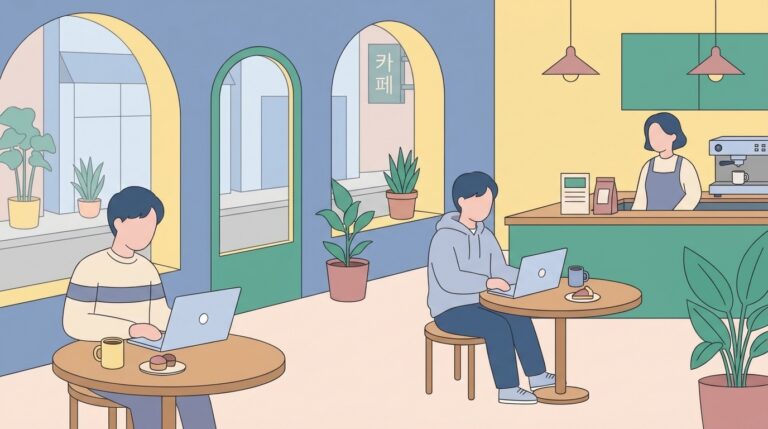
Phase 1: Empathy (Welcome to the Third Space)
안녕하세요! Welcome back to Daily Hangul! I’m your local culture navigator and Korean bestie. Picture this: You step into a sunlit three-story cafe in Hongdae on a weekday afternoon. You expect the quick sip-and-go vibe from back home, but instead, you see rows of college students with dual monitors, friends sharing croffles in cozy booths, and remote workers settled in with their chargers plugged into dedicated desk sockets. You find an empty table, but there is an open laptop and a wallet sitting right there with nobody around. You freeze. Can I sit here? Is this a library or a coffee shop? How long am I even allowed to stay?
If you’ve ever felt intimidated entering a buzzing Korean cafe, take a deep breath. For Koreans, a cafe is never just a spot for a caffeine fix. It is the ultimate 제3의 공간 (Je-sam-ui gong-gan – Third Space)—a vital sanctuary distinct from tiny studio apartments and high-stress workplaces. Over the past decade of coaching Korean learners, I’ve seen students order takeout in broken phrases and rush out, missing the very heart of modern Korean social life. This guide will give you the cultural decoding and natural B1-level Korean you need to claim your corner, study, recharge, and blend right in like a seasoned local.
Phase 2: Core Expressions in Depth
Here are three essential expressions that will immediately elevate your Korean cafe experience from an awkward tourist to a savvy insider.
1. 카공하기 좋은 카페예요. (Kagonghagi joeun kapeyeyo.)
- Pronunciation: [Kagonghagi joeun kapeyeyo] (Think: “Kah-gong-hah-gee jo-eun kah-peh-yeh-yo”)
- Meaning: Literal: “It’s a cafe good for doing kagong.” / Real Nuance: “This cafe has the perfect vibe, desk setup, and quiet atmosphere for studying or remote work.”
- K-Culture Moment: Seen frequently in slice-of-life K-Dramas like Crash Course in Romance or YouTube study vlogs where university students scout out neighborhood hangouts before midterms.
- Editor’s Insight: 카공 (Kagong) is a trendy portmanteau blending 카페 (Cafe) and 공부 (Study). Calling a venue “카공하기 좋은 곳” shows you appreciate its specific ambient lighting, outlet density, and low-tempo playlist.
- Situation Spectrum:
- Casual (Friends): ✅ 카공하기 딱 좋다! (Kagonghagi ttak jota!)
- Semi-formal (Polite): ✅ 카공하기 좋은 카페예요. (Kagonghagi joeun kapeyeyo.)
- Formal (Business/Staff): ⚠️ (Too colloquial for formal business presentations, use ‘학습하기 적합한 공간’)
- 🤔 Think About It: In many Western cultures, studying for four hours on a single coffee might draw irritated glares from servers. Why do you think Korea developed an entire subculture and vocabulary around studying in commercial cafes?
2. 콘센트 있는 자리 있어요? (Konsenteu inneun jari isseoyo?)
- Pronunciation: [Konsenteu inneun jari isseoyo?] (Think: “Cone-sen-teu een-neun jah-ree ee-ssuh-yo?”)
- Meaning: Literal: “Is there a seat that has a consent?” / Real Nuance: “Are there any seats available with accessible power outlets?”
- K-Culture Moment: You walk into a modern franchise like A Twosome Place or Hollys Coffee during rush hour and gently ask the barista before placing your drink order.
- Editor’s Insight: 콘센트 (Konsenteu) comes from “concentric plug,” a classic Konglish term for an electrical wall outlet. Asking this before ordering prevents the tragedy of buying a latte only to realize your laptop battery is on 3% with no outlet in sight.
- Situation Spectrum:
- Casual: ✅ 콘센트 자리 있어? (Konsenteu jari isseo?)
- Semi-formal: ✅ 콘센트 있는 자리 있어요? (Konsenteu inneun jari isseoyo?)
- Formal: ✅ 콘센트가 구비된 좌석이 있습니까? (Konsenteuga gubidoen jwaseogi itseumnikka?)
- 🤔 Think About It: Does your home country cater to digital nomads with outlets at almost every cafe table, or is cafe culture strictly about conversation and disconnecting?
3. 매장에서 마시고 갈게요. (Maejang-eseo masigo galgeyo.)
- Pronunciation: [Maejang-eseo masigo galgeyo] (Think: “Meh-jahng-eh-suh mah-she-go gahl-geh-yo”)
- Meaning: Literal: “I will drink inside the store and go.” / Real Nuance: “For here, please.” (Signaling you want a reusable mug and plan to stay a while.)
- K-Culture Moment: South Korean environmental laws strictly forbid disposable single-use plastic cups for dine-in guests. When baristas ask “드시고 가세요? (Deusigo gaseyo? – Having it here?)”, this is your smooth native response.
- Editor’s Insight: Saying simply “여기서 먹을게요 (Yeogiseo meogeulgeyo)” is okay, but using 매장 (maejang – store interior) sounds natural, polite, and displays great intermediate Korean mastery.
- Situation Spectrum:
- Casual: ✅ 먹고 갈래. (Meokgo gallae.)
- Semi-formal: ✅ 매장에서 마시고 갈게요. (Maejang-eseo masigo galgeyo.)
- Formal: ✅ 매장 내에서 이용하겠습니다. (Maejang nae-eseo iyonghagetseumnida.)
- 🤔 Think About It: Notice how Korean distinguishes between eating food (먹다) and drinking liquids (마시다) even when specifying dine-in options. How does your language differentiate sit-down versus to-go orders?
Phase 3: Textbook Korean vs. Real-World Korean
| Situation | 📖 Textbook Korean | 🗣️ Real-World Korean | 💡 Why the Difference? |
|---|---|---|---|
| 1. Asking to sit & study | 여기서 공부해도 됩니까? (Yeogiseo gongbuhaedo doemnikka? – May I study here?) | 혹시 노트북 하기 편한 자리 있을까요? (Hoksi noteubuk hagi pyeonhan jari isseulkkayo? – Is there a comfortable spot for laptop work?) | Asking “May I study?” sounds stiff and puts the staff on the spot. Asking for a laptop-friendly seat is casual, polite, and immediately understood. |
| 2. Finding the WiFi info | 와이파이 비밀번호를 가르쳐 주십시오. (Waipai bimilbeonhoreul gareuchyeo jusipsio. – Please teach me the WiFi password.) | 영수증에 와이파이 적혀 있나요? (Yeongsujeunge waipai jeokhyeo innayo? – Is the WiFi printed on the receipt?) | Most Korean cafes print WiFi passwords directly on receipts or tape them beside the pickup counter. Asking directly about the receipt shows local know-how! |
Phase 4: K-Culture Deep Dive & Non-Verbal Manners
4-1. Nunchi & Cafe Etiquette (눈치 센스)
- The Laptop ‘Seat Reservation’ Ritual: You will often see Koreans leave expensive MacBooks, wallets, or padded parkas on a table before walking up to order at the counter. While Korea’s personal property safety is legendary, exercise sensible 눈치 (Nunchi): never block an 8-person communal table if you are working alone with one small tablet.
- The 1-Drink-Per-Person Rule (1인 1음료): Almost every independent and chain cafe strictly enforces this. If three of you enter, you must purchase three beverages or individual desserts. Planning to study for more than 3–4 hours? The polite local convention is to order a second drink or a pastry as a courtesy to the owner.
- Tray Return Courtesy (반납대 매너): Leaving dirty mugs on the table when exiting is a major social faux pas. Always locate the 반납대 (Bannapdae – Return Station), separate your trash, and return your tray to the counter with a quick, polite nod.
4-2. Culture Code: The Cafe as the Urban Living Room
Why did Korea become the cafe capital of the world, with over 100,000 cafes nationwide? In dense metropolitan centers like Seoul, many young adults live in compact studio apartments (원룸 – wonroom) or stay with parents until marriage. Cafes evolved as an accessible, beautifully curated extension of personal space. Whether it’s an unmanned robotic cafe (무인 카페) running 24/7 or a multi-story mega bakery cafe in suburban Gyeonggi-do offering river views and fresh salt bread, cafes are Korea’s emotional pressure valve where people work, date, read, and heal.
Phase 5: Real-World Roleplay Scenario
Setting: Cafe Haru, a calm, aesthetic cafe in Yeonnam-dong filled with greenery and lo-fi beats.
Character: Barista Minho (friendly, stylish apron, professional).
- 민호 (Minho): 어서 오세요! 주문 도와드릴까요?
(Eoseo oseyo! Jumun dowadeurilkkayo?)
“Welcome! May I help you order?”
🎭 Smiles warmly while tapping the touchscreen POS. -
나 (Me): 안녕하세요! 혹시 안쪽에 콘센트 있는 자리 있어요?
(Annyeonghaseyo! Hoksi anjjoge konsenteu inneun jari isseoyo?)
“Hello! By any chance, are there seats inside with power outlets?”
🎭 Peeks gently past the counter toward the inner study zone. -
민호 (Minho): 네, 안쪽 창가 테이블 아래에 콘센트 마련되어 있습니다!
(Ne, anjjok changga teibeul araee konsenteu maryeondoeeo itseumnida!)
“Yes, power outlets are provided under the inner window tables!” -
나 (Me): 다행이네요. 아이스 아메리카노 한 잔이랑 소금빵 하나 주세요.
(Dahaeng-ineyyo. Aiseu amerigano han jan-irang sogeumbbang hana juseyo.)
“What a relief. One Iced Americano and one salt bread, please.” -
민호 (Minho): 매장에서 드시고 가시나요, 아니면 포장이실까요?
(Maejang-eseo deusigo gasinayo, animyeon pojang-isilkkayo?)
“Will you be enjoying it in-store, or is it for takeout?” -
나 (Me): 매장에서 마시고 갈게요!
(Maejang-eseo masigo galgeyo!)
“I’ll drink it here in the store!” -
민호 (Minho): 영수증 밑에 와이파이 비밀번호랑 화장실 비밀번호 나와 있습니다. 진동벨 울리면 가지러 와주세요.
(Yeongsujeung mite waipai bimilbeonhorang hwajangsil bimilbeonho nawa itseumnida. Jindongbel ullimyeon gajireo wajuseyo.)
“The WiFi and restroom passcodes are printed at the bottom of your receipt. Please pick up your order when the buzzer rings.” -
나 (Me): 네, 감사합니다! 맛있게 먹을게요.
(Ne, gamsahamnida! Masitge meogeulgeyo.)
“Yes, thank you! I’ll enjoy it.”
🎭 Takes the receipt and the buzzer (진동벨) with both hands.
🔀 Interactive Decision Branch
You’ve been studying at your table for 3.5 hours. Your laptop is full, but your iced coffee has been empty for an hour. What do you do?
- Option A: Continue sitting there for another 3 hours without ordering anything else; after all, you paid for a drink.
👉 Review (Risk): While staff rarely kick people out directly, staying over 4 hours on a single 5,000-won coffee violates Korean cafe courtesy and causes silent friction with owner-operated shops. - Option B: Order a fresh hot tea or a pastry at the counter to show courtesy before settling in for another study sprint.
👉 Review (Best): 100점! (Perfect score!) This is the quintessential 센스 (sense) move that cafe owners appreciate. You respect their business while keeping your study haven guilt-free. - Option C: Pack up your things, ask the staff for a free disposable cup refill, and leave abruptly.
👉 Review (Bad): Free coffee refills virtually disappeared from Korean cafes a decade ago, and disposable cup regulations make this an awkward request!
Phase 6: 10-Second Emotion Shadowing Drill
Practice these lines out loud! Follow the rhythm / pauses and channel the emotion markers:
[😊 밝고 공손하게 - Bright and polite]
저기요, / 혹시 콘센트 있는 자리 / 아직 남아있나요?
(Jeogiyo, / hoksi konsenteu inneun jari / ajik namaitnayo?)
“Excuse me, / by any chance are there seats with outlets / still left?”-
[☕ 여유롭고 명확하게 - Relaxed and clear]
테이크아웃 아니고요, / 매장에서 마시고 갈게요!
(Teikeu-aut anigoyo, / maejang-eseo masigo galgeyo!)
“Not takeout, / I’ll be drinking it inside the store!” -
[🤝 배려 넘치고 다정하게 - Thoughtful and considerate]
오래 머물러서, / 음료 한 잔 더 / 주문할게요.
(Orae meomulleoseo, / eumryo han jan deo / jumunhalgeyo.)
“Since I’ve stayed a while, / I’ll order / one more drink.”
Phase 7: K-Culture Mini Dictionary
| No. | Word (Hangul + Romanization) | English Meaning | Real-Life Context & Nuance |
|---|---|---|---|
| 1 | 카공족 (Kagongjok) | Cafe studier tribe | People who treat cafes as offices or study halls; a frequent topic of debate in Korean media regarding cafe table turnover. |
| 2 | 제3의 공간 (Je-sam-ui gong-gan) | The Third Space | Sociological term beloved in Korea describing places outside home (1st) and school/office (2nd) where you decompress. |
| 3 | 대형 베이커리 카페 (Daehyeong beikeori kape) | Mega Bakery Cafe | Massive suburban multi-story cafes boasting artisan breads, botanical gardens, and scenic photo zones. |
| 4 | 무인 카페 (Muin kape) | Unmanned / Self-serve Cafe | 24-hour automated cafes equipped with automated espresso dispensers and automated kiosk systems. |
Phase 8: Survival Kit for Travelers
Top 3 Survival Expressions
- 진동벨 울리면 갈게요. (Jindongbel ullimyeon galgeyo.)
“I’ll come pick it up when the buzzer rings.”
Pro Tip: Korean buzzers (진동벨) have great range; feel free to secure your second-floor seat first! - 와이파이 비밀번호 좀 알려주세요. (Waipai bimilbeonho jom allyeojuseyo.)
“Could you please let me know the WiFi password?”
Pro Tip: Use this if your receipt got tossed before you could read the code. - 남은 빵 포장해 주실 수 있나요? (Nameun ppang pojanghae jusil su innayo?)
“Could you wrap up the leftover bread for me?”
Pro Tip: Many mega bakery cafes offer self-packaging tables with paper bags and plastic wraps (자율 포장대).
Editor’s Travel Note
- Essential Navigation: Download the Naver Map app for smart navigation. It not only shows live subway routes but also highlights whether a cafe offers dedicated parking, private booths, or socket-friendly desks.
- Kiosk Mastery: Nearly 80% of urban cafes use self-service touchscreen kiosks. Look out for the buttons labeled 먹고가기 (Dine-in) versus 포장하기 (Takeout) on the first welcome screen.
Phase 9: “One Step Deeper” (Reflective Essay)
In Korean architecture and sociology, physical density shapes human emotion. High-rise living and close family proximity mean personal silence is often a luxury purchased for 5,000 won in an Americano cup. The cafe in Korea has evolved into an urban democratic oasis—a shared living room where you can be totally alone, yet surrounded by the warm, collective hum of human productivity. It embodies the modern Korean ethos: deeply connected yet craving an individual sanctuary.
💬 Your Turn: What does your country’s cafe culture prioritize most—quick morning fuel, leisurely social gossip, or quiet individual focus? Drop your thoughts below! 한국 카페에 가본 적 있나요? (Have you ever visited a Korean cafe?)
Phase 10: FAQ & Avoiding Misunderstandings
Q: Can I leave my laptop and backpack on the table while going to the restroom?
A: Yes! In almost all Korean cafes, leaving personal belongings on your table while stepping away for 5–10 minutes is completely standard and safe. However, keep your passport and critical credit cards with you just to stay sensible.
Q: Is there a maximum time limit for studying at a cafe?
A: Most independent cafes consider 2 to 3 hours reasonable for a single beverage. If you plan to spend half your day there, ordering an additional coffee or dessert is the polite golden rule.
Q: Why did the barista get flustered when I drank from a plastic takeout cup at an indoor table?
A: By South Korean environmental regulations, businesses face severe municipal fines if customers drink from single-use takeout cups inside the store. If you decide to stay, always order for dine-in (매장 이용).
🚨 Common Mistakes Warning Board
- ❌ Mistake 1: Grabbing an open seat without ordering a drink because your friend already ordered.
👉 Correct Action: Follow the 1인 1음료 (One drink per person) policy unconditionally. - ❌ Mistake 2: Talking on speakerphone or holding loud online Zoom meetings without headphones in the study section.
👉 Correct Action: Keep laptop volume on mute or wear earbuds; cafe studiers value the quiet library-like harmony. - ❌ Mistake 3: Leaving cups, straw wrappers, and napkins scattered on your table when leaving.
👉 Correct Action: Carry your tray back to the designated 반납대 (Tray Return Station) before stepping out.
Phase 11: Action Mission & Engagement
- 🥉 Bronze Level: Stand in front of your mirror and practice saying: “매장에서 마시고 갈게요! (Maejang-eseo masigo galgeyo!)” three times in a crisp, confident tone.
- 🥈 Silver Level: Next time you visit a cafe or post a study photo on Instagram, caption it using the Korean hashtag: #카공 (Kagong) and tag a friend who needs a productive study buddy!
- 🥇 Gold Level: Visit a local Korean-run cafe, order your favorite beverage completely in Korean, and locate the WiFi credentials on your receipt like a true native.
- 🎮 K-Culture Mission: Watch any episode of a contemporary K-Drama (like Hospital Playlist or Business Proposal). Spot a scene set in a cafe and observe what people do with their trays and bags when they move around!
Phase 12: Interactive Quiz Challenge
Test your intermediate cafe skills! Click each toggle to reveal the solution.
Question 1 (Situational Judgment)
You walk into a crowded cafe on a Saturday afternoon and want to confirm if you can sit and work on your laptop for two hours. What is the most natural, polite way to ask?
* A) 여기서 절대 나가기 싫어요. (Yeogiseo jeoldae nagagi sireoyo.)
* B) 혹시 콘센트 있는 자리 아직 있나요? (Hoksi konsenteu inneun jari ajik innayo?)
* C) 왜 와이파이를 안 줍니까? (Wae waipaireul an jumnikka?)
Click to reveal answer
Correct Answer: B
Explanation: Option B politely checks for a power outlet, which naturally implies you’ll be doing desk work. Option A means “I never want to leave here,” and Option C is an aggressive demand!
Question 2 (Fill in the Blank)
Fill in the missing word:
“테이크아웃 아니에요. [ ______ ]에서 마시고 갈게요!”
(It’s not takeout. I will drink it inside the store and go!)
Click to reveal answer
Correct Answer: 매장 (Maejang)
Explanation: 매장 means the store/shop interior. 매장에서 마시고 갈게요 is the standard, polite way to request a dine-in drink.
Question 3 (True or False Cultural Quiz)
Statement: In South Korea, it is legally permissible to sit inside a cafe and drink from a single-use plastic takeout cup as long as you promise to leave within 30 minutes.
Click to reveal answer
Correct Answer: False
Explanation: Korean environmental protection laws strictly prohibit single-use disposable plastic cups inside store premises. If you are sitting inside, you must use reusable glassware or mugs.
🎬 Watch Our Daily Videos! (Daily Hangul Official Instagram)
Review the expressions you learned in this article with our fun daily short videos! Check out native pronunciation and real-life nuances in action.
- Instagram @dailyhangul_en







