

Never Get Lost on Jeju Olle Trail: Ribbon Markers and Mountain Hiking Secrets
Phase 1: Empathy & Storytelling
안녕하세요! 매일한글 에디터입니다. (Hello! This is your Daily Hangul editor.)
Picture this: you have finally touched down at Jeju International Airport, inspired by the tranquil coastal scenes from hit K-dramas like Our Blues and Welcome to Samdal-ri. You have laced up your hiking shoes, stepped onto the famous Jeju Olle Trail Route 7, and started breathing in the fresh island air scented with wild tangerines and ocean salt. But suddenly, as you walk past emerald-green ferns and centuries-old basalt stone walls (doldam), the path splits into three unpaved dirt trails. Your phone’s GPS pin starts spinning erratically, and a sudden wave of panic washes over you: Did I take a wrong turn? Am I going to wander alone through tangerine groves until twilight?
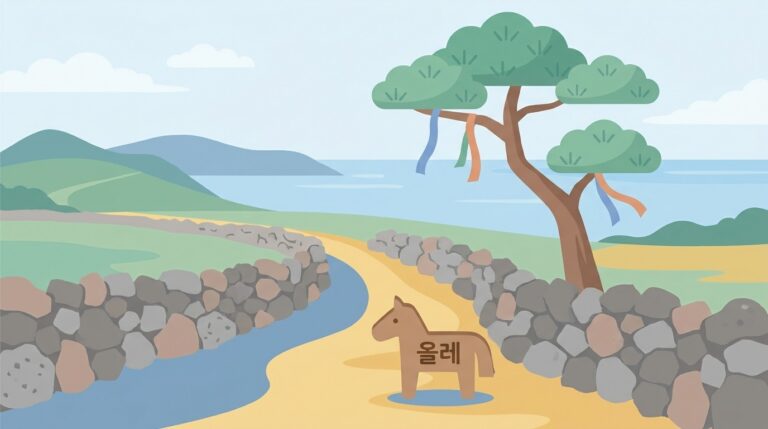
Just as your anxiety peaks, a gust of sea breeze rustles the pine branches ahead. Flapping cheerfully in the wind is a pair of vibrant cobalt blue and citrus orange ribbons, anchored by a charming wooden silhouette of a little pony. A wave of relief sweeps over your chest. You smile, take a deep breath, and realize you are exactly where you need to be. When hiking in Jeju, you will hear hikers and guides say with warm confidence:
갈림길마다 파란색과 주황색 리본(간세) 화살표가 표시되어 있어서 길을 잃을 걱정이 없어요.
(Gal-lim-gil-ma-da pa-ran-saek-gwa ju-hwang-saek ri-bon(gan-se) hwa-sal-pyo-ga pyo-si-doe-eo iss-eo-seo gil-eul ilh-eul geok-jeong-i eops-eo-yo.)
“Blue and orange ribbon markers (Ganse) and arrows are posted at every fork in the road, so there is no worry about getting lost.”
Many of our intermediate learners share that while they know basic directions like “left” and “right,” explaining trail waymarks, expressing reassurance, and navigating Korea’s outdoor culture feels intimidating. Today’s guide is crafted from real student trail experiences and Jeju local trekking tips so you can hike Hallasan and the Olle Trail with the confidence of an island native.
Phase 2: Core Expressions Deep Dive
1. 갈림길마다 표시되어 있어요 (Gal-lim-gil-ma-da pyo-si-doe-eo iss-eo-yo)
- Pronunciation: [Gal-lim-gil-ma-da pyo-shi-dweh-eo ee-sseo-yo] (Think of ‘gal’ like ‘gull’, ‘lim’ like ‘limb’, and ‘gil’ rhyming with ‘meal’ with a crisp hard G.)
- Meaning: Literally “It is marked at every fork in the road.” In actual nuance, it conveys soothing reassurance: “Don’t worry, every single turn is clearly marked!”
- K-Culture Moment: You will hear this exact phrase on travel variety shows like 2 Days & 1 Night or Europe Outside Your Tent whenever the cast navigates a remote mountain pass without a guide.
- Editor’s Insight: The particle -마다 (-mada) means “every” or “each” (e.g., 날마다 – every day; 곳곳마다 – at every spot). Pairing it with 갈림길 (gal-lim-gil), which refers to any fork or junction, turns you into an observant traveler who notices trail details.
- Situation Spectrum: Casual ⚠️ | Semi-formal ✅ | Formal ✅
- 🤔 Think About It: In English, we often say active phrases like “They put signs everywhere.” Korean naturally favors passive existence: “표시되어 있어요” (It remains marked). Why do you think Korean frequently describes states rather than individual actors?
2. 길을 잃을 걱정이 없어요 (Gil-eul ilh-eul geok-jeong-i eops-eo-yo)
- Pronunciation: [Geel-eul eel-eul geok-jeong-ee eop-seo-yo] (The double consonant ㅀ in 잃을 smoothly connects as an ‘L’ sound into the following vowel.)
- Meaning: Literally “The worry of losing the road does not exist.” Nuance: “You can walk with complete peace of mind.”
- K-Culture Moment: A seasoned Jeju haenyeo (female diver) or guesthouse owner calming a worried solo traveler in Welcome to Samdal-ri.
- Editor’s Insight: The grammatical pattern -(으)ㄹ 걱정이 없다 is your best friend when reassuring friends. Swap out the verb to say things like 비 올 걱정이 없어요 (No worry about rain) or 배고플 걱정이 없어요 (No worry about going hungry).
- Situation Spectrum: Casual ✅ (길 잃을 걱정 없어) | Semi-formal ✅ | Formal ✅
- 🤔 Think About It: Notice how Korean creates reassurance by negating the noun “worry” (걱정이 없다) instead of stating “You are safe.” How does this reflect Korea’s empathetic conversational culture?
3. 파란색 화살표를 따라가면 돼요 (Pa-ran-saek hwa-sal-pyo-reul tta-ra-ga-myeon dwae-yo)
- Pronunciation: [Pah-ran-saek hwa-sal-pyo-reul dda-rah-gah-myeon dweh-yo] (The tense double ㄸ in 따라 sounds punchy, just like the double ‘t’ in the Italian word ‘tutti’.)
- Meaning: Literally “If you follow the blue arrow, it becomes okay.” Nuance: “All you have to do is follow the blue arrows—simple as that!”
- K-Culture Moment: A ranger at Hallasan National Park explaining trail cut-offs or an Olle Tourist Center volunteer pointing at the map.
- Editor’s Insight: -(으)면 돼요 softens instructions. Instead of issuing a harsh command like “Follow this!” (따라가세요), it gently establishes the single condition needed for success.
- Situation Spectrum: Casual ⚠️ | Semi-formal ✅ | Formal ✅
- 🤔 Think About It: How does phrasing directions as “it will be fine if you do X” change the dynamic between a local guide and a foreign hiker?
Phase 3: Textbook Korean vs. Real Korean
Situation 1: Asking if you are on the right trail
- 📖 교과서 한국어 (Textbook): “이 길로 가면 올레길 7코스가 맞습니까?” (I gil-lo ga-myeon Olle-gil chil-ko-seu-ga mat-seup-ni-kka?)
- 🗣️ 진짜 한국어 (Real-life): “이쪽으로 쭉 가면 올레길 나와요?” (I-jjok-eu-ro jjuk ga-myeon Olle-gil na-wa-yo?)
- 💡 왜 다를까? (Why the shift?): Real hikers rarely use rigid question endings like -맞습니까. Instead, they use directional pointers like 이쪽으로 (this way) and vivid sound-symbolic adverbs like 쭉 (straight ahead), asking if the trail “appears” (나와요).
Situation 2: Reassuring someone about trail ribbons
- 📖 교과서 한국어 (Textbook): “표식이 존재하므로 조난당할 위험이 없습니다.” (Pyo-sik-i jon-jae-ha-meu-ro jo-nan-dang-hal wi-heom-i eops-seum-ni-da.)
- 🗣️ 진짜 한국어 (Real-life): “간세 리본만 보고 가면 길 안 잃어버려요!” (Gan-se ri-bon-man bo-go ga-myeon gil an ilh-eo-beo-ryeo-yo!)
- 💡 왜 다를까? (Why the shift?): Words like 조난 (perishing/lost in wilderness) sound like an extreme documentary on Mount Everest! Real Korean trekkers mention the beloved mascot name 간세 (Ganse) and use natural conversational negations like 길 안 잃어버려요.
Phase 4: K-Culture Deep Dive & Non-Verbal Manners
4-1. Nunchi & Trail Manners
When you hike in Korea, silence is rarely cold—it is respectful. However, when passing fellow trekkers on narrow Olle paths or ascending Hallasan’s rocky stairs, Korean nunchi calls for a gentle communal acknowledgement:
* The Trail Greeting: Make brief, warm eye contact, offer a polite 15-degree nod, and say: 안녕하세요~ (An-nyeong-ha-se-yo) or 안산하세요! (An-san-ha-se-yo – Have a safe hike!).
* Pointing Etiquette: If someone asks you where the next marker is, never point aggressively with your index finger. Extend your whole hand, palm tilted slightly upward toward the ribbon on the tree branch. It signals modesty and helpfulness.
4-2. The Mystery of the Ganse Ribbons & Hallasan Permits
- Blue vs. Orange: The ribbons are not decorative; they are your compass. Blue ribbons and arrows mark the 정방향 (Jeong-bang-hyang – standard forward route) starting from low numbers to high numbers. Orange ribbons and arrows mark the 역방향 (Yeok-bang-hyang – reverse route). Follow blue if you hike according to the guidebook!
- What is a Ganse (간세)?: Ganse is the Jeju pony symbol found on signposts. The name comes from Gansedari (간세다리), the Jeju dialect word for a relaxed, slow-paced person. The entire philosophy of the Olle Trail is to walk slowly without hurry.
- Hallasan Strict Reservations: If your itinerary includes conquering the summit of Mount Halla (Baekrokdam crater) via Seongpanak or Gwaneumsa trails, you cannot just show up! Korea’s digital reservation quota system requires booking a QR trail pass weeks in advance.
Phase 5: Real-Life Roleplay Scenario
Setting: A peaceful junction between a stone mandarin orchard and the rugged volcanic coastline on Olle Route 8.
Characters: You (an adventurous B1 learner) and Mr. Kang (강 삼춘), an elderly local Jeju tangerine farmer taking a rest.
- You: 저기요, 어르신! 여기서 어느 쪽으로 가야 올레길인가요?
(Jeo-gi-yo, eo-reu-sin! Yeo-gi-seo eo-neu jjok-eu-ro ga-ya Olle-gil-in-ga-yo?)
Excuse me, sir! Which way should I go from here to stay on the Olle Trail? -
Mr. Kang: [🎭 귤 바구니를 바닥에 내려놓으며 푸근하게 웃는다] 저기 돌담 옆에 주황색 리본 보이지예?
(Jeo-gi dol-dam yeop-e ju-hwang-saek ri-bon bo-i-ji-ye?)
[🎭 Setting down his tangerine basket with a warm, wrinkled smile] You see that orange ribbon next to the stone wall over there? -
You: 네, 보여요! 그런데 저쪽 소나무엔 파란색 화살표도 있네요?
(Ne, bo-yeo-yo! Geu-reon-de jeo-jjok so-na-mu-en pa-ran-saek hwa-sal-pyo-do inn-ne-yo?)
Yes, I see it! But there’s also a blue arrow on that pine tree over there? -
Mr. Kang: [🎭 바닷가 방향을 손바닥으로 가리키며] 정방향으로 걸으려면 파란색 화살표만 따라가믄 됩네다.
(Jeong-bang-hyang-eu-ro geol-eu-ryeo-myeon pa-ran-saek hwa-sal-pyo-man tta-ra-ga-meun dwaep-ne-da.)
[🎭 Pointing toward the ocean with an open palm] If you want to walk the forward route, you just need to follow the blue arrow. -
You: 아하! 갈림길마다 파란색과 주황색 리본 화살표가 표시되어 있어서 길을 잃을 걱정이 없겠네요!
(A-ha! Gal-lim-gil-ma-da pa-ran-saek-gwa ju-hwang-saek ri-bon hwa-sal-pyo-ga pyo-si-doe-eo iss-eo-seo gil-eul ilh-eul geok-jeong-i eopt-get-ne-yo!)
Aha! Since blue and orange ribbons and arrows are marked at every fork, there won’t be any worry about getting lost! -
Mr. Kang: [🎭 껄껄 웃으며 샛노란 감귤 두 개를 꺼내 건넨다] 맞수다! 혼저옵서, 천천히 쉬멍 걸으멍 가십서.
(Mat-su-da! Hon-jeo-op-seo, cheon-cheon-hi swi-meong geol-eu-meong ga-sip-seo.)
[🎭 Chuckling heartily, pulling two ripe yellow mandarins from his vest] Exactly right! Welcome to Jeju—rest a bit and walk slowly as you go. -
You: [🎭 두 손으로 공손하게 귤을 받으며 고개를 숙인다] 와, 정말 감사합니다! 맛있게 먹을게요.
(Wa, jeong-mal gam-sa-ham-ni-da! Mas-it-ge meok-eul-ge-yo.)
[🎭 Receiving the mandarins politely with both hands and bowing] Wow, thank you so much! I will enjoy eating them. -
Mr. Kang: [🎭 호탕하게 손을 흔들어 준다] 안산하고, 조심히 가요!
(An-san-ha-go, jo-sim-hi ga-yo!)
[🎭 Waving cheerily] Have a safe trek, and take good care!
🔀 Interactive Branching Choice
If you accidentally realized you had walked two kilometers following only the orange ribbons when your map assumed you were on the forward route, what would you say to Mr. Kang?
- Option A: “제가 역방향 주황색 리본을 따라왔나 봐요! 다시 돌아서 파란 리본을 찾아갈게요.”
- Feedback (Best): Clear, cheerful, and demonstrates that you understand the dual-color system. Locals will instantly admire your travel smarts!
- Option B: “아저씨, 길이 완전히 이상해요! 왜 리본 색깔이 두 개예요?”
- Feedback (Bad): Sounds accusatory and complains about a volunteer-maintained system. This breaches polite outdoor decorum.
- Option C: “몰라요, 그냥 아무 데나 걸어볼게요. 어디든 나오겠죠!”
- Feedback (Risk): Venturing off trail into dense coastal scrub (Gotjawal) can be genuinely hazardous. Jeju trails turn pitch dark very quickly after sunset! Always stick to marked paths.
Phase 6: 10-Second Emotion Shadowing Drill
Practice matching the cadence, natural pauses (/), and emotional resonance of native speakers:
- [😊 Reassured & Cheerful]
갈림길마다 / 리본이 있어서 / 길 잃을 걱정이 전혀 없어요!
(Gal-lim-gil-ma-da / ri-bon-i iss-eo-seo / gil ilh-eul geok-jeong-i jeon-hyeo eops-eo-yo!)
“At every fork in the road / there are ribbons / so there is zero worry about getting lost!” -
[🤔 Inquiring & Attentive]
정방향은 파란색이고, / 역방향은 주황색 리본 / 맞나요?
(Jeong-bang-hyang-eun pa-ran-saek-i-go, / yeok-bang-hyang-eun ju-hwang-saek ri-bon / man-na-yo?)
“The standard route is blue, / and the reverse route is orange ribbons / right?” -
[🏔️ Resolute & Fresh]
오늘 한라산 정상까지 / 안전하게 / 다녀오겠습니다!
(O-neul Hal-la-san jeong-sang-kka-ji / an-jeon-ha-ge / da-nyeo-o-get-seum-ni-da!)
“Today, all the way to Mount Halla’s peak / safely / I will go and return!”
Phase 7: K-Culture Mini Dictionary
- 간세 (Ganse)
- Meaning: The iconic Jeju pony emblem.
- Usage: Derived from the island term for leisure and rest. You will see miniature metal Ganse ponies at major trail forks pointing their noses in the direction of the forward route.
- 정방향 & 역방향 (Jeong-bang-hyang & Yeok-bang-hyang)
- Meaning: Forward direction vs. Reverse direction.
- Usage: Crucial terminology when buying the official Olle passport or asking information centers about bus connections back to your hotel.
- 올레패스 (Olle Pass) & 스탬프 (Seu-taem-peu)
- Meaning: The official trekking passport and trail stamps.
- Usage: At the beginning, midpoint, and finish line of each trail route, there is a decorative wooden Ganse box containing a unique route stamp.
- 안산 (An-san)
- Meaning: Safe hiking (Abbreviation of 안전한 등산).
- Usage: A warm, everyday well-wish exchanged among Korean hikers on steep inclines: “안산하세요!” (Have a safe and injury-free climb!).
Phase 8: Traveler Survival Kit
Top 3 Survival Expressions for Jeju Trails
- 한라산 탐방 예약 QR코드 보여드릴게요.
(Hal-la-san tam-bang ye-yak QR-ko-deu bo-yeo-deu-ril-ge-yo.)
Pro Tip: Have this sentence and your smartphone screen ready at the Seongpanak or Gwaneumsa checkpoint gates before 8:00 AM. - 이 근처에 올레 스탬프 찍는 간세 박스가 어디 있나요?
(I geun-cheo-e Olle seu-taem-peu jjik-neun gan-se bak-seu-ga eo-di in-na-yo?)
Pro Tip: Use this when you are within 50 meters of a route terminus to make sure you don’t miss stamping your passport booklet. - 가장 가까운 버스 정류장으로 가려면 어디로 가야 해요?
(Ga-jang ga-kka-un beo-seu jeong-ryu-jang-eu-ro ga-ryeo-myeon eo-di-ro ga-ya hae-yo?)
Pro Tip: Lifesaving when fatigue hits and you need to catch local blue trunk buses back to Jeju City or Seogwipo.
Editor’s Travel Note: Trail Navigation Essentials
- Digital Maps: Foreign map apps often lack rural trail footpaths in South Korea. Before stepping onto the trail, download 네이버 지도 (Naver Map 앱 다운로드) or KakaoMap. Search for specific route names like “제주올레길 7코스”.
- Trail App: For real-time audio guidance and offline GPS tracking, install the official 제주올레 공식 앱 올레패스 (Jeju Olle Pass 앱 안내).
- Mount Halla Permits: Book your summit slot at the official 한라산국립공원 탐방예약 사이트 (Hallasan National Park Reservation Portal) precisely on the first day of the preceding month.
Phase 9: One Step Deeper (Reflective Insight)
In Western hiking traditions, trails are frequently framed through the lens of conquest—taming rugged peaks, calculating elevation gain, and tracking split times. In South Korea, and particularly on Jeju Island, hiking is conceptualized as 치유 (Chi-yu – therapeutic healing) and 동행 (Dong-haeng – walking together).
The bright blue and orange ribbons are tied not by government machinery, but maintained meticulously by volunteer trail keepers (Olle-jigi). Whenever a storm or typhoons blow through Jeju, these volunteers walk the paths with shears and ribbons so strangers from across the globe never have to feel the biting chill of being lost. When you see a fluttering Ganse ribbon, you are looking at an unspoken pact of hospitality woven into nature.
💬 Your Turn: Have you ever experienced getting lost while hiking abroad? How does your culture mark backcountry paths compared to Korea’s fluttering ribbons? Leave a comment below and share your hiking memories!
Phase 10: FAQ & Avoiding Misunderstandings
Q: What should I do if I haven’t seen a ribbon for more than 10 minutes?
A: Stop immediately! Jeju trails are designed so that you spot a ribbon, arrow, or signpost at least every 5 to 7 minutes. If 10 minutes pass without seeing blue or orange ribbons, you have likely strayed onto an orchard access road or private farm. Retrace your steps back to the last confirmed marker.
Q: Can I climb Mount Halla without an advance online reservation?
A: Only on the non-summit trails (such as Yeongsil, Eorimok, and Donnaeko routes). If you want to stand on the rim of the Baekrokdam summit crater via the Seongpanak or Gwaneumsa trails, reservations are strictly required. Rangers will turn you away at the gate without an authentic QR code.
Q: Does the color of the ribbons indicate trail difficulty?
A: Not at all! The colors indicate travel direction only. Blue = Forward direction (정방향) starting from Route 1 to 27. Orange = Reverse direction (역방향). Both colors cover the identical physical path.
🚨 흔한 실수 (Common Mistakes) Notice Board
- Mistake: Following orange arrows thinking they indicate an “easier or coastal-only” route.
- Correct Action: If you want to finish at the official destination stamp station, follow the blue arrows!
- Mistake: Beginning a Hallasan summit trek late in the morning.
- Correct Action: Mount Halla enforces strict seasonal checkpoint cut-offs (often 12:00 PM or 1:00 PM at Jindallae shelter). Start before 7:30 AM to ensure you reach the peak.
- Mistake: Throwing away mandarin peels into the forest assuming they are harmless compost.
- Correct Action: Jeju’s wild animals and delicate soil ecosystems are disrupted by agricultural citrus peels. Always practice Leave No Trace (흔적 남기지 않기) and pack out all food waste.
Phase 11: Action Missions
- 🥉 Bronze Level: Read today’s core expression out loud three times with clear pauses: “갈림길마다 표시되어 있어서 / 길을 잃을 걱정이 없어요!”
- 🥈 Silver Level: Open your social media or language study journal and write one thing in your daily life that relieves your stress using the pattern: “~ㄹ 걱정이 없어요” (e.g., “냉장고에 김치가 많아서 반찬 걱정이 없어요!”).
- 🥇 Gold Level: During your next trip to Korea, greet a local hiker on the trail with a respectful bow and an energetic: “안녕하세요! 안산하세요!”
- 🎮 K-Culture Mission: Watch an episode of a Jeju-based drama (like Our Blues) and look closely at the background scenery to spot an authentic blue or orange Olle ribbon fluttering in the wind!
Phase 12: Interactive Quiz Challenge
1. Situation Judgment
You are hiking Olle Route 10 from Hwasun to Moseulpo (standard itinerary). You arrive at a fork in a pine grove and see two arrows painted on a stone: a Blue arrow pointing left and an Orange arrow pointing right. Which path should you choose?
👉 Click to reveal Answer & Explanation
Correct Choice: The Left Path (Blue Arrow)!
Explanation: Blue signifies 정방향 (Forward direction), which follows the canonical itinerary from starting points to endpoints. Orange indicates 역방향 (Reverse direction). Since you are hiking the standard itinerary, follow the blue arrow!
2. Fill-in-the-Blank
Complete the sentence to mean: “Markers are posted at every fork, so there is no worry about getting lost.”
“갈림길마다 리본이 있어서 길을 잃을 ______ 없어요.”
👉 Click to reveal Answer & Explanation
Correct Answer: 걱정이 (geok-jeong-i)
Explanation: The phrase 걱정이 없다 literally means “worry does not exist.” Combine it with 길을 잃을 (losing the road/getting lost) to complete the idiomatic reassurance.
3. True or False Cultural Quiz
True or False: The word Ganse (간세) represents a fast, galloping war horse from ancient Jeju history.
👉 Click to reveal Answer & Explanation
Correct Answer: False!
Explanation: Ganse comes from the Jeju dialect term Gansedari, meaning someone who walks slowly and takes life easy. It represents a slow, mindful pony that encourages hikers to de-stress and absorb the scenery rather than rush.
🎬 Watch Our Daily Videos! (Daily Hangul Official Instagram)
Review the expressions you learned in this article with our fun daily short videos! Check out native pronunciation and real-life nuances in action.
- Instagram @dailyhangul_en







