

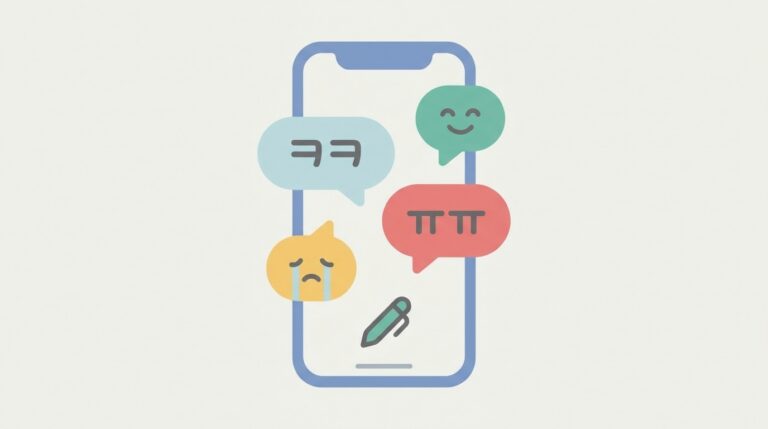
Master Korean Keyboard Typing: Chat Like a Real Seoulite with ㅋㅋ and ㅠㅠ
Phase 1: Empathy (Story-Immersive Opening)
안녕하세요! (Hello!) I’m your Daily Hangul editor and local culture navigator.
Picture this: You just made your very first Korean friend on a language exchange app, or maybe you finally gathered the courage to leave a comment on your K-pop bias’s Weverse live stream. You carefully open your smartphone keyboard, take a deep breath, and type out a sentence straight from chapter one of a beginner textbook: “정말 재미있습니다. 하하하.” (Jeongmal jaemiisseumnida. Hahaha. / It is very fun. Hahaha.)
A few seconds later, your phone buzzes with their reply:
“헐 진짜요?? ㅋㅋㅋㅋㅋ 대박 ㅠㅠㅠ”
Suddenly, your brain freezes. What on earth is “ㅋㅋㅋ”? Did their keyboard break? Why are there random Korean letters floating without vowels? And wait… why are they crying with “ㅠㅠ” if they’re happy? You frantically search your smartphone keyboard, but you can’t find these mystery symbols anywhere in your grammar book.
Here is the real truth from our years of coaching Korean learners: Texting in Korean is an entirely different world from textbook grammar. In Seoul’s lightning-fast digital culture, sending plain full sentences without emoticons can actually make you sound stiff, robotic, or even secretly angry! Master these simple consonant shortcuts and vowel emoticons, and you will instantly unlock the warmth, humor, and natural rhythm of how real Koreans talk every single day. Let’s get your fingers flying across that Korean keyboard!
Phase 2: Top 3 Core Expressions In-Depth Analysis
1. ㅋㅋ (kk)
- Pronunciation: [kk] (Sounds like a quick, breathy chuckle under your breath: k-k)
- Meaning: Literal: The Hangul consonant 키읔 (kieuk, ‘k’) / Real Nuance: “Lol”, “Haha”, giggling, or cracking up.
- K-Culture Moment: Flooding the live chat during a BTS or NewJeans variety show when a member trips over their words or does an accidental funny dance.
- Editor’s Insight: The number of “ㅋ”s you type completely changes your social vibe!
- Just one
ㅋ: Warning! It looks cold, cynical, or sarcastic (like a dry “heh”). - Two
ㅋㅋ: Friendly, polite chuckling (like a pleasant smile). - Three or more
ㅋㅋㅋ+: Genuine laughter! The more you type (e.g.,ㅋㅋㅋㅋㅋ), the harder you are laughing in real life.
- Just one
- Situation Spectrum: Casual ✅ | Semi-formal ⚠️ (Only with friendly coworkers) | Formal 🚫
- 🤔 Think About It: In English, we write full words like “haha” or acronyms like “lol”. Why do you think Korean digital culture prefers single phonetic consonants? (Hint: Think about typing speed and finger efficiency!)
2. ㅠㅠ / ㅜㅜ (yu-yu / u-u)
- Pronunciation: [yu-yu] / [u-u] (Sound of crying eyes streaming tears)
- Meaning: Literal: The Hangul vowels ㅠ (yu) and ㅜ (u) / Real Nuance: “Crying face”, deep sympathy, sadness, or a cute “Oh no!”
- K-Culture Moment: When concert tickets sell out in 0.5 seconds and you message your friend: “티켓 매진됐어 ㅠㅠ” (Tiket maejindwaesseo yuyu / The tickets are sold out ㅠㅠ).
- Editor’s Insight: Look closely at the vowel shape! The horizontal bar represents closed eyelids, while the vertical stems dropping down represent streams of tears.
ㅠㅠshows two streams of tears per eye (sobbing or dramatic crying), whileㅜㅜlooks like a single sniffle. - Situation Spectrum: Casual ✅ | Semi-formal ⚠️ | Formal 🚫
- 🤔 Think About It: Isn’t it fascinating how Hangul’s geometric vowels serve as built-in pictograms, letting you express vivid emotions without downloading a single external emoji sticker?
3. ㅇㅋ (o-ke)
- Pronunciation: [o-ke] (A snappy pronunciation of the English letters “O-K”)
- Meaning: Literal: The consonants 이응 (ieung, silent/ng) + 키읔 (kieuk, ‘k’) / Real Nuance: “Okay”, “Got it!”, “Sounds like a plan!”
- K-Culture Moment: Confirming where to meet for crispy Korean fried chicken in Hongdae: “홍대입구역 9번 출구에서 만나! (Hongdaeipguyeok gubeon chulgueseo manna! / Meet at Hongik Univ. Station Exit 9!) -> ㅇㅋ!”
- Editor’s Insight: This is a consonant shortcut (초성, choseong) for the loanword 오케이 (o-ke-i). It is the ultimate time-saver when you want to acknowledge plans without writing out full sentences.
- Situation Spectrum: Casual ✅ | Semi-formal ⚠️ | Formal 🚫
- 🤔 Think About It: Notice how Korean takes foreign words and effortlessly digests them into native consonant shorthand. What English texting abbreviations do you use that baffle non-native speakers?
Phase 3: Textbook Korean vs. Real Korean
Situation 1: Reacting to a funny meme or joke
- 📖 교과서 한국어 (Textbook): “그것은 정말 재미있습니다. 하하하.” (Geugeoseun jeongmal jaemiisseumnida. Hahaha. / That is very fun. Hahaha.)
- 🗣️ 진짜 한국어 (Real Korean): “아 진짜 웃겨 ㅋㅋㅋ” (A jinjja utgyeo kkk / Ah seriously so funny lolll)
- 💡 왜 다를까? (Why is it different?): Typing out “하하하” letter-by-letter feels like an emotionless GPS navigation voice or a robot villain in a movie. Real Koreans use consonant clusters like “ㅋㅋㅋ” to match human laugh rhythms.
Situation 2: Showing sympathy when a friend had a tough day
- 📖 교과서 한국어 (Textbook): “저는 당신이 슬퍼서 안타깝습니다.” (Jeoneun dangsini seulpeoseo antakkapseumnida. / I feel regretful that you are sad.)
- 🗣️ 진짜 한국어 (Real Korean): “헐 어떡해 ㅠㅠ 힘내요!” (Heol eotteokhae yuyu himnaeyo! / Oh no what to do ㅠㅠ hang in there!)
- 💡 왜 다를까? (Why is it different?): Textbook empathy often sounds like a stiff diplomatic speech. Adding “ㅠㅠ” acts like a warm, supportive digital hug across the screen.
Phase 4: K-Culture Deep Dive & Non-Verbal Manners
4-1. 눈치 (Nunchi) & Mobile Keyboard Manners: Beware the “Single-ㅋ”
In Korean culture, Nunchi (눈치)—the art of gauging social context and subtle emotional cues—is just as critical on your smartphone as it is face-to-face.
The number one pitfall for international learners is typing a single ㅋ. If your friend sends a funny video and you reply with just “ㅋ”, they will immediately panic and wonder, “Did I offend them? Are they mocking me?” A solitary “ㅋ” carries a sarcastic, smirk-like undertone. Always type at least two (ㅋㅋ) to guarantee a friendly atmosphere. And if you want to sound softer and slightly gentler, use ㅎㅎ (hh – sounds like he-he), which conveys a polite, warm smile!
4-2. Cultural Code: The World of KakaoTalk Group Chats (단톡방)
Over 95% of Koreans communicate via KakaoTalk. In Korean university groups, travel meetups, or K-pop fandom chats, speed and responsiveness (칼답, kaldap) signal that you care about the group. When chat threads scroll past at lightning speed, typing “ㅇㅋ”, “ㄱㅅ” (short for 감사 / thanks), and “ㅠㅠ” allows you to jump into the conversational flow without getting left behind!
Phase 5: Real-Life Roleplay Scenario
Setting: Friday evening. You are coordinating a dinner plan with Minji (민지), your Korean university exchange partner, in Sinchon.
- 민지 (Minji): 오늘 저녁에 신촌에서 떡볶이 먹을래요? (Oneul jeonyeoge Sinchoneseoe tteokbokki meogeullae-yo? / Want to eat tteokbokki in Sinchon this evening?)
🎭 [Texting eagerly with a dancing rabbit sticker] - 나 (You): 좋아요! 몇 시에 만나요? (Joayo! Myeot sie mannayo? / Sounds great! What time shall we meet?)
🎭 [Checking watch, typing with excitement] - 민지 (Minji): 6시 어때요? 역 근처 맛집 알아요! (Yeoseot si eottaeyo? Yeok geuncheo matjip arayo! / How about 6:00? I know a famous delicious spot near the station!)
🎭 [Sending a thumbs-up emoji] - 나 (You): ㅇㅋ! 6시에 신촌역 2번 출구에서 봐요. (O-ke! Yeoseot sie Sinchong-yeok ibeon chulgueseo bwayo. / OK! See you at Sinchon Station Exit 2 at 6:00.)
🎭 [Typing quickly with newly gained typing confidence] - 민지 (Minji): 헐 대박… 저 방금 지하철 놓쳤어요 ㅠㅠ (Heol daebak… jeo banggeum jihacheol nochyeosseoyo yuyu / Oh no… I just missed the subway ㅠㅠ)
🎭 [Gasping on the platform, sending a tearful sticker] - 나 (You): 헐 진짜요? 괜찮아요 천천히 와요 ㅠㅠ (Heol jinjjayo? Gwaenchanayo cheoncheonhi wayo yuyu / Oh really? It’s totally fine, take your time ㅠㅠ)
🎭 [Typing with warm, reassuring empathy] - 민지 (Minji): 고마워요! 10분만 늦을게요 ㅋㅋㅋ 미안해요! (Gomawoyo! Sibunman neujeulgeyo kkk mianhaeyo! / Thank you! I’ll be just 10 minutes late lol, sorry!)
🎭 [Sprinting up the stairs, feeling relieved] - 나 (You): 네 천천히 와요 ㅋㅋㅋ 기다릴게요! (Ne cheoncheonhi wayo kkk gidarilgeyo! / Sure, take your time lol, I’ll wait!)
🎭 [Smiling warmly, relaxing on a station bench]
🔀 Interactive Decision Point
When Minji texted “저 방금 지하철 놓쳤어요 ㅠㅠ” (I just missed the subway ㅠㅠ), how should you reply?
- Option A: “ㅋ”
- Feedback: [Bad ❌] Disaster! Sending a single ㅋ makes you look furious and dismissive. Minji will think you are angry about waiting.
- Option B: “알겠습니다. 저는 슬픕니다.”
- Feedback: [Risk ⚠️] Grammatically correct, but sounds like an automated voice bot. It creates unnecessary emotional distance.
- Option C: “괜찮아요 ㅋㅋㅋ 천천히 와요 ㅠㅠ”
- Feedback: [Best ⭐] Perfect! The “ㅋㅋㅋ” relieves her guilt, while the “ㅠㅠ” shares in her stressful subway mishap.
Phase 6: 10-Second Emotion Shadowing Drill
Read these aloud while tapping your keyboard to lock in the emotional rhythm!
- Drill 1:
[😊 Relieved and cheerful]
“괜찮아요 / ㅋㅋㅋ / 천천히 와요!” (Gwaenchanayo / kkk / cheoncheonhi wayo! / It is fine / haha / take your time!) - Drill 2:
[🥺 Empathetic and worried]
“헐 / 어떡해 / ㅠㅠ / 조심해요!” (Heol / eotteokhae / yuyu / josimhaeyo! / Oh no / what to do / ㅠㅠ / be careful!) - Drill 3:
[😎 Quick and confident]
“ㅇㅋ! / 6시에 / 만나요!” (O-ke! / yeoseot sie / mannayo! / OK! / at 6 o’clock / let’s meet!)
Phase 7: K-Culture Mini Dictionary
- 자음 퀴즈 (Jaeum Kwijeu) | Initial Consonant Quiz | A wildly popular game in Korea where players guess full words using only their first consonants (like guessing ‘ㅂㄱ’ for 불고기 / Bulgogi).
- 이모티콘 (Imotikon) | Digital Emoticons / Kakao Stickers | Beyond text punctuation, animated character stickers (such as Kakao Friends Ryan and Choonsik) are an indispensable part of daily Korean texting etiquette.
- 칼답 (Kaldap) | Lightning-fast Reply | Formed from 칼 (kal, sharp blade) and 답장 (dapjang, reply). Replying to a friend’s message within seconds shows high affection and attentiveness.
- 읽씹 (Ilgssip) | Leaving on Read | Short for “읽고 씹다” (read and chew/ignore). Opening a message without replying is considered a major social faux pas among Korean peers!
Phase 8: Traveler’s Survival Kit
Survival Expressions TOP 3
- “와이파이 비밀번호 뭐예요?” (Waipai bimilbeonho mwoyeyo? / What is the Wi-Fi password?)
- Pro Tip: Essential for cafes in Seoul so you can keep typing those live ㅋㅋㅋ messages!
- “카톡 아이디 알려주세요!” (Katok aidi allyeojuseyo! / Please let me know your KakaoTalk ID!)
- Pro Tip: The universal phrase to stay connected with new local friends you meet in Korea.
- “잠시만요 ㅠㅠ” (Jamsimanyo yuyu / Just a moment ㅠㅠ)
- Pro Tip: Text this when you need a few extra seconds to type out your reply on your phone!
Editor’s Travel Note
Before stepping on your flight to Seoul, set up your mobile keyboard! On iOS or Android, you can choose between two main layouts: 2-Set (두벌식 – Dubeolsik), which mirrors the standard QWERTY layout with consonants on the left and vowels on the right, or Cheonjiin (천지인), which uses three simple building blocks (•, ㅡ, ㅣ) and is loved by rapid one-thumb typists. Make sure to complete the KakaoTalk messenger app download and grab the Naver Map navigation app download to find cozy cafes with blazing-fast Wi-Fi!
Phase 9: Think Deeper
Korean interpersonal culture thrives on Jeong (정)—a deep, sticky sense of shared warmth and relational bonding. Because the Korean spoken language relies heavily on honorifics and polite inflection, flat black-and-white text messages can easily come across as blunt or overly rigid. Consonant abbreviations like ㅋㅋ and expressive vowel marks like ㅠㅠ were born out of a desire to soften emotional edges and inject genuine humanity into smartphone screens. By learning these simple keyboard combinations, you aren’t just learning internet slang; you are embracing Korea’s beautiful effort to protect feelings and stay connected in a hyper-digital world.
💬 Your Turn: What is the go-to texting abbreviation in your native language, and do you think “ㅋㅋㅋ” captures real laughter better than “haha”? Drop your thoughts in the comments below!
Phase 10: FAQ & Common Mistakes
Q: How many times should I press ‘ㅋ’ to sound natural?
A: As a golden rule, use two (ㅋㅋ) for a polite, pleasant smile, and three or more (ㅋㅋㅋ or ㅋㅋㅋㅋㅋ) when you are genuinely laughing out loud. Never send just a single ㅋ to a friend unless you intend to sound sarcastic or unimpressed!
Q: Can I use ‘ㅋㅋ’ or ‘ㅠㅠ’ when messaging my Korean professor or company boss?
A: Definitely not! Consonant shortcuts and vowel cries are strictly casual texting language. When writing to teachers, bosses, or senior clients, stick to polite formal Korean like “감사합니다” (Gamsahamnida / Thank you) without any internet slang.
Q: What is the difference between ‘ㅋㅋ’ and ‘ㅎㅎ’?
A: ㅋㅋ (kk) represents audible laughter or an energetic giggle (equivalent to “lol”). On the other hand, ㅎㅎ (hh) represents a soft, bashful, or gentle chuckle (like “he-he”). ㅎㅎ is often perceived as softer and slightly more polite than ㅋㅋ.
🚨 흔한 실수 (Common Mistakes) 경고판
- Mistake: Sending a single
ㅋafter someone shares a fun story.- Correct Action: Type at least
ㅋㅋㅋ 대박!(kkk daebak! / lolll awesome!) to show genuine excitement.
- Correct Action: Type at least
- Mistake: Searching through your phone’s emoji icon library for tear faces when texting in Korean.
- Correct Action: Just tap the Hangul vowel key
ㅠtwice right on your Korean keyboard:ㅠㅠ!
- Correct Action: Just tap the Hangul vowel key
- Mistake: Replying with “ㅇㅋ” to an older host or workplace supervisor.
- Correct Action: Use polite honorifics instead: “네, 알겠습니다!” (Ne, algesseumnida! / Yes, I understand!).
Phase 11: Action Mission & Engagement
Action Mission: 3 Steps to Keyboard Fluency
- 🥉 Bronze Mission (Solo Practice): Switch your smartphone keyboard to Korean right now. In your notes app, practice typing 5 sets of
ㅋㅋ,ㅎㅎ, andㅠㅠ. - 🥈 Silver Mission (Social Media): Head over to your favorite Korean variety show clip or idol TikTok and leave a comment with: “아 진짜 웃겨요 ㅋㅋㅋ” (Ah, this is so funny lolll).
- 🥇 Gold Mission (Real Life): Next time you message a Korean language partner, reply to their message with “ㅇㅋ! ㅋㅋㅋ” and see how naturally the chat flows!
🎮 K-Culture Mission: Open a live K-pop music video stream or a Weverse artist post. Count how many times Korean fans use ㅋㅋㅋ versus ㅠㅠ in the comment section. Notice how they stack them together when feelings run high!
Phase 12: Interactive Quiz Challenge
1. Situational Judgment: Your Korean buddy sends you a picture of an adorable puppy wearing a tiny raincoat. What is the most natural, friendly reply?
* a) 네, 개가 귀엽습니다. (Ne, gaega gwiyeopseumnida.)
* b) ㅋ
* c) 헐 너무 귀여워요 ㅠㅠ ㅋㅋㅋ
2. Fill-in-the-Blank: You want to quickly agree to meet your classmate for bubble tea. Type the two-consonant shortcut for “오케이” (Okay):
* Answer: [ _____ ]
3. True or False: Typing a single “ㅋ” is a polite way to show quiet respect to an elder in a text message.
* True or False?
👉 Click here to reveal the answers and explanations!
- Answer: c) 헐 너무 귀여워요 ㅠㅠ ㅋㅋㅋ
- Explanation: Option (a) sounds like an emotionless biology textbook, and Option (b) looks dismissive and cold. Option (c) expresses genuine warmth and delight!
- Answer: ㅇㅋ
- Explanation: Combining the initial consonants of 오 (ㅇ) and 케 (ㅋ) creates the standard shorthand for “OK”.
- Answer: False!
- Explanation: A single “ㅋ” carries a sarcastic or cold tone, and all consonant shortcuts should be avoided when messaging elders or superiors in Korean society!
- Explanation: A single “ㅋ” carries a sarcastic or cold tone, and all consonant shortcuts should be avoided when messaging elders or superiors in Korean society!
🎬 Watch Our Daily Videos! (Daily Hangul Official Instagram)
Review the expressions you learned in this article with our fun daily short videos! Check out native pronunciation and real-life nuances in action.
- Instagram @dailyhangul_en







