

Caught in a Sudden Seoul Downpour: How to Ask for an Umbrella in Korean Like a Local
Phase 1: Empathy (Story-Driven Opening)
안녕하세요! 매일한글 에디터입니다. (Hello! I’m your Daily Hangul editor!)
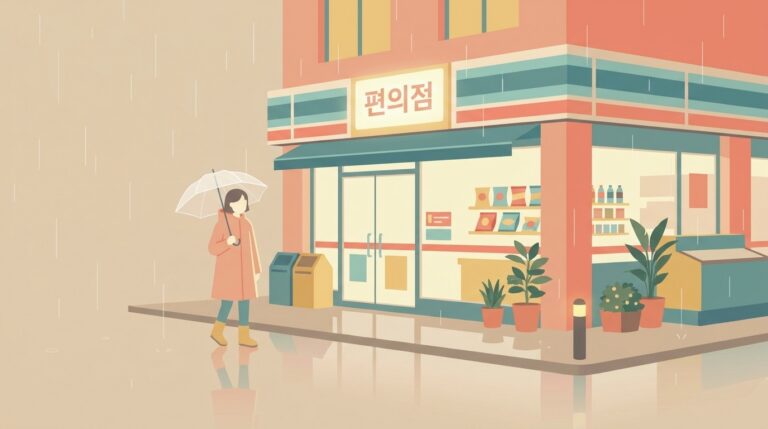
Picture this classic K-Drama scene: You step out of Hongdae Station Exit 9 into the neon-lit Friday evening buzz of Seoul. Without warning, the sky darkens and opens up into a fierce summer rainstorm—what locals call a 소나기 (sonagi, sudden downpour). Within seconds, everyone around you pops open crisp, clear vinyl umbrellas with effortless ease. Meanwhile, you are stranded under a tiny cafe awning, watching puddles swell around your favorite sneakers.
You spot a brightly lit convenience store across the pedestrian crossing. You make a mad dash through the sheets of rain, barge through the sliding doors with a chime, shake the droplets from your hair, and lock eyes with the store clerk. You urgently need to know if they sell umbrellas, but your brain freezes. Do you conjugate verbs? Do you say “to possess”? What if you sound awkward?
Take a deep breath! Over the past decade coaching beginner learners here at Daily Hangul, I have seen this exact scenario play out countless times. Asking for an umbrella isn’t just about surviving rainy days; it is your gateway into mastering one of the most essential building blocks in the entire Korean language: 있어요 (isseoyo – to exist / to have) and 없어요 (eopseoyo – to not exist / to not have). Master this single grammar pairing, and you will unlock the power to ask for anything in Korea—from iced Americanos to Wi-Fi passwords!
Phase 2: Top 3 Core Expressions In-Depth
1. 우산 있어요? (Usan isseoyo?)
- Pronunciation: [u-san i-sseo-yo] (Think: “Ooh-sahn” + “east” without the ‘t’ + “saw” + “yo”)
- Meaning: Literal: “Does an umbrella exist?” | Real Nuance: “Do you have an umbrella?” or “Do you sell umbrellas here?”
- K-Culture Moment: The iconic rainy scene in romance dramas where the lead ducked under a convenience store canopy and asked the shopkeeper if there were any umbrellas left before sharing one with their crush.
- Editor’s Insight: Korean rarely uses the possessive verb “to have” (gajida) for daily transactions. Instead, speakers frame possession as existence. If an item exists in the vicinity of the person, they have it!
- Situation Spectrum: Casual: ⚠️ (Say 우산 있어? to close friends) | Semi-formal: ✅ (Perfect for stores and strangers) | Formal: ⚠️ (Use 우산 있으십니까? in high-end corporate settings)
- 🤔 Think About It: In English, we place “I” or “You” at the center of ownership (“Do you have…?”). Korean skips the person entirely and asks if the object simply exists in that space. What does this reveal about Korean context-first communication?
2. 없어요 (Eopseoyo)
- Pronunciation: [eop-sseo-yo] (Sounds like “Up” + “saw” + “yo”)
- Meaning: Literal: “It does not exist.” | Real Nuance: “We don’t have any,” “I’m out of it,” or “There isn’t one.”
- K-Culture Moment: Hearing the store clerk gently cross their forearms or tilt their head while saying “우산 없어요…” during a sold-out rainy rush hour.
- Editor’s Insight: Notice that Korean has a dedicated, single word for non-existence! Rather than adding a negative modifier like “not” to “have,” Korean replaces the entire verb 있어요 with its polar opposite 없어요.
- Situation Spectrum: Casual: ⚠️ (없어) | Semi-formal: ✅ (없어요) | Formal: ✅ (없습니다)
- 🤔 Think About It: Having a dedicated word for absence (없다) gives negative statements a soft, factual weight rather than a personal refusal. How does that make you feel when hearing bad news?
3. 이거 있어요? (Igeo isseoyo?)
- Pronunciation: [i-geo i-sseo-yo] (Sounds like “E-go” + “ee-sseo-yo”)
- Meaning: Literal: “Does this exist?” | Real Nuance: “Do you have this one?” or “Is this in stock?”
- K-Culture Moment: Showing a screenshot of a coveted idol skincare product or viral snack on your phone screen directly to an Olive Young or convenience store worker.
- Editor’s Insight: This is the ultimate traveler survival phrase. If you forget the Korean word for “umbrella” (usan), simply point to a picture of an umbrella on your phone and ask, 이거 있어요? It works 100% of the time!
- Situation Spectrum: Casual: ⚠️ (이거 있어?) | Semi-formal: ✅ (이거 있어요?) | Formal: ✅ (이것 있습니까?)
- 🤔 Think About It: By mastering just one pronoun (이거 – this thing) and one verb (있어요), you can acquire literally anything in Korea without complex sentences.
Phase 3: Textbook Korean vs Real-World Korean
Situation 1: Asking a shopkeeper if they sell umbrellas
- 📖 교과서 한국어 (Textbook Korean): 우산을 판매하고 계십니까? (Usaneul panmae-hago gyesimnikka? / Are you currently selling umbrellas?)
- 🗣️ 진짜 한국어 (Real-World Korean): 우산 있어요? (Usan isseoyo? / Do you have umbrellas?)
- 💡 왜 다를까? (Why the difference?): Textbooks often introduce heavy Sino-Korean vocabulary (판매하다 – to sell) paired with honorific suffixes. In everyday retail counters across Korea, friendly polite
-요endings combined with natural existence verbs sound far more authentic and warm.
Situation 2: Asking a companion if they have a spare umbrella
- 📖 교과서 한국어 (Textbook Korean): 여분의 우산을 소지하고 있습니까? (Yeobun-ui usaneul sojihago isseumnikka? / Do you possess a surplus umbrella on your person?)
- 🗣️ 진짜 한국어 (Real-World Korean): 혹시 남는 우산 있어? (Hoksi namneun usan isseo? / By any chance, got an extra umbrella?)
- 💡 왜 다를까? (Why the difference?): Words like 소지하다 sound like a formal police report! Real Koreans casually toss in 혹시 (by any chance) and ask if an umbrella is “leftover” (남는) using casual talk with friends.
Phase 4: K-Culture Deep Dive & Non-Verbal Manners
4-1. 눈치 (Nunchi) & Rainy Day Gestures
When entering any Korean shop during a downpour, high-level 눈치 (situational awareness) is expected:
* The Umbrella Sheath Stand (우산 비닐 커버): Right inside the sliding doors, you will see a tall metal stand with long plastic bags or an absorbent drying sponge stand. Slide your wet umbrella into the sheath before stepping onto the dry tiled floors. Leaving a trail of puddles is considered impolite.
* The Two-Handed Handover: When paying for your 5,000-won vinyl umbrella, always hand your card or cash using both hands (or your right hand supported lightly at the forearm by your left hand). Combine this with a slight 15-degree head bow as you ask, 우산 있어요?
4-2. The K-Drama Umbrella Trope & Convenience Store Culture
In K-Dramas like Guardian: The Lonely and Great God (도깨비) or Something in the Rain, the humble umbrella is the ultimate romantic prop. There is even a beloved phrase: 우산 씌워주기 (usan ssui-wo-ju-gi)—the chivalrous act of angling your umbrella outward so your companion stays completely dry, even if your own outside shoulder gets thoroughly soaked!
Practically speaking, Korean 24-hour convenience stores (CU, GS25, 7-Eleven, Emart24) are literal lifesavers. During sudden rains, they immediately wheel umbrella displays right next to the automatic door, stocking cheap transparent umbrellas (비닐우산) starting around 5,000 KRW alongside sturdy long umbrellas (장우산).
Phase 5: Real-World Roleplay Scenario
Setting: A brightly lit GS25 convenience store near Gangnam Station during an unexpected evening storm. Water is dripping off your jacket as you step inside.
Characters: You (Rain-soaked Traveler) & Minho (민호, friendly part-time college student).
- 민호: 어서 오세요! (Eoseo oseyo! / Welcome!)
🎭 Bowing politely behind the counter as the door chimes ring - You: 저기요, 혹시 우산 있어요? (Jeogiyo, hoksi usan isseoyo? / Excuse me, by any chance do you have umbrellas?)
🎭 Brushing rain from your shoulders and smiling politely - 민호: 네, 입구 바로 오른쪽에 있어요! (Ne, ipgu baro oreunjjoge isseoyo! / Yes, they are right on the right side of the entrance!)
🎭 Pointing toward the metal bucket display with an open palm - You: 투명 비닐 우산 있어요? (Tumyeong binil usan isseoyo? / Do you have the clear vinyl umbrellas?)
🎭 Scanning the rack for the affordable clear ones - 민호: 아, 비닐 우산은 다 팔려서 없어요. 장우산만 있어요. (A, binil usaneun da pallyeoseo eopseoyo. Jang-usan-man isseoyo. / Ah, the vinyl ones are all sold out, so we don’t have them. We only have long sturdy umbrellas.)
🎭 Tilting head apologetically with palms slightly raised - You: 아, 그래요? 이거 얼마예요? (A, geuraeyo? Igeo eolmayeyo? / Ah, really? How much is this one?)
🎭 Holding up a sleek black umbrella to show the tag - 민호: 만 원이에요. 봉투 필요하세요? (Man-won-ieyo. Bongtu piryohaseyo? / It is 10,000 won. Do you need a plastic shopping bag?)
🎭 Scanning the barcode with a cheerful beep - You: 아니요, 괜찮아요. 카드 결제 돼요? (Aniyo, gwaenchanayo. Kadeu gyeolje dwaeyo? / No, I’m okay. Can I pay with card?)
🎭 Handing over your payment card with both hands
🔀 Interactive Choice Point: How do you respond to the 10,000 won price?
- Choice A: “너무 비싸요! 깎아주세요!” (Neomu bissayo! Kakkajuseyo! / Too expensive! Give me a discount!)
- Feedback: 🚫 Risk! Korean convenience stores use computerized fixed barcode pricing. Haggling at a corporate retail chain will only fluster the part-time worker.
- Choice B: “그냥 갈게요, 비 맞을래요.” (Geunyang galgeyo, bi majeullaeyo. / I’ll just go, I’ll walk in the rain.)
- Feedback: ⚠️ Bad! Seoul downpours are no joke, and you run the risk of ruining your phone, passport, and catching a cold.
- Choice C: “네, 이걸로 주세요!” (Ne, igeollo juseyo! / Yes, please give me this one!)
- Feedback: ✅ Best! Crisp, polite, and practical. You get a durable souvenir umbrella to keep for the rest of your Korea trip!
Phase 6: 10-Second Emotion Shadowing Drill
Practice reading these out loud! Focus on the pauses (/) and internalize the emotional tone:
[🥺 절박하고 간절하게 / Desperate and shivering from the rain]
저기요, / 우산 있어요? (Jeogiyo, / usan isseoyo? / Excuse me… do you have an umbrella?)-
[😮 살짝 아쉬워하며 확인 / Slightly disappointed, double-checking stock]
투명 우산은 / 정말 없어요? (Tumyeong usaneun / jeongmal eopseoyo? / Are there really no clear umbrellas?) -
[😊 안도하며 밝고 산뜻하게 / Relieved and delightfully cheerful]
다행이다! / 이거 하나 주세요! (Dahaeng-ida! / Igeo hana juseyo! / What a relief! Please give me one of these!)
Phase 7: K-Culture Mini Dictionary
- 편의점 (Pyeon-ui-jeom) | Convenience Store
Usage: Open 24/7 across every street corner in Korea. Your sanctuary for emergency rain umbrellas, quick hot ramyun, portable battery rentals, and transit card top-ups. - 비닐우산 (Binil-usan) | Clear Vinyl Umbrella
Usage: The quintessential Korean transparent umbrella costing around 4,000 to 5,000 KRW. Perfect for seeing the Seoul skyline through the canopy while walking without colliding with strangers! - 소나기 (Sonagi) | Sudden Shower / Rain Squall
Usage: A sudden, intense rain shower that catches pedestrians off guard on humid summer afternoons, often clearing up within an hour. - 장마 (Jangma) | East Asian Monsoon Season
Usage: The summer rainy season in Korea (typically late June through late July). Knowing 우산 있어요? is an absolute non-negotiable survival skill during this month.
Phase 8: Traveler’s Survival Kit
Top 3 Survival Phrases
- 우산 어디 있어요? (Usan eodi isseoyo?)
Meaning: “Where are the umbrellas?”
Pro Tip: Use this immediately when entering a huge multi-story supermarket like Daiso or Homeplus. - 영수증 버려주세요 (Yeongsujeung beoryeojuseyo)
Meaning: “Please throw away the receipt.”
Pro Tip: Clerks will often hold up the receipt inquiringly after you pay. Saying this saves paper and time. - 봉투 필요 없어요 (Bongtu piryo eopseoyo)
Meaning: “I don’t need a shopping bag.”
Pro Tip: Plastic bags cost 50 to 100 KRW by law in Korea. Since umbrellas have carry handles, this phrase shows you are an eco-conscious traveler!
Editor’s Travel Note
- Emergency Weather & Transit: When rain hits Seoul, subway stations get packed fast. Use the [Naver Map app download for English navigation] to locate nearby sheltered bus stops or the closest subway exit with an elevator.
- T-Money & Card Payments: Virtually all convenience stores accept foreign credit cards (Visa, Mastercard) and Apple Pay. You can also purchase your umbrella using your physical T-money transit card balance!
Phase 9: A Step Deeper (Reflection)
In western linguistic philosophy, ownership is an assertion of the individual ego: “I have this; you possess that.” But in Korean grammar, the phrase 우산 있어요? does not ask whether you own an umbrella. It asks whether the umbrella exists in relation to this shared space right here, right now.
This subtle shift shows how Korean naturally emphasizes situational context over individual ownership. Language mirrors society: Korea fosters a communal, cooperative reality where goods and assistance are shared according to the needs of the moment.
💬 Your Turn: Next time you step into a shop, how does it feel to ask whether something exists rather than asking whether a stranger possesses it? Share your thoughts and Korean learning moments in the comments below!
Phase 10: FAQ & Avoiding Misunderstandings
Q: Can I use “있어요” to say that I have friends or a partner?
A: Absolutely! You can say 친구 있어요 (Chingu isseoyo – I have friends) or 남자친구 있어요 (Namjachingu isseoyo – I have a boyfriend). It applies to both objects and people!
Q: What is the difference between “있어요” and “있으세요”?
A: 있으세요 (isseuseyo) is the honorific form used when referring to a respected elder or customer possessing something. Store clerks might ask you: 포인트 카드 있으세요? (Do you have a loyalty point card?), but when you speak about what you want or have, stick to 있어요.
Q: How do I say “I have time” or “I don’t have time”?
A: Just slot the word 시간 (sigan – time) into the formula! 시간 있어요 (Sigan isseoyo – I have time) vs 시간 없어요 (Sigan eopseoyo – I don’t have time / I’m busy).
🚨 Common Mistakes Alert
- Mistake: Saying “나는 우산을 가져요” for “I have an umbrella.”
Correction: Never use the dictionary verb 가지다 for simple possession in daily conversation. Always use 우산 있어요. - Mistake: Confusing “없어요 (does not exist)” with “아니에요 (is not).”
Correction: Use 없어요 when you lack an item (돈 없어요 – I don’t have money). Use 아니에요 to negate identity (한국 사람 아니에요 – I am not Korean). - Mistake: Forgetting the question intonation.
Correction: 우산 있어요. (falling pitch) = “I have an umbrella.” 우산 있어요? (rising pitch) = “Do you have an umbrella?” Your tone makes all the difference!
Phase 11: Action Missions
- 🥉 Bronze Level: Practice saying 우산 있어요? and 우산 없어요! three times in front of the mirror, matching the upward and downward intonation.
- 🥈 Silver Level: Next time you order coffee or head out shopping, replace English with: “[Item] 있어요?” (e.g., 아이스 아메리카노 있어요?).
- 🥇 Gold Level: During your next trip to Korea, buy an item at a convenience store solely using Korean (저기요, 있어요?, 봉투 필요 없어요, 감사합니다).
- 🎮 K-Culture Mission: Watch the next episode of any K-Drama on your watchlist. Write down every time a character says 있어? or 없어?—you will easily spot it at least five times!
Phase 12: Interactive Quiz Challenge
Test your knowledge with these three practical checks!
1. Situation Judgment: You walk into a cozy cafe during a downpour and need the Wi-Fi password. How do you ask?
* (A) 와이파이 아니에요?
* (B) 와이파이 비밀번호 있어요?
* (C) 와이파이 없어요?
2. Fill-in-the-Blank: Complete the dialogue.
* Customer: “혹시 따뜻한 물 ________?” (Excuse me, do you have hot water?)
* Clerk: “죄송합니다, 지금 ________.” (Sorry, we don’t have any right now.)
3. True or False: In a Korean retail store, asking 우산 판매하고 계십니까? is the most common, natural phrasing used by native speakers.
👉 Click here to reveal the answer key & detailed explanations!
1. Answer: (B) 와이파이 비밀번호 있어요? (Wa-i-pa-i bimilbeonho isseoyo?)
Explanation: Slotting “Wi-Fi password” (와이파이 비밀번호) before 있어요? is the natural, polite way to ask if they have it available!
2. Answer: 있어요? / 없어요.
Explanation: The customer inquires about existence (있어요?), and the clerk politely reports its absence (없어요).
3. Answer: False!
Explanation: While grammatically accurate, 우산 판매하고 계십니까? is stiff and overly bookish. Real native speakers almost always ask simply: 우산 있어요?
🎬 Watch Our Daily Videos! (Daily Hangul Official Instagram)
Review the expressions you learned in this article with our fun daily short videos! Check out native pronunciation and real-life nuances in action.
- Instagram @dailyhangul_en







