

Beyond ‘No Kids Zones’: Navigating the ‘No Seniors Zone’ Debate in Modern Korea
Phase 1: 공감 (Story-Driven Opening)
안녕하세요! 매일한글 에디터입니다.
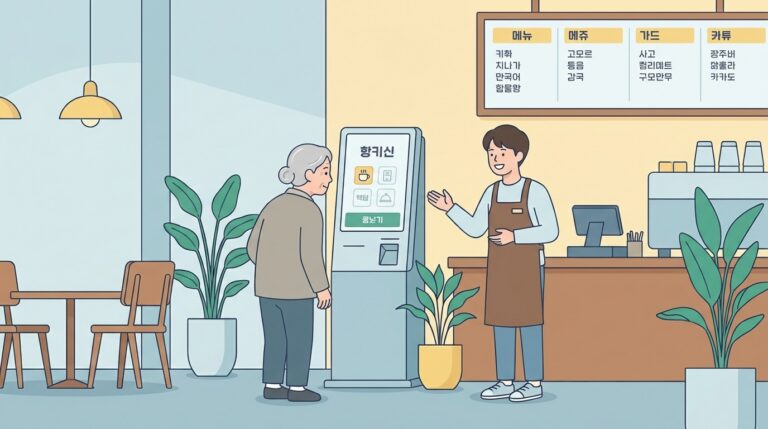
Imagine stepping into a sleek, aesthetic cafe in Yeonnam-dong. Lo-fi beats drift through the air, stainless-steel tables shine under minimalist lighting, and right by the door stands a tall, touch-screen kiosk. You are ready to order your iced Americano when you notice an older gentleman tapping the screen, pausing nervously, and squinting at tiny font menus offering twenty different milk alternatives and syrup pumps. Behind him, the queue slowly grows. Moments later, you recall a fiery debate currently trending on Korean social media: small businesses adopting not just ‘No Kids Zones’ (노키즈존), but now ‘No Seniors Zones’ (노시니어존)—restricting older guests due to kiosk friction or extended seating times.
For intermediate (B1) Korean learners, moving beyond basic travel requests like “이거 주세요” (Give me this, please) and stepping into genuine social conversations is the ultimate breakthrough. When you can tactfully share your perspective on nuanced societal debates, you transform from an observant tourist into an empathetic conversationalist. Based on real classroom insights from hundreds of foreign residents in Seoul, this guide provides the exact vocabulary, cultural intuition, and conversational tact you need to discuss modern social issues respectfully.
Phase 2: 핵심 표현 3선 심층 분석 (3 Core Expressions)
1. 이해는 가지만 좀 너무한 것 같아요. (Ihe-neun gajiman jom neomuhan geot gatayo.)
- Pronunciation: [I-hae-neun ga-ji-man jom neo-mu-han geot ga-ta-yo] (Sounds like: ee-heh-neun gah-jee-mahn johm nuh-moo-hahn guht gah-tah-yoh)
- Meaning: Direct translation: “Understanding goes, but it seems a bit excessive.” Actual nuance: “I can see their reasoning, but it still feels a bit too harsh.”
- K-Culture Moment: Heard frequently on Korean street interview shows and YouTube debate series like PSICK University when citizens discuss polarizing business practices.
- Editor’s Insight: Koreans value harmony (hwahap). Starting with “이해는 가지만” shows empathy toward business owners who face operational stress, while “좀 너무한 것 같아요” gently critiques the exclusionary outcome without causing direct conflict.
- Situation Spectrum: Casual: ✅ | Semi-formal: ✅ | Formal: ⚠️
- 🤔 Think About It: In English, we often say “I disagree because…” Why does Korean conversation prefer acknowledging the other side’s pressure before voicing criticism?
2. 세대 갈등이 점점 심해지는 것 같아요. (Sedae galdeung-i jeomjeom simhaejineun geot gatayo.)
- Pronunciation: [Se-dae gal-deung-i jeom-jeom sim-hae-ji-neun geot ga-ta-yo] (Sounds like: seh-deh gahl-deung-ee juhm-johm seem-heh-jee-neun guht gah-tah-yoh)
- Meaning: Direct translation: “Generation conflict gradually worsening seems like.” Actual nuance: “It feels like generational divide is intensifying these days.”
- K-Culture Moment: Frequently featured in Korean cultural essays, evening news segments, and office lunch talks between junior employees and managers.
- Editor’s Insight: The pattern “점점 ~해지다” indicates a continuous, gradual shift. Attaching “~것 같아요” rounds off your opinion so it sounds thoughtful rather than dogmatic.
- Situation Spectrum: Casual: ✅ | Semi-formal: ✅ | Formal: ✅
- 🤔 Think About It: How does rapid technological acceleration in hyper-connected Seoul influence the gap between digital natives and older generations compared to your home country?
3. 디지털 소외 현상을 배려해야 해요. (Dijiteol soeoe hyeonsang-eul baeryeohaeya haeyo.)
- Pronunciation: [Di-ji-teol so-oe hyeon-sang-eul bae-ryeo-hae-ya hae-yo] (Sounds like: dee-jee-tuhl soh-weh hyun-sahng-eul beh-ryuh-heh-yah heh-yoh)
- Meaning: Direct translation: “Must be considerate of digital alienation phenomenon.” Actual nuance: “We need to be mindful of those excluded by rapid digital automation.”
- K-Culture Moment: Emphasized in Korean municipal announcements and public welfare campaigns advocating for elder-friendly kiosk modes.
- Editor’s Insight: “배려” (consideration/thoughtfulness) is a gold-standard cultural value in Korea. Using this verb elevates your comment from a dry policy critique into a warm humanistic statement.
- Situation Spectrum: Casual: ⚠️ | Semi-formal: ✅ | Formal: ✅
- 🤔 Think About It: When everyday spaces replace human cashiers with screens, what civic duty do we have toward community elders?
Phase 3: 교과서 한국어 vs 진짜 한국어 (Textbook vs. Real Korean)
Situation 1: Calling a store policy unfair
- 📖 교과서 한국어: 이 규칙은 부당하다고 생각합니다. (I gyuchik-eun budanghadago saenggakhamnida. / I consider this regulation unjust.)
- 🗣️ 진짜 한국어: 아무리 그래도 손님을 가려 받는 건 좀 아니지 않아요? (Amuri geuraedo sonnim-eul garyeo banneun geon jom aniji anayo? / Even so, picking and choosing customers feels out of line, don’t you think?)
- 💡 왜 다를까?: In real conversations, using legalistic terms like “부당하다” (unjust) sounds stiff and academic. Native speakers use the rhetorical frame “~건 좀 아니지 않아요?” to voice polite yet firm moral reservation.
Situation 2: Offering help to an older adult struggling with a kiosk
- 📖 교과서 한국어: 제가 당신을 도와드릴까요? (Jega dangsin-eul dowadeurilkkayo? / Shall I help you?)
- 🗣️ 진짜 한국어: 어르신, 혹시 제가 주문 도와드릴까요? (Eoreusin, hoksi jega jumun dowadeurilkkayo? / Respected elder, may I help you place your order?)
- 💡 왜 다를까?: The pronoun “당신” is awkward and confrontational in spoken Korean. Addressing an elderly person warmly as “어르신” (honored senior) combined with the soft hedge “혹시” (by any chance) creates instant comfort and respect.
Phase 4: K-Culture 딥다이브 & 비언어적 매너 (Deep Dive & Non-Verbal Manners)
4-1. 눈치 (Nunchi) & Spatial Manners at Kiosks
When waiting in line behind an elder struggling with a touchscreen in Korea, physical demeanor speaks louder than words:
* Body Distance: Keep at least 1 to 1.5 meters of space. Hovering immediately over someone’s shoulder triggers anxiety in a high-speed society.
* Eye Contact & Patience: Avoid crossing your arms, checking your smartwatch repeatedly, or letting out audible sighs (hansum). Such body language projects negative pressure.
* Two-Handed Posture: If you step forward to offer assistance, make open-palm gestures with both hands slightly lifted, tilt your head down 15 degrees, and speak softly. This signals pure goodwill rather than patronizing impatience.
4-2. Cultural Code Analysis: ‘Palli-Palli’ vs. ‘Hyodo’
Korea is currently experiencing a fascinating friction between two deep-seated cultural forces:
1. 빨리빨리 (Palli-Palli / Quick-Quick Culture): Modern Korean cafe economics prioritize ultra-fast turnover, automated touchscreens, and silent study cafes (kagongjok culture) where noise is unwelcome.
2. 효도 (Hyodo / Filial Piety & Senior Reverence): Traditional Korean ethics place highest honor on elders.
When a viral news story reported that a small district cafe posted a “No Senior Zone” sign after an elder stayed for hours without ordering drinks through the kiosk, public backlash was immediate and intense. Many young Koreans argued that while small business owners (jayeong-eopja) face crushing rent, banishing seniors directly undermines communal decency. Navigating this nuance will make your conversations in Seoul remarkably authentic.
Phase 5: 실전 롤플레이 시나리오 (Real-World Roleplay Scenario)
Setting: Alex (an international exchange student) and Min-ji (his Korean classmate) are sitting at a quiet cafe in Sinchon, watching an older lady struggle with an automated order kiosk by the entrance.
- Alex: 민지 씨, 저기 키오스크 앞에서 어르신이 곤란해하시는 것 같아요. (Minji ssi, jeogi kioseukeu ap-eseo eoreusin-i gonranhehasineun geot gatayo. / Minji, it looks like that senior over by the kiosk is having trouble.)
🎭 Looking over with a concerned expression - Min-ji: 아, 그러게요. 글씨도 작고 결제 단계가 너무 복잡해서 그래요. (A, geureogeyo. Geulssido jakgo gyeolje dangyega neomu bokjaphaeseo geuraeyo. / Ah, you’re right. The font is tiny and the payment steps are way too complicated.)
🎭 Frowning softly at the screen UI - Alex: 요즘 뉴스 보니까 노시니어존 카페도 생겼다고 하더라고요. (Yojeum nyuseu bonikka nosinieojon kapedo saenggyeotdago hadeoragoyo. / Looking at recent news, they said even ‘No Seniors Zone’ cafes have appeared.)
🎭 Leaning forward in curiosity - Min-ji: 맞아요. 어르신들이 오래 계시거나 기계를 잘 못 다루신다고 출입을 막는 곳이 있대요. (Majayo. Eoreusindeul-i orae gyesigeona gigyereul jal mot darusindago churip-eul magneun gos-i itdaeyo. / Exactly. Apparently some places restrict entry claiming seniors stay too long or struggle with machines.)
🎭 Sighing quietly - Alex: 사장님 입장도 이해는 가지만, 손님을 나이로 제한하는 건 좀 너무한 것 같아요. (Sajangnim ipjangdo ihe-neun gajiman, sonnim-eul nairo jehanhaneun geon jom neomuhan geot gatayo. / I can understand the owner’s perspective, but restricting customers by age feels a bit excessive.)
🎭 Speaking thoughtfully with open palms - Min-ji: 저도 동감이에요. 누구나 나이가 드는데, 디지털 소외 현상을 먼저 해결해야죠. (Jeodo donggam-ieyo. Nuguna naiga deuneunde, dijiteol soeoe hyeonsang-eul meonjeo haegyeolhaeyajyo. / I completely agree. Everyone grows old; we should solve digital alienation first.)
🎭 Nodding affirmatively - Alex: 제가 가서 주문 좀 눌러드리고 와도 될까요? (Jega gaseo jumun jom nulleodeurigo wado doelkkayo? / Would it be okay if I go over and help press the buttons for her order?)
🎭 Half-standing up with a warm smile - Min-ji: 좋은 생각이에요! 같이 가서 도와드려요. (Joeun saenggak-ieyo! Gachi gaseo dowadeuryeoyo. / Great idea! Let’s go help her together.)
🎭 Standing up enthusiastically alongside Alex
🔀 인터랙티브 분기점 (Interactive Fork)
How would you intervene if you were in Alex’s shoes?
* Choice A: “어르신, 답답하시죠? 제가 그냥 다 해드릴게요.” (Senior, you must be frustrated, right? I’ll just do everything for you.)
* Feedback [Risk]: While well-intentioned, saying “답답하시죠?” (You must be frustrated/slow?) can accidentally bruise an elder’s dignity by emphasizing their struggle.
* Choice B: “어르신, 혹시 도움이 필요하시면 제가 결제 도와드릴까요?” (Respected elder, if you happen to need assistance, may I help you with payment?)
* Feedback [Best]: Exemplary Korean etiquette! Respectful honorifics (어르신, 도와드릴까요) paired with polite conditionals create a safe, dignified interaction.
* Choice C: Kiosk screen-을 직접 가리키며 카운터 직원에게 큰 소리로 항의한다. (Point at the screen and complain loudly to the counter clerk.)
* Feedback [Bad]: Causes severe loss of face (che-myeon) for both the staff and the elderly patron in public space.
Phase 6: 10초 감정 섀도잉 드릴 (Emotion Shadowing Drill)
Practice these lines using the slash marks / as brief natural pauses and honor the emotion tags:
[🤔 사려 깊고 공감하듯이 - Thoughtful & Empathetic]- 사장님 입장도 / 이해는 가지만 / 손님을 가려 받는 건 / 좀 너무한 것 같아요.
(Sajangnim ipjangdo / ihe-neun gajiman / sonnim-eul garyeo banneun geon / jom neomuhan geot gatayo.)
- 사장님 입장도 / 이해는 가지만 / 손님을 가려 받는 건 / 좀 너무한 것 같아요.
[🥺 안타깝고 따뜻하게 - Compassionate & Warm]- 누구나 / 나이가 드는데 / 어르신들을 위한 / 쉬운 키오스크가 / 꼭 필요해요.
(Nuguna / naiga deuneunde / eoreusindeul-eul wihan / swiun kioseukeuga / kkok piryohaeyo.)
- 누구나 / 나이가 드는데 / 어르신들을 위한 / 쉬운 키오스크가 / 꼭 필요해요.
[😊 다정하고 예의 바르게 - Friendly & Polite]- 어르신 / 혹시 / 주문하시는 데 / 제가 좀 / 도와드릴까요?
(Eoreusin / hoksi / jumunhasineun de / jega jom / dowadeurilkkayo?)
- 어르신 / 혹시 / 주문하시는 데 / 제가 좀 / 도와드릴까요?
Phase 7: K-Culture 미니 사전 (Mini Dictionary)
- 노키즈존 (No Kids Zone – No-ki-jeu-jon): Commercial venues (cafes, restaurants) that restrict children and toddlers, initiated around 2014 to ensure quiet ambiences and prevent accidental scaldings.
- 노시니어존 (No Senior Zone – No-si-ni-eo-jon): A controversial term referring to stores that informally or explicitly restrict individuals aged 60+ due to lengthy table stays or self-service tech friction.
- 디지털 격차 (Digital Divide – Di-ji-teol gyeok-cha): The socio-technological inequality separating younger digital natives from older generations who struggle with smartphone apps, QR codes, and automated kiosks.
- 상생 (Mutual Coexistence – Sang-saeng): An indispensable Korean sociopolitical value meaning living together harmoniously, where businesses, youth, and elders make mutual concessions.
Phase 8: 여행자를 위한 생존 키트 (Traveler Survival Kit)
서바이벌 표현 TOP 3 (Top 3 Survival Expressions)
- 혹시 카운터에서 직접 주문해도 될까요? (Hoksi kaunteo-eseo jikjeop jumunhaedo doelkkayo? / Could I possibly place my order directly at the counter?)
- Pro Tip: If a kiosk rejects your foreign credit card or feels overwhelming, use this polite inquiry at the front counter.
- 포장으로 누르면 돼요. (Pojang-euro nulleomyeon dwaeyo. / You can press ‘Takeout’.)
- Pro Tip: Perfect when helping an elder or friend choose between “매장” (Dine-in) and “포장” (Takeout).
- 천천히 하셔도 괜찮아요. (Cheoncheonhi hasyeodo gwaenchannayo. / Please take your time, it is totally fine.)
- Pro Tip: The ultimate phrase to relieve someone’s tension if they apologize for taking time ahead of you in line.
Editor’s Travel Note
- When exploring Korean cafes, checking access policies in advance spares awkward moments. Download the 네이버 지도 앱 다운로드 to read real-time visitor reviews and store notices before visiting specialty cafes.
- Remember that in franchise coffee shops (Mega Coffee, Compose Coffee, Ediya), kiosks are obligatory, but staff are instructed to assist anyone who approaches the register with card payment issues.
Phase 9: “한 발 더 깊이” (Going One Step Deeper)
In modern Korea, the rapid transition into an ultra-convenient hyper-digital society has brought unexpected growing pains. While younger generations cherish cafes as silent, individual productivity pods (kagong), Korean neighborhood cafes historically served as informal community living rooms where people met face-to-face. The emergence of ‘No Seniors Zones’ challenges the deeply ingrained Korean communal conscience, reminding everyone that efficiency cannot replace human warmth.
💬 Your Turn: How are self-service kiosks and automated shops changing social etiquette in your country? Have you ever witnessed generational clashes over technology? Share your thoughts below in Korean or English!
Phase 10: FAQ & 오해 방지 (FAQ Schema)
Q: Are ‘No Kids Zones’ and ‘No Senior Zones’ legally enforced in South Korea?
A: No. The National Human Rights Commission of Korea (NHRCK) has repeatedly ruled that blanket bans against age groups constitute unjust discrimination. However, private business owners retain partial autonomy regarding admission criteria, meaning while not legally backed by penal law, owners occasionally enforce informal rules.
Q: Is addressing an older stranger as “할머니” (Grandmother) or “할아버지” (Grandfather) rude in a cafe?
A: It is much safer to use “어르신” (Eoreusin). While “할머니/할아버지” can sound affectionate, some seniors in their 60s feel it ages them unnecessarily. “어르신” conveys pure honorific respect without presuming family-level intimacy.
Q: How can I offer kiosk assistance without making someone lose face?
A: Never take the payment card out of their hands without explicit permission. Instead, stand beside them, point to the screen buttons gently, and say: “여기 이거 누르시면 돼요” (You can press this one right here).
🚨 흔한 실수 (Common Mistakes) 경고판
- Mistake: Using “당신” (Dangsin) to address an elderly stranger when offering help.
- Correct Action: Always address older strangers as “어르신” (Eoreusin) or politely refer to them indirectly.
- Mistake: Saying “왜 노인들을 막아요?” (Why are you blocking old people?) using the blunt term “노인”.
- Correct Action: Soften the term to “어르신들” (Eoreusindeul): “어르신들 출입을 제한하는 건 아쉬워요.”
- Mistake: Slapping the kiosk screen or sighing loudly while waiting in line.
- Correct Action: Maintain a calm posture and 1-meter distance, practicing thoughtful 눈치 (Nunchi).
Phase 11: 액션 미션 & 참여 유도 (Action Mission)
- 🥉 Bronze Mission (Solo Practice): Stand in front of your mirror and practice shadow-drilling: “어르신, 혹시 제가 주문 도와드릴까요?” with a gentle smile 5 times.
- 🥈 Silver Mission (Community Connection): Share a short post on your Instagram Story or Korean study diary summarizing your opinion: “손님을 나이로 제한하는 건 좀 너무한 것 같아요.” Tag
@DailyHangul! - 🥇 Gold Mission (Real-world Challenge): Next time you visit a cafe or restaurant in Korea, consciously step back, practice calm Nunchi, and if you see anyone struggling with a kiosk, politely offer: “제가 대신 눌러드릴까요?”
🎮 K-Culture Mission: Watch an episode of a slice-of-life drama (like Our Blues or My Liberation Notes) and note down how older village elders interact with local small business owners. Notice the contrast with ultra-modern Seoul kiosk dynamics!
Phase 12: 인터랙티브 퀴즈 챌린지 (Interactive Quiz Challenge)
Q1. Situational Judgment
Which of the following responses is the most polite and natural way to express a moderate, respectful counter-opinion about business age restrictions?
– A) 사장님 마음대로 하는 게 맞아요. (It’s right for the boss to do whatever they want.)
– B) 사장님 입장도 이해는 가지만, 좀 너무한 것 같아요. (I understand the owner’s stance, but it feels a bit excessive.)
– C) 이건 법적으로 무조건 불법이라고 생각해요. (I think this is unconditionally illegal by law.)
👉 정답 & 해설 확인하기 (Click to reveal Answer & Explanation)
정답: B
해설: Option B strikes the gold standard of Korean conversational nuance: validating the store owner’s hardship (이해는 가지만) before expressing gentle ethical criticism (좀 너무한 것 같아요). Option A is dismissive, and Option C is overly aggressive for casual social debate.
Q2. Fill-in-the-Blank
Fill in the blank with the appropriate word to complete this empathetic sentence:
“급격한 기술 발전 때문에 생기는 디지털 ( ) 현상을 해결해야 해요.”
– A) 소외 (Soeoe)
– B) 충전 (Chungjeon)
– C) 할인 (Harin)
👉 정답 & 해설 확인하기 (Click to reveal Answer & Explanation)
정답: A (소외 – Alienation / Marginalization)
해설: “디지털 소외 현상” (Digital alienation / exclusion phenomenon) is the official and everyday sociological term used when discussing individuals left behind by technology.
Q3. True or False Cultural Quiz
True or False: In Korea, addressing an unfamiliar elderly stranger as “당신” (Dangsin) when helping them at a kiosk is considered exceptionally polite.
👉 정답 & 해설 확인하기 (Click to reveal Answer & Explanation)
정답: False
해설: “당신” should almost never be used with strangers in spoken Korean, as it often sounds confrontational or intimate between married couples. You should use “어르신” (Eoreusin) instead.
🎬 Watch Our Daily Videos! (Daily Hangul Official Instagram)
Review the expressions you learned in this article with our fun daily short videos! Check out native pronunciation and real-life nuances in action.
- Instagram @dailyhangul_en







