

Phase 1: Empathy (Story Opening)
안녕하세요! 매일한글 에디터입니다. (Hello! This is your Daily Hangul editor.)
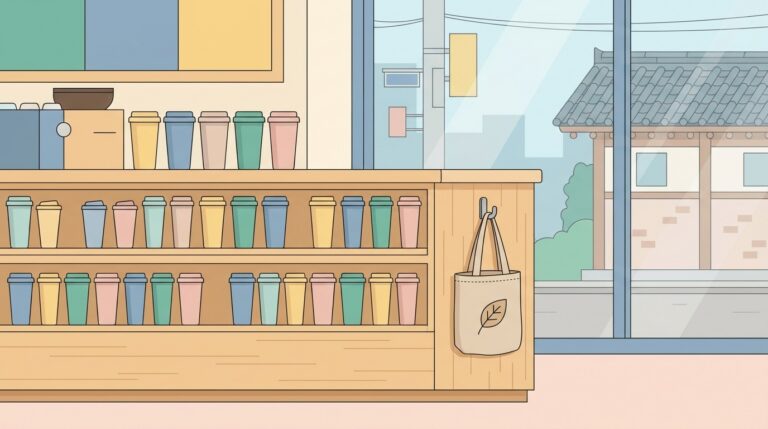
Have you ever opened your kitchen cupboard in Seoul or looked at the coat hooks in your hallway, only to be greeted by an avalanche of promotional tote bags and stainless-steel tumblers? You attended a trendy brand pop-up in Seongsu-dong, went to a climate talk in Gangnam, or bought a seasonal cafe drink, and walked away with another shiny “free eco-gift.” Before you know it, your cozy one-room apartment looks less like an eco-warrior’s sanctuary and more like a logistics warehouse for reusable containers!
South Korea has led decisive regulations against single-use plastics—charging for plastic grocery bags and banning disposable plastic cups inside cafes. Yet, this shift has sparked a fascinating modern contradiction: we collect dozens of “green” items that require immense amounts of water, energy, and fossil fuels to manufacture. As a B2 intermediate learner, how do you express this irony when chatting over coffee with Korean coworkers without sounding like a dry academic paper? Our students often tell us they know the words for “plastic” and “pollution,” but struggle to articulate nuanced concepts like performative eco-consumption or counterproductive habits. This guide unpacks natural, culturally grounded idioms and expressions drawn directly from real Seoul lifestyle debates so you can discuss climate dilemmas with genuine confidence.
Phase 2: Top 3 Core Expressions in Depth
1. 배보다 배꼽이 더 크다 (Bae-boda baekko-bi deo keuda)
- Pronunciation:
Bae-boda baekko-bi deo keuda(Think: Bae like ‘bacon’ without -con, baekkob like a clipped ‘back-cope’, deo keuda like ‘duh koo-dah’) - Meaning: Literal: “The belly button is bigger than the stomach.” / Nuance: “The secondary burden completely outweighs the original benefit” or “The tail is wagging the dog.”
- K-Culture Moment: In modern Korean workplace dramas and lifestyle shows like I Live Alone (나 혼자 산다), you will hear people sigh this expression when spending 30,000 KRW on accessories just to use a 2,000 KRW promotional voucher—or buying ten reusable cups to avoid a 300-won paper cup fee.
- Editor’s Insight: This classic proverb is the gold standard for calling out counterproductive actions. In eco-discussions, it captures the exact carbon footprint paradox: producing mass amounts of “green” merchandise emits far more greenhouse gases than the single-use plastic cups they replace.
- Situation Spectrum: Casual: ✅ | Semi-formal: ✅ | Formal: ✅
- 🤔 Think About It: Why does Korean use human anatomy (belly vs. belly button) to describe disproportionate effort, while English often relies on animal metaphors like “the tail wagging the dog”?
2. 보여주기식 친환경 (Boyeojugi-sik chinhoan-gyeong)
- Pronunciation:
Boyeojugi-sik chinhoan-gyeong(Think: Boy-eo-joo-gi seek chin-hwang-young) - Meaning: Literal: “Show-off style eco-friendliness” / Nuance: “Performative environmentalism” or “Greenwashing.”
- K-Culture Moment: Frequently analyzed by Korean environmental creators and culture columnists when criticizing retail brands that churn out non-recyclable “limited-edition reusable cups” purely for social media marketing buzz.
- Editor’s Insight: The suffix
-식 (-sik)denotes a style or method, usually carrying a sharp, critical undertone (e.g., 탁상공론식 = armchair-theorist style). Attaching it to 친환경 instantly transforms a compliment into an insightful critique of superficial green initiatives. - Situation Spectrum: Casual: ✅ | Semi-formal: ✅ | Formal: ✅
- 🤔 Think About It: While English-speaking debates often use the corporate term “greenwashing,” Korean speakers frequently focus on the social pressure of 보여주기 (putting on an outward show for others). What does this reveal about social optics in Korean society?
3. 하나를 진득하게 쓰다 (Hana-reul jindeuk-hage sseuda)
- Pronunciation:
Hana-reul jindeuk-hage sseuda(Think: Ha-na-reul jin-deuk-ha-geh ssoo-dah) - Meaning: Literal: “To use one thing stickily/patiently” / Nuance: “To stick with one single item faithfully over a long haul.”
- K-Culture Moment: Praised in Korean zero-waste vlogs when creators proudly display a scuffed, dented five-year-old tumbler covered in faded travel stickers rather than buying brand-new seasonal merchandise.
- Editor’s Insight: The adverb
진득하게 (jindeukhage)stems from being steadfast, resilient, and patient. When applied to consumer habits, it conveys genuine cultural respect for mindful stewardship and resisting fast-trend consumerism. - Situation Spectrum: Casual: ✅ | Semi-formal: ✅ | Formal: ⚠️ (In high-level academic presentations, prefer 지속적으로 사용하다)
- 🤔 Think About It: How does praising someone who uses an item 진득하게 connect with the traditional Korean cultural appreciation for enduring bonds and emotional attachment (정, jeong) to everyday objects?
Phase 3: Textbook Korean vs. Real Korean
Situation 1: Pointing out the carbon footprint dilemma of collecting tumblers
- 📖 교과서 한국어: 텀블러를 지나치게 많이 생산하면 탄소 배출량이 증가하여 환경에 유해합니다. (Teombeulleoreul jinachige mani saengsanhamyeon tanso baechullyangi jeunggahayeo hwan-gyeong-e yuhaehamnida. – “If you produce tumblers excessively, carbon emissions increase and it is harmful to the environment.”)
- 🗣️ 진짜 한국어: 텀블러를 모으기만 하면 오히려 일회용품 쓰는 것보다 탄소 발자국이 더 커져요. (Teombeulleoreul moeugiman hamyeon ohiryeo ilhoeyongpum sseuneun geotboda tanso baljagugi deo keojyeoyo. – “If you just hoard tumblers, the carbon footprint ironically ends up bigger than using disposables.”)
- 💡 왜 다를까?: Textbook Korean relies heavily on formal Sino-Korean verbs like 유해하다 (to be harmful). Real conversational Korean uses vivid, relatable contrasts like
오히려 ~보다 더 커져요(ironically becomes larger than…) to sound engaging and natural.
Situation 2: Politely declining an unwanted promotional giveaway
- 📖 교과서 한국어: 이것은 저에게 불필요하니 가져가지 않겠습니다. (Igeoseun jeo-ege bulpilyohani gajyeogaji anketseumnida. – “This is unnecessary for me, so I will not take it.”)
- 🗣️ 진짜 한국어: 집에 에코백이 이미 넘쳐나서, 이건 괜찮습니다! 다른 분께 양보할게요. (Jibe ekobaegi imi neomchyeonaseo, igeon gwaenchansseumnida! Dareun bunkke yangbohalkeyo. – “My house is already overflowing with tote bags, so I am good! I will pass it on to someone else.”)
- 💡 왜 다를까?: Directly telling a staff member “I don’t need this” sounds abrasive in Korean. Softening your refusal by mentioning your overflowing stash at home (넘쳐나서) and framing the decline as generosity toward others (양보할게요) preserves harmonious social rapport.
Phase 4: K-Culture Deep Dive & Non-Verbal Manners
4-1. 눈치 (Nunchi) & Gestures
When declining promotional merchandise at an exhibition or pop-up store in Korea, non-verbal cues carry enormous weight. Never swat your hand dismissively or push the item away. Instead, raise both hands slightly in front of your chest with palms angled inward, nod your head gently, and say: “감사하지만 괜찮습니다! (Gamsahajiman gwaenchansseumnida! – Thank you, but I’m alright!)”
Similarly, when handing your personal tumbler to a barista in a bustling Korean cafe, take off the lid beforehand, ensure the inside is rinsed, and hand it across the counter using both hands. This shows quick 눈치 (nunchi) by respecting the barista’s tight drink-making rhythm during peak lunch hours.
4-2. Culture Code Analysis: Merchandise Obsession vs. The Rise of “Yong-gi”
South Korea has an immense love for high-quality merchandise (굿즈, “goods”). Seasonal tumbler launches often draw queues at dawn outside prominent cafes. However, a strong counter-movement has taken root among environmentally conscious urbanites in neighborhoods like Mangwon-dong and Seongsu-dong.
You will frequently encounter the viral phrase “용기내 챌린지 (Yong-gi-nae Challenge).” In Korean, 용기 (yong-gi) is a clever pun meaning both “courage” and “food container.” The movement encourages citizens to have the courage to bring multi-use containers to restaurants, bakeries, and street tteokbokki stalls instead of accepting plastic packaging. It is an inspiring example of how Korean wordplay sparks meaningful civic action.
Phase 5: Real-World Roleplay Scenario
Setting: A vibrant office cafe near Yeouido, Seoul, during a post-lunch coffee run.
Characters:
* Min-jun (민준): A pragmatic Korean team colleague who cares deeply about sensible consumption.
* Sarah (세라): A B2-level international professional navigating office eco-initiatives.
- Min-jun: 세라 씨, 이번 회사 창립기념일 선물로 또 보온 텀블러를 준대요.
(Sarah-ssi, ibeon hoesa changnipginyeomil seonmullo tto boon teombeulleoreul jundaeyo.)
“Sarah, they said the company is giving out insulated tumblers again for the founding anniversary.”
🎭 머리를 긁적이며 쓴웃음을 짓는다 (Scratches his head with a wry smile) -
Sarah: 아, 진짜요? 작년에도 친환경 에코백이랑 텀블러 세트로 받았잖아요.
(A, jinjjayo? Jaknyeonedo chinhoan-gyeong ekobaegirang teombeulleo seteuro badatjanhayo.)
“Oh, really? We received a set with an eco tote bag and a tumbler last year too, didn’t we?”
🎭 책상 서랍 안쪽을 떠올리며 눈을 크게 뜬다 (Opens eyes wide while thinking of her desk drawer) -
Min-jun: 맞아요. 제 서랍에도 포장도 안 뜯은 텀블러만 서너 개는 쌓여 있어요.
(Majayo. Je seorabedo pojangdo an ttedeun teombeulleoman seoneo gaeneun ssahyeo isseoyo.)
“Exactly. I have three or four tumblers piled up in my drawer that haven’t even been unboxed.”
🎭 가볍게 한숨을 내쉰다 (Exhales a mild sigh) -
Sarah: 이건 완전 배보다 배꼽이 더 큰 상황이네요. 환경을 위한다면서 쓰레기만 늘어나요.
(Igeon wanjeon baeboda baekkobi deo keun sanghwang-ineyo. Hwan-gyeong-eul wihandamyeonseo sseuregiman neureonayo.)
“This is totally a case of the belly button being bigger than the belly. They claim it is for nature, but it just creates more clutter.”
🎭 고개를 절레절레 흔든다 (Shakes head in shared frustration) -
Min-jun: 그러니까요. 이런 보여주기식 친환경 굿즈는 그만 만들었으면 좋겠어요.
(Geureonikkayo. Ireon boyeojugisik chinhoan-gyeong gutjeuneun geuman mandeureosseumyeon jokesseoyo.)
“I know, right. I really wish they would stop making this kind of performative eco-merchandise.”
🎭 동의하며 턱을 괸다 (Rests chin on hand, nodding in agreement) -
Sarah: 맞아요. 새 걸 자꾸 만드는 것보다, 있는 거 하나를 진득하게 쓰는 게 진짜잖아요.
(Majayo. Sae geol jakku mandeuneun geotboda, inneun geo hanareul jindeukhage sseuneun ge jinjjajanhayo.)
“Agreed. Rather than constantly manufacturing new ones, using the single item you already have faithfully is what really counts.”
🎭 들고 온 낡은 개인 텀블러를 톡톡 두드린다 (Taps her own worn personal tumbler affectionately) -
Min-jun: 우리 이번 기념품은 신청하지 말고 사양하기 운동이라도 해볼까요?
(Uri ibeon ginyeompumeun sincheonghaji malgo sayanghagi undong-irado haebolkkayo?)
“Shall we opt out of this year’s anniversary gift and start a gentle decline campaign?”
🎭 장난스러우면서도 진지한 표정으로 묻는다 (Asks with a playful yet serious expression) -
Sarah: 좋은 생각이에요! 불필요한 생산을 줄이는 게 최우선이니까 저도 동참할게요.
(Joeun saenggag-ieyo! Bulpilyohan saengsaneul jurineun ge choe-useon-inikka jeodo dongchamhalkeyo.)
“Great idea! Reducing unnecessary production is the top priority, so count me in.”
🎭 환하게 웃으며 주먹을 가볍게 쥔다 (Smiles warmly and pumps her fist playfully)
🔀 Interactive Choice Point: How would you react if HR asks why you opted out?
- Option A: “그냥 당근마켓에 팔기 귀찮아서 안 받으려고요.” (I am opting out simply because selling it on Karrot Market is too much hassle.)
- Feedback: [Bad] Excessively cynical and unprofessional. It makes you sound dismissive rather than thoughtful.
- Option B: “친환경 취지는 좋지만, 이미 가진 물건이 충분해서 자원 낭비를 줄이고자 사양했습니다.” (The eco-friendly spirit is wonderful, but since I already have enough items, I declined to help curb resource waste.)
- Feedback: [Best] Articulate, polite, and demonstrates high emotional intelligence (눈치) alongside advanced B2-level reasoning.
- Option C: “회사에서 공짜로 주는 걸 굳이 왜 거절해요? 그냥 받아둘게요.” (Why refuse what the company gives out for free? I will just take it.)
- Feedback: [Risk] Misses the opportunity to advocate for environmental integrity and contradicts the group’s ethical stance.
Phase 6: 10-Second Emotion Shadowing Drill
-
Sentence 1:
[🤔 회의적이고 안타까운 톤으로 / Skeptical and concerned]
“친환경이라면서 / 텀블러를 자꾸 나눠주면 / 완전 배보다 배꼽이 더 크잖아요!”
(Chinhoan-gyeong-iramyeonseo / teombeulleoreul jakku nanwojumyeon / wanjeon baeboda baekkobi deo keujanhayo!) -
Sentence 2:
[😌 확신에 차고 차분한 어조로 / Confident and grounded]
“새 굿즈를 모으는 것보다 / 하나를 진득하게 쓰는 게 / 진짜 환경 보호예요.”
(Sae gutjeureul moeuneun geotboda / hanareul jindeukhage sseuneun ge / jinjja hwan-gyeong boho-yeyo.) -
Sentence 3:
[🙅♀️ 정중하지만 단호한 미소로 / Polite yet firm]
“마음은 정말 감사하지만 / 집에 이미 많아서 / 이번엔 사양하겠습니다.”
(Maeumeun jeongmal gamsahajiman / jibe imi manhaseo / ibeonen sayanghagetseumnida.)
Phase 7: K-Culture Mini Dictionary
-
그린워싱 (Geurinwosing) | Greenwashing
Frequently headline news in Korean media when companies promote eco-friendly packaging while actually expanding non-biodegradable promotional gifts. -
텀블러 할인 (Teombeulleo hal-in) | Personal cup/tumbler discount
A standard perk across almost all Korean coffee franchises and indie cafes, granting a 200–500 KRW deduction when ordering in your own container. -
에코백의 역설 (Ekobaeg-ui yeokseol) | The Tote Bag Paradox
A sociopolitical phrase often cited in Korean environmental journalism to describe how organic cotton bags must be reused over 7,000 times to offset their production footprint. -
제로웨이스트 샵 (Jero-we-i-seuteu syap) | Zero-waste refill shop
Charming boutique stores tucked into residential hotspots like Mangwon and Yeonnam where residents refill household detergents and cosmetics by the gram.
Phase 8: Traveler Survival Kit
Top 3 Survival Phrases
- “개인 텀블러에 담아주세요.” (Ge-in teombeulleo-e dama-juseyo.)
Pro Tip: Say this right as you place your order at the counter so the staff does not accidentally prepare your beverage in a single-use cup. - “쇼핑백은 따로 안 주셔도 괜찮아요.” (Syopingbaegeun ttaro an jusyeodo gwaenchanayo.)
Pro Tip: Korean convenience stores legally must charge 100–200 won for bags. Saying this early saves both money and plastic. - “빨대는 안 주셔도 돼요.” (Ppaldaeneun an jusyeodo dwaeyo.)
Pro Tip: Perfect for iced drinks when your tumbler already features a sip lid.
Editor’s Travel Note
Before wandering through trendy Seoul districts, consult the Naver Map app download guide to bookmark local zero-waste cafes and package-free bakeries. Remember: Seoul metropolitan buses strictly forbid passengers from boarding with open single-use beverage cups, but fully leak-proof sealed tumblers are entirely welcome onboard!
Phase 9: “One Step Deeper” (Critical Reflection)
Korean consumer culture moves at breathtaking speed, rapidly alternating between ultra-fast lifestyle trends and community-oriented civic responsibility. When the government institutes environmental policies—such as meticulous multi-tier apartment recycling (분리수거)—citizens adapt with remarkable discipline. However, the commercial craze for limited-edition merchandise (한정판 굿즈) frequently turns environmental tools into disposable fashion statements. This paradox invites us to reflect: does authentic ecological awareness come from buying “greener” products, or does it require practicing mindful contentment with what we already own?
💬 Your Turn: Do you own an accidental collection of tote bags or tumblers at home? How is your home country addressing the fine line between true sustainability and green marketing? Drop your thoughts below in Korean or English!
Phase 10: FAQ & Avoiding Misunderstandings
Q: Can I bring any brand of tumbler to a Korean cafe, or must it match the cafe chain?
A: Any clean tumbler is welcome! You do not need a Starbucks tumbler at Starbucks or a Twosome tumbler at A Twosome Place. As long as your container is clean and large enough for the drink volume (Regular/Tall is usually 355ml, Grande is 473ml), you will receive the discount.
Q: How does ‘배보다 배꼽이 더 크다’ differ from ‘주객전도 (Jugaekjeondo)’?
A: While both describe upside-down priorities, 배보다 배꼽이 더 크다 emphasizes that the incidental costs, burdens, or side effects dwarf the primary benefit. In contrast, 주객전도 (主客顚倒) refers specifically to a reversal of roles, such as an invited guest acting like the master of the house.
Q: Is it considered rude to turn down a company-issued promotional gift in Korea?
A: Not at all, provided you exercise tact (눈치). Politely stating that your household already has plenty (집에 이미 충분히 있어서요) conveys responsible simplicity rather than disrespect toward the organizer.
🚨 Common Mistakes Warning Board
- Mistake: Declining a giveaway by stating bluntly, “이거 쓰레기 돼요 (This becomes garbage).”
Correct Action: Soften the blow by saying, “집에 이미 많아서 다른 분께 양보할게요 (I have plenty at home, so I will happily yield it to someone else).” - Mistake: Using the noun 친환경 (eco-friendliness) directly as an adjective without grammatical connectors.
Correct Action: Say친환경적인 소비(eco-friendly consumption) or친환경 제품(eco-friendly product). - Mistake: Handing over a tumbler filled with beverage remnants or ice from another shop.
Correct Action: Ask the staff politely, “혹시 텀블러 한 번 헹궈주실 수 있나요? (Could you possibly rinse my tumbler?)” before ordering.
Phase 11: Action Missions
- 🥉 Bronze Mission (Solo): Practice saying “배보다 배꼽이 더 커요!” three times out loud, varying your tone from humorous irony to serious critique.
- 🥈 Silver Mission (Social): Snap a photo of your most battered, reliable everyday tumbler or tote bag, post it on social media, and caption it in Korean: “하나를 진득하게 쓰는 중! #매일한글 #제로웨이스트”
- 🥇 Gold Mission (Real Life): During your next store or cafe visit, politely decline an unneeded bag or straw using: “쇼핑백은 괜찮습니다. 제 가방에 넣을게요!”
- 🎮 K-Culture Mission: Search YouTube for “미니멀리스트 왓츠인마이백 (Minimalist What’s in My Bag)” and listen for how creators describe cherishing single items over collecting freebies.
Phase 12: Interactive Quiz Challenge
1. Situational Judgment:
You attend a green business conference and notice they are handing out thick polyester tote bags to all 1,000 attendees to hold a single two-page pamphlet. Which expression most sharply captures this contradiction?
(A) 일석이조 (Il-seok-i-jo)
(B) 배보다 배꼽이 더 크다 (Bae-boda baekko-bi deo keuda)
(C) 다다익선 (Da-da-ik-seon)
2. Fill-in-the-Blank:
새로 나오는 유행 굿즈를 자꾸 사 모으기보다, 이미 가진 물건 하나를 (_______) 오래 쓰는 습관이 중요해요.
(Hint: An adverb meaning steadfastly, patiently, and without wavering.)
3. True or False:
In South Korea, declining a promotional tote bag by saying “다른 분께 양보할게요” (I will yield it to someone else) is considered insulting to the venue staff.
Click to reveal answers & explanations
- Answer: (B) 배보다 배꼽이 더 크다.
Explanation: The excessive environmental cost of manufacturing 1,000 synthetic bags far exceeds the trivial benefit of carrying a small pamphlet. -
Answer: 진득하게 (jindeukhage).
Explanation:진득하게expresses the patient, enduring dedication to sticking with one item over a long span. -
Answer: False.
Explanation: Framing your refusal as an act of yielding to someone else (양보) is seen as courteous, considerate, and culturally graceful.
🎬 Watch Our Daily Videos! (Daily Hangul Official Instagram)
Review the expressions you learned in this article with our fun daily short videos! Check out native pronunciation and real-life nuances in action.
- Instagram @dailyhangul_en







