

Phase 1: 공감 (Story Immersion Opening)
안녕하세요! 매일한글 에디터입니다.
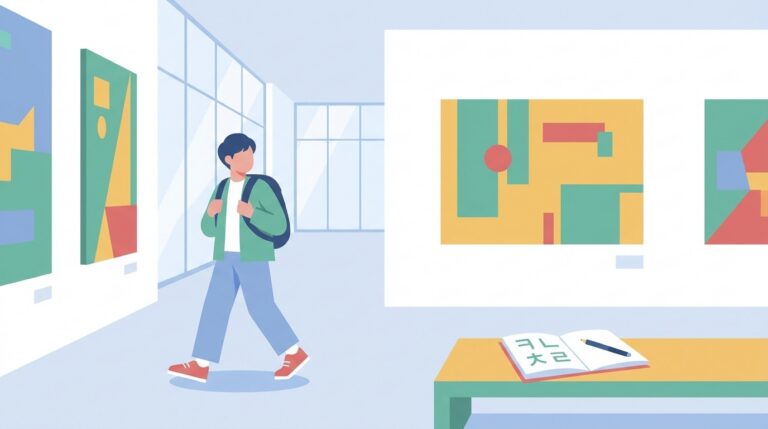
Picture this: It is a crisp Saturday afternoon in Seoul. You turn off the bustling main street of Hannam-dong or stroll past the stone walls of Samcheong-dong, slipping into a quiet alleyway. You find yourself standing in front of a minimalist concrete building with floor-to-ceiling glass windows. Inside, contemporary paintings hang in a serene white-cube space. You step inside, your shoes clicking softly against the polished floor. Immediately, the gallery staff glances up with a warm smile, and a wave of panic hits you.
“Do I need a ticket? Can I just look around? How do I ask about the artist without sounding like a complete beginner, or worse, accidentally interrupting someone?”
If you have ever felt intimidated stepping into Seoul’s boutique art galleries or navigating grand art fairs like Kiaf or Frieze Seoul, you are not alone! Many intermediate Korean learners tell me that while they can comfortably order coffee in Seongsu or ask for directions in Hongdae, stepping into cultural spaces freezes their Korean completely. Art vocabulary often feels unapproachable, and textbook phrases like “이것은 얼마입니까?” (How much is this?) feel out of place in a boutique exhibition.
In this guide, curated from over a decade of art-hopping across Seoul with foreign friends, I will teach you the exact, natural phrases to explore boutique galleries with effortless confidence. You will learn how to ask about docent commentaries, discuss an artist’s world, and master the unspoken nunchi etiquette of Korean art sanctuaries.
Phase 2: 핵심 표현 3선 심층 분석
1. 혹시 도슨트 투어나 작품 설명은 몇 시에 진행되나요? (Hoksi doseunteu tueona jakpum seolmyeong-eun myeot sie jinhaengdoenayo?)
- Pronunciation: [Hok-si do-seun-teu tu-eo-na jak-pum seol-myeong-eun myeot si-e jin-haeng-doe-na-yo?] (Think of ‘Hoksi’ as a polite vocal softener, like gently clearing your throat with ‘By any chance…’)
- Meaning: “By any chance, what time are the docent tour or artwork commentaries held?”
- K-Culture Moment: Seen frequently in K-Dramas like Her Private Life or artsy lifestyle vlogs when characters visit exhibitions in Samcheong-dong.
- Editor’s Insight: The word 도슨트 (docent) has become a massive trend among young Korean art enthusiasts. Koreans love learning the hidden backstory of works rather than just glancing at them. Pairing “혹시” (by any chance) with “진행되나요?” (is it being conducted?) sounds impeccably courteous and natural.
- Situation Spectrum: Casual: ⚠️ | Semi-formal: ✅ | Formal: ✅
- 🤔 Think About It: Why does Korean rely so heavily on softeners like “혹시” before asking informational questions in public spaces?
2. 이 작가님의 작업 세계나 이번 전시 주제가 궁금해요. (I jakkanim-ui jageop segyena ibeon jeonsi jujega gung-geumhaeyo.)
- Pronunciation: [I jak-ga-nim-ui ja-geop se-gye-na i-beon jeon-si ju-je-ga gung-geum-hae-yo.] (Flow ‘jak-ga-nim’ smoothly with an honorific lift on ‘-nim’)
- Meaning: “I am curious about this artist’s creative world and the theme of this exhibition.”
- K-Culture Moment: The signature phrase used by artsy influencers and celebrity art collectors (like BTS’s RM) during private views or gallery open days.
- Editor’s Insight: Instead of asking “이 그림 뭐예요?” (What is this painting?), which sounds childish at a B2 level, native speakers use 작업 세계 (world of work/artistic vision). It immediately signals that you respect the creator’s conceptual depth.
- Situation Spectrum: Casual: ⚠️ | Semi-formal: ✅ | Formal: ✅
- 🤔 Think About It: In English, we often ask “What is this piece about?” How does framing it as “the artist’s world” (작업 세계) change the dynamic between viewer and artist?
3. 편하게 천천히 둘러보고 올게요. (Pyeonhage cheoncheonhi dulleobogo olgeyo.)
- Pronunciation: [Pyeon-ha-ge cheon-cheon-hi dul-leo-bo-go ol-ge-yo.] (Imagine saying ‘cheon-cheon-hi’ with a rhythmic, unhurried cadence)
- Meaning: “I will take my time browsing around comfortably.”
- K-Culture Moment: Said when an attentive gallery assistant or art fair booth representative approaches you to offer an explanation, but you prefer quiet contemplation first.
- Editor’s Insight: In boutique galleries, staff often hover politely to assist. This sentence is your ultimate polite buffer. It acknowledges their hospitality while gently requesting personal space without any awkward tension.
- Situation Spectrum: Casual: ⚠️ | Semi-formal: ✅ | Formal: ✅
- 🤔 Think About It: How does setting personal space politely reflect the balance between communal attentiveness and individual privacy in modern Korean spaces?
Phase 3: 교과서 한국어 vs 진짜 한국어
Situation 1: Asking if silent photography is allowed
- 📖 교과서 한국어: 여기서 사진을 찍어도 됩니까? (Yeogiseo sajineul jjigeodo doebnikka? – “Is one permitted to take photos here?”)
- 🗣️ 진짜 한국어: 혹시 무음으로 사진 촬영 가능할까요? (Hoksi mueum-euro sajin chwaryeong ganeunghalkkayo? – “By any chance, would silent photo shooting be okay?”)
- 💡 왜 다를까? Textbook Korean uses overly rigid military-style formal endings (
-ㅂ니까). Modern gallery visitors specify 무음 (silent mode) because shutter sounds disrupt the tranquil gallery ambiance. Adding “가능할까요?” softens the request gracefully.
Situation 2: Expressing deep appreciation for an artwork
- 📖 교과서 한국어: 이 그림은 매우 아름답습니다. (I geurimeun maeu areumdapseumnida. – “This painting is very beautiful.”)
- 🗣️ 진짜 한국어: 질감이 독특해서 여운이 오래 남네요. (Jilgami dokteukhaeseo yeo-uni olae namneyo. – “The texture is unique, leaving a lasting resonance.”)
- 💡 왜 다를까? Intermediate and advanced Korean speakers rarely stop at “아름답다” (beautiful). Using sensory art terms like 질감 (texture) and emotional depth terms like 여운 (lingering resonance) elevates your conversation into a genuine aesthetic critique.
Phase 4: K-Culture 딥다이브 & 비언어적 매너
4-1. 눈치 (Nunchi) & Gallery Gestures
When stepping into an intimate gallery in Hannam-dong or an indie experimental space in Seongsu, the etiquette is silent and subtle:
* The 15-Degree Nod: As you enter, make brief eye contact with the gallery desk attendant and give a light, respectful 15-degree head nod. A loud “안녕하세요!” breaks the acoustic calm.
* The Two-Step Distance: Keep at least two steps (approx. 50–70cm) away from wall-mounted canvases. Even pointing your finger too close to a painting makes curators nervous.
* Two-Handed Leaflet Collection: If complimentary pamphlets or artist statements (리플릿) are arranged on the central table, pick one up with both hands if someone hands it to you, or gently take one with quiet precision.
4-2. Cultural Code: The ‘Art-Stroll’ (갤러리 산책) Boom
In Seoul, gallery visits are no longer reserved for wealthy collectors. Driven by the arrival of international art fairs like Frieze Seoul alongside Kiaf, gallery hopping has transformed into a staple weekend lifestyle for younger generations. In neighborhoods like Seongsu-dong, former red-brick factories now house contemporary installations; in Samcheong-dong, minimalist modern galleries contrast with ancient Hanok roofs. Visiting a gallery, picking up exhibition postcards, and debriefing over pour-over coffee has become the ultimate urban ritual of mindfulness and self-care.
Phase 5: 실전 롤플레이 시나리오
Setting: Space Hannam, a tranquil boutique contemporary gallery tucked behind the bustling cafe street of Hannam-dong. Soft ambient soundscapes play in the background.
Characters: Alex (Intermediate art lover visiting Seoul) & Curator Jimin (A warm, stylish gallery manager).
- 알렉스: [🎭 조심스럽게 문을 열고 들어가며 눈인사를 건넨다] 안녕하세요. 혹시 지금 전시 관람 가능한가요? (Annyeonghaseyo. Hoksi jigeum jeonsi gwanram ganeunghangayo? / [Entering carefully, offering a gentle nod] Hello. By any chance, is the exhibition open for viewing right now?)
- 큐레이터 지민: [🎭 미소를 지으며 일어서서 맞이한다] 네, 환영합니다! 자유롭게 관람하시면 돼요. (Ne, hwanyeonghamnida! Jayurobge gwanramhasimyeon dwaeyo. / [Standing up with a warm smile] Yes, welcome! Feel free to view at your own pace.)
- 알렉스: [🎭 데스크의 팜플렛을 가리키며] 감사합니다. 혹시 리플릿 하나 챙겨가도 될까요? (Gamsahamnida. Hoksi ripeullit hana chaenggyeogado doelkkayo? / [Pointing politely to the desk brochures] Thank you. May I take one of these leaflets?)
- 큐레이터 지민: [🎭 두 손으로 리플릿을 건네며] 그럼요! 이번 전시는 신진 작가 3인의 기획전이에요. (Geureomyo! Ibeon jeonsineun sinjin jakga sam-in-ui gihoekjeon-ieyo. / [Handing the leaflet with both hands] Of course! This exhibition is a curated show featuring three emerging artists.)
- 알렉스: [🎭 메인 설치 작품을 흥미롭게 바라보며] 와, 공간 활용이 인상적이네요. 혹시 도슨트 설명도 따로 진행되나요? (Wa, gonggan hwalyongi insangjeogineyo. Hoksi doseunteu seolmyeongdo ttaro jinhaengdoenayo? / [Looking at the main installation with intrigue] Wow, the spatial arrangement is striking. Is there a separate docent commentary conducted by any chance?)
- 큐레이터 지민: [🎭 브로셔의 QR 코드를 가리키며] 정규 도슨트는 주말 3시인데요, 옆에 있는 QR코드를 찍으시면 모바일 오디오 가이드를 들으실 수 있어요. (Jeonggyu doseunteuneun jumal sesi-indeyo, yeope inneun QRkodeureul jjigeusimyeon mobail odio gaideureul deureusil su isseoyo. / [Pointing to the QR code on the brochure] Scheduled docents are at 3 PM on weekends, but if you scan this QR code, you can listen to our mobile audio guide.)
- 알렉스: [🎭 휴대폰을 꺼내며] 정말 좋네요! 편하게 천천히 둘러보고 올게요. (Jeongmal jonneyo! Pyeonhage cheoncheonhi dulleobogo olgeyo. / [Taking out phone thoughtfully] That’s fantastic! I’ll take my time browsing comfortably.)
- 큐레이터 지민: [🎭 가볍게 고개를 끄덕이며] 네, 편하게 보시고 궁금한 점 있으시면 언제든 말씀해 주세요. (Ne, pyeonhage bosigo gung-geumhan jeom isseusimyeon eonjedeun malsseumhae juseyo. / [Nodding gently] Sure, enjoy your viewing and let me know anytime if you have any questions.)
🔀 인터랙티브 분기점 (Interactive Branching Point)
You are standing in front of a delicate mixed-media canvas with real dried wildflowers attached. You want to take an aesthetic photo for your feed. What do you do?
- Choice A: Pull out your phone and snap a photo right away with the camera sound on.
- Choice B: Ask the curator: “저기요, 이거 인스타에 올려도 돼요?” (Hey, can I post this on Insta?)
- Choice C: Approach the curator calmly and ask: “혹시 플래시랑 소리 없이 사진 촬영해도 괜찮을까요?” (Hoksi peullaesirang sori eopsi sajin chwaryeonghaedo gwaenchaneulkkayo?)
Feedback:
* Choice A (Risk): Not recommended! The loud shutter sound will startle people in a quiet gallery, and certain private boutique shows prohibit photography altogether.
* Choice B (Bad): While understandable, “저기요” (Hey there) can sound abrupt in high-end cultural spaces, and asking directly about social media might seem superficial.
* Choice C (Best!): Perfect! Specifying “without flash and sound” shows immense respect for both the artwork preservation and other gallery patrons.
Phase 6: 10초 감정 섀도잉 드릴 (Emotional Shadowing Drill)
Read these out loud, pausing where indicated by / and embodying the emotional cues:
[🎨 호기심 가득하고 정중하게]
혹시 / 도슨트 투어나 / 작품 설명은 / 몇 시에 진행되나요?
(Hoksi / doseunteu tueona / jakpum seolmyeong-eun / myeot sie jinhaengdoenayo?)-
[✨ 깊은 감탄과 지적인 여운을 담아]
질감이 독특해서 / 작품의 여운이 / 오래 남는 것 같아요.
(Jilgami dokteukhaeseo / jakpum-ui yeo-uni / olae namneun geot gat-ayo.) -
[🌿 편안하고 나지막한 목소리로]
안내 감사해요. / 편하게 / 천천히 둘러보고 올게요.
(Annae gamsahaeyo. / Pyeonhage / cheoncheonhi dulleobogo olgeyo.)
Phase 7: K-Culture 미니 사전
-
눈호강 (Nun-hogang)
- Meaning: “Feast for the eyes” / Visual luxury.
- Usage: Used when visiting an aesthetically stunning exhibition or gorgeous gallery space. “오늘 성수동 갤러리 투어 완전 눈호강이었어!” (Today’s Seongsu gallery tour was a total feast for the eyes!)
- 도슨트 (Doseunteu)
- Meaning: Exhibition docent / Gallery guide.
- Usage: In Korea, popular docents like Kim Chan-yong have celebrity-like followings. People actively search for “도슨트 시간” (docent schedule) before visiting art centers.
- 기획전 (Gihoekjeon)
- Meaning: Curated special exhibition (vs. 상설전, permanent collection).
- Usage: Boutique galleries in Hannam and Samcheong almost exclusively run thematic gihoekjeon rotating every 4 to 8 weeks.
- 여운 (Yeo-un)
- Meaning: Lingering resonance / Afterglow of emotion.
- Usage: The quintessential Korean aesthetic value. A masterpiece is measured not by how flashy it looks, but by how much yeo-un it leaves in your heart on your walk back home.
Phase 8: 여행자를 위한 생존 키트
서바이벌 표현 TOP 3
- 리플릿 하나 챙겨가도 될까요? (Hoksi ripeullit hana chaenggyeogado doelkkayo?)
Pro Tip: Use this at reception desks. Boutique galleries print stunning mini-posters as leaflets that make wonderful free travel souvenirs! - 관람 동선이 어떻게 되나요? (Gwanram dongseoni eotteoke doenayo?)
Pro Tip: In multi-floor historic Hanok or restored industrial warehouses in Seongsu, knowing the intended route (동선, dongseon) ensures you view the story chronologically. - 이 작품은 플래시 없이 촬영 가능한가요? (I jakpumeun peullaesi eopsi chwaryeong ganeunghangayo?)
Pro Tip: Flashing lights damage pigment and canvas textures; asking this demonstrates top-tier cultural sophistication.
Editor’s Travel Note
- Essential Navigation: Use the 네이버 지도 앱 다운로드 to search for “갤러리” (gallery) in Samcheong-dong (삼청동), Hannam-dong (한남동), and Seongsu-dong (성수동). Bookmark them into customized folders.
- Admission Culture: The vast majority of independent boutique commercial galleries in Seoul are completely free! You do not need to buy artwork to enter and appreciate the exhibits.
- Transit Insight: For Samcheong-dong, take Subway Line 3 to Anguk Station (Exit 1) and walk past the Seoul Museum of Craft Art. For Hannam-dong, Hangangjin Station (Line 6, Exit 1) puts you minutes away from prestigious contemporary spots like Leeum Museum of Art and Pace Gallery.
Phase 9: “한 발 더 깊이” (Cultural Insight)
In hyper-fast Seoul, where ppalli-ppalli (빨리빨리, hurry-hurry) culture drives the daily rhythm, boutique galleries serve an essential socio-cultural function: they are urban sanctuaries of yeobaek (여백, contemplative white space). When Koreans walk into a quiet gallery in Hannam or Samcheong on a Saturday, they are not simply inspecting paintings; they are intentionally resetting their senses. Stepping into an empty room to look at a monochrome Dansaekhwa (단색화) canvas is a quiet rebellion against digital burnout.
💬 Your Turn: Have you ever visited an art gallery or museum in your home country or in Korea? What emotion did the space evoke in you? Leave your thoughts below in Korean using the word 여운 (lingering resonance)!
Phase 10: FAQ & 오해 방지
Q: Do I have to pay an entrance fee or buy something when entering boutique commercial galleries in Seoul?
A: In almost all commercial galleries (like PKM, Kukje, or smaller project spaces in Seongsu), admission is 100% free! You are welcome to browse quietly without any obligation to purchase.
Q: Can I use conversational 반말 (informal speech) if the gallery curator looks younger than me?
A: Absolutely not! Cultural venues always require 존댓말 (honorific speech). Always use polite endings like -요 or -ㅂ니다, regardless of the staff’s apparent age.
Q: What should I do if a gallery displays a “촬영 금지” (No Photography) sign?
A: Respect the sign immediately by putting your phone away. Even taking a quick photo of your shoes against the floor or an aesthetic corner can lead to an awkward reminder from staff.
🚨 흔한 실수 (Common Mistakes) TOP 3
- Calling the gallery worker “아줌마” (Ajumma) or “아가씨” (Agassi):
Correct Action: Use neutral, professional titles: simply say “저기요, 실례지만…” or refer to them as “큐레이터님” (Curator-nim). - Touching the display pedestals or lean rails:
Correct Action: Keep your hands lightly folded behind your back or at your sides—a classic stance known as 뒷짐 (dwit-jim), signaling you have no intention of touching delicate installations. - Using textbook “얼마예요?” directly to start a conversation:
Correct Action: Asking prices right away can come across as crass. First ask about the artist’s concept (“이 작가님 작업에 대해 더 알 수 있을까요?”), and only request the price list (“프라이스 리스트 확인 가능할까요?”) if seriously interested.
Phase 11: 액션 미션 & 참여 유도
- 🥉 Bronze Mission (Solo Practice): Read the Phase 6 shadowing drill out loud 3 times until the phrase “편하게 천천히 둘러보고 올게요” rolls off your tongue in under 3 seconds.
- 🥈 Silver Mission (Social Connection): Search Instagram for the hashtag
#삼청동갤러리or#한남동전시and leave a Korean comment on an artwork you like: “질감이 독특해서 여운이 깊네요!” - 🥇 Gold Mission (Real World): Visit an art gallery near you or in Korea this month, greet the staff with a gentle nod, and politely ask for a brochure: “혹시 리플릿 하나 챙겨가도 될까요?”
🎮 K-Culture Mission: Watch a gallery tour vlog by a Korean creator or check BTS RM’s Instagram archive of gallery visits. Spot at least two artworks that give you a sense of 여운!
Phase 12: 인터랙티브 퀴즈 챌린지
Quiz 1. Situational Judgment
You walk into a quiet boutique gallery in Samcheong-dong and want to know if there is an audio guide or docent tour. Which sentence is the most natural and courteous?
1. 저기요, 도슨트 왜 안 해요? (Hey, why aren’t you doing a docent?)
2. 혹시 도슨트 투어나 작품 설명은 몇 시에 진행되나요? (By any chance, what time is the docent tour or commentary held?)
3. 그림 설명 빨리 해주세요. (Explain this painting quickly please.)
👉 정답 및 해설 보기 (Click to view answer)
정답: 2번
해설: ‘혹시’로 부드럽게 말을 열고, 정중한 종결 어미인 ‘-몇 시에 진행되나요?’를 사용한 2번이 가장 자연스럽고 교양 있는 표현입니다. 1번과 3번은 명령조이거나 무례하게 들릴 수 있습니다.
Quiz 2. Fill-in-the-Blank
Fill in the blank to politely tell the gallery staff you will browse on your own first:
“안내 감사합니다. 편하게 [ ] 둘러보고 올게요.”
👉 정답 및 해설 보기 (Click to view answer)
정답: 천천히 (cheoncheonhi – slowly / unhurriedly)
해설: ‘천천히 둘러보고 올게요’는 상대방의 호의를 정중히 받으면서도 개인적인 감상 시간을 요청하는 세련된 표현입니다.
Quiz 3. True / False Cultural Quiz
Q: In Korea, small boutique commercial art galleries in Hannam-dong or Samcheong-dong always charge an expensive entrance fee at the door. (True / False)
👉 정답 및 해설 보기 (Click to view answer)
정답: False
해설: 대형 미술관의 블록버스터 특별전을 제외한 대부분의 상업 화랑 및 부티크 갤러리는 무료로 열려 있습니다. 누구나 산책하듯 들어가 자유롭게 작품을 감상할 수 있습니다.
🎬 Watch Our Daily Videos! (Daily Hangul Official Instagram)
Review the expressions you learned in this article with our fun daily short videos! Check out native pronunciation and real-life nuances in action.
- Instagram @dailyhangul_en







