

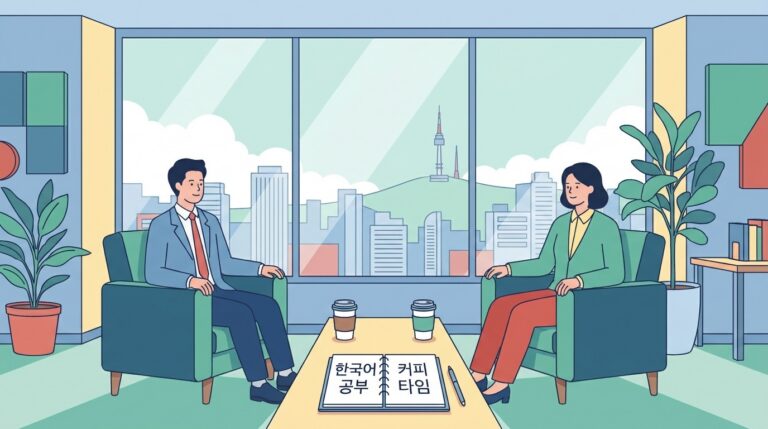
Mastering Modern Korean HR: 360-Degree Reviews and 1-on-1 Feedback
Phase 1: Empathy (Story-driven Opening)
안녕하세요! 매일한글 에디터입니다. (Hello! It’s your Daily Hangul editor here.)
If you have ever watched classic workplace K-dramas like Misaeng (Incomplete Life), you probably remember the suffocating image of traditional Korean offices: an autocratic team leader shouting down commands, grading performance behind closed doors, while junior associates hold their breath in corner cubicles. For decades, the notorious ‘하향식 평가’ (top-down evaluation) was the undisputed law of Korean corporate life. However, step into Pangyo Techno Valley or a modern Seoul multinational today, and you will encounter an entirely transformed workplace ecosystem.
International executives and bilingual managers frequently confide in me: “I know how to deliver a performance review in English, but doing it in Korean feels like navigating a cultural minefield. How do I facilitate peer evaluations without triggering defensive hostility or sounding like a rigid textbook?” Navigating this shift requires more than just translating “feedback” into Korean; it demands an understanding of relational hierarchy, face-saving tactics, and modern corporate etiquette. This C1-level masterclass is distilled from real-world corporate coaching to help you confidently champion 360-degree reviews, cultivate psychological safety, and conduct seamless one-on-one sessions in contemporary Korean business environments.
Phase 2: Core Expressions Deep Dive
1. 하향식 평가의 한계를 극복하고자 다면평가를 도입했습니다
- Pronunciation: Hahyangsik pyeong-ga-ui hangyereul geukbokhagoja damyeonpyeong-gareul do-iphaessseumnida. (Sounds like: Hah-hyang-sheek pyung-gah-ui hahn-gyeh-reul gook-bok-hah-go-jah dah-myun-pyung-gah-reul doh-eep-haet-seum-nee-dah)
- Meaning:
- Literal: To overcome the limitations of downward evaluations, we introduced multi-faceted evaluations.
- Corporate Nuance: We implemented 360-degree peer feedback to resolve the systemic blind spots of conventional top-down reviews.
- K-Culture Moment: Seen in contemporary corporate dramas like Search: WWW or Agency, where innovative team directors dismantle legacy evaluation rubrics to champion merit- and peer-based metrics.
- Editor’s Insight: The connector ‘-하고자’ elevates your rhetoric to an executive tier, signaling clear intentionality and strategic vision rather than simple reactionary policy changes.
- Situation Spectrum: Casual 🚫 | Semi-formal ⚠️ | Formal ✅
- 🤔 Think About It: In many Western companies, 360-degree reviews are treated as standard diagnostic data. Why might introducing peer reviews in a culturally Confucian workplace require such strategic, formal framing?
2. 상시 원온원 미팅을 통해 심리적 안전감을 조성하고 있어요
- Pronunciation: Sangsi won-on-won miting-eul tonghae simrijeok anjeongameul joseonghago isseoyo. (Sounds like: Sahng-shee one-on-one mee-ting-eul tong-heh sheem-ree-juck ahn-jung-gahm-eul joh-sung-hah-goh ee-ssuh-yoh)
- Meaning:
- Literal: Through frequent one-on-one meetings, we are forming psychological security.
- Corporate Nuance: We are fostering an atmosphere of psychological safety through regular 1-on-1 check-ins.
- K-Culture Moment: Common in Pangyo startup vlogs and modern IT corporate documentaries where managers swap formal conference rooms for casual coffee chats to discuss career alignment and roadblocks.
- Editor’s Insight: ‘심리적 안전감’ (psychological safety) has become an essential buzzword among Korean leadership teams. Pairing it with ‘조성하다’ (to foster/cultivate) demonstrates high-level managerial empathy.
- Situation Spectrum: Casual ⚠️ | Semi-formal ✅ | Formal ✅
- 🤔 Think About It: How does the English concept of “radical candor” need to be adapted when pursuing “심리적 안전감” in a high-context communication culture like Korea?
3. 일방적인 지시보다는 정례적인 피드백 루프를 정착시키는 것이 핵심입니다
- Pronunciation: Ilbangjeogin jisibodaneun jeongnyejeogin pideubaek lupeureul jeongchaksikineun geosi haeksimimnida. (Sounds like: Eel-bahng-juck-een jee-shee-boh-dah-noon jung-ryeh-juck-een pee-deu-baek loop-peul jung-chahk-shee-kee-noon guh-shee hehk-sheem-eem-nee-dah)
- Meaning:
- Literal: Rather than one-way instructions, anchoring a regular feedback loop is the core.
- Corporate Nuance: Embedding a consistent, iterative feedback cycle takes precedence over unilateral top-down directives.
- K-Culture Moment: Heard during HR transformation town halls and all-hands meetings at forward-thinking Korean unicorn startups such as Toss or Coupang.
- Editor’s Insight: ‘정착시키다’ (to firmly establish/embed) suggests systemic organizational transformation rather than a superficial, short-lived HR initiative.
- Situation Spectrum: Casual 🚫 | Semi-formal ✅ | Formal ✅
- 🤔 Think About It: What communicative friction arises when transitioning a team from ‘일방적인 지시’ (command-and-control) to an open loop system in your home corporate culture?
Phase 3: Textbook Korean vs. Real Korean
Situation 1: Suggesting a routine check-in with a team member
- 📖 교과서 한국어 (Textbook Korean):
- 이번 주에 업무 성과에 대한 면담을 진행합시다. (Ibeon jue eommu seonggwae daehan myeondameul jinhaenghapsida. / Let us conduct an interview regarding job performance this week.)
- 🗣️ 진짜 한국어 (Real Korean):
- 이번 주에 잠깐 티타임 하면서 가볍게 원온원 할까요? 지난 스프린트 회고도 할 겸요. (Ibeon jue jamkkan titaim hamyeonseo gabyeopge won-on-won halkkayo? Jinan seupeurinteu hoegodo hal gyeom-yo. / Shall we grab a quick coffee and do a light 1-on-1 this week? We can recap the last sprint as well.)
- 💡 왜 다를까? (Why the difference?):
The textbook term ‘면담’ (interview/interrogation) evokes being called into the principal’s office or facing a punitive HR audit. Real corporate leaders suggest a ‘티타임’ (tea time) or ‘원온원’ (1on1) paired with agile terminology like ‘스프린트 회고’ (sprint retro) to defuse tension.
Situation 2: Encouraging honest peer input without defensive anxiety
- 📖 교과서 한국어 (Textbook Korean):
- 동료들의 결점을 솔직하게 지적하여 제출해 주십시오. (Dongnyodeurui gyeoljeomeul soljikhage jijeokhayeo jechulhae jusipsio. / Please frankly point out your colleagues’ flaws and submit them.)
- 🗣️ 진짜 한국어 (Real Korean):
- 동료 다면평가는 상호 성장을 돕기 위한 constructive feedback 차원이니 편하게 적어주세요. (Dongnyo damyeonpyeong-ganeun sangho seongjang-eul dopgi wihan constructive feedback chawon-ini pyeonhage jeogeojuseyo. / The 360 peer review is designed for mutual growth and constructive input, so feel free to share candidly.)
- 💡 왜 다를까? (Why the difference?):
Direct words like ‘결점 지적’ (pointing out flaws) create profound social dread in collectivist corporate settings. Modern leaders emphasize ‘상호 성장’ (mutual growth) and frequently borrow global HR expressions like “constructive feedback” to soften interpersonal weight.
Phase 4: K-Culture Deep Dive & Non-Verbal Manners
4-1. 눈치 (Nunchi) & Non-Verbal Tact in 1-on-1 Settings
Conducting a successful 1-on-1 in Korea requires master-level 눈치 (tactful situational awareness). When offering developmental feedback:
* The 45-Degree Seating Angle: Avoid sitting squarely across a conference table in an adversarial pose. Opt for a 45-degree angle or a round coffee table in an open lounge. This spatial arrangement dismantles hierarchical confrontation.
* Softening Linguistic Delivery: Replace conclusive assertions with hedged modals like “-인 것 같아요” (it seems that…) or “-하는 방향은 어떨까요?” (how would you feel about moving toward…?). This allows the subordinate to accept recommendations without losing face (체면).
* Eye Contact Modulation: Unbroken, intense eye contact can be perceived as an aggressive interrogation by senior or junior Korean professionals. Soften your gaze toward shared notes or sprint boards rather than staring directly down the table.
4-2. Cultural Shift: Pangyo Startup Ethos vs. Yeouido Tradition
The traditional ‘상명하복’ (absolute obedience to orders) of old conglomerates is rapidly losing ground to the Pangyo tech corridor style. While Yeouido’s traditional finance hubs still balance strict annual appraisals with mandatory after-work drinking sessions (회식), tech unicorns in Pangyo have normalized bi-weekly 1-on-1s over specialty pour-overs. This cultural pivot mirrors themes seen in the drama Start-Up, where transparent metric tracking and flat peer alignments replace bureaucratic seniority (서열 문화).
Phase 5: Real-World Roleplay Scenario
Setting: A modern glass meeting room at a Pangyo tech enterprise.
Characters:
* Elena (Head of People Operations): An experienced bilingual HR director spearheading culture transformation.
* Min-woo (Engineering Team Lead): A brilliant technical leader who previously operated under strict hierarchical structures.
— dialogue —
Turn 1: Elena
민우 님, 이번 분기부터 도입된 동료 다면평가 결과 받아보셨죠? 전반적인 팀 분위기는 어떤가요?
(Min-u nim, ibeon bunggibuteo do-ipdoen dongnyo damyeonpyeong-ga gyeolgwa badabosyeottjyo? Jeonbanjeogin tim bunwigineun eotteongayo?)
“Min-woo, you’ve received the results from our newly implemented peer reviews this quarter, right? How is the overall team climate?”
🎭 [Warm smile, leans back in an open posture, gesturing toward the tablet screen]
Turn 2: Min-woo
네, 솔직히 팀원들이 서로 눈치를 보느라 평가 작성을 꽤 부담스러워하더라고요.
(Ne, soljikhi timwondeuri seoro nunchireul boneura pyeong-ga jakseong-eul kkwae budamseureowohadeoragoyo.)
“Yes, honestly, the team members felt quite burdened writing evaluations because they were constantly trying to read each other’s reactions.”
🎭 [Sighs slightly, resting hands together on the table, displaying genuine concern]
Turn 3: Elena
충분히 이해해요. 기존의 하향식 평가에 익숙하다 보니 상호 피드백을 ‘평가’가 아닌 ‘비난’으로 받아들일 위험이 있죠.
(Chungbunhi ihaehaeyo. Gijonui hahyangsik pyeong-gae iksukhada boni sangho pideubaegeul ‘pyeong-ga’ga anin ‘binan’euro badadeuril wiheomi itjyo.)
“I completely understand. Because they are accustomed to legacy top-down evaluations, there is a risk of perceiving mutual feedback as criticism rather than growth.”
🎭 [Nods empathetically, speaking with an understanding and calm cadence]
Turn 4: Min-woo
맞습니다. 특히 시니어 개발자가 주니어의 피드백을 수용하는 과정에서 약간의 심리적 저항도 감지되고 있습니다.
(Matseumnida. Teukhi sinieo gaebaljaga junieoui pideubaegeul suyonghaneun gwajeong-eseo yakganui simrijeok jeohangdo gamjidoego isseumnida.)
“Exactly. In particular, we are sensing some psychological resistance when senior engineers have to digest feedback from juniors.”
🎭 [Taps pencil lightly, speaking candidly with furrowed brows]
Turn 5: Elena
그 지점을 완화하려면 상시 원온원 미팅을 정례화해서 심리적 안전감을 다져주는 게 시급해요.
(Geu jijeomeul wanhwaharyeomyeon sangsi won-on-won miting-eul jeongnyehwahae-seo simrijeok anjeongameul dajyeojuneun ge sigeuphaeyo.)
“To alleviate that exact friction, it is urgent that we formalize regular 1-on-1s to fortify psychological safety.”
🎭 [Maintains a constructive tone, pointing gently toward the proposed onboarding roadmap]
Turn 6: Min-woo
원온원을 단순한 업무 보고 자리가 아니라, 성장을 지원하는 피드백 루프로 안착시켜야겠군요.
(Won-on-woneul dansunhan eommu bogo jariga anira, seongjang-eul jiwonhaneun pideubaek lup-euro anchaksikyeoyagettgunyo.)
“So we need to anchor 1-on-1s as an iterative feedback loop supporting career growth, rather than just a status-reporting meeting.”
🎭 [Eyes light up with realization, taking notes briskly]
Turn 7: Elena
정확해요! 리더가 먼저 취약성을 보여줄 때 팀원들도 방어 기제를 풀고 건설적인 논의를 시작할 수 있습니다.
(Jeonghwakhaeyo! Lideoga meonjeo chwiyakseong-eul boyeojul ttae timwondeuldo bang-eo gijereul pulgo geonseoljeogin non-uireul sijakhal su isseumnida.)
“Precisely! When leaders demonstrate vulnerability first, team members let down their defensive mechanisms and step into constructive dialogue.”
🎭 [Speaks with encouraging conviction, offering an affirming nod]
Turn 8: Min-woo
좋습니다. 이번 주부터 팀원들과 1대1 싱크를 잡고, 평가 제도 개편의 취지를 직접 공유하겠습니다.
(Jotseumnida. Ibeon jubuteo timwondeulgwa il-dae-il singkeureul japgo, pyeong-ga jedo gaepyeonui chwijireul jikjeop gong-yuhagesseumnida.)
“Understood. Starting this week, I will schedule 1-on-1 syncs with the team and communicate the strategic purpose of this evaluation reform firsthand.”
🎭 [Smiles confidently, closing his laptop with renewed determination]
— 🔀 Interactive Branching Decision —
Imagine Min-woo asks you: “How should I react if a junior teammate writes that my code reviews are overly curt and demotivating?” How do you advise him?
- Choice A (Defensive Assertiveness): “팀의 엔지니어링 표준을 위해 단호함이 필요했다고 정당성을 명확히 설명하세요.” (Clarify that firmness was necessary to maintain team standards.)
- Outcome (Bad): Shuts down future honest reviews. The junior engineer will immediately retract into self-protective silence.
- Choice B (Vulnerable Engagement): “피드백 고맙다고 먼저 말한 뒤, 어떤 전달 방식이 더 성장에 도움이 될지 원온원에서 구체적으로 물어보세요.” (Thank them for the feedback, then ask in a 1-on-1 what delivery style would best support their development.)
- Outcome (Best): Demonstrates genuine leadership maturity and directly cements psychological safety across the team.
- Choice C (Indifference/Bypassing): “다면평가는 익명이니 그냥 못 본 척 넘어가고 다음 스프린트에 집중하세요.” (Since it’s an anonymous review, pretend you didn’t see it and move on.)
- Outcome (Risk): Fails to resolve interpersonal friction; latent resentment will eventually leak into sprint productivity.
Phase 6: 10-Second Emotion Shadowing Drill
Practice reading these lines aloud with native rhythm and cadence. Notice the slash / marks where you should pause slightly.
[🤝 진중하면서도 부드럽게 - Sincere and Gentle]
하향식 평가의 한계를 / 극복하고자 / 다면평가를 도입했습니다.
(Hahyangsik pyeong-ga-ui hangyereul / geukbokhagoja / damyeonpyeong-gareul do-iphaessseumnida.)-
[💡 확신에 찬 어조로 - Confident and Strategic]
상시 원온원 미팅을 통해 / 팀 내 심리적 안전감을 / 확고히 조성하고 있어요.
(Sangsi won-on-won miting-eul tonghae / tim nae simrijeok anjeongameul / hwakkwohi joseonghago isseoyo.) -
[🌱 격려와 공감을 담아서 - Encouraging and Empathetic]
일방적인 지시보다는 / 정례적인 피드백 루프를 / 정착시키는 것이 핵심입니다.
(Ilbangjeogin jisibodaneun / jeongnyejeogin pideubaek lupeureul / jeongchaksikineun geosi haeksimimnida.)
Phase 7: K-Culture Mini Dictionary
- 다면평가 (Damyeon-pyeongga) | 360-Degree / Multi-Rater Assessment
Refers to evaluation systems factoring in reviews from peers, subordinates, and cross-functional partners rather than relying exclusively on a direct boss’s scoring. Widely embraced in modern Korean tech culture. - 원온원 / 싱크 (Won-on-won / Singkeu) | 1-on-1 Check-in / Sync
Adopted from global tech parlance, it denotes recurring, bilateral career-and-blocker check-ins between a manager and an employee, contrasting sharply with traditional disciplinary ‘면담’. - 심리적 안전감 (Simrijeok anjeong-gam) | Psychological Safety
A high-frequency corporate term indicating an organizational climate where team members feel safe taking intellectual risks, admitting technical errors, and speaking truth to power without retribution. - 당근과 채찍 (Danggeun-gwa chaecchik) | Carrot and Stick
Common idiom denoting incentive versus punitive levers. Modern HR strategies in Korea emphasize moving away from ‘채찍’ (top-down penalties) toward holistic engagement and recognition.
Phase 8: Business Traveler’s Survival Kit
Top 3 Survival Phrases for Executive & HR Travelers
- 혹시 오늘 오후에 15분 정도 싱크 가능하실까요?
(Hoksi oneul ohue sib-o-bun jeongdo singkeu ganeunghasilkkayo?)
“Would you happen to have about 15 minutes for a quick sync this afternoon?”
Pro Tip: Use ‘싱크’ (sync) or ‘티타임’ (tea time) to solicit ad-hoc updates without causing sudden calendar anxiety. - 솔직한 피드백 감사드리며, 개선안을 함께 고민해 보겠습니다.
(Soljikhan pideubaek gamsadeurimyeo, gaeseon-aneul hamkke gominhae bogesseumnida.)
“Thank you for the candid feedback; I will actively brainstorm improvement solutions together with you.”
Pro Tip: A graceful, non-defensive formula to respond to peer reviews during town halls or committee reviews. - 저희 조직문화에 맞춰 유연하게 조율해 나가면 좋겠습니다.
(Jeohui jojikmunhwae matchwo yuyeonhage joyulhae nagamyeon jokessseumnida.)
“It would be wonderful to flexibly calibrate this in alignment with our organizational culture.”
Pro Tip: Ideal for diplomatic alignment when global HR frameworks clash with regional office sensibilities.
Editor’s Travel Note: Business Tech & Logistics
- Local Navigation: Download the 네이버 지도 앱 (Naver Map app) to seamlessly locate Pangyo Techno Valley complexes, Gangnam corporate towers, and quiet meeting cafes.
- Corporate Intelligence: If your Korean is advanced, browse workplace forums like Blind Korea to monitor raw employee sentiment, prevailing appraisal grievances, and hot cultural topics across domestic enterprises.
Phase 9: “한 발 더 깊이” (Reflective Humanistic Essay)
In classical Confucian philosophy, harmony (화, hwa) was often preserved by upholding hierarchical order (수직적 질서). Speaking critically of an elder or senior was traditionally viewed as a disruption of that cosmic harmony. However, contemporary Korean businesses are radically redefining harmony not as the absence of conflict, but as the presence of transparent, mutual trust. When a junior engineer offers constructive feedback to an executive in today’s Pangyo boardroom, it is no longer an act of insubordination—it is a collaborative investment in collective survival. Modern Korean HR operates right at this dynamic fault line: honoring respectful linguistic decorum while courageously building flatter, fearless communication pipelines.
💬 Your Turn: How does your native business culture balance deference to authority with radical transparency? Have you ever had to deliver tough feedback across a cultural divide? Drop your reflections in the comments below!
Phase 10: FAQ & Avoiding Misunderstandings
Q: Can I use informal banmal (반말) during a 1-on-1 if we are close colleagues outside of work?
A: Even if you are close peers, keeping a respectful semi-formal tone (존댓말 with ‘-요’) during official 1-on-1s preserves psychological safety and keeps the dialogue focused on objective professional goals rather than personal boundary blurring.
Q: What is the biggest pitfall foreign managers face when reading peer reviews written in Korean?
A: Overlooking indirect phrasing. Korean professionals rarely write: “He is disorganized.” Instead, they might write: “우선순위 조율에 있어 소통이 조금 더 보완되면 좋겠습니다” (It would be helpful if communication around priority alignment were slightly complemented). Look for soft qualifiers like ‘조금’ (slightly) or ‘보완’ (complemented)—they often flag significant developmental bottlenecks.
Q: Is the term ‘면담’ (Myeondam) completely forbidden now?
A: Not strictly forbidden, but it carries legacy hierarchical baggage. While traditional manufacturing plants or military organizations still use ‘면담’, tech, retail, and media teams prefer ‘원온원’, ‘피드백 미팅’, or ‘1:1 싱크’.
🚨 Common Mistakes Warning Board
- Translating “You need to fix this” literally as “이거 고치세요” (Igeo gochiseyo):
Consequence: Sounds abrasively accusatory and shuts down conversation.
Correct Action: Use: “이 부분을 함께 개선해 보면 좋을 것 같은데, 어떻게 생각하세요?” (I think it would be great if we improved this aspect together; what are your thoughts?) - Forcing public peer evaluations:
Consequence: Publicly critiquing colleagues triggers deep public humiliation (체면 훼손).
Correct Action: Ensure 360-degree reviews are anonymized or shared exclusively within private, confidential channels. - Treating 1-on-1s as a rapid task-delegation sprint:
Consequence: The direct report feels micromanaged rather than supported.
Correct Action: Reserve at least the first 10 minutes for rapport building, emotional check-ins, and career trajectory discussions.
Phase 11: Action Mission & Engagement
- 🥉 Bronze Level (Solo Drill): Recite the three core expressions from Phase 2 in front of your mirror twice, consciously adopting the soft 45-degree hand gestures and facial expressions outlined in Phase 4.
- 🥈 Silver Level (Network Practice): Post an update on LinkedIn or your preferred network in Korean discussing your leadership philosophy using the phrase: “건강한 조직문화를 위해 심리적 안전감과 정례적인 피드백 루프가 필수적입니다.”
- 🥇 Gold Level (Real-world Execution): In your next corporate check-in with a Korean colleague or partner, suggest: “편하게 원온원 하면서 서로 피드백을 나눠볼까요?” and monitor their positive reaction!
🎮 K-Culture Mission: Watch an episode of modern office dramas like Search: WWW or Agency. Spot how different managerial generations handle developmental reviews and note down two real-life feedback phrases used on screen!
Phase 12: Interactive Quiz Challenge
1. Situational Judgment
You are introducing 360-degree feedback to a traditional Korean team that fears peer conflict. Which introductory framing statement is most professional and culturally reassuring?
* (A) 동료들의 잘못된 일처리를 가감 없이 고발해 주시기 바랍니다.
* (B) 서로의 부족한 점을 지적하지 않으면 연봉 협상에서 불이익을 받습니다.
* (C) 이번 다면평가는 상호 비방이 아닌, 팀의 지속적인 성장과 역량 개발을 지원하기 위한 안전한 피드백 과정입니다.
🔍 Click to view Answer & Explanation
Correct Answer: (C)
Explanation: Option (C) clearly articulates the developmental rationale while establishing psychological safety (상호 비방이 아닌, 성장을 지원하기 위한 과정). Option (A) uses punitive language (고발 – reporting/whistleblowing), and Option (B) induces coercive fear (불이익 – disadvantages).
2. Fill-in-the-Blank
Fill in the missing corporate terminology:
“단방향 지시보다 팀원 간의 신뢰를 바탕으로 ( )을(를) 구축하는 것이 혁신의 출발점입니다.”
(Building [psychological safety] based on mutual trust rather than one-way directives is the starting point of innovation.)
🔍 Click to view Answer & Explanation
Correct Answer: 심리적 안전감 (Simrijeok anjeong-gam)
Explanation: ‘심리적 안전감’ refers to the shared belief that team members can voice concerns, take risks, and share feedback without fear of negative interpersonal consequences.
3. True or False Cultural Quiz
Statement: In modern Korean corporate 1-on-1s, maintaining continuous, unblinking eye contact while directly listing a subordinate’s weaknesses is considered the most respectful demonstration of executive focus and sincerity.
🔍 Click to view Answer & Explanation
Correct Answer: False
Explanation: Unbroken, fierce eye contact paired with direct personal critique can feel intimidating and aggressive. Culturally competent Korean leaders soften eye contact toward shared materials and cushion critiques using thoughtful, conditional language (-인 것 같아요).
🎬 Watch Our Daily Videos! (Daily Hangul Official Instagram)
Review the expressions you learned in this article with our fun daily short videos! Check out native pronunciation and real-life nuances in action.
- Instagram @dailyhangul_en







