

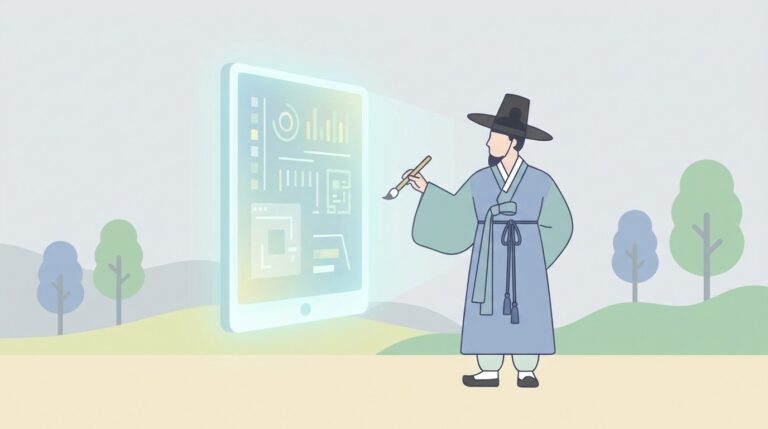
Beyond Old Ink: How Yeonam Pak Chi-won’s Revolutionary Prose Transforms Your Advanced Korean Writing
Phase 1: Empathy (스토리 몰입형 오프닝)
안녕하세요! 매일한글 에디터입니다.
Imagine sitting in a high-concept production room in Sangam-dong or an avant-garde editorial salon overlooking the tiled rooftops of Bukchon. The director turns to you and asks how to calibrate the dialogue for an ambitious project that bridges 18th-century Joseon aesthetics with cyberpunk Seoul. You know exactly what you want to convey in your mind, but the moment you speak, you hit that agonizing C2 plateau: your words either sound like a dry, pedantic Joseon encyclopedia recitation, or they tumble out as hyper-casual internet banter. You feel trapped between hollow archaism and shallow modernity.
This exact creative crisis unfolded over two hundred years ago in the court of King Jeongjo. One brilliant, sharp-tongued intellectual named Yeonam Pak Chi-won (박지원, 1737–1805) looked around at the elite aristocrats copying ancient Chinese prose styles and declared war on their creative stagnation. Traveling through Qing China, he penned the legendary Jehol Diary (열하일기), interweaving high classical Chinese poetics with bawdy street humor, market vernacular, and biting social critique. His literary rebellion sparked the famous Munche Banjeong (문체반정)—an imperial literary purge meant to stamp out his wild, intoxicating style. Yeonam didn’t burn down tradition; he revolutionized it from the inside out through a philosophy known as 법고창신 (法古創新): modeling upon the past to invent the genuinely new.
Over the past ten years of coaching university lecturers, diplomats, and K-drama script consultants, I have witnessed that mastering C2 Korean is no longer about vocabulary volume. It is about rhetorical poise. When you master Yeonam’s rhetoric of beopgochangsin, you no longer just “speak Korean”—you wield the language with historical gravity, sharp wit, and undeniable cultural presence.
Phase 2: 핵심 표현 3선 심층 분석
1. 법고창신 (法古創新)
- Pronunciation: [Beop-go-chang-sin] (Think of it rhythmically: “Bup-go-chahng-seen”, crisp on the double consonant)
- Meaning:
- Literal: Modeling upon antiquity while creating the new.
- Actual Nuance: An organic, dialectical synthesis where deep canonical mastery serves as the springboard for radical, contemporary artistic innovation—far from superficial novelty.
- K-Culture Moment: Used by film critics when analyzing Bong Joon-ho’s cinematic grammar or how traditional pansori vocal textures are interpolated into high-octane hip-hop beats.
- Editor’s Insight: Do not confuse this with a mere compromise or a “50/50 blend.” Classical Korean scholars view beopgo as the root and changsin as the blossoming branch. If you innovate without the root, your work is frivolous; if you preserve the root without innovation, your work is a petrified fossil.
- Situation Spectrum:
- Casual: 🚫 (Sounds comically pedantic over tteokbokki)
- Semi-formal: ✅ (Elevates creative pitches and essays)
- Formal: ✅ (Standard currency in academic and aesthetic discourse)
- 🤔 Think About It: In your native language, is traditional homage often viewed as the enemy of radical modern originality, or can the two feed into one another as an inseparable continuum?
2. 의고(擬古)를 경계하다
- Pronunciation: [Ui-go-reul gyeong-gye-ha-da] (Smooth “Wee-go-reul” transitioning into the alert cadence of “gyung-gyae-hah-dah”)
- Meaning:
- Literal: To guard against imitating antiquity.
- Actual Nuance: To actively criticize and resist slavish imitation, academic pastiche, or blind adherence to stale orthodoxies that have lost their living emotional pulse.
- K-Culture Moment: Frequently uttered in literary review panels or architecture forums critiquing projects that merely replicate Hanok roofs without rethinking modern living spaces.
- Editor’s Insight: Pak Chi-won fiercely attacked scholars who wrote about horses using phrases composed two millennia prior for ancient chariots. To guard against uigo means demanding that language reflect the raw, immediate reality of the speaker’s living world.
- Situation Spectrum:
- Casual: 🚫
- Semi-formal: ⚠️ (Requires an intellectually minded conversational partner)
- Formal: ✅ (Ideal for thesis defenses and critical manifestos)
- 🤔 Think About It: When an artist repeats celebrated formulas of the past, at what point does reverence cross the line into hollow intellectual imitation in your culture?
3. 파격의 미학 (破格의 美學)
- Pronunciation: [Pa-gyeo-gui mi-hak] (Explosive “Pah-” followed by soft “gyuh-gwee mee-hahk”)
- Meaning:
- Literal: The aesthetics of breaking structural rules.
- Actual Nuance: The deliberate, breathtaking subversion of established form, executed with such supreme technical mastery that the breach itself establishes a higher artistic truth.
- K-Culture Moment: Invoked when an auteur director intentionally shatters traditional 3-act narrative structures, or when an idol group fuses aristocratic royal court music (Jongmyo Jeryeak) into a bass-heavy dance bridge.
- Editor’s Insight: An amateur makes a mistake; a master commits 파격 (pageok). You can only break the mold once everyone in the room knows you already command it effortlessly.
- Situation Spectrum:
- Casual: ⚠️ (Can be used playfully among creative friends)
- Semi-formal: ✅
- Formal: ✅
- 🤔 Think About It: How does your mother tongue distinguish between a clumsy violation of conventions and a stroke of genius that deliberately dismantles them?
Phase 3: 교과서 한국어 vs 진짜 한국어
Situation 1: Describing a work that successfully blends heritage and bleeding-edge trends
- 📖 교과서 한국어: 과거의 전통과 현대의 유행을 잘 결합하여 훌륭한 작품을 만들었습니다. (Gwagweoui jeontong-gwa hyeondaeui yuhaeng-eul jal gyeolhapayeo hullyunghan jakpum-eul mandeureossseumnida. / “They created a great work by combining past traditions and modern trends well.”)
- 🗣️ 진짜 한국어: 전통의 결을 섬세하게 벼려내어 동시대적 감각으로 과감히 재해석한, 실로 법고창신의 정수를 보여주는 수작입니다. (Jeontong-ui gyeol-eul seomsehage byeoryeonaeeo dongsidaejeok gamgag-euro gwagamhi jaehaeseokan, sil-lo beopgochangsin-ui jeongsu-reul boyeojuneun sujag-imnida. / “It is an exceptional masterpiece that truly captures the essence of beopgochangsin, delicately honing the grain of tradition while boldly reinterpreting it with contemporary sensibility.”)
- 💡 왜 다를까?: High-level Korean discussions avoid flat verbs like 결합하다 (combine) in favor of poetic physical metaphors such as 결을 벼리다 (honing the grain of wood/blade) and philosophically laden idioms.
Situation 2: Urging a team to break away from sterile, outdated precedents
- 📖 교과서 한국어: 옛날 방식을 계속 따라 하는 것은 비효율적이니 새로운 방식을 찾아봅시다. (Yennal bangsing-eul gyesok ttara haneun geoseun bihyeoyuljeog-ini saeroun bangsing-eul chajabopsida. / “Continuing to follow old methods is inefficient, so let us find new methods.”)
- 🗣️ 진짜 한국어: 고루한 전범(典範)에 매몰되어 의고(擬古)를 반복하기보다는, 당대의 호흡을 담은 과감한 파격을 시도해야 할 시점입니다. (Goruhan jeonbeom-e maemol-doeeo uigo-reul banbokhagibodaneun, dangdaeui hoheub-eul dameun gwagamhan pageog-eul sidohaeya hal sijeom-imnida. / “Rather than being buried in stagnant orthodox models and repeating soulless imitation, this is the moment to attempt a bold stylistic departure that breathes with the pulse of our own time.”)
- 💡 왜 다를까?: C2 discourse builds prestige by substituting broad critiques (“옛날 방식”) with historically loaded terms like 전범 (classical canon/paradigm) and 의고 (slavish antiquarianism).
Phase 4: K-Culture 딥다이브 & 비언어적 매너
4-1. 눈치(Nunchi) & 제스처: The Rhetoric of the Restrained Pause (여백의 미)
When engaging in high-stakes Korean intellectual or cultural deliberations, rapid-fire debating tactics will backfire. Classical Korean rhetoric operates heavily on the concept of 여백 (empty space / pregnant silence).
* The Visual Cadence: Before you present an iconoclastic, mold-breaking proposal (파격), never immediately refute your senior counterpart. Lower your gaze slightly to your notes, nod twice in measured appreciation of the canonical precedent they just stated, take a distinct two-second contemplative breath, and only then look up with steady, warm eye contact.
* The Gesture: Keep both forearms gently resting on the conference table with open hands. When invoking 법고창신, a subtle, upward-turning cupping motion of one hand suggests lifting the weight of the past up into the light of the present.
4-2. Cultural Code: The Literary Subversion of Yeolha Ilgi
Yeonam Pak Chi-won wrote during a period when the Joseon Dynasty was trapped in an existential ideological crisis. Having suffered devastating invasions, the scholarly class desperately clung to Ming Dynasty classicism as an intellectual shield. Yeonam saw through this collective self-delusion. When he accompanied the diplomatic mission to Chengde (Jehol), he wrote about brick-making techniques, manure carts, and market vendors using rhythmic, earthy Korean-inflected phrasing that sent shockwaves through the royal court.
Today, you see Yeonam’s intellectual DNA pulsing through South Korea’s most electrifying cultural exports. When you watch K-dramas that reframe Joseon history through modern socio-economic satire, or when you analyze contemporary K-pop visual art drawing inspiration from Danwon Kim Hong-do’s folk paintings, you are witnessing living, breathing Yeonamche (연암체)—the relentless drive to dismantle stagnant decorum in order to touch real human experience.
Phase 5: 실전 롤플레이 시나리오
Setting: A private curatorial salon inside the National Museum of Modern and Contemporary Art (MMCA) in Seoul. You are pitching a radical new exhibition concept to Senior Curator Min-woo (민우 수석 큐레이터).
- 민우: 이번 기획전은 조선 후기 진경산수화의 원형을 엄격하게 복원하는 데 초점을 맞춰야 할 것 같습니다. (Ibeon gihoekjeon-eun Joseon hugi jingyeong-sansuhwaui wonhyeong-eul eomgyeokhage bogwonhaneun de chojeom-eul matchwoya hal geot gatseumnida. / “I believe this special exhibition must focus strictly on restoring the authentic archetype of late-Joseon true-view landscape paintings.”)
🎭 미간을 살짝 찌푸리며 학술 보고서를 단호하게 정돈한다. -
You: 선배님 말씀처럼 원형의 무게감을 지키는 것도 중요하지만, 자칫 박제된 고답주의로 흐를까 염려됩니다. (Seonbaenim malsseumcheoreom wonhyeong-ui mugegam-eul jikineun geotdo jungyohajiman, jachit bakjedoen godapjuui-ro heureulkka yeomryeodoemnida. / “Preserving the gravity of the original archetype is vital as you noted, yet I fear we might lapse into petrified, pedantic antiquarianism.”)
🎭 차분하게 눈을 맞추며 부드럽게 고개를 끄덕인다. -
민우: 박제라니요? 고전의 엄격한 법도(法度)를 흩뜨리면 전시의 학술적 권위가 무너지지 않겠습니까? (Bakjeraniyo? Gojeon-ui eomgyeokhan beopdo-reul heut-tteurimyeon jeonsi-ui haksuljeok gwon-wiga muneojiji ankkessseumnikka? / “Petrified? If we dilute the rigorous canonical laws of antiquity, won’t the exhibition’s academic authority collapse?”)
🎭 찻잔을 조용히 내려놓으며 의아하다는 듯 반문한다. -
You: 연암 박지원 선생께서도 옛 법을 본받되 변화를 통달해야 한다고 역설하셨잖습니까? (Yeonam Pak Chi-won seonsaengkkeseodo yet beob-eul bonbatdoe byeonhwa-reul tongdalhaeya handago yeokseolhasyeotjanseumnikka? / “Did not Master Yeonam Pak Chi-won emphasize that one must model upon the old while thoroughly mastering transformation?”)
🎭 목소리에 은은한 지적 확신을 담아 미소를 짓는다. -
민우: 아, 법고창신(法古創新)의 논리를 꺼내시는군요. 그렇다면 이번 전시에 어떻게 그 파격을 녹여내실 생각인가요? (A, beopgochangsin-ui nolli-reul kkeonaesineungunyo. Geureotdamyeon ibeon jeonsie eotteoke geu pageog-eul nogyeonaesil saenggag-ingayo? / “Ah, invoking the logic of beopgochangsin. How exactly do you intend to blend that unconventional departure into this exhibition?”)
🎭 팔짱을 살짝 풀며 흥미롭다는 표정으로 상체를 기울인다. -
You: 전통 수묵의 필선 위에 현대 미디어아트의 디지털 픽셀을 중첩하여, 과거와 오늘의 대화를 시각화하고자 합니다. (Jeontong sumug-ui pilseon wie hyeondae midieo-ateu-ui dijiteol piksel-eul jungcheophayeo, gwageowa oneul-ui daehwa-reul sigwakhahogoja hamnida. / “By layering digital pixels of contemporary media art over the brushstrokes of traditional ink, we visualize an ongoing dialogue between past and present.”)
🎭 태블릿 화면을 띄워 콘셉트 아트를 부드럽게 밀어 보여준다. -
민우: 옛것을 흉내 내는 데 그치지 않고, 당대의 기술로 새 지평을 열겠다는 뜻이군요. (Yetgeoseul hyungnae naeneun de geuchiji anko, dangdaeui gisul-lo sae jipyeong-eul yeolgettaneun tteus-igunyo. / “So your intent is not merely imitating antiquity, but opening new horizons using the tools of our own era.”)
🎭 턱을 괴고 감탄을 삼키며 화면을 찬찬히 응시한다. -
You: 맞습니다. 뿌리가 깊기에 가장 날 선 혁신도 그 정당성을 얻을 수 있는 법이니까요. (Matseumnida. Ppuriga gipgie gajang nal seon hyeoksindo geu jeongdangseong-eul eodeul su inneun beob-inikkayo. / “Precisely. Because the roots are deep, even the sharpest innovation earns its undeniable legitimacy.”)
🎭 정중하면서도 확신에 찬 어조로 가볍게 고개를 숙인다.
🔀 인터랙티브 분기점: How Will You Frame Your Final Argument?
- Choice A: “솔직히 과거의 방식은 이제 지루하니, 전통 요소는 최소화하고 완전히 현대적인 감각으로 밀어붙여야 합니다.” (Honestly, the old way is boring now, so we should minimize traditional elements and push fully modern sensibility.)
- Outcome (Bad 🚫): You completely sever the canonical foundation. Min-woo will perceive you as intellectually shallow, lacking appreciation for classical mastery.
- Choice B: “원형의 법도를 기저에 충실히 두되, 동시대적 매체로 법고창신의 파격을 일으켜야만 오늘날의 관객을 사로잡을 수 있습니다.” (While faithfully resting upon the canonical rules at the foundation, we must ignite the breakthrough of beopgochangsin through contemporary media to captivate modern audiences.)
- Outcome (Best ⭐): You harmonize respect for orthodoxy with an uncompromising appetite for innovation. Min-woo gives the exhibition green light.
- Choice C: “선배님의 학술적 견해가 정통하시니, 제가 제안한 미디어아트는 빼고 원형 복원 위주로 전면 수정하겠습니다.” (Since your academic insight is orthodox, I will remove the media art I proposed and revise entirely toward archetype restoration.)
- Outcome (Risk ⚠️): You preserve harmony, but you lose your distinctive creative voice and surrender your authority as a C2 cultural thinker.
Phase 6: 10초 감정 섀도잉 드릴
Pause markers (/) indicate breath resets and deliberate rhetorical emphasis.
[🧐 진중하고 학구적인 무게감으로]
“옛것을 본받되 / 시대의 변화에 휘둘리지 않고 / 새로움을 창조해야 합니다.”
(Yetgeoseul bonbatdoe / sidaeui byeonhwa-e hwidulliji anko / saeroumeul changjohaeya hamnida.)
“One must model upon the old, / yet without being swayed by the tides of time, / forge the new.”-
[🔥 단호하고 날카로운 비판 의식을 담아]
“단순한 답습은 모조품에 불과하며, / 살아 숨 쉬는 파격만이 / 고전의 정신을 계승합니다.”
(Dansunhan dapseub-eun mojopum-e bulgwahamyeo, / sara sum swineun pageogmani / gojeon-ui jeongsin-eul gyeseunghamnida.)
“Mere repetition is nothing more than imitation; / only living, breathing subversion / truly inherits the classical spirit.” -
[✨ 지적이고 우아한 확신을 채워]
“깊은 전통의 뿌리가 있기에, / 우리의 가장 날 선 실험은 / 흔들리지 않는 법입니다.”
(Gipeun jeontong-ui ppuriga itgie, / uriui gajang nal seon silheom-eun / heundeulliji anneun beob-imnida.)
“Because the roots of tradition run deep, / our sharpest experimentation / shall never waver.”
Phase 7: K-Culture 미니 사전
-
연암체 (Yeonamche)
- Definition: The prose style invented by Pak Chi-won.
- Usage: In academic and literary discussions, refers to any daringly fresh, satirical, and vernacular prose that breaks through rigid linguistic orthodoxy without losing intellectual weight.
- 실학 (Silhak)
- Definition: The “Practical Learning” school of the late Joseon Dynasty.
- Usage: Used in contemporary corporate and political spheres to demand pragmatic solutions rooted in actual empirical evidence rather than theoretical dogma.
- 문체반정 (Munche Banjeong)
- Definition: King Jeongjo’s 1792 Literary Style Purge.
- Usage: Metaphorically referenced in media when conservative regulatory institutions push back against linguistic shifts, youth slang, or innovative media formats.
- 파격 (Pageok)
- Definition: The transgression of standard protocol or artistic format.
- Usage: Ubiquitous in business headlines (e.g., 파격적인 인사 개편 – radical personnel reorganization) and artistic critiques (e.g., 파격적인 캐스팅 – game-changing, unconventional casting).
Phase 8: 여행자를 위한 생존 키트
Survival Expressions for Seoul’s Literary & Art Spaces
- 온고지신의 정신이 깃들어 있네요.
(Ongojisin-ui jeongsin-i gitdeoreo inneyo.)
Pro Tip: Drop this while touring a repurposed historic building in Euljiro or Bukchon to flatter the architect or gallery host immediately. -
이 공간은 전통과 현대가 절묘하게 교차하네요.
(I gonggan-eun jeontong-gwa hyeondaega jeolmyohage gyochahaneyo.)
Pro Tip: A peerless compliment when visiting boutique tea houses or contemporary craft exhibitions. -
과거의 문법을 해체해서 재해석한 기획이 돋보입니다.
(Gwagweoui munbeob-eul haechehaeseo jaehaeseokan gihoeg-i dotboimnida.)
Pro Tip: The definitive sentence to write in a museum guest book or gallery feedback ledger.
Editor’s Travel Note
When tracing Yeonam’s footsteps in Seoul, begin at the old alleys of Jae-dong (near Anguk Station) where Northern School (Bukhak) scholars met under the summer stars to envision a modernized Joseon. To read translated excerpts of rare Joseon manuscripts on your commute, utilize the 국립중앙도서관 모바일 앱 다운로드 to explore archival scans. Afterward, use the 네이버 지도 앱 다운로드 to trace your walking path from Changdeokgung Palace to the quiet historic tea houses hidden along the stone walls of Samcheong-dong.
Phase 9: “한 발 더 깊이” (생각 질문)
Every culture experiences an eternal tug-of-war between the safety of canonical tradition and the volatile threat of raw creativity. In Joseon Korea, where neo-Confucianism served as state law, altering the rhythm of your classical sentence could literally invite royal censure. Yet figures like Yeonam Pak Chi-won understood that true honor toward the past does not mean mummifying it; it requires having the courage to speak to the living present. When you study high-level Korean, you inherit this thrilling ideological lineage: the balance between profound honorific courtesy and the sharp, playful spirit of vernacular subversion.
💬 Your Turn: Which creator in your own country—be it in literature, cinema, cuisine, or music—best embodies this concept of beopgochangsin? Share their work in the comments below using one of our three core expressions!
Phase 10: FAQ & 오해 방지
Q: How does 법고창신 (Beopgochangsin) differ from the common proverb 온고지신 (Ongojisin)?
A: While 온고지신 (溫故知新) centers on personal moral reflection and gaining inner ethical wisdom through learning from the past, 법고창신 (法古創新) is fundamentally an aggressive creative and rhetorical manifesto. It explicitly demands the production of groundbreaking, tangible artistic or structural innovations.
Q: Will I sound arrogant if I use terms like 파격 (Pageok) in business meetings?
A: Not if it is contextualized properly. If you characterize an unverified marketing blunder as 파격, it sounds foolish. However, if you describe a calculated, bold brand repositioning strategy as a 파격을 통한 혁신 (innovation through the deliberate breaking of molds), you command the room.
Q: Can classical rhetorical strategies really improve my everyday Korean spoken fluency?
A: Immeasurably. Reaching C2 is not about mastering more street slang; it is about grasping the underlying cultural frameworks that educate native discourse. Understanding beopgochangsin allows you to understand why modern Koreans react so passionately to works that successfully reinvent tradition.
🚨 흔한 실수 (Common Mistakes) 경고판
- Mistake: Using 파격 (Pageok) to describe unintentional mistakes or sloppiness.
Correct Action: Only use 파격 when an established standard is broken intentionally by someone who possesses mastery. - Mistake: Over-relying on historical drama sentence endings (
-하오,-옵소서) when attempting to sound profound.
Correct Action: Maintain standard polite endings (-습니다,-해요) while elevating your nouns and rhetorical idioms. - Mistake: Assuming 법고창신 implies a complete rejection of old masters.
Correct Action: Remember that 법고 (modeling upon the old) is non-negotiable; you must demonstrate understanding of the original form before you reconfigure it.
Phase 11: 액션 미션 & 참여 유도
- Bronze Mission: Stand in front of your mirror, set a timer for 30 seconds, and recite the 3 emotional shadowing drills from Phase 6 with deliberate pauses.
- Silver Mission: Write a three-sentence critique of your favorite Korean drama, book, or music video on Instagram or Threads, using the phrase “전통의 결을 벼려낸 파격의 미학” and tag @DailyHangul.
- Gold Mission: In your next Korean conversational exchange or academic seminar, frame a counter-proposal using the 법고창신 dialectic: acknowledge the precedent first, pause, and present your modern subversion.
🎮 K-Culture Mission: Watch Agust D’s (Suga’s) music video for Daechwita or analyze the stage choreography of a traditional fusion ensemble like Leenalchi. Identify three specific moments where classical Joseon music/symbolism is deliberately subjected to 파격.
Phase 12: 인터랙티브 퀴즈 챌린지
1. 상황 판단 퀴즈 (Situational Judgment)
An editorial colleague wants to write an article that copies 18th-century court Korean word-for-word to describe modern smartphone addictions. Which expression best diagnoses the fatal flaw in their approach?
* A) 법고창신의 미덕
* B) 당대 현실의 통찰
* C) 맹목적인 의고(擬古)의 함정
🔍 정답 및 해설 확인하기 (Click to Reveal)
정답: C) 맹목적인 의고(擬古)의 함정
해설: Merely copying ancient diction to describe modern phenomenological realities is the exact definition of blind uigo (slavish antiquarianism) that Yeonam Pak Chi-won warned against.
2. 빈칸 채우기 퀴즈 (Fill-in-the-Blank)
“옛것의 엄격한 규범을 완전히 체득한 장인만이 비로소 눈부신 ( )의 미학을 완성할 수 있다.”
* A) 파격
* B) 답습
* C) 모방
🔍 정답 및 해설 확인하기 (Click to Reveal)
정답: A) 파격
해설: Only a true master who has thoroughly internalized classical rules (규범) can legitimately shatter them to manifest the aesthetics of rule-breaking (파격의 미학).
3. True / False 문화 퀴즈
King Jeongjo initiated the Munche Banjeong (문체반정) because he wanted all Joseon scholars to freely invent radical slang and adopt Yeonam Pak Chi-won’s prose style. (True / False)
🔍 정답 및 해설 확인하기 (Click to Reveal)
정답: False
해설: King Jeongjo launched the purge precisely to suppress Yeonam’s unconventional, energetic style and force Joseon scholars back into the rigid mold of orthodox ancient Chinese classical prose.
🎬 Watch Our Daily Videos! (Daily Hangul Official Instagram)
Review the expressions you learned in this article with our fun daily short videos! Check out native pronunciation and real-life nuances in action.
- Instagram @dailyhangul_en







