

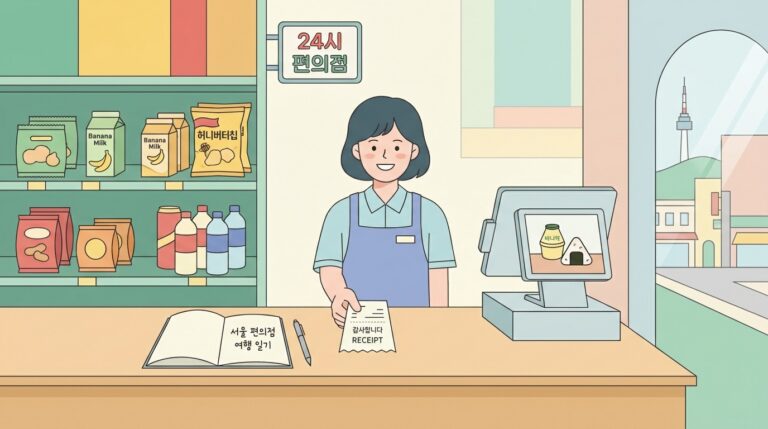
Master the Magic Word ‘주세요’: How to Confidently Ask for a Receipt in Korea
Phase 1: 공감 (Story-Immersive Opening)
안녕하세요! 매일한글 에디터입니다. (Hello! I’m your Daily Hangul editor.)
Imagine this classic Seoul moment: You are standing inside a bustling Olive Young in Hongdae or a sleek GS25 convenience store in Myeongdong. Your arms are loaded with cute peach-flavored snacks, sheet masks, and cool K-pop merchandise. You tap your credit card against the reader with a sigh of relief. The cashier looks right at you and asks something at lightning speed: “영수증 필요하세요?” (Do you need a receipt?)
Suddenly, your mind goes blank. You want that physical slip for your travel budget tracker or the airport tax-refund booth, but you freeze up under the cashier’s friendly gaze. Should you just nod? What if they toss it away? Over the past 10 years of mentoring beginner Korean learners, I have heard this exact story hundreds of times. But do not worry! Today, with just one golden phrase built around the superhero word 주세요 (Juseyo), you will handle retail counters like a savvy local. Let’s make store checkout stress-free!
Phase 2: 핵심 표현 3선 심층 분석 (Top 3 Core Expressions)
1. 영수증 주세요 (Yeongsujeung juseyo)
- Pronunciation: [Yeong-su-jeung ju-se-yo] (Think: “Young-suit-jung jew-say-yo”)
- Meaning: Literal: “Receipt, please give.” | Real Nuance: “Please give me the receipt.” (Polite, warm, and natural)
- K-Culture Moment: Seen in nearly every workplace or romance K-Drama whenever characters settle business meals or split lunch bills at casual bistros.
- Editor’s Insight: This is the gold-standard phrase. The noun 영수증 (receipt) meets 주세요 (please give me). It strikes the ideal balance between everyday friendliness and clear politeness.
- Situation Spectrum: Casual ✅ | Semi-formal ✅ | Formal ⚠️
- 🤔 Think About It: In English, we often say “Can I get a receipt?” focusing on our ability to receive. Korean focuses on asking the counter partner directly to hand it over. How does this shift your perception of customer-staff interaction?
2. 영수증 버려주세요 (Yeongsujeung beoryeojuseyo)
- Pronunciation: [Yeong-su-jeung beo-ryeo-ju-se-yo] (Think: “Young-suit-jung burr-yaw jew-say-yo”)
- Meaning: Literal: “Receipt, please discard.” | Real Nuance: “You can toss the receipt, please!”
- K-Culture Moment: The signature phrase echoed across convenience stores every second when office workers grab an iced Americano.
- Editor’s Insight: Korea is extremely eco-conscious and paper receipts are often declined. If you do not need it, saying this brings an instant, appreciative smile from busy staff.
- Situation Spectrum: Casual ✅ | Semi-formal ✅ | Formal ⚠️
- 🤔 Think About It: Notice how polite Korean still remains even when asking someone to discard trash—it always finishes with respect.
3. 이거 주세요 (Igeo juseyo)
- Pronunciation: [I-geo ju-se-yo] (Think: “Ee-gaw jew-say-yo”)
- Meaning: Literal: “This thing, please give.” | Real Nuance: “I’d like this one, please.”
- K-Culture Moment: Street food stalls in Myeongdong or Gwangjang Market where travelers point directly to steaming tteokbokki.
- Editor’s Insight: The most versatile A1 starter phrase in existence. Pair it with pointing your index finger, and you can order food, buy souvenirs, or select pastries.
- Situation Spectrum: Casual ✅ | Semi-formal ✅ | Formal ⚠️
- 🤔 Think About It: A simple demonstrative pronoun combined with an honorific request eliminates complicated sentence structures completely.
Phase 3: 교과서 한국어 vs 진짜 한국어 (Textbook vs Real Korean)
Situation 1: Asking for your store receipt
- 📖 교과서 한국어 (Textbook): 영수증을 주십시오. (Yeongsujeungeul jusipsio.)
- 🗣️ 진짜 한국어 (Real Life): 영수증 주세요! (Yeongsujeung juseyo!)
- 💡 왜 다를까? (Why the difference?): “-십시오” is ultra-formal, primarily used in military settings, train public broadcasts, or rigid corporate meetings. In regular shops, “주세요” is the standard standard of polite warmth.
Situation 2: Declining the paper slip politely
- 📖 교과서 한국어 (Textbook): 영수증을 발급하지 않아도 됩니다. (Yeongsujeungeul balgeubhaji anh-ado doemnida.)
- 🗣️ 진짜 한국어 (Real Life): 영수증은 괜찮아요! (Yeongsujeungeun gwaenchannayo!)
- 💡 왜 다를까? (Why the difference?): Foreign language textbooks translate administrative regulations, but everyday native Koreans simply say “괜찮아요” (It’s okay / No thank you).
Phase 4: K-Culture 딥다이브 & 비언어적 매너 (Deep Dive & Body Language)
4-1. 눈치(Nunchi) & Gestures
- The Two-Handed Handover: When the clerk offers you the receipt or payment card, always accept it with both hands, or support your right wrist/forearm with your left hand. This physical gesture signals genuine gratitude.
- Micro-Bow (목례 – Mok-rye): You do not need a dramatic 90-degree bow. A gentle 15-degree nod with soft eye contact while uttering “감사합니다 (Gamsahamnida)” completes the polite transaction.
4-2. Culture Code: Smart Receipts & The Green Trend
In modern South Korea, eco-friendly policies mean store cashiers default to asking if you actually want a paper receipt (“영수증 필요하세요?”). If you are shopping at duty-free shops or large cosmetics stores, however, keep that paper receipt! You will need it to process your instant tax refunds at the terminal.
Phase 5: 실전 롤플레이 시나리오 (Real-Life Roleplay)
- Setting: A bright, friendly convenience store near Hongik University Station.
- Characters:
- 민호 (Minho): The upbeat, energetic student clerk wearing a store apron.
- You (A1 Learner): Ready to check out snacks and practice speaking.
민호 (Minho): 안녕하세요! 계산 도와드릴게요. (Annyeonghaseyo! Gyesan dowadeurilgeyo.)
🎭 Scans your banana milk and honey butter chips with a cheerful beep.
“Hello! I’ll help you check out.”
You: 네, 감사합니다! (Ne, gamsahamnida!)
🎭 Smiling softly and placing items onto the checkout mat.
“Yes, thank you!”
민호 (Minho): 4,500원입니다. 카드 꽂아주세요. (Sacheon-obaek-won-imnida. Kadeu kkoja-juseyo.)
🎭 Gestures politely to the card payment terminal.
“That will be 4,500 won. Please insert your card.”
You: 네, 여기요. (Ne, yeogiyo.)
🎭 Inserting card into the IC chip reader smoothly.
“Sure, here you go.”
민호 (Minho): 결제 완료되셨습니다. 영수증 필요하세요? (Gyeolje wanryo-doesyeotseumnida. Yeongsujeung piryohaseyo?)
🎭 Hand pauses over the printer roll, waiting for your cue.
“Payment completed. Do you need a receipt?”
You: 네, 영수증 주세요! (Ne, yeongsujeung juseyo!)
🎭 Making clear, confident eye contact with a warm tone.
“Yes, please give me the receipt!”
민호 (Minho): 여기 있습니다. 좋은 하루 되세요! (Yeogi itseumnida. Joeun haru doeseyo!)
🎭 Hands over the receipt using both hands.
“Here you are. Have a great day!”
You: 감사합니다! 수고하세요! (Gamsahamnida! Sugohaseyo!)
🎭 Receiving the paper with both hands and bowing head slightly.
“Thank you! Keep up the good work!”
🔀 Interactive Branch: The Cashier asks “영수증 버려드릴까요?” (Shall I toss the receipt?)
What should you reply if you do want your receipt?
- Option A: “아니요, 영수증 주세요!” (Aniyo, yeongsujeung juseyo!)
- Outcome (Best): Spot on! Friendly, polite, and completely understandable.
- Option B: “영수증 줘.” (Yeongsujeung jwo.)
- Outcome (Bad): Risk of offense! “줘” is informal casual talk (반말). Using this with strangers sounds rude.
- Option C: “괜찮아요.” (Gwaenchannayo.)
- Outcome (Risk): Misunderstanding! In this context, “괜찮아요” means “It is fine without it,” so the clerk will immediately toss the receipt!
Phase 6: 10초 감정 섀도잉 드릴 (10-Second Emotion Shadowing Drill)
Practice out loud with these pauses (/) and emotional cues:
[😊 Bright & Polite]
네! / 영수증 / 주세요!
(Ne! / Yeongsujeung / juseyo!)-
[🌿 Calm & Easygoing]
영수증은 / 괜찮아요! / 버려주세요.
(Yeongsujeungeun / gwaenchannayo! / beoryeojuseyo.) -
[👋 Warm & Friendly Goodbye]
감사합니다! / 수고하세요!
(Gamsahamnida! / Sugohaseyo!)
Phase 7: K-Culture 미니 사전 (Mini Dictionary)
- 영수증 (Yeongsujeung) | Receipt | The printed physical document showing items purchased and tax paid.
- 계산 (Gyesan) | Calculation / Checkout bill | Used when asking to settle the tab at a restaurant or shop (e.g., “계산해 주세요”).
- 봉투 (Bongtu) | Plastic/Paper bag | Cashiers almost always ask: “봉투 필요하세요?” (Do you need a bag?).
- 택스리펀 (Taekseu-ripeon) | Tax Refund | Essential phrase for overseas travelers shopping at department stores and cosmetic boutiques.
Phase 8: 여행자를 위한 생존 키트 (Traveler’s Survival Kit)
Survival Phrases TOP 3
- 봉투는 됐어요 (Bongtuneun dwaesseoyo): [Bong-tu-neun dwae-sseo-yo] – “No plastic bag needed, thank you.”
- 카드 돼요? (Kadeu dwaeyo?): [Ka-deu dwae-yo?] – “Can I pay by card?” (Super handy at traditional market stalls!)
- 따로 계산해 주세요 (Ttaro gyesanhae juseyo): [Tta-ro gye-san-hae ju-se-yo] – “Please split the bill / charge separately.”
Editor’s Travel Note
- Navigation Guide: Google Maps often lags in Korea for walking routes. Make sure to download and set up the Naver Map application on iOS or Android before landing.
- Payment Culture: Korea is nearly 100% cashless. Small stalls, vending machines, and taxis prefer card payments or reloadable transit cards like WOWPASS and T-Money.
Phase 9: “한 발 더 깊이” (Reflective Question)
In Korean culture, the word 주세요 (Juseyo) comes from the honorific root verb 주다 (Juda – to give) with the honorific suffix -시- (si). When you utter “주세요”, you are linguistically elevating the person serving you. It transforms a mundane commercial purchase into an exchange grounded in mutual respect and human warmth.
💬 Your Turn: In your home country, how do you usually request a receipt without sounding overly demanding? How does it feel to explicitly use an honorific verb for service workers in Korea? Share your thoughts below!
Phase 10: FAQ & 오해 방지 (FAQ Schema)
Q: Can I use “주세요” when asking for non-physical things, like help?
A: Yes! When attached to verbs, it changes into the request formula “-아/어 주세요” (e.g., “도와주세요” – Please help me).
Q: What should I say if the cashier asks me “영수증 드릴까요?”?
A: You can simply answer: “네, 주세요!” (Yes, please!) or “아니요, 괜찮아요!” (No, I’m okay!).
Q: Is “영수증 부탁합니다” more polite than “영수증 주세요”?
A: “부탁합니다” (Please / I request of you) sounds slightly more formal, but in ordinary store checkout scenarios, “영수증 주세요” sounds much more natural and friendly.
🚨 Common Mistakes Warning Board
- Mistake 1: Saying “영수증 원해요” (I want a receipt).
- Fix: Expressing direct desire (“원해요”) at store staff sounds blunt. Always use “주세요”.
- Mistake 2: Dropping the “-요” and saying “영수증 줘”.
- Fix: Never use 반말 (informal speech) with cashiers or waitstaff. Keep the “-요” firmly attached!
- Mistake 3: Shaking hands while taking the receipt.
- Fix: Handshakes are reserved for corporate introductions. Simply hold out both hands and nod gently.
Phase 11: 액션 미션 & 참여 유도 (Action Mission)
- 🥉 Bronze Mission (Solo Shadowing): Stand in front of your mirror, smile, and say “영수증 주세요!” three times in 10 seconds.
- 🥈 Silver Mission (Social Share): Write your own sample sentence using
[Noun] + 주세요in the comment section below. - 🥇 Gold Mission (Real Life Action): Visit a local Korean grocery store or K-town restaurant this week and ask for your receipt in Korean!
- 🎮 K-Culture Mission: Watch an episode of a slice-of-life K-drama (like Hospital Playlist or Business Proposal) and spot how many times characters utter “주세요” during cafe scenes.
Phase 12: 인터랙티브 퀴즈 챌린지 (Interactive Quiz Challenge)
Test your knowledge before you head out on your Seoul adventure!
Q1. (Fill-in-the-blank)
At a cafe counter: “아메리카노 한 잔 ________.” (Please give me one Americano.)
1) 줘라
2) 주세요
3) 합니다
Q2. (True / False)
When declining a paper receipt in a Korean shop, saying “영수증은 괜찮아요” is considered impolite. (True / False)
Q3. (Scenario Judgment)
The cashier asks: “영수증 버려드릴까요?” (Shall I discard your receipt?). You DO need the receipt. What is the most natural answer?
1) 네, 버려주세요.
2) 아니요, 주세요!
3) 싫어요.
👉 Click to reveal answers & explanations!
- Q1 Answer: 2) 주세요 — Combining any item with “주세요” creates an instant, polite request.
- Q2 Answer: False — “영수증은 괜찮아요” (The receipt is fine / not needed) is very polite and commonly used across Korea.
- Q3 Answer: 2) 아니요, 주세요! — The cashier asked if they should throw it out, so answering “No, please give it to me!” gets your receipt printed right away.
🎬 Watch Our Daily Videos! (Daily Hangul Official Instagram)
Review the expressions you learned in this article with our fun daily short videos! Check out native pronunciation and real-life nuances in action.
- Instagram @dailyhangul_en







