

Decoding Your Traditional Korean Clinic Visit: From Pulse Diagnosis to Natural Fluency
Phase 1: Empathy (Story-Driven Opening)
안녕하세요! 매일한글 에디터입니다. (Hello! I’m your Daily Hangul editor.)
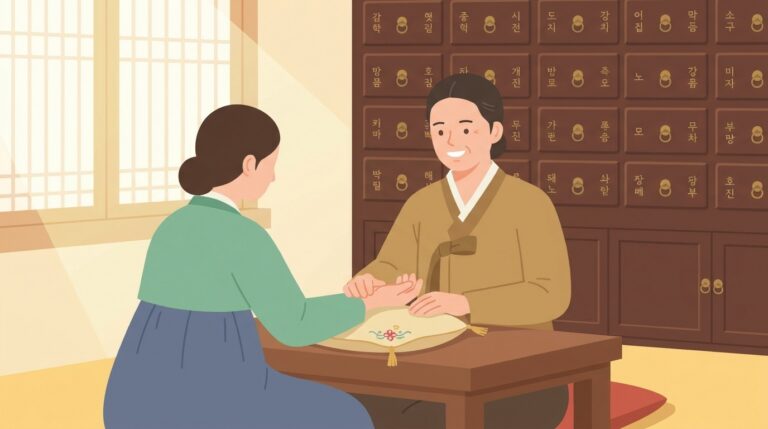
Picture this: You step into a traditional Korean medicine clinic (한의원 – Haniwon). The air smells deeply comforting—warm earthy mugwort, cinnamon, dried roots, and steamy herbal concoctions simmering in porcelain vats. You came in because of chronic shoulder stiffness and cold hands, but instead of handing you a sterile tablet or an X-ray referral, the white-coated doctor (원장님 – Wonjangnim) smiles gently, places three fingers deliberately against the radial artery of your wrist, and closes their eyes in silence.
Next, they politely say: “혀를 살짝 내밀어 보세요” (Hyeo-reul saljjak naemil-eo bose-yo — Please stick your tongue out a little), followed by gentle finger pressure along your stomach (복진 – bokjin). Then comes the diagnosis that feels straight out of a historical K-drama: “몸에 찬 기운이 많고 기혈 순환이 막혀 있네요.” (You have a lot of cold energy in your body, and your vital energy and blood circulation are blocked.)
If you felt confused, overwhelmed, or wondered whether your modern traveler’s insurance covers “blocked qi,” take a breath! You are not alone. Many intermediate learners freeze when entering the world of Hanbang (한방 – Korean traditional medicine) because textbook Korean rarely teaches holistic physiological terminology. Today’s guide is crafted from real clinical transcripts and learner feedback to empower your B2 Korean skills so you can explain your symptoms fluently, understand constitutional diagnoses, and ask about insurance claims without missing a beat!
Phase 2: Core Expressions Deep Dive (핵심 표현 3선)
1. 몸에 찬 기운이 많아요 (Mom-e chan gi-un-i man-a-yo)
- Pronunciation: [Mom-e chan gi-un-i man-a-yo] (Think of ‘chan’ like the nickname ‘Chan’ in Jackie Chan, and ‘gi-un’ like ‘energy/vigor’ spoken with a smooth rise).
- Meaning: Literal: “There is a lot of cold energy in the body.” / Real Nuance: “Your core temperature regulation and internal metabolic vitality are sluggish or deficient.”
- K-Culture Moment: You will hear grandmothers (할머니 – halmeoni) or mother-in-laws in family dramas remark whenever someone drinks iced Americano in midwinter: “아이고, 그러다 몸에 찬 기운 들어찬다!” (Gosh, you’ll fill your body with cold energy!)
- Editor’s Insight: In Korean wellness philosophy, 찬 기운 (cold energy) isn’t just about feeling chilly; it reflects poor peripheral circulation, sluggish digestion, or low stamina. When a doctor says this, it’s an invitation to discuss remedies like warm ginger-jujube tea (생강대추차), moxibustion (뜸), or warming herbal tonic.
- Situation Spectrum:
- Casual: 몸에 찬 기운이 많아. (⚠️ To close friends only)
- Semi-formal: 몸에 찬 기운이 많아요. (✅ Daily clinic conversations)
- Formal: 원장님께서 몸에 찬 기운이 많다고 진단하셨습니다. (✅ Explaining to colleagues or medical staff)
- 🤔 Think About It: Does your native culture attribute chronic digestive or joint issues to internal “coldness” or “dampness,” or do you solely measure body temperature with a clinical thermometer?
2. 기혈 순환이 막혀 있어요 (Gi-hyeol sun-hwan-i mak-hyeo iss-eo-yo)
- Pronunciation: [Gi-hyeol sun-hwan-i ma-kyeo iss-eo-yo] (The consonant cluster ‘ㄱ+ㅎ’ merges into an aspirated ‘ㅋ’ sound: [마켜]).
- Meaning: Literal: “Circulation of qi (vital energy) and blood is blocked.” / Real Nuance: “Your musculoskeletal tension and systemic fatigue have caused physical and vascular stagnation.”
- K-Culture Moment: Seen frequently in historical medical dramas like Dae Jang Geum (Jewel in the Palace) or Live Up to Your Name (명불허전) right before an acupuncturist dramatically brandishes a golden needle to clear a patient’s blocked meridians.
- Editor’s Insight: 기혈 (氣血) pairs vital life energy (기) with physical blood circulation (혈). In modern clinic settings, this diagnosis usually leads to treatments like acupuncture (침), cupping (부항), or manual spinal alignment (추나요법).
- Situation Spectrum:
- Casual: 기혈 순환이 막혔대. (⚠️ Casual recount)
- Semi-formal: 기혈 순환이 막혀 있다고 해요. (✅ Common reportative polite form)
- Formal: 체내 기혈 순환이 정체되어 통증을 유발합니다. (✅ Clinical paperwork/consultation)
- 🤔 Think About It: In Western medicine, we speak of nerve compression or poor vascular flow. Notice how Korean combines tangible blood (혈) with intangible vital life breath (기) in a single composite word.
3. 맥을 짚어 보다 / 진맥하다 (Maeg-eul jip-eo bo-da / Jin-maek-ha-da)
- Pronunciation: [Mae-geul ji-peo bo-da / Jin-mae-ka-da] (Pronounce ‘맥을’ as [매글] via liaison).
- Meaning: Literal: “To feel the pulse” / “To perform pulse diagnosis.”
- K-Culture Moment: In workplace or comedy sketches, when a boss is overly stressed, a colleague playfully grabs their wrist: “제가 맥 좀 짚어 볼까요?” (Shall I take your pulse?)
- Editor’s Insight: 맥을 짚다 is the pure Korean verbal idiom, while 진맥(診脈)하다 is the formal Sino-Korean medical term. In a Hanbang clinic, pulse-checking is dynamic—the practitioner tests superficial and deep pulses on both wrists to assess internal organ balance.
- Situation Spectrum:
- Casual: 손목 맥 좀 짚어 봐. (⚠️ Teasing a pal)
- Semi-formal: 원장님께서 손목 맥을 짚어 보셨어요. (✅ Standard recounting)
- Formal: 진맥 결과에 따라 처방이 달라집니다. (✅ Medical discussion)
- 🤔 Think About It: English says “take someone’s pulse,” treating it as an objective numeric count (BPM). Korean uses 짚다 (to press/probe thoughtfully with finger tips), reflecting an intuitive, qualitative reading.
Phase 3: Textbook Korean vs Real Korean (교과서 vs 진짜 한국어)
Situation 1: Explaining systemic fatigue and cold limbs
- 📖 교과서 한국어 (Textbook):
- 저는 손발이 매우 차갑고 피로를 자주 느낍니다. (Jeo-neun son-bal-i mae-u cha-gap-go pi-ro-reul ja-ju neu-kkim-ni-da.)
- 🗣️ 진짜 한국어 (Real-life Native):
- 조금만 무리해도 손발이 차가워지고 온몸이 천근만근 무거워져요. (Jo-geum-man mu-ri-hae-do son-bal-i cha-ga-wo-ji-go on-mom-i cheon-geun-man-geun mu-geo-wo-jyeo-yo.)
- 💡 왜 다를까? (Why the difference?):
Textbooks teach stiff declarative descriptors (매우 차갑다). Native speakers use vivid sensory idioms like 천근만근 (heavy like ten thousand tons) and conditional triggers (무리해도 – even with slight overexertion) to convey bodily distress with precision.
Situation 2: Asking if physical manipulation therapy qualifies for private insurance reimbursement
- 📖 교과서 한국어 (Textbook):
- 추나요법 치료는 보험 회사에서 돈을 돌려받을 수 있습니까? (Chu-na-yo-beop chi-ryo-neun bo-heom hoe-sa-e-seo don-eul dol-lyeo-ba-deul su iss-seum-ni-kka?)
- 🗣️ 진짜 한국어 (Real-life Native):
- 이번에 받는 추나 치료, 실손보험(실비) 청구 가능한 항목인가요? (I-beon-e bat-neun chu-na chi-ryo, sil-son-bo-heom(sil-bi) cheong-gu ga-neung-han hang-mok-in-ga-yo?)
- 💡 왜 다를까? (Why the difference?):
Rather than phrasing it as “getting money back from the insurance company,” native adults use professional terminology like 실손보험/실비 (private indemnity health insurance) and 청구 가능한 항목 (claimable billable item).
Phase 4: K-Culture Deep Dive & Non-verbal Manners
4-1. 눈치 (Nunchi) & Clinic Etiquette
- Pulse Diagnosis (맥진): When the doctor places their fingers on your wrist, rest your forearm comfortably on the small silk cushion provided (맥탁/맥쿠션). Relax your shoulders, turn your palm slightly upward, and avoid talking while the doctor concentrates.
- Tongue Examination (설진): When asked to show your tongue, don’t stick it out aggressively with wide eyes! Simply relax your mouth, open gently, and rest the tongue comfortably on your lower lip for 3 to 5 seconds. Avoid drinking coffee, milk tea, or colored candy right before the appointment, as tongue coatings (설태) reflect your digestive status.
- Abdominal Palpation (복진): You will lie on your back and bend your knees slightly. When the doctor gently presses your abdomen, do not clench your stomach muscles. Exhale through your mouth and indicate clearly if a specific pressure point feels sore or tender: “거기 누르실 때 뻐근하게 아파요.” (It feels dull and sore when you press there.)
4-2. Cultural Code: The Philosophy of Balance & Chuna
Koreans frequently turn to Hanbang clinics not as a replacement for emergency Western medicine, but as an integrative restoration system. You will see college students recovering from exam burnout receiving 침 (acupuncture), office workers seeking 추나요법 (manual joint-spinal manipulation), and elders taking restorative decoctions (보약). Knowing that modern Korean National Health Insurance (국민건강보험) actually covers acupuncture, cupping, and a designated number of Chuna sessions per year gives you instant local savvy!
Phase 5: Real-Life Roleplay Scenario (실전 롤플레이)
Setting: A tranquil consultation room at 경희바른한의원 (Kyunghee Bareun Korean Medicine Clinic) in Seoul.
Characters:
* 박 원장 (Director Park): A perceptive, warm acupuncturist in his late 40s.
* 줄리아 (Julia): A B2-level international resident working in Seoul experiencing chronic fatigue and stiff neck.
Turn 1
* 박 원장: 줄리아 씨, 어서 오세요. 어디가 제일 불편해서 오셨나요?
(Julia-ssi, eoseo oseyo. Eodiga jeil bulpyeonhaeseo osyeotnayo?)
“Welcome, Julia. What has been bothering you the most?”
🎭 [소매를 걷으며 온화한 미소로 맞이한다]
Turn 2
* 줄리아: 최근 들어 뒷목이 뻐근하고 소화도 잘 안 돼요. 특히 손발이 얼음장처럼 차가워요.
(Choegeun deureo dwinmogi ppeogeunhago sohwado jal an dwaeyo. Teukhi sonbari eoreumjangcheoreom chagawoyo.)
“Lately the back of my neck is stiff and my digestion is poor. Especially my hands and feet are cold like sheets of ice.”
🎭 [목 뒤를 손으로 매만지며 걱정스러운 눈빛으로 말한다]
Turn 3
* 박 원장: 그러셨군요. 손목을 이 쿠션 위에 편하게 올려보세요. 진맥 좀 해보겠습니다.
(Geureosyeotgunyo. Sonmogeul i kusyeon wie pyeonhage ollyeoboseyo. Jinmaek jom haebogetseumnida.)
“I see. Please rest your wrist comfortably on this cushion. Let me check your pulse.”
🎭 [쿠션을 밀어주며 세 손가락을 조심스럽게 손목 맥박에 얹는다]
Turn 4
* 줄리아: 네, 원장님. 숨은 평소처럼 쉬면 되나요?
(Ne, wonjangnim. Sumeun pyeongso-cheoreom swimyeon doenayo?)
“Yes, Director. Should I just breathe normally?”
🎭 [호흡을 가다듬으며 조용히 기다린다]
Turn 5
* 박 원장: 네, 편안하게 쉬세요. …자, 이번엔 입을 살짝 벌리고 혀 상태를 보여주시겠어요?
(Ne, pyeonanhage swiseyo. …Ja, ibeonen ibeul saljjak beol-ligo hyeo sangtaereul boyeojusigetseoyo?)
“Yes, breathe comfortably. …Now, could you open your mouth slightly and show me your tongue?”
🎭 [눈을 가늘게 뜨고 혀의 백태와 혈색을 꼼꼼히 살핀다]
Turn 6
* 줄리아: 아— 하구 이렇게 내밀면 될까요?
(Ah— hagu ireoke naemilmyeon doelkkayo?)
“Ah— like this? Is sticking it out this much okay?”
🎭 [민망한 듯 살짝 혀를 내민다]
Turn 7
* 박 원장: 좋습니다. 맥이 깊고 가라앉아 있고 혀에 백태가 껴 있네요. 복진을 해보니 아랫배도 차갑습니다. 몸에 찬 기운이 많고 기혈 순환이 막혀 있어요.
(Jotseumnida. Maegi gipgo gara-anja itgo hyeoe baektaega kkyeo itneyo. Bokjineul haeboni araetbaedo chagapseumnida. Mome chan giuni manko gihyeol sunhwani makyeo isseoyo.)
“Good. Your pulse feels deep and sunken, and there is a white coating on your tongue. Pressing your abdomen, your lower belly is also cold. You have an excess of cold energy and stagnant circulation.”
🎭 [진단 차트에 메모하며 차분하게 설명한다]
Turn 8
* 줄리아: 그렇군요! 오늘 침 치료랑 척추 교정해 주는 추나요법도 같이 받을 수 있을까요? 실비보험 청구 서류도 챙겨주세요.
(Geureokunyo! Oneul chim chiryorang cheokchu gyojeonghae juneun chunayobeopdo gachi badeul su isseulkkayo? Silbiboheom cheonggu seoryudo chaenggyeojuseyo.)
“I understand! Could I receive acupuncture and spinal alignment Chuna therapy together today? Please also prepare my private insurance claim documents.”
🎭 [안도하는 표정으로 고개를 끄덕인다]
🔀 Interactive Decision Point (인터랙티브 분기점)
When Director Park finishes checking your pulse and tongue, you want to inquire about the exact treatment plan and cost before proceeding. What do you say?
- Option A: “야, 원장! 침 아프냐? 돈 많이 나오면 안 할래.”
(Hey doctor! Do needles hurt? If it costs a lot, I won’t do it.) - Option B: “원장님, 오늘 침이랑 추나요법 치료받으면 대략 비용이 얼마나 나오고, 실손보험 적용이 되나요?”
(Director, approximately how much will today’s acupuncture and Chuna therapy cost, and is it covered under private indemnity insurance?) - Option C: “선생님, 그냥 약국 가서 진통제 먹으면 안 될까요? 한약은 비싸잖아요.”
(Teacher, can’t I just go to a pharmacy and take painkillers? Herbal medicine is expensive.)
Detailed Feedback:
* Option A (Bad / Disrespectful): Using extreme informal speech (야, 반말) with a physician will cause instant awkwardness and freeze communication. Medical staff in Korea deserve polite honorifics (원장님).
* Option B (Best / Fluent B2 Choice): Perfectly polite, natural, and assertive! You respectfully address the director, check both the estimate and the insurance applicability (실손보험 적용 여부) in one coherent, professional sentence.
* Option C (Risk / Social Faux Pas): While understandable if on a tight budget, dismissing the doctor’s diagnostic work immediately by demanding Western painkillers can come across as dismissive of the clinic’s care philosophy. Better to politely ask if non-herbal therapy options are available first.
Phase 6: 10-Second Emotion Shadowing Drill (감정 섀도잉 드릴)
Practice matching the cadence, emotion, and pause breaks (/) of real clinic consultations!
[🥺 지치고 나른하게 / Weary & exhausted]
“요즘 들어 / 자고 일어나도 개운하지 않고 / 온몸의 기혈 순환이 / 꽉 막힌 느낌이에요.”
(Yo-jeum deu-reo / ja-go il-eo-na-do gae-un-ha-ji an-ko / on-mom-ui gi-hyeol sun-hwan-i / kkwak ma-kin neu-kkim-i-e-yo.)-
[😮 신기하고 안도하며 / Curious & relieved]
“손목 맥만 짚어 보시고도 / 제가 소화 안 되는 걸 / 바로 알아맞히셔서 / 깜짝 놀랐어요!”
(Son-mok maeng-man ji-peo bo-si-go-do / je-ga so-hwa an doe-neun geol / ba-ro al-a-ma-chi-syeo-seo / kkam-jjak nol-lass-eo-yo!) -
[💼 똑 부러지고 정중하게 / Clear & businesslike]
“오늘 진료받은 내역으로 / 실비보험 청구할 수 있게 / 진료비 영수증과 세부내역서 / 발급 부탁드립니다.”
(O-neul jin-ryo-ba-deun nae-yeok-eu-ro / sil-bi-bo-heom cheong-gu-hal su it-ge / jin-ryo-bi yeong-su-jeung-gwa se-bu-nae-yeok-seo / bal-geup bu-tak-deu-rim-ni-da.)
Phase 7: K-Culture Mini Dictionary (핵심 어휘 사전)
- 한의원 (Han-ui-won) | Traditional Korean Medicine Clinic
Everyday Usage: A certified primary healthcare clinic where doctors of Korean medicine (한의사) treat musculoskeletal pain, digestion, chronic fatigue, and post-accident trauma using holistic methods. - 기혈 (Gi-hyeol) | Vital Energy (Qi) and Blood
Everyday Usage: Often paired with 순환 (circulation). Koreans say “기혈이 원활하다” (smooth, unimpeded energy/blood flow) to describe vibrant wellness and glowing skin. - 추나요법 (Chu-na-yo-beop) | Chuna Manual Manipulation Therapy
Everyday Usage: An integrated manipulation therapy where the practitioner uses their hands and a specialized drop table to realign subluxated vertebrae, balance pelvic joints, and relax fascial tension. Covered up to 20 times annually by national insurance for qualifying joint conditions! - 실손보험 / 실비 (Sil-son-bo-heom / Sil-bi) | Private Indemnity Health Insurance
Everyday Usage: In everyday spoken Korean, people simply say 실비 (sil-bi). While standard herbal tonics (첩약/보약) are often excluded, standard medical consultations, acupuncture, and insured Chuna treatments can frequently be reimbursed depending on your policy.
Phase 8: Survival Kit for Travelers (여행자를 위한 생존 키트)
Top 3 Clinic Survival Phrases:
- 침 맞을 때 많이 아픈가요?
(Chim ma-jeul ttae man-i a-peun-ga-yo?)
Pro Tip: Use this if you have needle phobia! The doctor will use thinner needles (호침) and guide your breathing to make it painless. - 치료 후에 샤워해도 되나요?
(Chi-ryo hu-e sya-wo-hae-do doe-na-yo?)
Pro Tip: If you had wet cupping (사혈 부항) where tiny pinpricks release stagnant blood, doctors usually advise waiting at least 2 to 3 hours before taking a warm shower to prevent skin irritation. - 보험 청구용 서류 좀 떼어주실 수 있나요?
(Bo-heom cheong-gu-yong seo-ryu jom tte-eo-ju-sil su in-na-yo?)
Pro Tip: Say this at the reception desk after treatment. They will print the receipt (영수증) and itemized treatment statement (진료비 세부내역서) instantly for free.
Editor’s Travel Note:
When seeking out reputable traditional clinics in Seoul, open your 네이버 지도 앱 다운로드 (Naver Map application) and search for “야간진료 한의원” (night clinic) if you work late, or “추나 한의원” (Chuna-specialized clinic). For non-Korean speakers, check clinics in tourist-friendly hubs like Myeongdong, Gangnam, or Gwanghwamun where staff often offer multi-lingual intake sheets. Always carry your Alien Registration Card (ARC) or passport for identification at reception!
Phase 9: “한 발 더 깊이” (One Step Deeper)
Western medicine often functions like precision mechanics: if a specific part squeaks, you isolate it, image it, and replace or medicate that isolated node. Korean traditional medicine (한의학), however, views the human body as an organic ecosystem (소우주 – microcosm). Stiff shoulders are rarely seen merely as contracted deltoid muscles; they may stem from liver qi stagnation (간기울결) caused by workplace stress, or cold accumulation in the stomach impeding pelvic circulation. Understanding this vocabulary isn’t just about learning medical Korean—it is an intellectual window into how Koreans understand harmony, seasonality, and the delicate equilibrium between internal emotional climate and physical resilience.
💬 Your Turn: Have you ever experienced an alternative wellness treatment in Korea or your own home country? How would you describe your typical stress symptoms using the concept of internal warmth or coldness? Let’s chat in the comments below!
Phase 10: FAQ & Common Mistakes (질문과 실수 방지)
Q: Can foreigners without Korean National Health Insurance receive treatment at a Haniwon?
A: Absolutely! Anyone can visit as a self-pay patient (일반/비급여). A standard first consultation including acupuncture and heat therapy typically costs around 25,000 to 45,000 KRW without insurance, making it very accessible compared to private care abroad. Bring your passport for registration.
Q: What is the difference between 침 (Acupuncture) and 부항 (Cupping)?
A: 침 (Chim) inserts hair-thin disposable sterile needles into meridian trigger points to regulate bio-energy and alleviate spasms. 부항 (Buhang) uses suction cups on your back or shoulders. Dry cupping (건식) uses vacuum pressure alone, while wet cupping (습식/사혈) makes tiny micro-punctures to draw out small amounts of stagnant, dark venous blood (어혈).
Q: Will my private international travel insurance reimburse Chuna therapy?
A: It depends on your plan. Most comprehensive travel insurers cover manual therapy if prescribed by a licensed doctor of Korean medicine (한의사). Always request a 진료비 세부내역서 (Itemized Clinical Receipt) and 진단서 (Medical Certificate) in English or Korean at the reception desk before leaving.
🚨 Common Mistakes Warning (외국인 학습자가 자주 하는 실수 TOP 3)
- Mistake: Calling the head doctor “선생” without the honorific suffix 님.
Correct Action: Always say 원장님 (Clinic Director/Head Doctor) or 한의사 선생님 (Korean Medicine Doctor). - Mistake: Drinking iced cold water right after moxibustion (뜸) or hot herbal therapy.
Correct Action: Korean clinics strongly advise sipping warm barley tea or water to maintain the internal warmth stimulated by your treatment. - Mistake: Confusing 한약 (Hanbang herbal medicine) with 양약 (Western pharmaceutical medicine).
Correct Action: If a doctor asks what medicine you take, distinguish clearly: “양약(혈압약 등) 복용 중입니다” vs “한약 먹고 있어요.”
Phase 11: Action Mission & Engagement (액션 미션)
- 🥉 Bronze Mission (Solo Practice): Stand in front of a mirror, look at your tongue, and practice saying aloud: “원장님, 요즘 손발이 차고 기혈 순환이 잘 안 되는 것 같아요.” (Director, lately my hands and feet are cold, and I feel like my circulation is sluggish.)
- 🥈 Silver Mission (SNS Sharing): Take a photo of your favorite warm tea (like ginger, jujube, or green tea) and post it on your Instagram Story with the caption: “오늘의 한방 힐링: 몸에 찬 기운 없애기! 🍵 #매일한글 #한의원체험”
- 🥇 Gold Mission (Real-world Challenge): Next time you visit a Korean pharmacy (약국) or clinic (한의원), request your receipts specifically using the phrase: “실비보험 청구용 세부내역서 부탁드립니다.”
- 🎮 K-Culture Mission: Watch an episode of a medical K-drama (such as Hospital Playlist or the classic Live Up to Your Name) and spot at least one mention of 맥을 짚다 or 기혈!
Phase 12: Interactive Quiz Challenge (퀴즈 챌린지)
Test your clinic instincts with these three quick questions!
Q1. [Situational Judgment] You are lying on the clinic bed and the doctor places hands on your abdomen. What is the most appropriate reaction?
* A) Flex your abs tightly so the doctor knows your stomach is firm.
* B) Relax your body, exhale softly, and give feedback if a spot feels sore.
* C) Pull out your phone and take a selfie of the exam.
Q2. [Fill-in-the-blank] Complete the doctor’s diagnostic statement:
“진맥을 해보니 몸에 찬 ( )이 많고 ( ) 순환이 막혀 있습니다.”
* A) 바람 / 영양
* B) 기운 / 기혈
* C) 피로 / 수분
Q3. [True or False Cultural Fact] In South Korea, manual spinal Chuna therapy (추나요법) conducted by a certified Hanbang doctor is recognized by National Health Insurance for qualifying musculoskeletal conditions.
* True (T) / False (F)
👉 Click to reveal answers & explanations (정답 및 해설 보기)
- Q1 Answer: B
Explanation: In abdominal palpation (복진), tensing your stomach prevents the doctor from assessing deep organ tenderness. Breathing calmly and providing verbal feedback (“거기 누르면 뻐근해요”) is the gold standard. - Q2 Answer: B (기운 / 기혈)
Explanation: The natural clinic combination is 찬 기운 (cold energy) and 기혈 순환 (circulation of qi and blood). - Q3 Answer: True (T)
Explanation: Yes! Since April 2019, Chuna therapy has been integrated into National Health Insurance coverage (up to 20 sessions per patient per calendar year for covered conditions), which also makes it widely eligible for private 실손보험 claim reimbursement.
🎬 Watch Our Daily Videos! (Daily Hangul Official Instagram)
Review the expressions you learned in this article with our fun daily short videos! Check out native pronunciation and real-life nuances in action.
- Instagram @dailyhangul_en







