

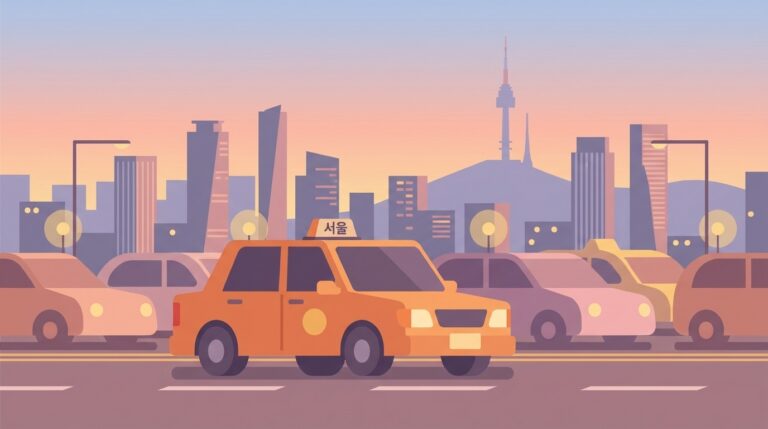
Speak Like a Seoul Local: Directing Your Taxi Driver During Rush Hour
Phase 1: Empathy (Story-Driven Opening)
안녕하세요! 매일한글 에디터입니다. (Hello! This is your Daily Hangul editor.)
Picture this: It is 6:30 PM on a rainy Friday in Gangnam. You just finished an amazing cafe tour, but your feet are begging for mercy. You hop into an iconic orange Seoul taxi to head back to your hotel in Hongdae. As the taxi pulls out, you see an endless sea of red brake lights stretching across Teheran-ro. The driver sighs, looks at the GPS navigation, and taps the steering wheel. You look at your phone map and spot an open bypass route through the side avenues—yet your mind freezes. How do you politely suggest an alternative route without sounding disrespectful to an experienced driver?
If you have ever frozen in the backseat of a Korean taxi while the digital meter relentlessly ticks upward, you are not alone. Our beginner learners frequently tell us that communicating inside a taxi is one of the most intimidating parts of traveling in Korea. Taxis move fast, drivers talk quickly, and navigating hierarchical politeness feels like an exam.
Today, we are unpacking practical, A2-friendly tools to help you give respectful suggestions and stop exactly where you need to. By the end of this guide, you will be guiding drivers with calm confidence!
Phase 2: Core Expressions Deep Dive
1. 지금 퇴근 시간이라 큰길은 차가 많이 막힐 것 같아요.
- Pronunciation: [Jigeum toegeun sigan-ira keungil-eun chaga mani makil geot gat-ayo.]
(Sound analogy: Think “Chi-geum toy-goon she-gan-ee-ra koon-geel-oon cha-ga ma-nee ma-keel got gat-ah-yo”—flow smoothly without hard stops). - Meaning: Literal: “Right now, it is work-leaving time, so big road cars a lot will likely be blocked.” / Real Nuance: “Since it’s rush hour now, the main road will probably be heavily congested.”
- K-Culture Moment: Seen in nearly every urban K-Drama where the main lead rushes across Seoul to stop a wedding or catch someone at Incheon Airport.
- Editor’s Insight: Notice the ending
~것 같아요(~geot gat-ayo, “it seems like”). Koreans rarely state opinions to elders or service workers as blunt facts. Using this soft speculative ending makes your observation sound modest and considerate rather than pushy. - Situation Spectrum: Casual: ⚠️ (too formal for friends) | Semi-formal: ✅ (perfect for drivers & elders) | Formal: ✅
- 🤔 Think About It: In English, we often say, “The highway is blocked; take the side streets.” In Korean culture, softening a claim with “it seems like” protects the driver’s professional pride. How does indirect phrasing change how people receive advice in your native culture?
2. 골목길로 가주실 수 있나요?
- Pronunciation: [Golmokgil-ro gajusil su innayo?]
(Sound analogy: “Goal-mok-geel-lo ga-joo-sheel soo een-na-yo?”) - Meaning: Literal: “Can you go via the alley road?” / Real Nuance: “Could we take the back streets / side alleys instead?”
- K-Culture Moment: When characters navigate vibrant neighborhood enclaves like Ikseon-dong or Yeonnam-dong where main streets come to a complete standstill.
- Editor’s Insight: The marker
~로(~ro) indicates direction or means (“by way of”). Adding~주실 수 있나요?frames your request as a humble question asking for their favor. - Situation Spectrum: Casual: ⚠️ | Semi-formal: ✅ (ideal) | Formal: ✅
- 🤔 Think About It: A Korean
골목길(alleyway) is not a deserted or dangerous back alley; it is the vibrant lifeblood of residential neighborhoods filled with bakeries and cafes.
3. 저기 신호등 앞에서 내려주세요.
- Pronunciation: [Jeogi sinhodeung ap-eseo naeryeojuseyo.]
(Sound analogy: “Chaw-gee she-no-doong ap-eh-saw neh-ryaw-joo-seh-yo.”) - Meaning: Literal: “Please lower/drop me off in front of that traffic light over there.” / Real Nuance: “Please let me off right before that traffic light.”
- K-Culture Moment: The classic conclusion of any taxi scene where a passenger pays quickly with their transit card and rushes into a cafe.
- Editor’s Insight: Using physical landmarks (신호등 = traffic light, 편의점 = convenience store) is 100 times clearer for drivers than shouting “Right here!”
- Situation Spectrum: Casual: ⚠️ | Semi-formal: ✅ | Formal: ✅
- 🤔 Think About It: Dropping off passengers exactly where requested can be tricky for drivers due to bus lanes and sudden fines. Specifying landmarks gives them time to pull over safely.
Phase 3: Textbook Korean vs. Real Korean
Situation 1: Describing Bad Traffic
- 📖 교과서 한국어 (Textbook): 도로에 차량 정체가 심합니다. (Doroe charyang jeongchega simhamnida. / “Vehicle congestion on the roadway is severe.”)
- 🗣️ 진짜 한국어 (Real Korean): 차가 너무 많이 막혀요. (Chaga neomu mani makhyeoyo. / “Traffic is so backed up.”)
- 💡 왜 다를까?: Words like
차량 정체belong on radio traffic broadcasts. Real Koreans simply use the verb막히다(makhida – to be blocked/stuck) with차(car).
Situation 2: Asking to Stop
- 📖 교과서 한국어 (Textbook): 여기서 하차하겠습니다. (Yeogiseo hachahagessseumnida. / “I shall alight here.”)
- 🗣️ 진짜 한국어 (Real Korean): 여기서 내려주세요. (Yeogiseo naeryeojuseyo. / “Please drop me off here.”)
- 💡 왜 다를까?:
하차(hacha) is an official Sino-Korean public transit term heard in automated subway announcements. In everyday conversation, native speakers always say내리다(naerida – to get off/drop off).
Phase 4: K-Culture Deep Dive & Non-Verbal Manners
4-1. Nunchi & Backseat Etiquette
Korean taxi drivers (called 기사님, gisanim) are seasoned navigators who pride themselves on their road knowledge. When suggesting a route, tone and body language matter:
* The Gentle Lean: Lean slightly toward the center divider when speaking so the driver can hear you clearly above the radio or navigation system.
* Two-Hand Gesture: If you point to a landmark or an alley entrance, use an open palm with both hands or gesture respectfully with your fingers held together. Pointing aggressively with a single index finger can feel commanding.
* Eye Contact via the Mirror: When speaking, catch the driver’s eyes briefly in the rearview mirror with a polite nod.
4-2. The Seoul Commute Phenomenon: 퇴근길 (Toegeungil)
Between 6:00 PM and 8:00 PM, Seoul transforms into an intricate gridlock. Major arteries like Gangnam-daero, Mapo Bridge, and Olympic-daero become crawling parking lots. Drivers frequently rely on real-time navigation tools like TMAP. When you politely suggest side avenues, you aren’t questioning their skill—you’re showing great situational awareness (눈치, nunchi) of Seoul’s notorious rush hour!
Phase 5: Real-Life Roleplay Scenario
Setting: 6:40 PM near Sinnonhyeon Station. Rain begins to drizzle. Driver Kim (50s, friendly veteran driver) checks his side mirrors.
- Turn 1 (Driver Kim): 어디로 모실까요? (Eodiro mosilkkayo?)
(🎭 Glances back through the rearview mirror with a welcoming nod)
“Where can I take you?” -
Turn 2 (You): 홍대입구역으로 가주세요. (Hongdae-ipguyeog-euro gajuseyo.)
(🎭 Fastening your seatbelt and smiling politely)
“Please take me to Hongik University Station.” -
Turn 3 (Driver Kim): 아이고, 지금 비도 오고 올림픽대로가 꽉 막혔을 텐데. (Aigo, jigeum bido ogo ollimpikdaeroga kkwak makyeosseul tende.)
(🎭 Sighing while checking the GPS navigation screen displaying red traffic)
“Oh boy, it’s raining and Olympic-daero must be jammed packed right now.” -
Turn 4 (You): 지금 퇴근 시간이라 큰길은 차가 많이 막힐 것 같아요. (Jigeum toegeun sigan-ira keungil-eun chaga mani makil geot gat-ayo.)
(🎭 Leaning slightly forward with an empathetic tone)
“Since it’s rush hour now, the main road will probably be very backed up.” -
Turn 5 (Driver Kim): 맞아요. 강변북로 쪽으로 돌아가는 게 낫겠어요. (Majayo. Gangbyeonbukro jjogeuro doraganeun ge natgesseoyo.)
(🎭 Turning the steering wheel toward the alternative expressway entry)
“You’re right. It would be better to detour toward Gangbyeonbuk-ro.” -
Turn 6 (You): 네, 기사님 편하신 길로 가주세요! (Ne, gisanim pyeonhasin gillo gajuseyo!)
(🎭 Nodding with trust and sitting back relaxed)
“Yes, please take whichever route is best for you, driver!” -
Turn 7 (Driver Kim): 손님, 저기 사거리 다 왔는데 어디에 세워드릴까요? (Sonnim, jeogi sageori da wanneunde eodie seowodeurilkkayo?)
(🎭 Slowing down as you approach Hongdae)
“We’re arriving at the intersection; where should I drop you off?” -
Turn 8 (You): 저기 편의점 앞에서 내려주세요. 감사합니다! (Jeogi pyeon-uijeom ap-eseo naeryeojuseyo. Gamsahamnida!)
(🎭 Pointing gently toward the brightly lit CU convenience store with your transit card ready)
“Please drop me off in front of that convenience store over there. Thank you!”
🔀 Interactive Choice Point
The driver gets stuck in a surprise jam right before an alley turnoff. What do you say?
- Choice A: “야! 골목으로 들어가!” (Ya! Golmog-euro deureoga! – “Hey! Enter the alley!”)
Feedback (Bad): 🚫 Dangerously rude! “야” (ya) is harsh informal slang, and the imperative form will shock and offend the driver. - Choice B: “기사님, 혹시 저 골목길로 가주실 수 있나요?” (Gisanim, hoksi jeo golmokgillo gajusil su innayo? – “Driver, by any chance, could you go through that side street over there?”)
Feedback (Best): ✅ Perfect! Adding혹시(hoksi – by any chance) makes your polite request extraordinarily soft and natural. - Choice C: “차가 막히니까 그냥 여기서 문 열어요.” (Chaga makhinikka geunyang yeogiseo mun yeoreoyo. – “Traffic is stuck so just open the door here.”)
Feedback (Risk): ⚠️ Not respectful and potentially illegal if you are stranded in the middle of a multi-lane road. Drivers cannot open doors in active lanes.
Phase 6: 10-Second Emotion Shadowing Drill
Practice speaking with natural cadence and realistic emotion. Slits (/) mark natural pauses.
[😰 살짝 걱정하며 / Slightly worried & empathetic]
지금 퇴근 시간이라 / 큰길은 차가 / 많이 막힐 것 같아요.
(Jigeum toegeun sigan-ira / keungil-eun chaga / mani makil geot gat-ayo.)-
[🙋♂️ 조심스럽고 정중하게 / Polite & suggestive]
기사님, / 혹시 골목길로 / 가주실 수 있나요?
(Gisanim, / hoksi golmokgil-ro / gajusil su innayo?) -
[😊 밝고 명쾌하게 / Cheerful & relieved]
저기 신호등 앞에서 / 내려주세요. / 감사합니다!
(Jeogi sinhodeung ap-eseo / naeryeojuseyo. / Gamsahamnida!)
Phase 7: K-Culture Mini Dictionary
-
퇴근길 (Toegeungil)
Meaning: The evening commute home from work.
Usage: From 6:00 to 7:30 PM, public transport and roads are packed. Friends often text: “퇴근길 조심해!” (Take care on your way home from work!). -
기사님 (Gisanim)
Meaning: Honorable Driver / Captain.
Usage: Always address bus, taxi, or delivery drivers as기사님, never by general pronouns or “저기요” (excuse me) if you want an instant smile. -
골목길 (Golmokgil)
Meaning: Back alley / Neighborhood side street.
Usage: Seoul’s alleys hold hidden gems, quaint cafes, and useful traffic shortcuts that smart navigation systems utilize. -
티머니 (T-Money)
Meaning: Korea’s ubiquitous rechargeable transit card.
Usage: Works seamlessly in all Korean taxis. Simply tap it on the terminal between the front seats when paying.
Phase 8: Traveler’s Survival Kit
Top 3 Backseat Survival Lines:
- 천천히 가셔도 괜찮아요. (Cheoncheonhi gasyeodo gwaenchannayo.)
Pro Tip: “It’s okay to go slowly.” If your driver drives a little too energetically, this gentle phrase works wonders. - 카드 결제할게요. (Kadeu gyeoljehalgeyo.)
Pro Tip: “I’ll pay by card.” Have your credit card or T-Money ready before stopping. - 영수증 버려주세요. (Yeongsujeung beoryeojuseyo.)
Pro Tip: “Please discard the receipt.” Most people in Korea decline paper receipts today.
Editor’s Travel Note:
Avoid hailing taxis blindly during rush hour in congested hotspots like Gangnam Station Exit 10 or Myeongdong. Instead, install the [Kakao T taxi hailing application] beforehand to book taxis with upfront route tracking. If you are tracking your route manually, using the [Naver Map navigation application] provides real-time traffic updates showing red, yellow, and green road congestion indicators.
Phase 9: “Going One Step Deeper”
Have you ever noticed how often Koreans say ~것 같아요 (~geot gat-ayo, “it seems like”) even when they are 100% sure about something? If it is pouring rain outside, someone might still say, “비가 오는 것 같아요” (It seems like it is raining).
This linguistic habit stems from a deep-rooted cultural desire to maintain group harmony (화, hwa) and avoid sounding dogmatic. Stating things definitively can feel confrontational or self-assertive. When dealing with a senior driver, framing your observation as a soft possibility shows high social intelligence.
💬 Your Turn: Does your native language have ways to soften statements to avoid sounding rude to elders? Share your thoughts in the comments below!
Phase 10: FAQ & Common Mistakes
Q: Can I sit in the front passenger seat of a Korean taxi?
A: Yes, but solo riders and tourists almost universally sit in the back seat on the right-hand side. It gives both you and the driver comfortable personal space.
Q: Do I need to tip taxi drivers in Korea?
A: No! Tipping is not part of Korean culture. You pay the exact amount displayed on the meter. Attempting to tip can create confusion or polite refusals.
Q: How do I tell the driver to pull over immediately if I feel carsick?
A: Say urgently and politely: “기사님, 잠깐만 세워주세요!” (Gisanim, jamkkanman seowojuseyo! – “Driver, please pull over for just a moment!”).
🚨 Common Mistakes Alert:
- Shouting “여기요!” (Yeogiyo) to stop: In restaurants, “여기요” works, but in moving cars, saying “여기서 내려주세요” (Please drop me off here) gives the driver safe notice.
- Saying “스톱!” (Stop!): Abrupt English commands sound like an emergency brake warning and can startle the driver.
- Trying to open the door before the car stops: Seoul taxi drivers watch their mirrors for passing motorbikes. Wait until the vehicle stops completely before unbuckling.
Phase 11: Action Missions
- 🥉 Bronze Mission (Solo Mastery): Practice saying “지금 퇴근 시간이라 큰길은 차가 많이 막힐 것 같아요” 5 times aloud in your room, emphasizing the soft cadence of
막힐 것 같아요. - 🥈 Silver Mission (Shadowing): Record a 10-second voice memo delivering your drop-off request (“저기 신호등 앞에서 내려주세요”) and check your intonation.
- 🥇 Gold Mission (Real Life / Immersion): On your next taxi trip in Korea or in a conversation exchange session, guide your partner using at least two landmarks (신호등, 편의점, or 지하철역).
🎮 K-Culture Mission: Watch an episode of a modern K-drama (like Hospital Playlist or My Liberation Notes). Spot the exact moment a character enters a taxi and listen for 기사님 or 내려주세요!
Phase 12: Interactive Quiz Challenge
1. Situation Judgment:
You are in a taxi heading to Gangnam at 7:00 PM. The navigation recommends the jammed main boulevard. How do you suggest an alley shortcut politely?
(A) 야! 저 골목으로 가!
(B) 골목길로 가주실 수 있나요?
(C) 큰길은 절대 가지 마세요.
2. Fill-in-the-Blank:
“Please drop me off in front of the convenience store.”
“저기 편의점 앞에서 [ ].”
3. True or False:
In Korea, it is polite and customary to give a 15% cash tip to taxi drivers after a smooth ride during rush hour. (True / False)
Click to view answers and explanations
- Answer: (B) –
골목길로 가주실 수 있나요?is polite, respectful, and appropriately humble. (A is rude informal speech; C is an aggressive command). - Answer: 내려주세요 (naeryeojuseyo) – The essential chunk meaning “please drop me off / let me alight.”
- Answer: False – Korea has a strict no-tipping culture. Tipping can make drivers uncomfortable. Simply pay the exact fare shown on the meter with your card or T-Money!
🎬 Watch Our Daily Videos! (Daily Hangul Official Instagram)
Review the expressions you learned in this article with our fun daily short videos! Check out native pronunciation and real-life nuances in action.
- Instagram @dailyhangul_en







