

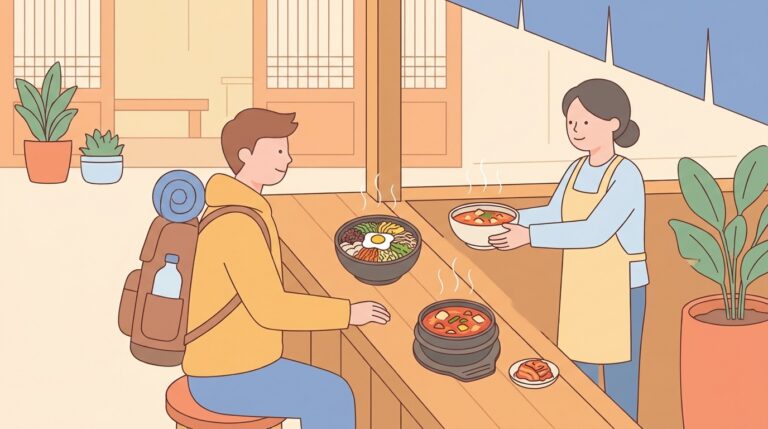
Order Korean Food Like a Local: The Ultimate Beginner’s Menu Guide
Phase 1: Empathy & Storytelling Opening
안녕하세요! 매일한글 에디터입니다. Have you ever stepped into a lively local restaurant in Seoul, surrounded by the heavenly sizzle of pork belly and the comforting aroma of bubbling stews, only to experience complete brain freeze the moment the server approaches your table?
You open the menu, and even if you’ve practiced Hangul, the wall of Korean characters looks like a secret code. Your stomach is rumbling, the server is waiting patiently with a pen and notepad, and your mind races. You desperately want that bubbling pot of Kimchi-jjigae and a bowl of colorful Bibimbap you saw in Itaewon Class, but all you can manage is awkward pointing and nervous smiles.
Take a deep breath! You are definitely not alone. Over 80% of our beginner students tell us that ordering at a bustling Korean eatery (sikdang) was their most intimidating travel moment. But here is the secret: you don’t need hundreds of grammar rules to order like a pro. With just one versatile connector and a magic request word, you will command the dining room with confidence. This guide is crafted directly from real classroom breakthroughs and traveler experiences to help you step up from timid tourist to confident diner in five minutes.
Phase 2: 3 Core Expressions In-Depth Analysis
1. 하나랑 (Hana-rang)
- Pronunciation: Hana-rang (Sounds like “HA-na-rahng” – rhyme rang with “song” spoken loosely)
- Meaning: Literally “one and…” | Real Nuance: “One of this, plus…”
- K-Culture Moment: Seen in nearly every K-Drama casual dining scene where characters place rapid-fire comfort food orders at street stalls (pojangmacha).
- Editor’s Insight: In Korean, when listing items you want to buy or eat, you attach
~랑 (~rang)directly to nouns ending in vowels, or~이랑 (~irang)to nouns ending in consonants. It is friendly, snappy, and infinitely more natural than robotic textbook counters. - Situation Spectrum: Casual: ✅ | Semi-formal: ✅ | Formal: ⚠️
- 🤔 Think About It: In English, we usually specify the quantity before the noun (“two coffees”), but Korean places the quantity or counter right after the noun (“Coffee two”). How does flipping the word order change your focus when reading a menu?
2. 비빔밥 하나 주세요 (Bibimbap hana juseyo)
- Pronunciation: Bibimbap hana juseyo (Sounds like “Bee-bim-bap ha-na joo-seh-yo”)
- Meaning: Literally “Bibimbap one give please” | Real Nuance: “Please give me one bibimbap.”
- K-Culture Moment: In food reality shows like Jinny’s Kitchen (Seojin’s), customers from all over the world enchant the cast whenever they say “주세요 (juseyo)” with a bright smile.
- Editor’s Insight:
주세요 (juseyo)is the ultimate golden key of Korean culture. Adding it to any noun instantly turns a demand into a polite, warm request. If you forget everything else in Korea, remember this word! - Situation Spectrum: Casual: ⚠️ | Semi-formal: ✅ | Formal: ✅
- 🤔 Think About It: English requires words like “May I please have…” to sound polite. In Korean, adding just three syllables (
주세요) effortlessly creates mutual respect without needing complex sentence gymnastics.
3. 여기요 (Yeogiyo) / 저기요 (Jeogiyo)
- Pronunciation: Yeogiyo / Jeogiyo (Sounds like “Yuh-gee-yo” / “Juh-gee-yo”)
- Meaning: Literally “Here, please” / “Over there, please” | Real Nuance: “Excuse me, server!”
- K-Culture Moment: The hilarious moment in slice-of-life K-dramas where a shy character tries to summon the courage to call out “저기요!” in a loud restaurant.
- Editor’s Insight: Unlike Western dining where waving or calling across a room might feel impolite, calling
여기요!or저기요!in Korea is expected and appreciated. Servers don’t interrupt your meal constantly to ask “How are the first few bites?”; they give you space until you call them. - Situation Spectrum: Casual: ✅ | Semi-formal: ✅ | Formal: ⚠️
- 🤔 Think About It: Korean service culture prioritizes speed and autonomy over table-side small talk. Does calling your server directly feel empowering or nerve-wracking to your cultural instincts?
Phase 3: Textbook Korean vs. Real-World Korean
Situation 1: Ordering multiple dishes
- 📖 Textbook Korean: 비빔밥 한 개와 김치찌개 한 개를 주십시오. (Bibimbap han gae-wa kimchi-jjigae han gae-reul jusipsio.)
- 🗣️ Real-World Korean: 비빔밥 하나랑 김치찌개 하나 주세요. (Bibimbap hana-rang kimchi-jjigae hana juseyo.)
- 💡 Why does it differ? The particle
~와/과 (~wa/gwa)and imperative~주십시오 (~jusipsio)belong in written manuals, formal speeches, or news broadcasts. In real life, native speakers prefer smooth, rhythmic native numbers (하나, 둘) and colloquial connectors (~랑).
Situation 2: Calling the server to your table
- 📖 Textbook Korean: 실례지만, 주문을 받아주시겠습니까? (Sillyejiman, jumun-eul badajusigesseumnikka?)
- 🗣️ Real-World Korean: 사장님, 주문할게요! (Sajangnim, jumunhalgeyo!) or simply 저기요~ (Jeogiyo~)
- 💡 Why does it differ? Elaborate grammatical conditionals feel overly distant and stiff. Calling the shopkeeper
사장님 (Sajangnim - "Boss/Owner")establishes an instant, affectionate community bond.
Phase 4: K-Culture Deep Dive & Non-Verbal Manners
4-1. 눈치 (Nunchi) & Table Gestures
Ordering in Korea is a choreography of subtle cues:
1. The Call Button Magic: Look closely at the corner of your table or the napkin dispenser. If there is a small round button labeled “CALL” or “벨”, skip calling out aloud! Press it once. A gentle chime will alert the staff.
2. Hand Positions: When pointing to menu items or receiving hot stone pots (ttukbaegi), support your right forearm lightly with your left hand or place your left hand on your chest. This two-handed etiquette shows deep deference.
3. Eye Contact & Voice Pitch: When saying 저기요~, lengthen the ending syllable with a gentle upward inflection to sound friendly rather than demanding.
4-2. Cultural Code: The Communal Table & Banchan Love
When your food arrives, do not be surprised when four to six small side dishes (banchan) hit the table first without you ordering them. In Korean dining culture, banchan is a symbol of unconditional hospitality (jeong). Notice how Korean stews arrive bubbling furiously in heavy stoneware pots (ttukbaegi). In K-dramas like Let’s Eat, sharing dishes in the center of the table breaks down social barriers faster than any business meeting.
Phase 5: Real-World Roleplay Scenario
- Setting: A warm, nostalgic diner in Euljiro, Seoul, decorated with yellowed newspaper clippings and filled with the mouthwatering smell of sesame oil.
- Characters:
- You (Chris): A hungry A1 traveler.
- Imo (Auntie/Server): A brisk, motherly restaurant owner holding a notepad.
- Imo: 어서 오세요! 몇 분이세요? (Eoseo oseyo! Myeot bun-iseyo?)
🎭 Wiping down a sturdy wooden table with a warm, welcoming smile.
(Welcome! How many people?) - Chris: 두 명이에요! (Du myeong-ieyo!)
🎭 Holding up two fingers politely.
(Two people!) - Imo: 편한 데 앉으세요. 메뉴판 여기 있어요. (Pyeonhan de anjeuseyo. Menyupan yeogi isseoyo.)
🎭 Placing a laminated menu and a chilled bottle of roasted barley water on the table.
(Sit anywhere comfortable. Here is the menu.) - Chris: (Looking at menu) 저기요, 사장님! (Jeogiyo, sajangnim!)
🎭 Raising one hand halfway up and making brief eye contact.
(Excuse me, owner!) - Imo: 네, 뭐 드릴까요? (Ne, mwo deurilkkayo?)
🎭 Approaching quickly with pen poised.
(Yes, what can I get you?) - Chris: 비빔밥 하나랑 김치찌개 하나 주세요. (Bibimbap hana-rang kimchi-jjigae hana juseyo.)
🎭 Speaking clearly while pointing gently at the two menu items.
(One bibimbap and one kimchi stew, please.) - Imo: 찌개 안 맵게 해 드릴까? (Jjigae an maepge hae deurilkka?)
🎭 Looking with caring eyes, checking your spice tolerance.
(Should I make the stew not too spicy for you?) - Chris: 아니요, 괜찮아요! 맛있게 해 주세요. (Aniyo, gwaenchanayo! Masitge hae juseyo.)
🎭 Nodding cheerfully with two hands together on the lap.
(No, it’s okay! Please make it delicious.)
🔀 Interactive Choice Point
The Imo turns to leave, but you notice your table has no metal chopsticks or spoons. What do you do?
- Choice A: Stand up, walk into the kitchen area, and grab cutlery from the drying rack.
- Choice B: Check the sides or under the table for a hidden wooden slide-out drawer containing spoons and napkins.
- Choice C: Shout across the entire restaurant: “스푼 주세요! (Seupun juseyo!)”
FEEDBACK:
- Choice A [Bad]: Entering the kitchen violates hygiene boundaries and surprises the staff.
- Choice B [Best]: 90% of modern Korean casual restaurants store cutlery in a pull-out side drawer beneath the table surface!
- Choice C [Risk]: Shouting "spoon" in English-loan words without checking the drawer first will cause unnecessary fuss.
Phase 6: 10-Second Emotion Shadowing Drill
Practice these core sentences aloud. Pause at each slash / and mimic the emotional inflection tags:
[🙋♂️ Cheerful and attentive]
저기요~ / 주문할게요!
(Jeogiyo~ / jumunhalgeyo!)
“Excuse me~ / We are ready to order!”-
[😋 Hungry and clear]
비빔밥 하나랑 / 김치찌개 하나 / 주세요!
(Bibimbap hana-rang / kimchi-jjigae hana / juseyo!)
“One bibimbap / and one kimchi stew / please!” -
[🙏 Heartfelt and grateful]
물은 어디 있어요? / 감사합니다!
(Mureun eodi isseoyo? / Gamsahamnida!)
“Where is water located? / Thank you!”
Phase 7: K-Culture Mini Dictionary
- 하나 (Hana)
- Meaning: “One” (Native Korean number)
- Usage: Use native numbers (
하나 [1], 둘 [2], 셋 [3]) when counting food portions, drinks, or objects at dining tables.
- ~랑 (~rang)
- Meaning: “And” / “With”
- Usage: Attaches right after a vowel-ending noun to connect multiple food items fluidly (
라면이랑 김밥– Ramen and gimbap).
- 주세요 (Juseyo)
- Meaning: “Please give me”
- Usage: Append this to practically anything you want:
물 주세요 (Water, please),메뉴판 주세요 (Menu, please).
- 반찬 (Banchan)
- Meaning: “Side dishes”
- Usage: Refers to kimchi, pickled radish, seasoned bean sprouts, and braised potatoes that accompany any standard Korean meal.
Phase 8: Traveler’s Survival Kit
Top 3 Survival Phrases
- 물은 셀프인가요? (Mureun selpeu-ingayo?)
- Pro Tip: Look around for signs saying
물은 셀프(Water is self-service). If you see a metal water dispenser and cups, feel free to pour your own!
- Pro Tip: Look around for signs saying
- 계산해 주세요. (Gyesanhae juseyo.)
- Pro Tip: Take your paper bill receipt from your table and bring it up to the front counter register to pay.
- 덜 맵게 해 주세요. (Deol maepge hae juseyo.)
- Pro Tip: If your spice tolerance is low, say this magic phrase: “Please make it less spicy.”
Editor’s Travel Note
- Navigation Guide: Google Maps does not support walking routes reliably in South Korea due to national security map data laws. Make sure to download and set up the Naver Map App for iOS and Android before departing. It displays detailed English menus, real-time operating hours, and user photos for almost every restaurant in the country.
- Payment Culture: South Korea is nearly 100% cashless. International credit cards (Visa/Mastercard) work seamlessly, even for a $3 street snack. Tipping is non-existent—in fact, leaving extra cash behind may cause the server to chase you down the street thinking you forgot your change!
Phase 9: Step Deeper (Reflective Insight)
In many Western cultures, dining out is hyper-individualized; everyone orders their own separate plate with customized ingredients, and bills are split automatically. Traditional Korean dining, however, is deeply rooted in communal harmony (Gongdongche). Dishes like stews, side dishes, and barbecue grills are designed to occupy the shared center of the table, uniting everyone around the hearth. Even the language reflects this: Koreans rarely say “my house” or “my family”—they say “our house” (uri jip) and “our mother” (uri eomma). When you order food in Korean, you are taking part in a historic cultural ritual of shared warmth.
💬 Your Turn: What is the first dish you dream of ordering when you land in Seoul? Tell us in the comments below!
Phase 10: FAQ & Avoiding Misunderstandings
Q: What is the difference between 하나 (hana) and 일 (il) when ordering food?
A: Korean has two counting systems! Native Korean numbers (하나, 둘, 셋) are used for counting portions of food, drinks, and physical items. Sino-Korean numbers (일, 이, 삼) are used for money, dates, minutes, and phone numbers. Always say 비빔밥 하나 (Bibimbap hana), never 비빔밥 일.
Q: Can I ask to split the bill at the counter?
A: While casual restaurants can split the payment across multiple cards if you ask 따로 계산해 주세요 (Ttaro gyesanhae juseyo), it can slow down busy lines during lunch rushes. It is customary for one person to pay and have friends settle up via bank transfer or cash.
Q: Is 반찬 (banchan) really free, and can I ask for refills?
A: Yes! Standard side dishes are complimentary. If you run out of kimchi or seasoned spinach, simply bring the dish to the counter or ask 반찬 더 주세요 (Banchan deo juseyo). Many restaurants now feature self-serve banchan bars.
🚨 Common Mistakes Alert Board
- Mistake 1: Calling female servers “아줌마 (Ajumma)”.
- Why it’s risky: While not an insult, “Ajumma” can sound blunt or dismissive.
- Correct Action: Always use the sweet, polite title
이모 (Imo - Auntie)or universal사장님 (Sajangnim - Boss).
- Mistake 2: Tipping cash on the table.
- Why it’s risky: Tipping creates confusion and is not part of Korean service culture.
- Correct Action: Express your gratitude vocally with
잘 먹었습니다! (Jal meogeossseumnida! - I ate very well!)when paying.
- Mistake 3: Waiting for the waiter to walk over without signaling.
- Why it’s risky: You could sit waiting for 30 minutes! Staff give you total privacy until prompted.
- Correct Action: Press the table bell or call out
저기요~ (Jeogiyo~)with confidence.
Phase 11: Action Mission & Engagement
- 🥉 Bronze Level (Solo Practice): Stand in front of your mirror or open your phone’s voice memo. Recite: “비빔밥 하나랑 김치찌개 하나 주세요” three times with steady rhythm in under 10 seconds.
- 🥈 Silver Level (Social Sharing): Snap a photo of your favorite Asian takeout or home meal today, post it to your Instagram or Twitter stories with the caption: “[Dish Name] 하나 주세요!” and tag @DailyHangul.
- 🥇 Gold Level (Real-World Test): Visit your local Korean restaurant or grocery food court this weekend. Order your entire meal completely in Korean without reverting to English!
- 🎮 K-Culture Mission: Watch the first episode of any food-centric K-Drama (like Let’s Eat or Midnight Diner: Tokyo/Seoul) and spot at least two instances where a character says
주세요 (juseyo)or여기요 (yeogiyo).
Phase 12: Interactive Quiz Challenge
Test your real-world restaurant readiness with these three quick questions:
1. Situation Challenge: You are dining with a friend at a busy noodle shop in Myeongdong. You want to order two bowls of cold noodles (naengmyeon). What should you say?
* A) 냉면 둘 주세요 (Naengmyeon dul juseyo.)
* B) 냉면 이 주세요 (Naengmyeon i juseyo.)
* C) 냉면 주세요 둘 (Naengmyeon juseyo dul.)
2. Fill-in-the-Blank: Complete the sentence to order one ramen and one gimbap:
* 라면 (____) 김밥 하나 주세요. [Hint: It ends with a vowel]
3. True or False: In Korea, raising your hand and saying 여기요! to call your server is considered rude table etiquette.
👉 Click to reveal answers & explanations!
- Answer: A) 냉면 둘 주세요 (Naengmyeon dul juseyo.)
- Explanation: Food portions use Native Korean numbers (
하나 [1], 둘 [2]). Option B uses the Sino-Korean number이 (2), which sounds unnatural here.
- Explanation: Food portions use Native Korean numbers (
- Answer: 하나랑 (hana-rang)
- Full Sentence: 라면 하나랑 김치찌개 하나 주세요.
- Explanation:
하나is one, and~랑connects items ending in a vowel sound.
- Answer: False!
- Explanation: Calling
여기요or저기요is completely standard and expected etiquette in Korean dining rooms. It ensures you get fast service without awkward lingering!
- Explanation: Calling
🎬 Watch Our Daily Videos! (Daily Hangul Official Instagram)
Review the expressions you learned in this article with our fun daily short videos! Check out native pronunciation and real-life nuances in action.
- Instagram @dailyhangul_en






