

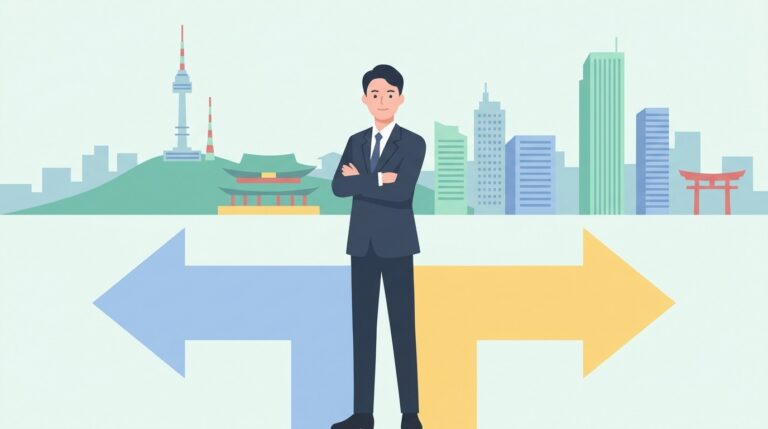
Master the Art of Conviction: Why Leaders in Korea Detest ‘Jwagoumyeon’ (좌고우면)
Phase 1: Empathy (Story-Driven Opening)
안녕하세요! 매일한글 에디터입니다. (Hello! I’m your Daily Hangul editor.)
Picture this: You are watching a high-stakes K-Drama like Stranger (비밀의 숲) or Queenmaker. A critical boardroom vote or an anti-corruption reform is hanging by a thread. The lead reformer stands before a room of executives who are constantly checking their smartphones, whispering among themselves, and refusing to take a stand. Suddenly, the prosecutor or CEO bangs the table and fires off a sharp phrase: “언제까지 좌고우면할 겁니까?” (Eonjekkaji jwagoumyeon-hal geomnikka? / “How long are you going to keep glancing left and right?”)
If you have ever felt trapped in a meeting where everyone tries to please opposing stakeholder factions instead of doing what is right, you already understand the core frustration behind this expression. Many advanced Korean learners hit a wall when transitioning from basic conversational fluency to navigating high-level corporate debates, political news commentary, and editorial discussions. You know words like ‘눈치’ (nunchi – social tact) and ‘망설이다’ (mangseol-ida – to hesitate), but they lack the rhetorical punch needed to critique systemic paralysis.
Today, we are unlocking 좌고우면 (左顧右眄) alongside the vital contrasting four-character idioms (사자성어) that differentiate steadfast integrity from spineless opportunism. Drawn directly from our masterclasses and real-world executive mentoring sessions, this guide will transform how you analyze Korean workplace politics and current affairs with genuine C1 sophistication.
Phase 2: Top 3 Core Idioms Deep-Dive
1. 좌고우면 (左顧右眄)
- Pronunciation: Jwa-go-u-myeon (Think of it as: Jwah like the start of ‘jaw’, Go as in ‘go’, Oo like ‘ooh’, and Myeon rhyming with ‘pure’ + ‘yun’).
- Meaning:
- Literal: Glancing to the left (좌/左) and looking carefully to the right (우/右).
- Actual Nuance: Paralysis by analysis caused by obsessively watching competing factions or public opinion; timid indecisiveness that stalls critical reforms.
- K-Culture Moment: Seen constantly in political thrillers and tech startup dramas (e.g., Start-Up or Agency) when a decision-maker sits on an urgent issue because they fear alienating major shareholders or influential labor groups.
- Editor’s Insight: ‘좌고우면’ is rarely a self-reflection; it is an intellectual weapon used to call out leadership failure. When Korean media accuses a policymaker of ‘좌고우면’, they are saying: “Stop looking over your shoulder for political approval and do your job.”
- Situation Spectrum: Casual 🚫 | Semi-formal ⚠️ | Formal & Editorials ✅
- 🤔 Think About It: In many Western corporate settings, taking time to weigh everyone’s input is praised as ‘inclusive consensus building.’ Why does Korean socio-political discourse treat prolonged hesitation as moral cowardice under the label 좌고우면?
2. 초지일관 (初志一貫)
- Pronunciation: Cho-ji-il-gwan (Sounds like: Cho like ‘choke’ without the k, Ji as in ‘jeep’, Il like ‘eel’, Gwan like ‘gwan-tanamo’).
- Meaning:
- Literal: Carrying through (일관/一貫) one’s initial aspiration (초지/初志) from beginning to end.
- Actual Nuance: Iron-willed perseverance; sticking uncompromisingly to foundational principles despite shifting winds or public backlash.
- K-Culture Moment: Used by iconic drama protagonists (think Park Sae-ro-yi in Itaewon Class) who refuse to compromise their core values, even when giant conglomerates threaten their livelihood.
- Editor’s Insight: This serves as the direct moral opposite of 좌고우면. While a 좌고우면 mindset blows with the wind, 초지일관 is the golden virtue of visionary founders and reformers.
- Situation Spectrum: Casual ⚠️ | Semi-formal ✅ | Formal ✅
- 🤔 Think About It: How does your native language express someone who maintains their core philosophy without swaying? Does it carry the same romanticized nobility as 초지일관?
3. 부화뇌동 (附和雷同)
- Pronunciation: Bu-hwa-noe-dong (Sounds like: Boo + Hwah + Nweh like ‘no-eh’ blended quickly + Dong like a ringing bell).
- Meaning:
- Literal: Echoing in unison (부화/附和) with the thunderclap (뇌동/雷同).
- Actual Nuance: Jumping on the bandwagon; mindlessly echoing the loudest voice or majority opinion without having any personal convictions.
- K-Culture Moment: Portrayed in workplace dramas when sycophantic junior managers immediately nod, applaud, and repeat whatever the corrupt managing director blurts out in a strategy meeting.
- Editor’s Insight: If 좌고우면 is passive indecision, 부화뇌동 is active cowardice. Calling someone out for 부화뇌동 is a direct critique of their intellectual independence.
- Situation Spectrum: Casual 🚫 | Semi-formal ⚠️ | Formal ✅
- 🤔 Think About It: Do trend-driven social media environments encourage 부화뇌동, or is conformity viewed differently in collective vs. individualistic cultures?
Phase 3: Textbook Korean vs. Real Korean
Scenario 1: Criticizing an indecisive project committee
- 📖 교과서 한국어 (Textbook):
- 우리 팀은 남들의 눈치를 너무 많이 봐서 결정을 못 내립니다.
- (Uri timeun namdeurui nunchireul neomu mani bwaseo gyeoljeongeul mot naerimnida. / Our team checks other people’s vibes too much, so we cannot make decisions.)
- 🗣️ 진짜 한국어 (Real C1 Native):
- 이해관계자들 눈치 보느라 좌고우면하다가 개혁 골든타임을 다 놓치겠어요.
- (Ihaegwangyejadeul nunchi boneura jwagoumyeonhadaga gaehyeok goldeuntaimeul da notchigesseoyo. / If we keep looking left and right worrying about stakeholders, we’ll miss the golden window for reform completely.)
- 💡 왜 다를까? (Cultural Context): Textbook sentences rely on the basic colloquial phrase 눈치를 보다. Educated native speakers and professionals combine socio-political terms like 이해관계자 (stakeholders), 좌고우면 (hesitation), and 골든타임 (critical window) to build an authoritative, persuasive critique.
Scenario 2: Refusing to blindly follow industry hype
- 📖 교과서 한국어 (Textbook):
- 유행을 그냥 따라가지 말고 우리 생각대로 계속 합시다.
- (Yuhaengeul geunyang ttaragaji malgo uri saenggakdaero gyesok hapsida. / Let’s not just follow fashion, let’s keep going according to our thoughts.)
- 🗣️ 진짜 한국어 (Real C1 Native):
- 업계 트렌드에 부화뇌동하지 말고, 초지일관의 자세로 우리만의 본질에 집중합시다.
- (Eopgye teurendeue buhwanoedonghaji malgo, chojiilgwanui jasero urimanui bonjire jipjunghapsida. / Rather than blindly bandwagoning on industry fads, let’s focus on our core essence with steadfast resolution.)
- 💡 왜 다를까? (Cultural Context): 부화뇌동 and 초지일관 create an evocative contrast. It elevates simple operational instructions into a powerful mission statement worthy of an executive address.
Phase 4: K-Culture Deep-Dive & Non-Verbal Nuance
4-1. Nunchi & Physical Cues: The Body Language of ‘Jwagoumyeon’
In Korean executive culture, non-verbal cues speak louder than official minutes. When a director is privately accused of 좌고우면, their physical behavior reveals it immediately:
* The Darting Eye Contact (눈동자 굴리기): Instead of making direct eye contact with the presenter, an indecisive executive’s gaze flits rhythmically between the senior director on the left and the audit chief on the right.
* The Pen-Tapping Delay: Deliberately organizing notes or repeatedly uncapping a fountain pen while letting silence drag out. In Korea, prolonged tactical silence isn’t always deep contemplation—it often signals fear of being held solely accountable.
* The Counter-Posture: Conversely, someone embodying 초지일관 sits with an upright spine, keeps their hands clasped firmly on the desk, and maintains steady, measured eye contact when delivering tough news.
4-2. Cultural Code Analysis: The Boardroom of Teheran-ro
In modern Korean corporate hubs like Teheran-ro (Seoul’s Silicon Valley) or Yeouido (the financial district), corporate restructuring is notorious for intense stakeholder conflict. Between traditional founders (오너 일가), institutional investors, labor unions, and Gen-Z employees demanding radical transparency, leaders frequently fall into the 좌고우면 trap.
When Korean business articles use this idiom, they tap into the collective memory of historical governance failures. Koreans possess an innate cultural urgency around “골든타임” (the golden hour). In Korean business psychology, a mediocre decision made boldly is often favored over a perfect decision that came too late because the committee was busy playing political 좌고우면.
Phase 5: Real-Life Roleplay Scenario
Setting & Characters
- Location: Strategic Planning War Room at a major Seoul tech enterprise.
- Team Leader Min (민 팀장): A sharp, reform-minded product director pushing an aggressive cloud-migration pivot.
- Senior Director Park (박 상무): A politically calculated executive anxious about pushback from legacy departments.
[Scene: Team Leader Min slams a finalized proposal on the glass table. Senior Director Park adjusts his glasses nervously.]

Turn 1 (Min):
상무님, 클라우드 전면 전환안 최종 결재 부탁드립니다.
(Sangmunim, keulla-udeu jeonmyeon jeonhwan-an choejong gyeoljae butakdeurimnida.)
"Director Park, please approve the final sign-off for the full cloud migration."
🎭 [두 손으로 서류철을 정중하지만 단호하게 내밀며 / Extending the folder politely yet firmly with both hands]

Turn 2 (Park):
민 팀장, 레거시 운영팀 반발이 만만치 않아. 주총 전까지 조금 더 지켜보는 건 어때?
(Min timjang, regeosi un-yeongtim banbari manmanchi ana. Juchong jeonkkaji jogeum deo jikyeoboneun geon eottae?)
"Team Leader Min, the backlash from the legacy ops team is intense. What if we watch things a bit more until the shareholders' meeting?"
🎭 [시선을 좌우로 힐끔거리며 볼펜을 만지작거린다 / Glancing left and right while nervously fidgeting with his ballpoint pen]

Turn 3 (Min):
언제까지 이해집단 눈치만 보며 좌고우면하실 겁니까?
(Eonjekkaji ihaejipdan nunchiman bomyeo jwagoumyeonhasil geomnikka?)
"How long are you going to waver left and right just reading the room of stakeholder factions?"
🎭 [물러섬 없는 날카로운 눈빛으로 상무를 응시하며 / Looking directly at the director with an unyielding, piercing gaze]

Turn 4 (Park):
좌고우면이라니! 그건 조직을 위한 정무적 판단이야.
(Jwagoumyeon-irani! Geugeon jojigeul wihan jeongmujeok pandaniya.)
"Glancing left and right?! That's a diplomatic, political judgment call for the sake of the organization."
🎭 [당황한 듯 목소리 톤을 높이며 헛기침을 한다 / Raising his voice flusteredly and clearing his throat]

Turn 5 (Min):
지금 결단하지 않으면 경쟁사에 시장 점유율을 완전히 빼앗깁니다.
(Jigeum gyeoldanhaji aneumyeon gyeongjaengsa-e sijang jeomyuyureul wanjeonhi ppae-atgimnida.)
"If we do not make a decisive move right now, we will surrender our entire market share to our rivals."
🎭 [태블릿 모니터의 급락하는 분석 그래프를 가리키며 / Pointing at the plunging analytic graph on the tablet]

Turn 6 (Park):
하지만 기존 부서들의 반대 여론에 부화뇌동하는 임원들이 많아.
(Hajiman gijon buseodeurui bandae yeorone buhwanoedonghaneun imwondeuri mana.)
"But there are many executives jumping on the bandwagon of the internal opposition."
🎭 [창밖 여의도 빌딩 숲을 내려다보며 한숨을 쉰다 / Looking down at the Yeouido skyline out the window and sighing]

Turn 7 (Min):
우리가 혁신을 약속했던 첫 다짐, 초지일관으로 밀고 나가야 합니다.
(Uriga hyeoksineul yaksokhaetdeon cheot dajim, chojiilgwan-euro milgo nagaya hamnida.)
"The initial pledge we made for innovation—we must push it through with unwavering integrity."
🎭 [가슴에 손을 얹고 흔들림 없는 어조로 말한다 / Placing a hand over the heart and speaking with an unshakeable tone]

Turn 8 (Park):
...좋아. 더 이상 흔들리지 않고 내가 총대 메고 통과시키지.
(...Joha. Deo isang heundeulliji anko naega chongdae mego tonggwasikhiji.)
"...Fine. I will waver no longer; I'll bite the bullet and push this through myself."
🎭 [안경을 벗고 결의에 찬 표정으로 서명한다 / Taking off his glasses and signing with a look of resolve]
🔀 Interactive Decision Point
If you were in Team Leader Min’s shoes at Turn 3, how would you address Director Park’s reluctance?
- Option A: “상무님, 눈치 보지 마시고 그냥 빨리 결재해 주세요.” (Sangmunim, nunchi boji masigo geunyang ppalli gyeoljaehae juseyo. / “Director, stop watching people’s reactions and just approve it quickly.”)
- Option B: “이해관계자 눈치 보느라 좌고우면하다간 혁신의 골든타임을 영영 놓치게 됩니다.” (Ihaegwangyeja nunchi boneura jwagoumyeonhadagan hyeoksinui goldeuntaimeul yeong-yeong notchige doemnida. / “If we waver left and right reading stakeholder reactions, we will lose this golden window for innovation forever.”)
- Option C: “모두가 반대하니 이번 개혁안은 그냥 없던 일로 하시죠.” (Moduga bandaehani ibeon gaehyeoganeun geunyang eopdeon illo hasijyo. / “Since everyone opposes it, let’s just pretend this reform proposal never existed.”)
Feedback:
- Option A (Risky): Using 눈치 보지 마세요 directly to a superior sounds like an insolent, unprofessional emotional jab. It lacks C1 decorum.
- Option B (Best!): Spot on! It leverages the refined idiom 좌고우면 to frame the delay not as prudence, but as a strategic systemic threat to the company’s survival.
- Option C (Bad): Total submission. It demonstrates 부화뇌동 (blind bandwagoning) and abandons your reform objective entirely.
Phase 6: 10-Second Emotion Shadowing Drill
Practice these lines out loud. Pay attention to the pauses marked with / and internalize the emotional markers!
- [😤 단호하고 비판적인 어조로 / Firm, Critical & Urgent]
- 더 이상 / 이해관계자들 눈치 보느라 / 좌고우면할 시간이 없습니다!
- (Deo isang / ihaegwangyejadeul nunchi boneura / jwagoumyeonhal sigani eopseumnida!)
- “There is no more time / to waver left and right / walking on eggshells around interest groups!”
- [🔥 신념에 차서 당당하게 / Confident, Resolute & Inspiring]
- 남들의 비난에 흔들리지 말고 / 초지일관의 자세로 / 밀고 나갑시다.
- (Namdeurui binane heundeulliji malgo / chojiilgwanui jasero / milgo nagapsida.)
- “Without swaying under others’ criticism / with an unwavering initial resolve / let us push forward!”
- [🧊 차갑고 이성적인 경고로 / Cold, Analytical & Cautionary]
- 대세에 부화뇌동하는 전략은 / 결국 브랜드의 본질을 / 망가뜨릴 뿐입니다.
- (Daese-e buhwanoedonghaneun jeonryageun / gyeolguk beuraendeu-ui bonjireul / manggatteuril ppunimnida.)
- “A strategy that blindly jumps on the bandwagon / will ultimately only destroy / the brand’s true essence.”
Phase 7: K-Culture Mini Dictionary
- 이해관계자 (Ihae-gwangyeja) | Stakeholders / Vested Interests
- Usage: Essential in corporate meetings and policy reports. Used when discussing how unions, investors, and vendors pull decisions in multiple directions.
- 개혁 드라이브 (Gaehyeok deura-ibeu) | Reform Drive / Aggressive Push
- Usage: Frequently paired with 좌고우면. When an administration or executive launches a bold policy, media will evaluate whether their 개혁 드라이브 will stall due to hesitation.
- 총대를 메다 (Chongdaereul meda) | To bite the bullet / Bear the brunt of responsibility
- Usage: Literally meaning ‘carrying the rifle,’ this is the courageous foil to 좌고우면. A real leader stops hesitating and “총대를 멘다” to assume all risks.
- 골든타임 (Goldeun-taim) | The Golden Window / Critical Decisive Period
- Usage: Borrowed from medical emergency terminology, Koreans use this in business to express that delayed decisions equal systemic death.
Phase 8: Traveler’s & Business Professional Survival Kit
Survival Expressions TOP 3
- 원칙대로 진행해 주십시오.
- (Wonchikdaero jinhaenghae jusipsio.)
- Pro Tip: When administrative staff or counterparties hem and haw trying to bypass policy due to external requests, this command restores order immediately.
- 소신껏 결정하겠습니다.
- (Sosingkkeot gyeoljeonghagessumnida.)
- Pro Tip: When multiple advisors or colleagues give conflicting, unsolicited opinions, use this polite phrase to say: “I will decide according to my own deep conviction.”
- 흔들리지 마세요.
- (Heundeulliji maseyo.)
- Pro Tip: A comforting, high-impact reassurance to give a colleague facing immense peer pressure or public scrutiny.
Editor’s Travel Note: Business Tech Essentials
If you are visiting Seoul for business meetings or strategy conferences, navigating the city without delays is your top priority:
* Forget Google Maps for walking directions—it does not support local step-by-step pedestrian navigation in South Korea due to national security mapping laws. Make sure to complete your 네이버 지도 앱 다운로드 before stepping off the plane.
* For corporate expense reports, taxis are cheap and reliable; connect your foreign credit card through 카카오 T 앱 다운로드 to hail both standard and premium black cabs without payment snags.
Phase 9: “One Step Deeper” (Reflective Essay)
Korean culture is globally famous for its intense communal harmony (공동체 의식) and social antennae (눈치). In everyday life, scanning the room to ensure you do not disrupt the collective atmosphere is seen as emotional intelligence. Yet, in the arena of leadership, that exact same behavior flips into a fatal flaw when it devolves into 좌고우면 (左顧右眄). Korean history is marked by rapid, miraculous compressed development (압축성장), which demanded bold, resolute decisions against seemingly insurmountable odds. Consequently, modern Koreans deeply admire leaders who respect harmony yet possess the moral courage to defy factional pressure when duty calls.
💬 Your Turn: Have you ever worked under a manager who practiced 좌고우면, or have you experienced a leader who exemplified 초지일관? Share your story in the comments below using today’s idioms!
Phase 10: FAQ & Common Mistakes
Q: Can I use ‘좌고우면’ when I am choosing what to eat at a restaurant?
A: Absolutely not! 좌고우면 carries weighty political, philosophical, and moral gravity. Using it because you can’t decide between 김치찌개 (Kimchi stew) and 된장찌개 (Soybean paste stew) will sound absurdly melodramatic or like a comedic parody. For trivial choices, use 결정 장애가 있다 (gyeoljeong jang-aega itda – I have decision paralysis) or simply 고민 중이에요 (gomin jung-ieyo).
Q: Is ‘부화뇌동’ the same as ‘트렌드를 따르다’ (following trends)?
A: Not at all. 트렌드를 따르다 is neutral or even positive in commercial business. 부화뇌동 (附和雷同) is explicitly derogatory. It implies mindless, sheep-like behavior driven by a lack of personal morals or critical thinking.
Q: What is the grammatical pattern for ‘좌고우면’?
A: It functions as a noun, but is most commonly combined with the verb 하다: 좌고우면하다 (to waver left and right), or used adverbially: 좌고우면하지 않고 (without wavering), 좌고우면 끝에 (after prolonged wavering).
🚨 흔한 실수 (Common Mistakes) Warning Board
- Mistake: Saying “저는 지금 좌고우면하고 있어요.” to mean “I’m considering my personal career options carefully.”
- Correct Action: Do not use it as a casual self-descriptor for thoughtful reflection! Say “심사숙고하고 있습니다” (simsasukgohago itseumnida – I am giving this deep, deliberate thought).
- Mistake: Confusing 초지일관 (positive steadfastness) with 고집불통 (stubborn inflexibility).
- Correct Action: Use 초지일관 when praising principled loyalty to an ideal; use 고집불통 when someone arrogantly refuses to listen to reason.
- Mistake: Mixing up Chinese character roots and saying 좌우고면.
- Correct Action: The set idiom is strictly 좌고우면 (Left Look, Right Glace). Rearranging the characters marks you immediately as non-native.
Phase 11: Action Missions
- 🥉 Bronze Mission (Solo Practice): Stand in front of your mirror and practice the Phase 6 Shadowing Drill #1 three times with intense eye contact, pausing cleanly at the slash marks.
- 🥈 Silver Mission (Community Sharing): Write a 2-sentence comment on a Korean news article or your personal study journal evaluating a recent global event using 좌고우면하지 말고.
- 🥇 Gold Mission (Real-World Execution): In your next Korean business meeting or advanced study group, swap out 눈치 보느라 늦어졌어요 with 좌고우면하다가 늦어졌습니다.
- 🎮 K-Culture Mission: Watch an episode of a political drama like Designated Survivor: 60 Days (60일, 지정생존자) or Chief of Staff (보좌관) and listen closely for the words 좌고우면, 원칙, or 소신.
Phase 12: Interactive Quiz Challenge
Test your mastery of principled action vs. opportunistic wavering!
1. Situational Judgment
Which of the following leaders is guilty of 좌고우면?
* (1) A director who sticks to eco-friendly packaging despite a temporary 10% drop in margin.
* (2) A politician who delays safety legislation for months because competing lobby groups keep threatening protests.
* (3) A startup CEO who pivots product design after analyzing objective user telemetry data.
2. Fill-in-the-Blank
우리는 유행에 ( )하지 말고, 창립 이념을 ( )으로 지켜내야 합니다.
(Let us not blindly bandwagon on fads, but protect our founding philosophy with steadfast principle from start to finish.)
3. True / False Cultural Check
- Statement: 좌고우면 is widely accepted as a compliment indicating that a leader has broad, multi-dimensional vision and listens to everyone.
🔍 Click here to reveal the Quiz Answers & Explanations
- Answer: (2)
- Explanation: Hesitating, stalling reforms, and freezing up due to fear of offending competing factions is the quintessential definition of 좌고우면.
- Answer: 부화뇌동 / 초지일관
- Explanation: 부화뇌동하다 means to jump on the bandwagon mindlessly; 초지일관 is the virtue of persevering with your foundational goal.
- Answer: FALSE
- Explanation: 좌고우면 is fundamentally a critical idiom. Calling someone’s stance 좌고우면 implies they are timid, indecisive, and lacking strong leadership integrity.
- Explanation: 좌고우면 is fundamentally a critical idiom. Calling someone’s stance 좌고우면 implies they are timid, indecisive, and lacking strong leadership integrity.
🎬 Watch Our Daily Videos! (Daily Hangul Official Instagram)
Review the expressions you learned in this article with our fun daily short videos! Check out native pronunciation and real-life nuances in action.
- Instagram @dailyhangul_en







